Firearms
DiscussFrom the Sovereign Realms Encyclopedia
Firearms are the hand guns of Sovereign Realms: the Arquebus, the Musket, the Blunderbuss, the Wheellock Pistol and the Pistol. Each is loaded with one Cartridge and fired where you aim. A ball flies too fast to see, straight to whatever it meets first, and goes partly through armour. The shot is a flash, a cloud of smoke and a roar heard far off; horses near it shy, and raw soldiers of the other side lose heart.
Guns are made at a gunsmith's shop, over hours, if the realm knows the technique of firearms: a barrel is bored at his boring bench, a lock filed at his vise, and the gun stocked and put together at his bench. The musket's barrel, and so the wheellock's, is steel. No crafting table makes a gun. A player makes one the same way, at a gunsmith's they own or are taken on at, or commissions one there (see Making a gun below). Cartridges are filled at a powder mill (see Gunpowder). Arquebusiers, musketeers and dragoons carry them in an army (see Armies and Soldiers).
Comparison
| Firearm | Damage | Range | Reload | Scatter | Goes through armour | Durability |
|---|---|---|---|---|---|---|
 Arquebus | 14 | 40 blocks | 3.0 s | 3.0 degrees | 45% | 250 |
 Musket | 16 | 56 blocks | 2.5 s | 1.8 degrees | 55% | 400 |
 Pistol | 10 | 14 blocks | 2.0 s | 4.0 degrees | 30% | 200 |
 Wheellock Pistol | 11 | 20 blocks | 2.75 s | 2.2 degrees | 30% | 350 |
 Blunderbuss | 24 in all, in seven shot | 18 blocks | 3.5 s | 2.8 degrees, and the shot spread 6 degrees | 15% | 250 |
Damage is for one ball at close range. Reload is how long you hold use to load. Scatter is how far the shot strays from your aim in a steady hand. The share that goes through armour is the share of the target's armour that is ignored.
Loading and firing
- Have a cartridge in your pack. Without one the gun says "No cartridges to load it with (a powder mill makes them)".
- Hold use to load: a cartridge is bitten, poured and rammed home. When the reload time has passed, release; one cartridge is taken from the pack. Let go too soon and nothing loads.
- Use the loaded gun to fire where you look. The gun's hover text reads "Loaded: use it to fire." Each shot wears the gun by one, and you wait half a second before using it again.
Only one cartridge is spent per shot. Rain may spoil the priming: in rain, a ball gun misfires a quarter of the time (a flash in the pan, and the cartridge wasted); a wheellock, whose priming is sheltered, only about one time in twelve. Standing in water wets the charge itself for all of them: one time in four.
How they differ
- A ball (arquebus, musket, pistol, wheellock) loses force over distance: at the end of its reach it strikes at half strength. A stone or other solid block stops it; a pane of glass it meets is shattered.
- The Arquebus is the common long gun, slow to load.
- The Musket, of steel, reaches further, is truer and goes through more armour; it needs steel (see Steel).
- The Pistol is the quick sidearm: short in reach, loose in aim.
- The Wheellock Pistol is a more precise sidearm with sheltered priming, whose priming fails less often in rain, but loading takes longer than a pistol.
- The Blunderbuss throws seven small shot from one cartridge. It is strong at a few paces; the cloud spreads and weakens quickly and each shot has lost all its force at 18 blocks. Stone and glass stop it. Several shot in one body make one wound.
Making a gun
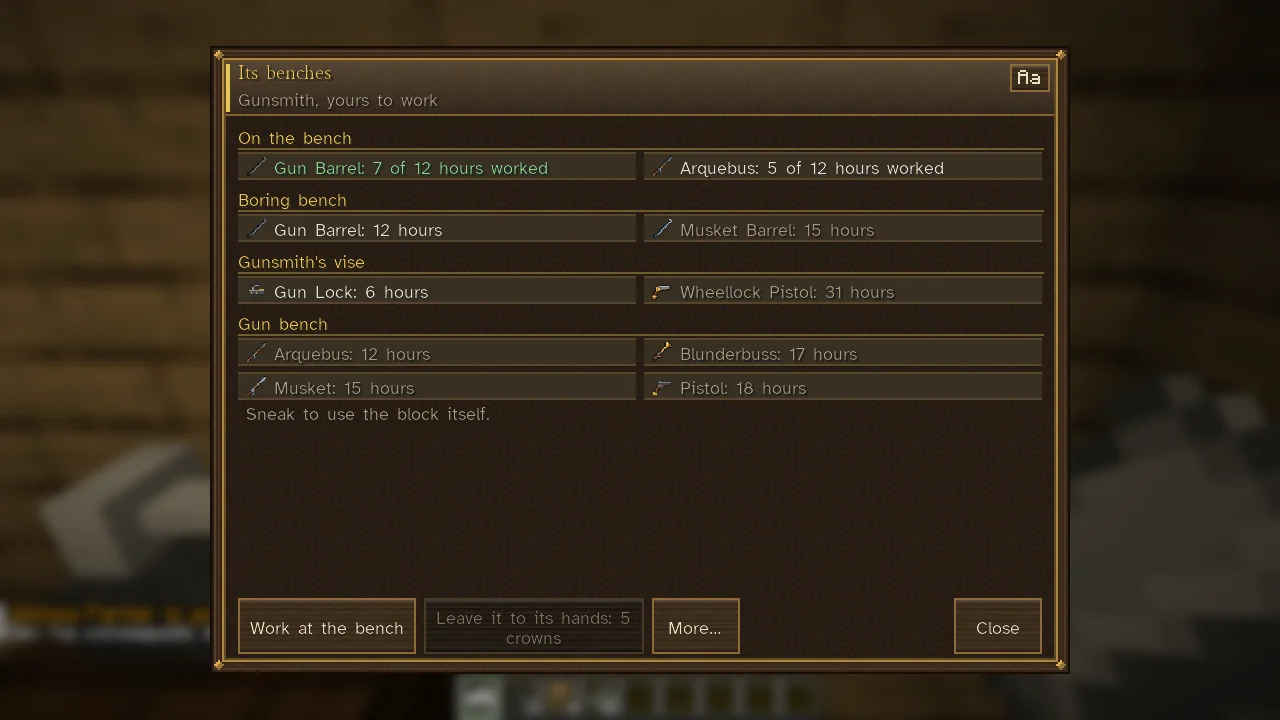
A gun is put together from its parts, each made at one of the gunsmith's stations, which are the blocks of his own shop:
- the boring bench, his anvil or smithing table, where barrels are bored;
- the gunsmith's vise, the shop's marker block, where locks are filed and the wheellock pistol is made;
- the gun bench, his crafting table, where a gun is stocked and put together.
| Makes | Station | Hours | Makings | Commission |
|---|---|---|---|---|
 Gun Barrel |  Boring bench | 12 | 2  Iron Ingot | 11 crowns |
 Musket Barrel | Boring bench | 15 | 2  Steel Ingot | 14 crowns |
 Gun Lock |  Gunsmith's vise | 6 | Iron Ingot,  Flint | 6 crowns |
| Arquebus |  Gun bench | 12 | Gun Barrel, Gun Lock,  any planks,  String | 11 crowns |
| Musket | Gun bench | 15 | Musket Barrel, Gun Lock, any planks | 14 crowns |
| Pistol | Gun bench | 18 | Gun Lock, Iron Ingot, any planks | 16 crowns |
| Blunderbuss | Gun bench | 17 | Gun Barrel, Gun Lock,  Copper Ingot, any planks | 15 crowns |
| Wheellock Pistol | Gunsmith's vise | 31 | Musket Barrel,  Gold Ingot, any planks | 27 crowns |
Hours are working hours as the benches' sheet shows them, twelve to a working day; Commission is what one who may not work the benches pays for those hours. So an arquebus is two and a half days of a gunsmith's work in all: twelve hours on its barrel, six on its lock and twelve to stock it.
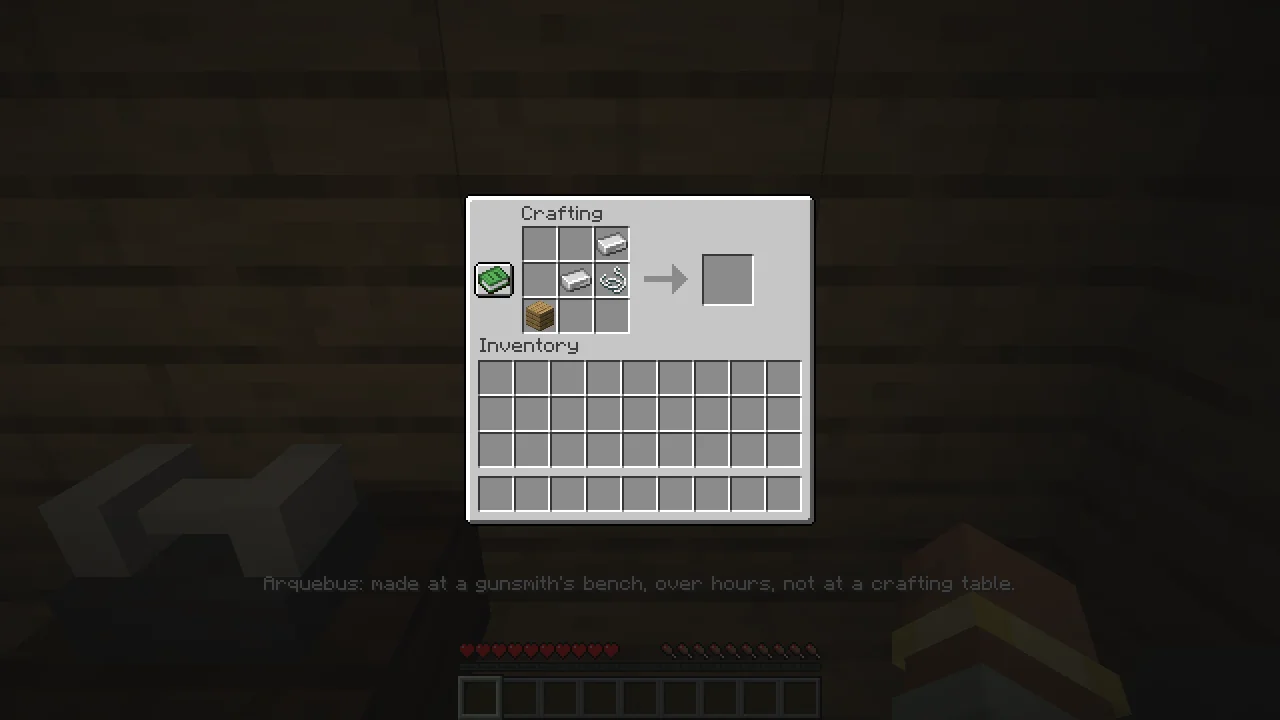
A crafting table makes none of these. Lay a gun's makings in its grid (as the station names them, or as guns were once made at a table) and nothing comes of it; a line says where the thing is made instead: "Arquebus: made at a gunsmith's bench, over hours, not at a crafting table."
At the benches
Use one of a workshop's stations and its sheet, Its benches, opens (at a gunsmith's, his anvil or his crafting table: the vise is his counter); sneak to use the block itself as usual. The sheet shows what lies On the bench, your own pieces in green with the hours worked, and under each station what is made there and its hours. A line is greyed where you lack its makings, or where the realm does not know its craft ("Its realm does not know its craft."). The same sheet serves every workshop that does skilled work at its stations: a steelworks (see Steel and Plate Armour), a siege workshop (Siege Engines), a foundry (Artillery) and a powder mill's charging bench (Bombs).
- Working it yourself. In a workshop you own (your realm's own, if you rule it) or one where you are taken on, Lay out… puts a piece's makings from your pack on the bench by its station. Work at the bench while you stand by it: an hour's work goes by with each game hour, about fifty seconds, and a line shows how far it has come ("Boring a barrel: 7 of 12 hours"). Step away and the piece waits on the bench ("You leave the bench: the work waits on it.") through nights and saves until you come back. When its hours are done it is yours ("Done: it is yours.").
- Leaving it to the hands. The owner may Leave it to its hands: the workshop's own hands work it, at their wage, and Work it yourself takes it back. One taken on there pays for the hours left at the hands' wage, into the shop's till or the town's treasury.
- Commissioning it. Anyone else may Commission… a piece: bring its makings, pay its hours at the trade's wage (the Commission column above) into the till or the treasury, and its hands make it. Come back and Take what is done from the bench.
- Take back its makings gives up a piece of yours that no one has been paid to work.
What comes off a workshop's bench, made by its hands or by you, bears a maker's mark, and its hover says so ("Bears a maker's mark."); so do skilled pieces a town buys from abroad.
What a gun is worth
A gun's worth is its makings, its gunsmith's hours at a skilled hand's wage (the craft wage and a half), and the maker's margin; the margin is taken once, on the gun, not on its barrel and lock. At the world's reckoning an arquebus is worth about 44 crowns and a musket about 65, the gunsmith's wages being most of what the making adds. A market asks from half to three times a thing's worth as it is plentiful or scarce there (see Markets and Trade). A town's market or shop pays for a gun with no maker's mark only its stuff, and says so: "no maker's mark: only its stuff is paid for". The markets across the sea pay only for the stuff of anything.
Cartridges
Cartridges are still made at a crafting table (and at a powder mill):


In war
A company of pike and shot pairs pikemen to hold with arquebusiers to fire behind them (see Armies and Soldiers). A volley from a company that holds its fire for the word looses together (see Battlefield Orders). Weighed in a battle no one watches, shot breaks a charge and goes through armour, while bows fall off against armour (see Campaigns). The roar unsettles untrained soldiers and horses nearby (see Morale). A gunsmith makes guns for his town's orders, its soldiers' arms, first, and then for his counter, where they are sold (see Markets and Trade); what his shop does not make it may order from abroad.
For the great guns, see Artillery; for thrown powder, see Bombs. Other hand weapons are in Weapons.