Campaigns
DiscussFrom the Sovereign Realms Encyclopedia
A campaign is a company, or a whole brigade, sent against an enemy town. At war, a company's page lists the enemy towns it could march on, the nearest first, each with how far it is, when the band would be there and whether its food lasts, and offers two orders for each: to raid the town, sacking it and coming home, or to take it and hold it. The soldiers who will go march out as a war band, lay siege, fight, and either carry off what they can or, winning outright, keep the town. It is the main way a realm takes the war to its enemy; the war itself is declared and ended through Diplomacy and Envoys and War and Peace.
Choosing a target
- Be at war: only a realm you are at war with can be a target (see War and Peace).
- Open the company's page (click its card on the Army tab of the The Command Table, or sneak-use the Command Horn at the sky) and choose Campaign…; it may sit under More… on the page's bar. The same towns are under Order… in the company's section of the Army page. Only the towns of realms your realm has met are listed: send a scout, an envoy or a spy first (see Diplomacy and Envoys). Knowing none, the button says "You are at war with no one whose towns you know."; where none is within reach, "No enemy town is within reach of their food."
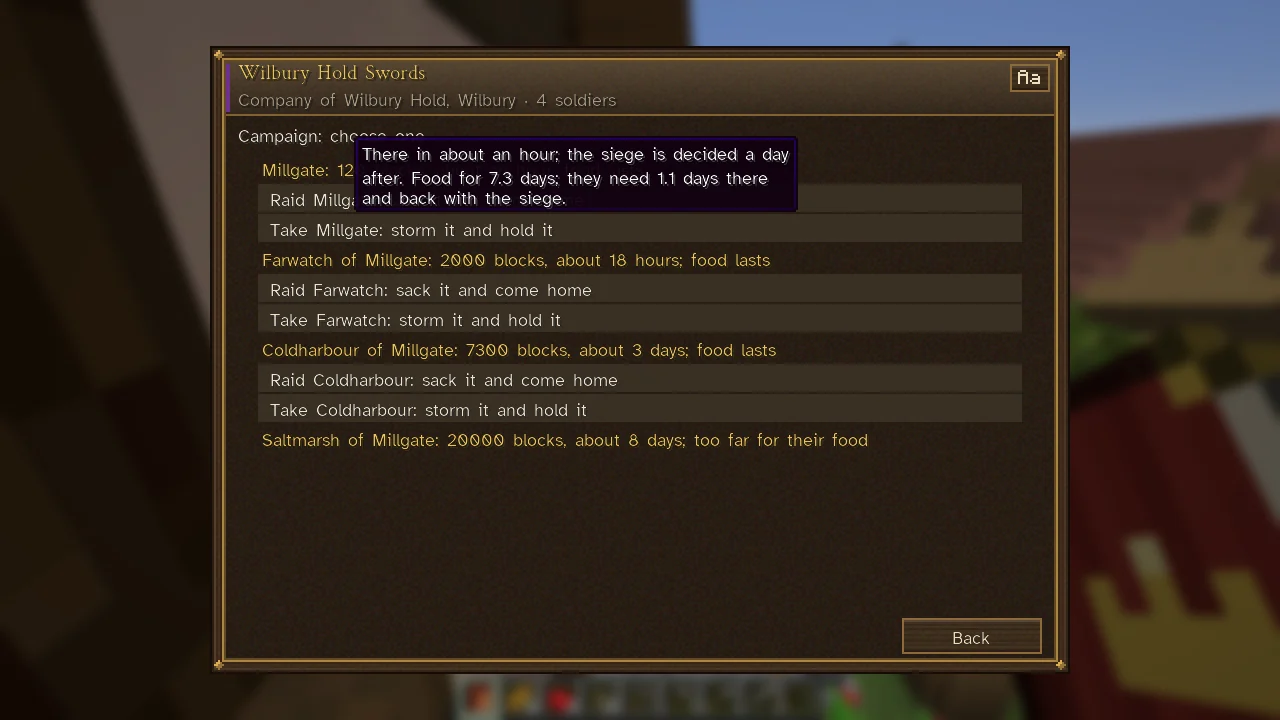
- Each town is a heading: its name and realm, its distance, about how long the band would take to get there in the game's hours, and its food: "Farwatch of Millgate: 2000 blocks, about 18 hours; food lasts". The food reads food lasts, food tight, too far for their food or too little food. The heading's hover says when the band would arrive, that the siege is decided a day after, and its food in days against the days it needs: "There in about an hour; the siege is decided a day after. Food for 7.3 days; they need 1.1 days there and back with the siege." For a walled town it says instead that to sack it they storm it a day after, and to take it they invest it.
- Under the heading stand the two orders: *Raid town: sack it and come home, and Take town: storm it and hold it ("Won outright, the town is ours and some of them stay to hold it; won narrowly, they only sack it."). For a walled town the second reads Take town: besiege it and hold it* ("They invest it: nothing goes in. It falls when its food is gone or a breach is stormed; they lift the siege when their own food runs short."), and the order's answer says when they will be there, "then they invest it." A town beyond the band's food has no orders under it, and its heading says why.
- Choose an order: the game says what will come of it, with a warning first if the food is tight, and you choose it again to send the company.
Food for the march
A war band packs food for the way there and back with a day over, four days at the least and twelve at most, from its town's stores as far as they hold it; what each soldier already carries and how well fed they are count too. Unseen on the road a band covers about 2,600 blocks a day. The march is refused where the packs cannot hold the way there and back ("Too far: their packs hold … at most, and there and back takes …") or where the stores are too bare to fill them ("Too little food in town: …"). Where the food lasts the walk but not the day of the siege as well, it reads food tight, and the band may turn home before the siege is decided.
Sending it
Soldiers who are willing march; those whose Morale is below 35 may refuse, and those on a journey or in prison stay behind. The game lists who refused, and if none will go, the order fails. The soldiers who do not march are sent back to barracks for a week. A town across the sea needs a sea passage; the game checks that the band can cross.
Against walled towns the band takes what siege stores the home town keeps in its armory, yard or storehouse: rams, mangonels, trebuchets, ladders, great bombs, mantlets, cannon and mortars, with the shot, powder and kegs for them (see Siege Engines, Artillery and Bombs). If the stores hold no ram but do hold a great timber, the band takes a ram made of it. Guns are drawn on the road behind a team horse, then unlimbered before the walls and served by the band's gunners.
The company is written up in the realm's chronicle: "Company (n) marched from home on target to take it, with a ram and two ladders." (or "to sack it"), and you are told when it should arrive.
A brigade as one host
Order all of … in a company's section of the Army page gives every company of its brigade the same order. Sent to raid or to take a town, the brigade's companies muster at the one of their towns nearest the target and march from there as one war band, every company's willing soldiers together: each soldier packs from their own town's stores for the walk to the muster, the march and the way back, and the siege reckons the whole host against the garrison. The list's headings give the march from the muster town, with the food of the worst fed company, and each hover says where they muster. The host takes its siege stores from the muster town, and the order goes to the company there, by courier if your realm sends its orders so. The chronicle has "Brigade (n, k companies) mustered at town and marched on target"; when the host comes home, every company of it stands down to garrison.
On the road
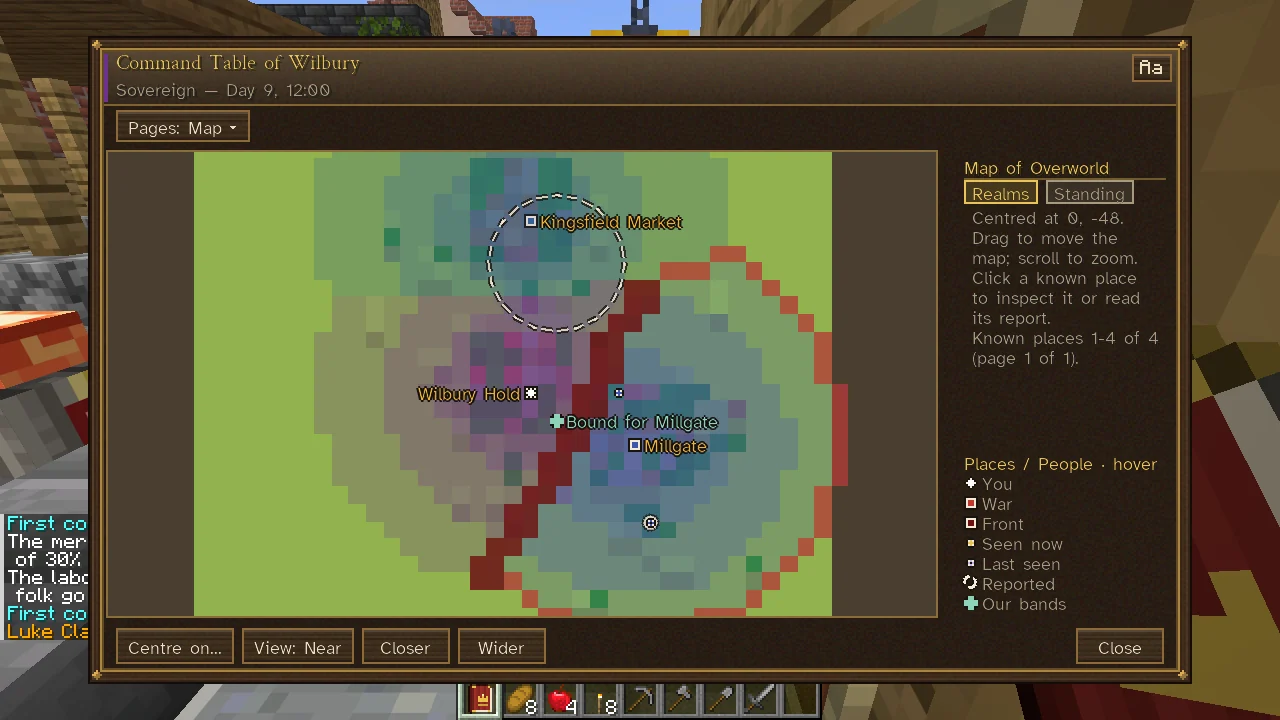
A war band is a real group on the road. It is seen by the watch of any town within sight of it, farther with a watchtower, and by anyone near. When an army is seen marching on one of your towns, you are told at once, with when it may come, and so are your allies; it shows on your map and on the Command Table's map, which draws an enemy force where it is if it is seen now, where it was if it was seen a while ago, a ring if it was only heard of, and nothing of one no one has seen. Your own bands are drawn there with where each is bound, when it should arrive and its food. You can call war bands and supply trains back with Recall… on the Army tab.
On the Army tab a company sent on a campaign shows its March order on its card's chip in gold, and where it is: "Bound for town", "On the march", or "Near town" while its soldiers are about. Its card's meters show its strength, how many bear all their kit and the days of food it carries and holds; an amber edge marks a company that is hungry, unpaid, refusing orders, or short of food or heart (see Armies and Soldiers).
One of the world's realms that has seen an army coming marches out to meet it, if the town has the soldiers. Where hosts meet on the road and no one is watching, the fight is weighed by what each side carries and the weaker breaks: of its first to fall half are killed and half taken. Where someone is near, they fight it out in the world, the soldiers beyond each side's share of bodies fighting by share out of sight; a company you lead into such a fight gets a verdict of its own, "Victory" or "Defeat" (see Battlefield Orders). A company that holds a post in wartime also stops caravans, supply columns, envoys, scouts and settlers of an enemy that pass in sight, and takes the goods of a weak party.
Patrols, columns and skirmishes
The world's own realms at war watch their roads toward the enemy and feed their hosts on campaign. These parties are on the map like other traffic on the road; near a player they walk in the flesh, and anyone at war with them can fall on them.
Patrols. A realm of the world at war keeps a patrol out from its town nearest the enemy's, where the two lie within 2,500 blocks of each other by land. Two to four of the soldiers the town can spare, the weakest of them, walk the road toward the enemy's town, a little past the midway and never more than 1,400 blocks out, watch the road there for four hours, and come home ("Patrol: on the road toward …", "Patrol: watching the road toward …"); the next goes out after three hours' rest. A town that can spare fewer than four soldiers, or that an enemy host is bound for, sends none.
Supply columns. A host a realm of the world sends against an enemy town is followed by its rations once its food would last fewer than five days: a column from the realm's best-stocked town within 3,000 blocks of the host, carrying three days of the host's bread out of its granary and storehouses on a pack donkey, with up to two of its garrison as escort and a carter. It follows the host, hands the food over when it comes up with it (on the march, before the walls or in the fields it ravages) and goes home; another follows half a day later if the host's food runs under two days. A column lost (beaten by an enemy patrol, its pack donkey killed, its party cut down to the last, or stopped by a company holding a post) leaves the host short, so it runs out sooner, and the realm's chronicle says so: "Realm's host against town goes short: its supply column was lost (…)."
Skirmishes. Where parties of two realms at war come within 48 blocks of each other on the road out of everyone's sight, and one of them is a patrol, they fight a short skirmish, weighed as a field battle is. The beaten lose one to half of their number, killed or taken, and break off for home; the winners lose one at most. A patrol that beats a column takes its load home as spoils; a host that a patrol runs into loses no one if it drives the patrol off, and marches on whatever the outcome. Where someone is near, the soldiers fight it out in the world, and when the fight has gone quiet it is told as a skirmish won by the side that lost fewer. Either way it is a point to the winner in the war, keeps the war under way (see War and Peace), and goes in both realms' chronicles: "Skirmish near town: a patrol of realm broke a patrol of realm; 2 of … and 0 of … were lost." A party set on by outlaws, beasts or anyone in no war with it is told only in its own realm's chronicle.
A player in the pay of a realm at war is paid a bounty for an enemy patrol cut down to the last or a supply column destroyed (see Mercenaries).
Before the walls
When a band comes to the walls, its own realm is told where it is and when the siege will be decided: "Company is before town: the siege is decided by about time." (a brigade's host by the brigade's name and its companies). For a company a player sent, every member of the realm hears it. A band sent to take a walled town invests it instead, and its realm is told "Company has invested town: nothing goes in. Its stores last about n days." The siege then runs from one of the town's mornings to the next until the town gives up, is stormed or relieved, or the band lifts it for want of food; its card on the Army tab carries the besieger's orders (Storm now, Offer terms, Hold the siege, Lift the siege) and the defender's (Sally, Ask terms). See Walls and Sieges.
A war band that has arrived pitches a camp on open ground facing the town (a band investing a walled town pitches it out of bowshot of the walls): tents in rows in its realm's colour, a captain's pavilion with the banners before it, a cook fire and a supply dump, horse lines, and a line of stakes toward the town. Players of its enemy taken in battle nearby are held in it (see Taken in Battle). A band come to raid, or to take an open town, sits there about a day. If no one is watching, the fight is then reckoned from arms, armour, heart and the town's walls, and the dead are just as dead. Where someone is watching, the band storms the town on foot (see Walls and Sieges): it batters down gates, breaks through walls (stone slower than timber), fights the defenders, and fills its packs from the town's chests, coin first and then food, every piece marked as taken from its realm. A company whose commander is with it at the walls answers their orders as in the field, following them or holding where they put it, until Charge sends it at the town.
The storm ends when half the band has fallen or its time, about five minutes, is spent; a raiding band also leaves once its packs are full or the stores are bare, but a band sent to take the town stays for the whole storm. A band that hauled engines to the walls sets them up first. If peace is made while the band sits before the town, it goes home without a blow. Kill the raiders before they leave and the plunder is still on them.
Taking and holding
A band sent to take a town carries the same aim of conquest the world's realms march with. Unseen, its siege is reckoned with chance in it: won outright (the attack more than a fifth over the defence), the town is taken; won narrowly, it is only sacked. Seen, the town is taken as soon as its defenders are all fallen or fled; and when the storm's time is spent, those of the band still on their feet are weighed against the defenders still on theirs, behind their walls and with their golems and guns, as an unseen siege weighs them but without the chance. A band that clearly outweighs them has the town; otherwise it withdraws with whatever plunder it carries, and both chronicles say so ("A war band of realm failed to break into town." when it carried off nothing).
A walled town besieged falls when it surrenders (its food gone, its walls breached against a band clearly the stronger, or on terms) or when the siege's storm takes it; its garrison marches out under arms to its realm's nearest town (see Walls and Sieges). A town taken passes to the conquering realm with its people, and its old soldiers lay down their arms. A third of the band, one to three of the best, stays as its garrison, a company of the town named "town Garrison", and the rest march home. Both realms hear "realm has taken town from realm." The war score records "took town", worth 25 points for a village and 40 for a town, double when it was its realm's seat, and a war its taker declared to take that town has reached its goal (see War and Peace). A realm of the world that loses its last town is no more. A town taken by a thin garrison over a people who hate their new crown can rise again.
The world's own realms choose their aims when they march: to raid a town, to ravage its countryside, or to conquer it. A band that ravages falls on the fields, pastures and outlying workplaces rather than the walls: it tramples and burns crops, drives off and butchers beasts and empties the barns, until the countryside is bare or its time is up; it runs from a stronger force that comes out against it.
Relief and reprisal
When the watch of one of the world's towns is cut down (two of its soldiers killed by a foe within a day, or its last), the nearest town of its realm with soldiers to spare sends a detachment to hold the stricken town's heart: a third of its soldiers (never more than six), and never leaving fewer than two at home. The detachment holds until the town raises as many of its own again, or for three days. Kill it, and the next town sends its own. A player's realm sends such help only by its ruler's order, a company told to hold another of its towns. Allies' soldiers defend each other's land (see Diplomacy and Envoys).
Other orders
A company can also be told to march to a place and fight whatever enemies are there, to hold a place, to patrol, or to raze an enemy building: it goes to it and pulls it down block by block, the roof first. See Battlefield Orders.
War for hire
A player can also fight for a realm at war without marching a company of their own: sign on as a mercenary at its Town Heart, its barracks or the Adventurers' Guild in its towns, for a day's pay from its treasury and a bounty for each deed, ten days or until the peace (see Mercenaries). A soldier brought down by a player leaves a skull named for them and their realm, unless a mercenary was already paid the bounty for them as a deed; a realm at war with theirs pays 10 crowns for a levy's, 20 for a soldier's and 40 for a captain's, at any of its Town Hearts. A realm at war can grant a letter of marque against its enemy for a 10-crown bond, good for 20 days: the enemy ships the bearer sinks are fair prize (see Naval Warfare). A player who rules a realm with at least three soldiers may offer their company's service to a realm at war, for a retainer each day for ten days, their realm going to war beside it (see Military Career); a ruler who signs on as a mercenary may bring the company with them.
Costs and ending
A war costs pay, food, dead soldiers and lost work, and wears a realm out: each day of want weakens the realm, and a realm whose weariness passes what its temper bears sues for peace (see War and Peace). The war counts a realm hungry when its stores hold under three days of food, or when more than a tenth of its grown people go hungry.
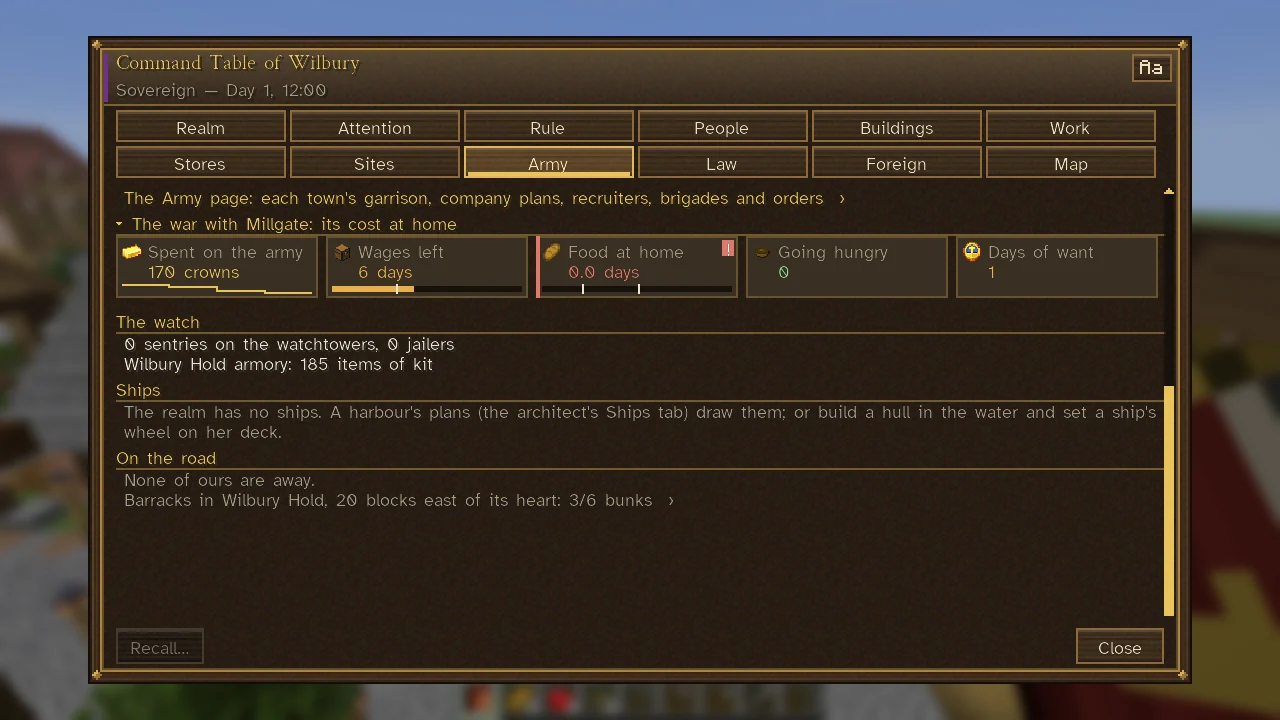
At war the Army tab shows what the war costs at home as five tiles, each explained on its hover:
- Spent on the army: the army's pay the books have entered since the war began, a bar a day.
- Wages left: the days of the crown's wages the treasuries hold, the third of a fortnight under which the realm is broke marked on its meter.
- Food at home: the days of food the stores hold for all the realm's people, marked at 3 and 7 days.
- Going hungry: how many go hungry; a click opens the Attention tab's food view.
- Days of want: the days of want counted in the war, amber for the first two and red from the third; its hover gives each side's weariness, and a click opens the Foreign tab, where peace is made.
The Foreign tab shows the cost at home again, as four tiles beside the war's card (see War and Peace).