Markets and Trade
DiscussFrom the Sovereign Realms Encyclopedia
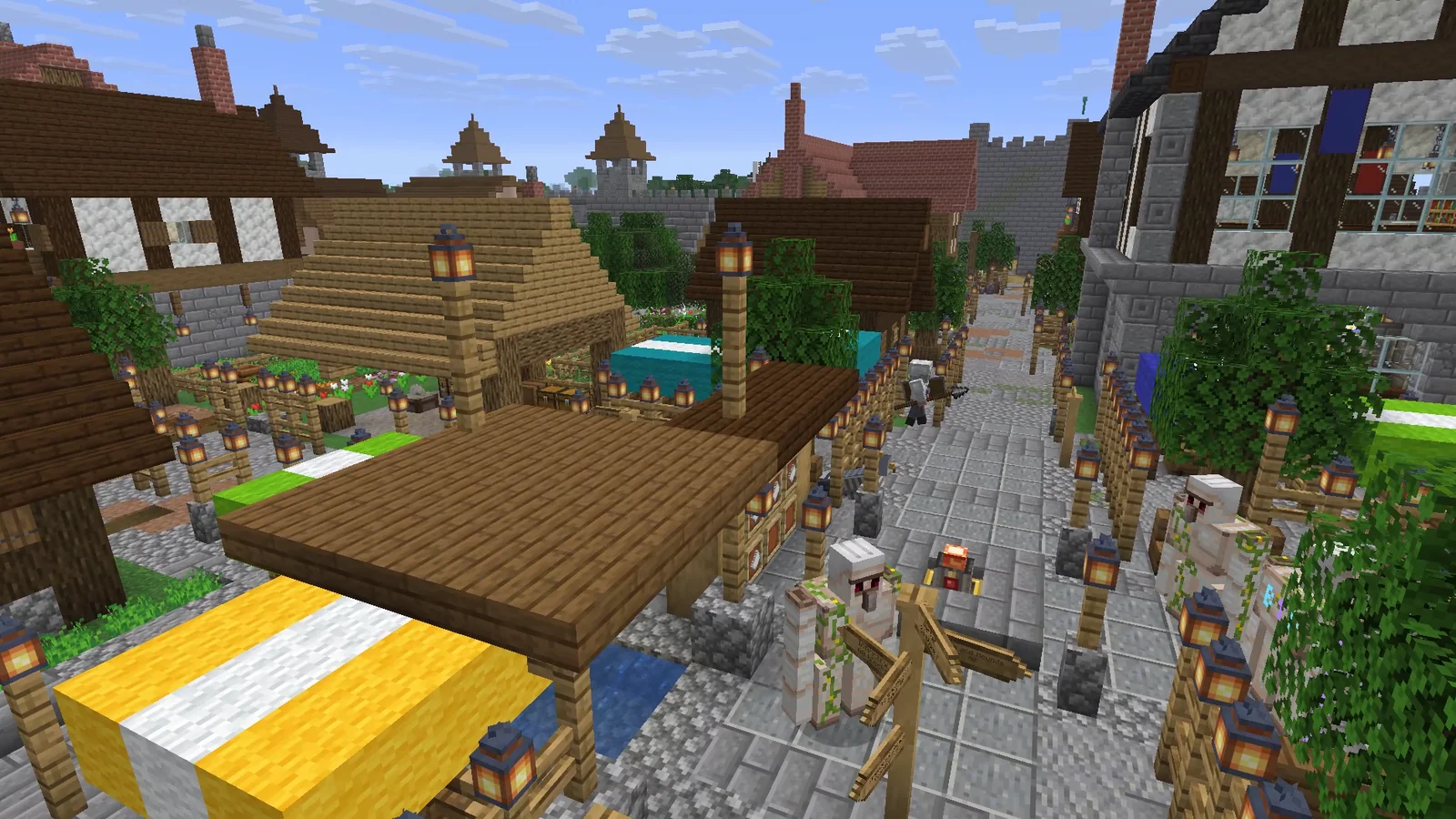
A market is the open-air building where a town's merchants keep their stalls and where players buy and sell for Crowns and Nobles. It is declared by a Market Bell and holds at least two stalls (chests or barrels), the keepers' own stores. The dealing is done at the bell in the middle of the square; a stall's chest or barrel opens the same counter for anyone but its keepers, and a hand laid elsewhere on the market's ground is told in chat to trade at the bell. Crouched, a hand on a stall's barrel goes into the keeper's own store instead, and what is taken from it is theft: the first such reach is stopped with a warning, and only one made again within a minute goes in (see Crime and Punishment).
Prices are not fixed. Every good has a customary value, and the asking price rises when the town is short of it and falls when the stalls overflow, so a player can carry goods from where they are cheap to where they are dear.
Buying at the counter
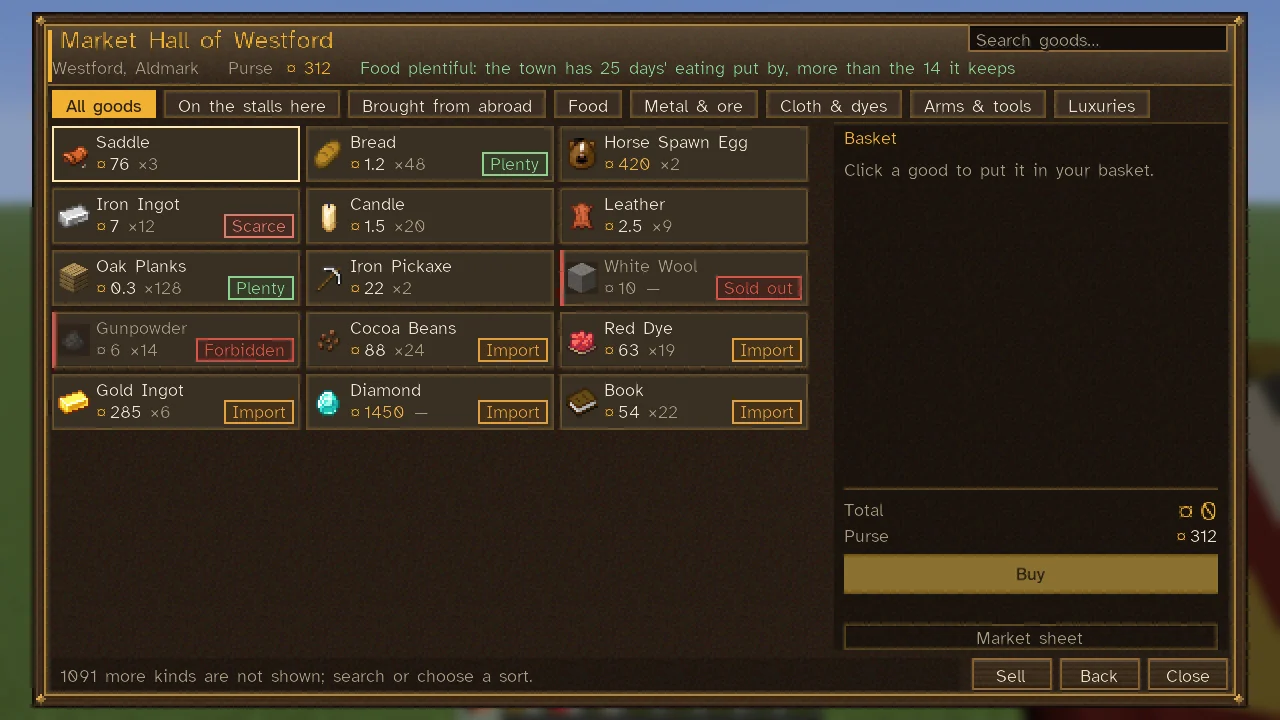
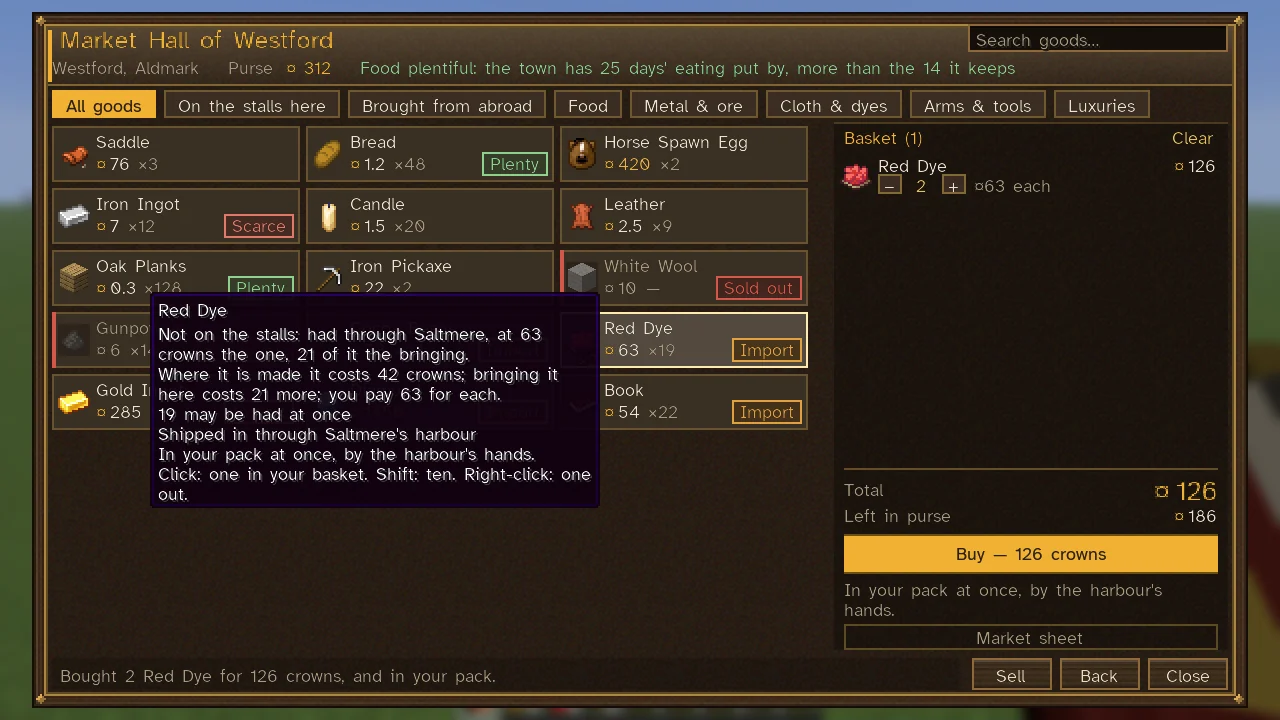
Ring the market bell, or talk to one of the market's merchants and choose Trade; if no merchant is about, the clerk serves you. (Sneak as you use the bell for the market's sheet instead.) The counter opens on its goods:
- The head: the market's name, its town and realm, and your purse. Where food is on the stalls and the town's food stands off its usual, one line says so for every food, such as "Food plentiful: the town has 25 days' eating put by, more than the 14 it keeps".
- The sorts, chips along the top: All goods, On the stalls here, Brought from abroad, then one for each shelf with goods on it (Food, Metal & ore and so on). Search goods… finds a kind by name.
- The goods, a grid of cells: each good's picture, name, price of one, stock and a word on a chip.
- The basket, always in view beside the grid. At the foot are Sell, Back and Close, and a band saying what became of your last buying.
What a good's chip says
A good on the stalls at about its value carries no chip. Otherwise:
| Chip | What it means |
|---|---|
| Plenty (green) | A tenth or more under its value: more than the town wants (for food, more put by than it keeps, or a glut of that dish). |
| Short (amber) | Food only: the town's food is a little short, and every food dearer, but under half again its value. |
| Scarce (pale red) | Food at half again its value or more; any other good a tenth or more over it. |
| Import | Not on the stalls here: brought from abroad through a harbour, at about twice its usual price here. |
| Sold out, Forbidden, Refused (red) | The counter will not sell it: the stalls are out, the realm's law forbids it, or for the reason its hover gives. The cell is edged red, its picture dimmed. |
Red is kept for the counter's refusals: a price your purse cannot reach is drawn in amber, and a full pack is no refusal either. A cell's hover gives the reckoning of its price, any refusal, the stock and how soon you have it; for an import, what it costs where it is made, what bringing it here adds and the harbour it comes through.
The basket
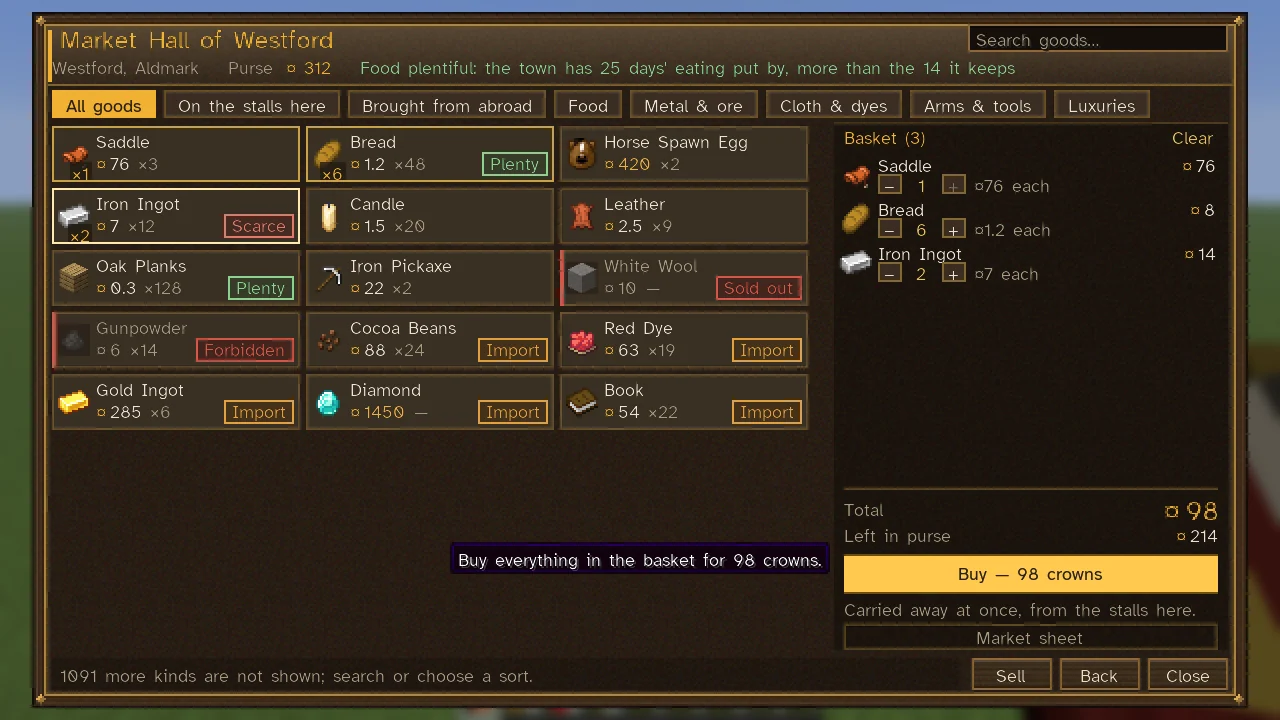
- Click a good to put one in the basket, shift-click for ten, ctrl-click for a stack, right-click to take one out (ten with shift, a stack with ctrl). A cell's hover says so: "Click: one in your basket. Shift: ten. Ctrl: a stack. Right-click: one out." The keyboard does the same: the arrows walk the grid, Enter puts one in, Backspace takes one out (each stepping ten with shift and a stack with ctrl), and Tab moves on to the basket.
- Each line shows its sum, the count between − and +, and the price of one. The − and + step one, ten with shift held, or a stack with ctrl held. The sum is the counter's price for the lot, in whole crowns. A line holds at most a stack, what the stalls hold or what your pack has room for; a basket holds up to twelve goods, and Clear empties it.
- Under the lines: the Total, what is Left in purse (or Short by, in red), the amber button saying what it costs ("Buy — 98 crowns") and how the goods are had ("Carried away at once, from the stalls here.").
- Buy pays line by line at the prices shown. If a price has moved or a good is refused, the paying stops there, the band says why and the rest stay in the basket. The basket is kept while you go to Sell and back.
Selling to the market
Sell opens the selling counter, and Shop brings you back. On the left, For sale, are the stalls' goods, each with Buy and a button for a stack, or for all the stalls hold where that is less ("×48"); on the right, Sell to the market, your pack with what the town's treasury would pay, each with Sell and All. A button's hover gives what it comes to, and a card's the reckoning of its price.
The market buys what the town will use, and what it will not take says why on a red chip: Stolen, Enough, Worthless, No coin, No room or Not taken. An honest market refuses goods stolen from its own realm or its friends (allies, trading partners, an overlord or vassals) and calls the guard, and pays half, asking no questions, for goods stolen anywhere else; see Stealth and Thievery. A realm at war with yours will not trade with you, and an embargo laid from the Foreign tab stops trade both ways with a named realm.
Some of what the market will not take goes elsewhere, under an amber chip and its own button:
- Pawnshop (Pawn). In a town of 15 or more people the pawn counter takes anything of value at two fifths of its worth, paid from the treasury, for the town's stores.
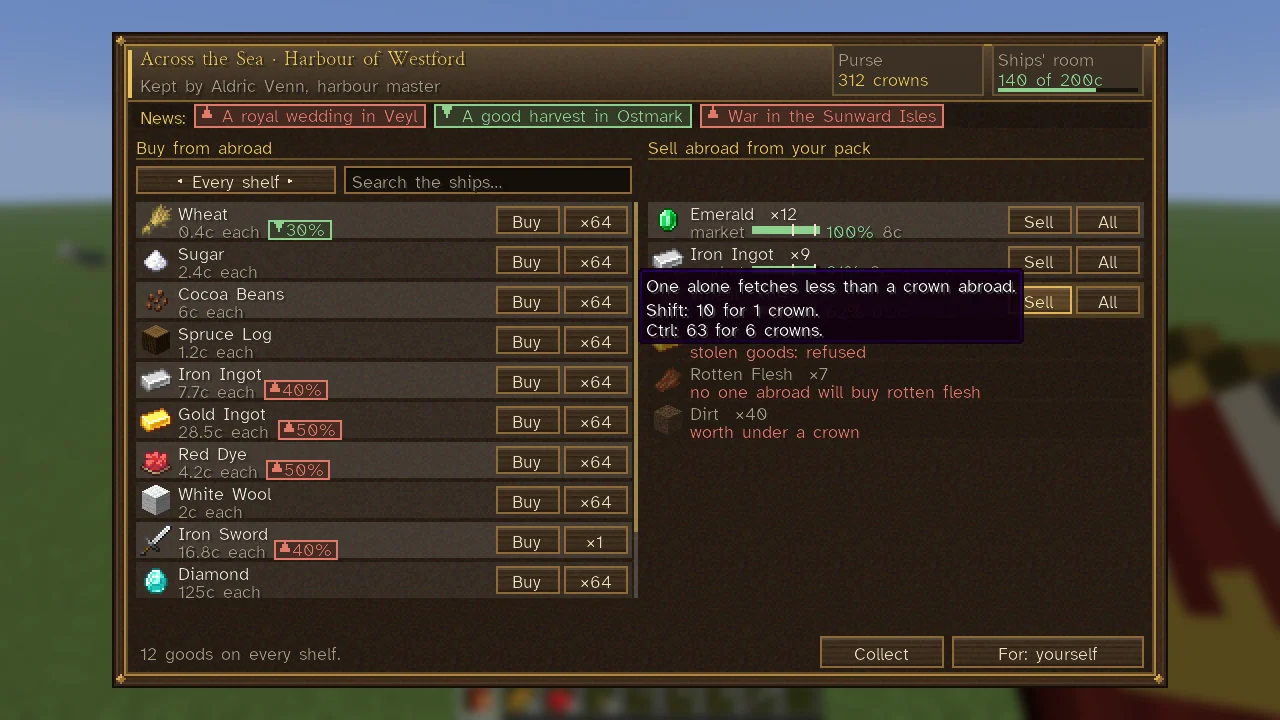
- Abroad (Ship). What neither takes, the merchants ship abroad for you at the far markets' price less their cut (a quarter, at a harbour), from your weekly room in the ships; goods too poor to carry fetch nothing. See Resources and Scarcity and Harbours.
Selling part of a stack
Sell sells one when clicked, ten with shift held, and a stack with ctrl held (64 of a good that stacks to ten or fewer, such as a tool or a potion). A step never sells everything you hold: it stops one short of it, and only All sells the whole. With a single one in your pack, Sell sells it. Buy steps the same way, one, ten or a stack, never more than the stalls hold.
The hover of Sell has a line for each step: what one fetches ("Wheat: sell one for about 1 crown."), then "Shift: 10 for about 3 crowns." and "Ctrl: 63 for about 19 crowns." Where one alone would fetch less than a crown, the first line says so, and a larger step is had with shift or ctrl. The counter never sells more than you carry: asked for more (your pack having changed under the counter), it sells nothing and says "You carry only" so many "of that."
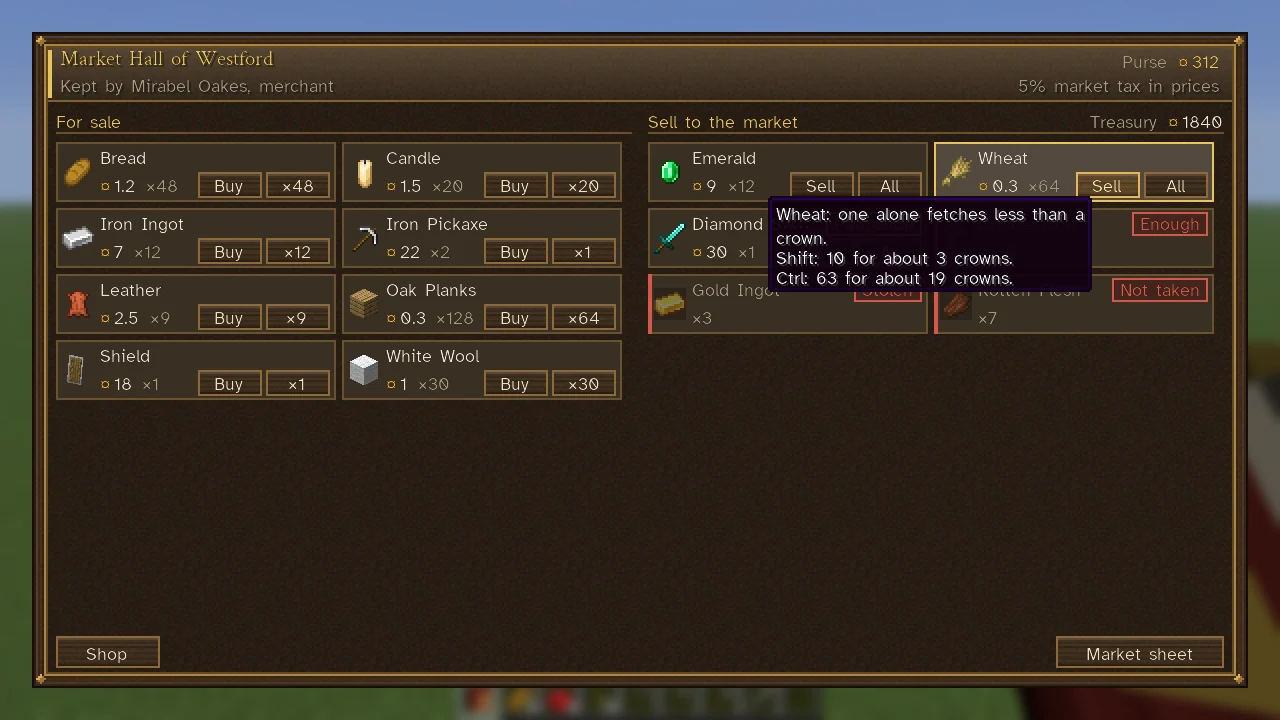
The same steps hold on every counter that buys or sells: the Pawn and Ship buttons here, a shop's counter, a town's stores where it has no market, and a harbour's Across the Sea counter, whose Sell steps the same way short of the whole lot and whose Buy buys one, ten with shift or a stack with ctrl (see Harbours).
Why a price is what it is
| Rule | What happens |
|---|---|
| Value | A made good's customary value is the worth of its makings and its maker's hours at the bench or station, reckoned at a craftsman's day of seven crowns for twelve hours' work (half as much again for a gunsmith's or a golemwright's work), with a maker's margin on top: a tenth on food, a quarter on anything else (none on a gun's barrel or lock, the margin being taken once, on the gun). A few raw goods are valued by the work of gathering them and by how rare the world makes them. |
| Scarcity | The asking price is the value times the square root of what is wanted over what is held, never below half the value nor above three times it. |
| Food | Foods stand in for one another: every food's price follows the town's food in store against the 14 days of eating it keeps, not the stock of one dish. |
| Buying many | Each one you take makes the next a little dearer. |
| Selling to the market | A market pays three quarters of its asking price; gold, nine tenths. |
| Selling many | Each one the market takes makes the next worth less to it; it takes no more than twice what it would like to hold. |
| Gold | Worth its weight in crowns, whatever the stalls hold: a nugget strikes two crowns and an ingot eighteen. |
| Maker's mark | A piece worked over its hours at a workshop's bench or station, by its hands or by you, bears a maker's mark ("Bears a maker's mark." on its hover), as does what a workshop makes while no one is near it. A piece whose worth rests on its maker's hours but that bears no mark, such as one made in an instant at a crafting table, is paid only for its stuff, as the markets abroad pay for everything; its hover at the counter says "no maker's mark: only its stuff is paid for". |
| Renown | What people know you for changes what you pay; see Renown and Following. |
| Language | Where the keeper shares no tongue with you, you pay up to a twentieth more, unless someone near can put it into words; see Tongues. |
The price boards at the stalls and the How it fares and Its market parts of a town's sheet say why bread or iron is dear. Every price at the counter has the realm's market tax in it, as the hover on the line under the market's name says.
Shop counters
Each trade sells what it makes at its own counter, opened from the shop's marker block and laid out as the market's. It sells from the shop's stores at the town's market prices, and buys only plain, sound goods of its own trade that its racks lack, paid from its till (or the town's treasury); worn work, or more than its racks want, it offers to ship abroad for you.
| Shop | Sells |
|---|---|
| Smithy | Tools, weapons and armour |
| Armory | Arms |
| Gunsmith | Firearms its gunsmiths make at their benches, cartridges, powder and grenades (see Firearms) |
| Bakery | Bread, cake, cookies and pies |
| Cookshop | Cooked food |
| Alehouse | Drink (see Alehouses and Drink) |
| Masonry | Dressed stone |
| Joinery | Furniture and wooden goods |
| Apothecary and infirmary | Remedies and potions |
| Enchanter | Enchanted books |
| Tinker's shop | Clockwork of redstone |
| Clothier | Dyed wool, carpets, beds, banners and leather clothes (from a town of 15 people) |
| Scribe's shop | Paper and books (from a town of 15 people); writing books and blank maps (from 40) |
| Builders' merchant | Timber, planks, stone, brick and furniture a town has over |
A live horse, grown, broken and saddled, is bought only at a stable's manger. A saddle alone is had at a market bell: from the stalls if a merchant has one, else from abroad through the nearest harbour the far ships call at, in your pack at once and dearer for the speed.
Goods from other towns
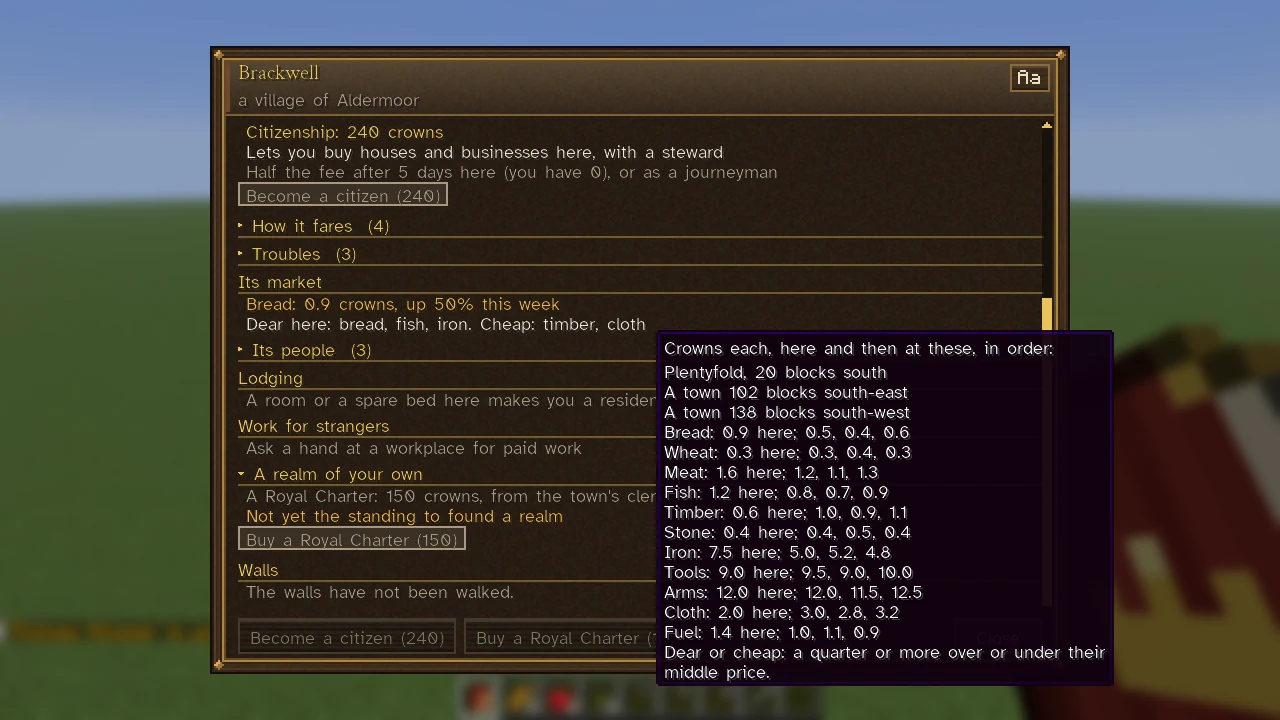
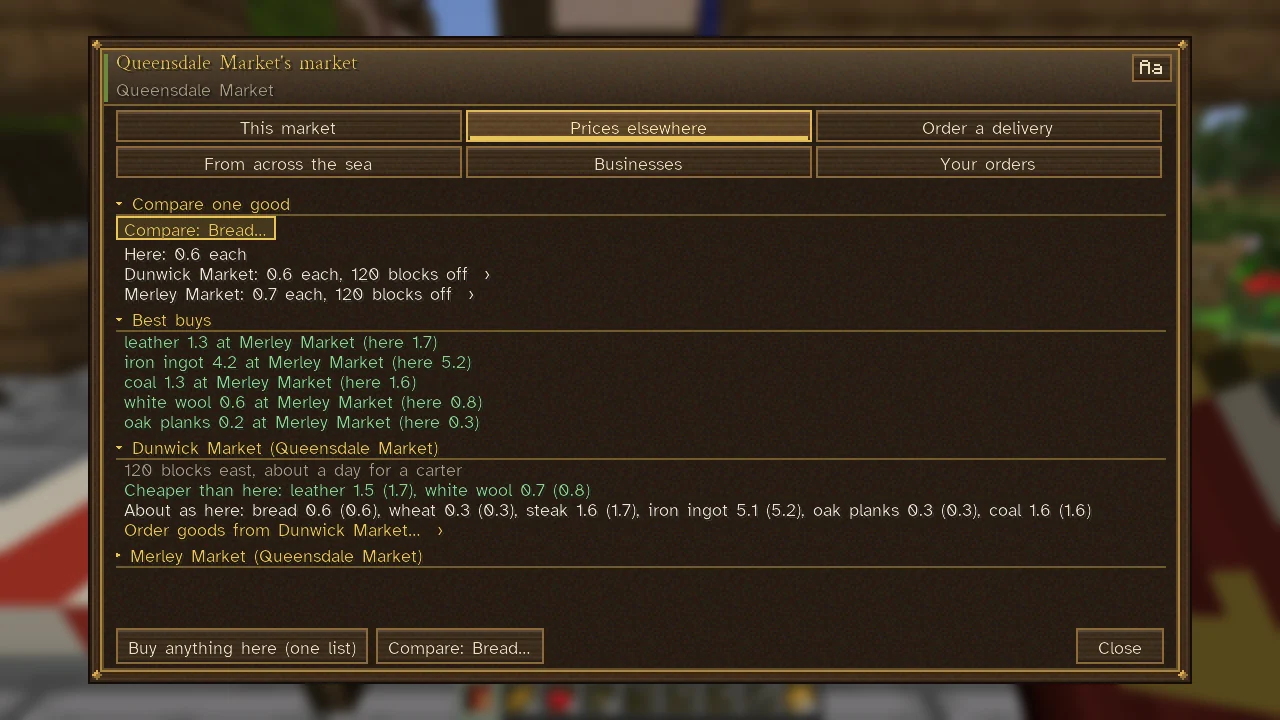
Market sheet, under the basket, opens the market's own page, whose Prices elsewhere, and goods brought here from other markets… opens the market sheet (also /realm market). Its tabs are This market, Prices elsewhere, Order a delivery, From across the sea, Businesses (who owns what, and which trade would pay here: see Businesses and Property) and Your orders. Three of them reach past the local stalls.
Prices elsewhere
What the markets you know of within 4,000 blocks were asking when their merchants last had word (cheaper than here, dearer than here, about as here), and the best buys. At its head, Compare one good… picks one good and lists its price here and at every market you know that had word of it, the cheapest first, with how far off each is: green where it is a tenth or more cheaper than here, red where it is a tenth or more dearer. Each line leads to an order of that good from that market, and its hover says how old the word is.
Order a delivery
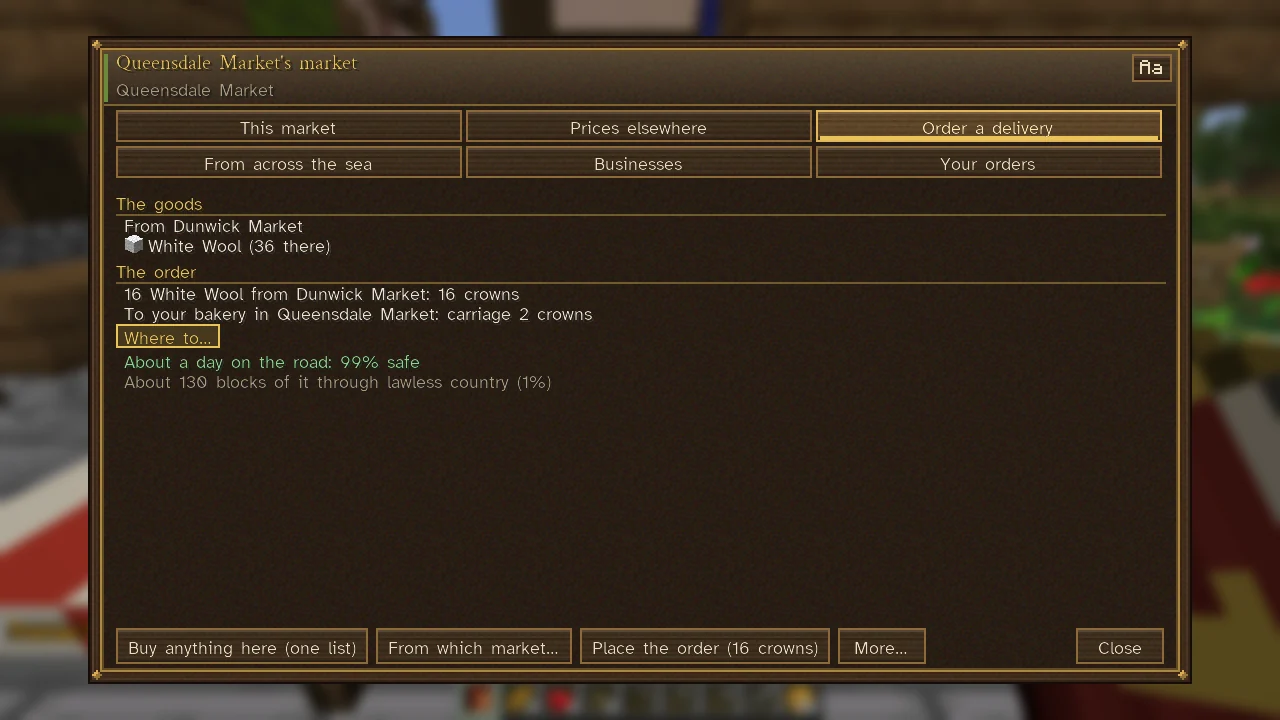
Pick a market, the goods (up to 256 of one kind) and any guards, and pay for all of it at once. A carter of the selling town brings them, about a day's road for every 3,600 blocks; the sheet says how safe the road is as you know it, and what is lost on it is your loss. Four orders may be open at once.
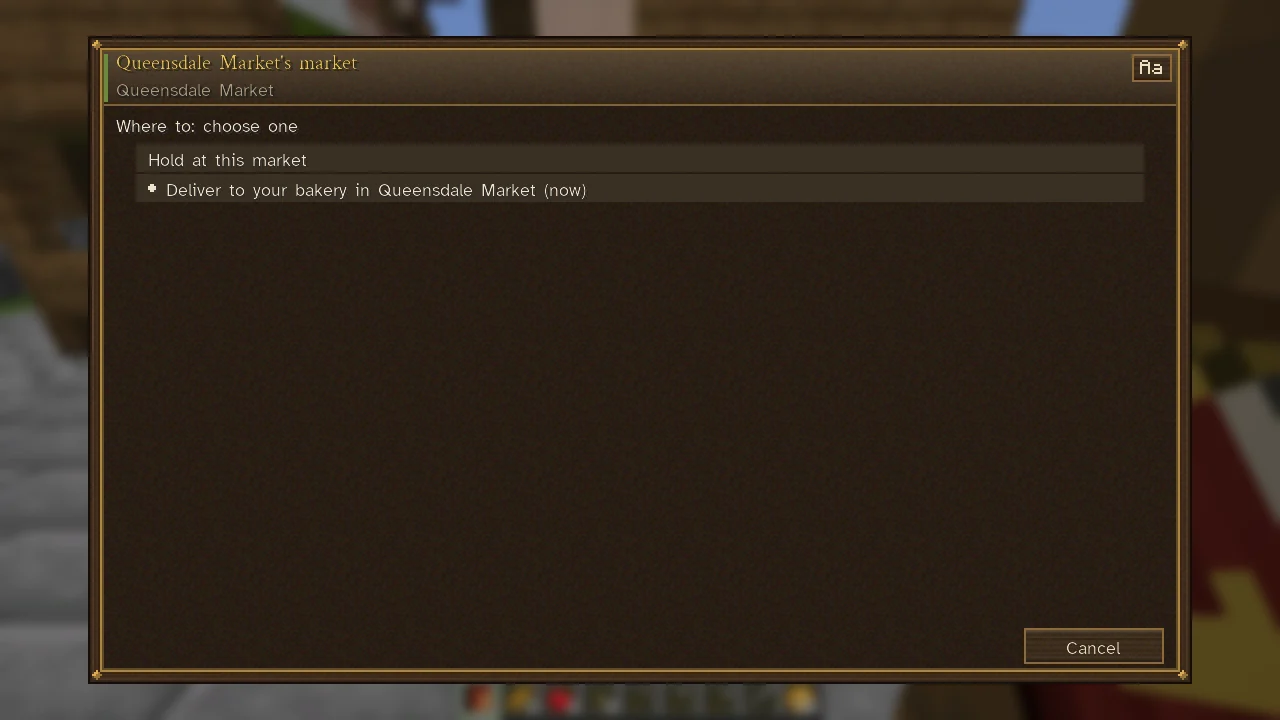
Where to… says where the goods go, where you own somewhere to send them:
- Hold at this market: collect them here when they come.
- Deliver to a business or house of yours, or your homestead, within 4,000 blocks of this market (the nearest first): the carter brings them to the door, into its chests (a homestead's, into its store). What does not fit is held for you at the market of its town; at a homestead, or with no market, it is left in a crate by it.
The quote adds the carriage to that door ("To your bakery in …: carriage N crowns"), and the road's days and safety are reckoned to it. Delivered into a business, the goods go on its books as bought in and as your money put in, and its hands use what is in its chests first. You are told in chat when they come, with a [Your orders] link to the market sheet, whose Your orders tab shows what went into the chests for three days after; an order delivered into chests, with nothing held at a market to collect, no longer counts among your four.
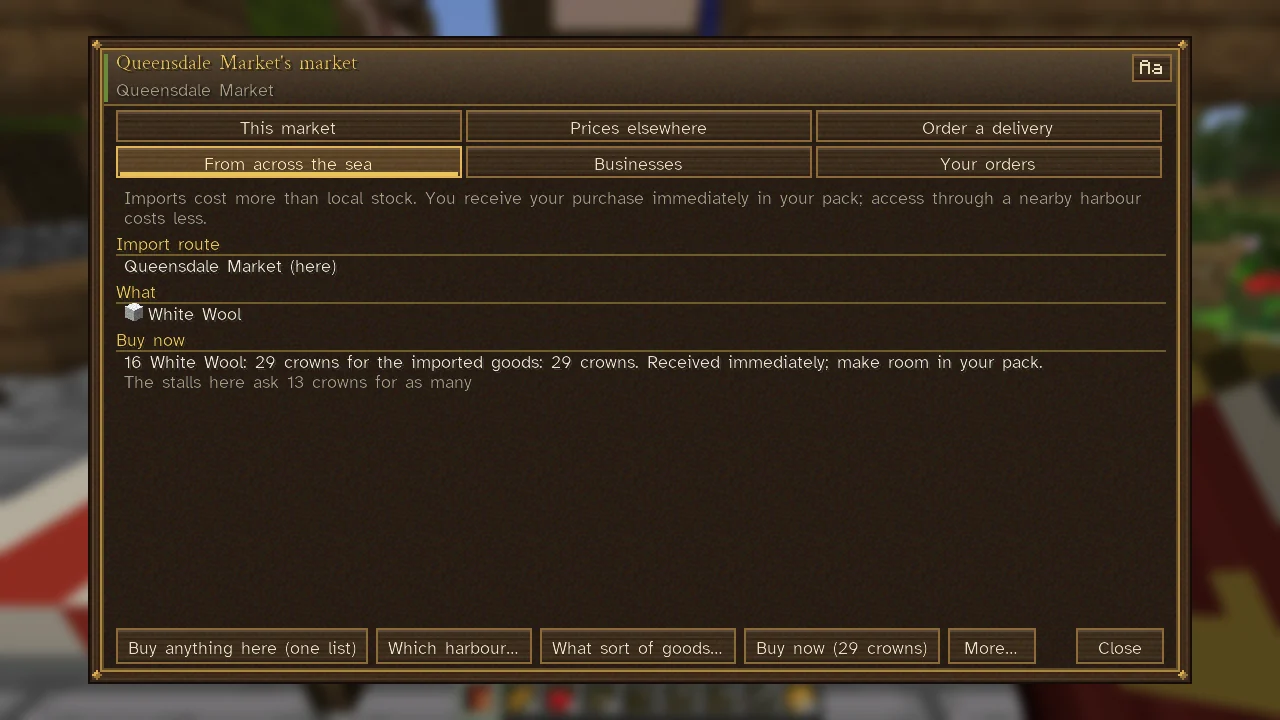
From across the sea
Buys goods from abroad through a harbour, received at once in your pack, with a charge for access through a harbour that is not this town's own. An import costs about twice what the stalls here would ask for as many, or twice its usual price here where they hold too few, moved up or down by the news from abroad; never less than the far markets themselves ask, nor within a tenth of what this market would pay for the same goods, so nothing is to be made by buying abroad and selling here. Beside the price the page says what the stalls here ask for as many, or that they have none or only so many. At the counter, goods the stalls do not have come from abroad the same way, under the Import chip.
To find where something is sold, open the first page of the Companion (Where can I buy...?) or type /find: it names the shops and markets of the towns you know of that had it, how far and which way, and whether they are open now. Your Your Steward can also buy at a market for you with the purse you keep with them, and bring it to you or leave it at a building.
Market tax, tolls and the law
The realm sets these on the Command Table's Stores tab, under Policy…:
| Setting | What it does |
|---|---|
| Market tax | A share of each sale kept for the treasury: 0, 5, 10, 15, 20 or 30 per cent; new realms start at 10. |
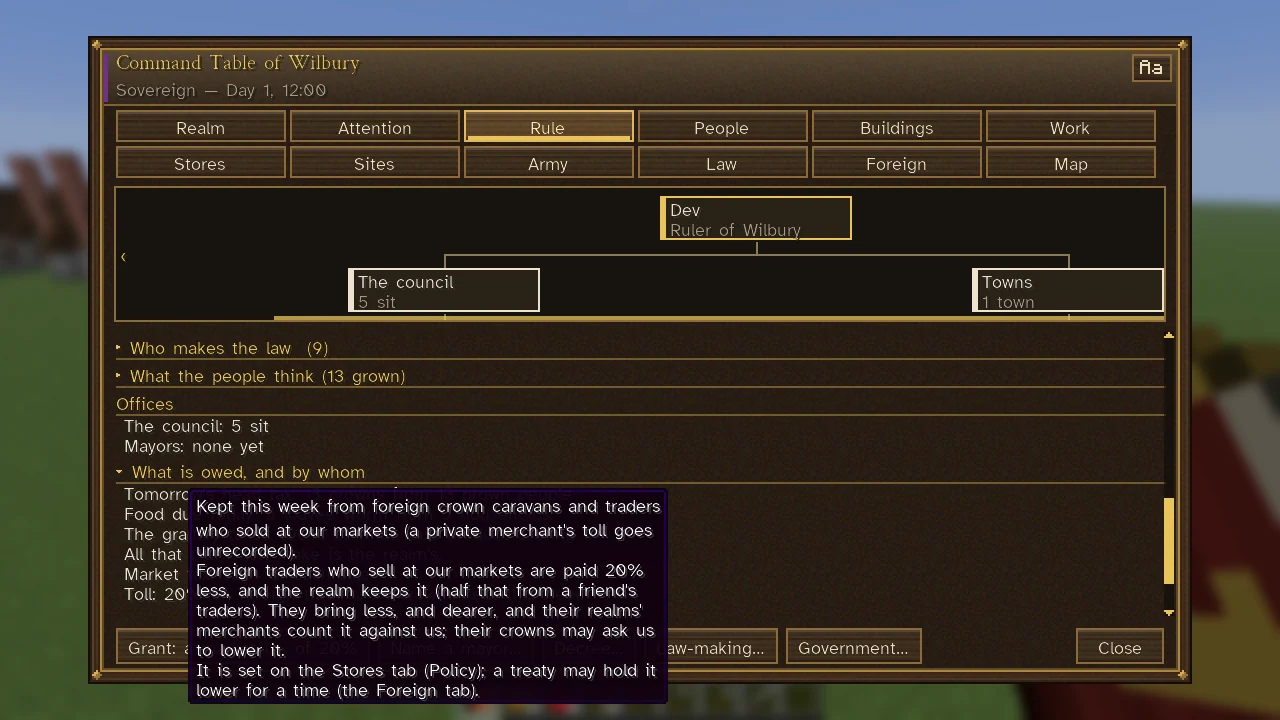
| Toll on foreign traders | A share kept from what foreign traders are paid at the realm's markets: 0, 5, 10, 20 or 30 per cent. A realm with a trade pact or an alliance with the trader's realm keeps half of it. |
| Market (who may trade) | Open to all, Our own only or Closed; a closed market stands empty and the people live on their rations and their own pantries. One turned away is told the nearest market that deals with them, how far and which way. |
A high toll means foreign traders bring less, and dearer, and their merchants resent it; a realm's own merchants may press for a lower market tax (see Factions and Demands). A treaty can hold a toll lower for a time (see Diplomacy and Envoys). The ruler may decree a market holiday: three days without market tax or toll. The Rule tab lists the market tax and the toll under What is owed, and by whom, with what the toll kept this week.
Making a market grow
Better markets are earned by what is added:
| Level | Needs | Gain |
|---|---|---|
| Market | Two stalls (chests or barrels) | Stalls where merchants sell to townsfolk and travellers |
| Market hall | Eight stalls, two lanterns over the stalls, two banners | More stalls, more buyers from abroad |
| Exchange | A lectern for the ledgers and a cartography table | Merchants' credit and maps: better prices and news from abroad |
A merchant also sells maps: a map to a town costs 15 crowns, a map of the country about 40, a plan of the town's streets 8, a sea chart 60 and a survey of deposits 200; at a market hall or an exchange, an atlas of the world as the realm knows it, 250. The Bazaar great work draws caravans to its market thrice as strongly; see Great Works.



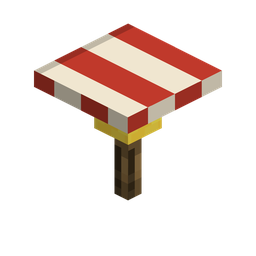
Staffing and stocking
Merchants stock the market's stalls from the town's surplus, and townsfolk buy food and treats there (see Households and Wages and Food, Granaries and Hunger). A staffed market sells cookies, pies, cake, candles and books, and in a larger town compasses, clocks and maps; the baker, carpenter and mason make them to order.
What sells is made again. Every sale at a town's counters (a household's at a stall, a shop, a bakery or an inn, and a player's at the market) is written in the town's counter ledger, and whenever the town reckons its orders, each good a trade makes that sold there in the last three days is ordered again: as many as sold (128 of one good at most), less what the crown already holds of it in its stalls, storehouses, yards and workshops and what is already on the town's benches. Such an order is paid for, stands "sold at the counters lately", and the workshops' hours, the hands they keep and their hiring follow it as they follow any order (see Work and Professions). A market's fixed few of each nicety (4 candles, 2 books, a painting, carpets, a banner, flower pots, and in a larger town a compass, a clock and a map) are ordered only while none of that good has sold at the town's counters in fourteen days. Food makes no sale order, nor does a good no trade makes (salt, logs, wool, hides), so the stalls' cookies, pies and cake are always kept in their fixed few; and what a farm, camp, mine or other producer sells from its own chests is its own to make good.
A market keeps one to four hands depending on its stalls. See Work and Professions and Businesses and Property for who works the market and who may own a shop, Merchants and Supply Trains for how goods travel between towns, and Treasury and Taxes for where the market tax goes.
Pedlars
A market also reaches the homesteads about it. Every six to eight days a pedlar's cart from the nearest market town within 800 blocks calls at a homestead someone has lived at in the last week: it buys the farm and hunt produce its stores hold beyond 16 of each kind, at that market's offer less carriage, and leaves the coin in the chest the goods came out of; when the stores are short of food it sells the house bread. Its owner is told in a line what changed hands. See Homesteads.