Businesses and Property
DiscussFrom the Sovereign Realms Encyclopedia
A business is a workplace (or a house) that belongs to a person rather than to the crown (a workplace the crown runs keeps books too: see below). A citizen of a realm may buy a house or a workplace of its town that no one owns, run it, take its profit, and sell it back. A business's hands are its owner's staff, paid out of its till, which is the coin in its chests.
Who may own what
To buy you must be a citizen of the town's realm (see Citizenship and Ranks), and carry the price in crowns. A town's sheet tells a stranger what its citizenship costs and that it "Lets you buy houses and businesses here, with a steward". The ruler of a realm does not buy: as its ruler, all of it is theirs to order already. The realm's Enterprise law (Rule tab) decides how far the crown sells:
| Law | Meaning |
|---|---|
| The crown's works | Every workplace is the crown's: none may be bought (those already owned stay so). |
| Chartered trades | The crown sells the workplaces it can spare to its citizens, players and people alike, at their price. |
| Free trade | Owners may sell to one another as well, and the crown sells at four-fifths of the price; the rich buy out those who fail. |
These buildings can be owned: houses, farms, lumber camps, quarries, mines, fisheries, pastures, apiaries, bakeries, smithies, joineries, masonries, inns (taverns), salterns, stables, cookshops and alehouses. A house that has people living in it cannot be bought ("Not for sale: someone lives there."), and a house let whole to a tenant is not for sale while the let runs: its page says "Let to" the tenant ": not for sale while it is let.", any For sale sign over its door comes down, and only the tenant may buy it (the let ends, and all in it is theirs; see Lodging). A town's own offices, stores and defences are never for sale.
Buying one
- Go to the building. Right-click its marker block (a baker's peel for a bakery, a forge's bellows for a smithy; see Building Markers) or its name board over the door.
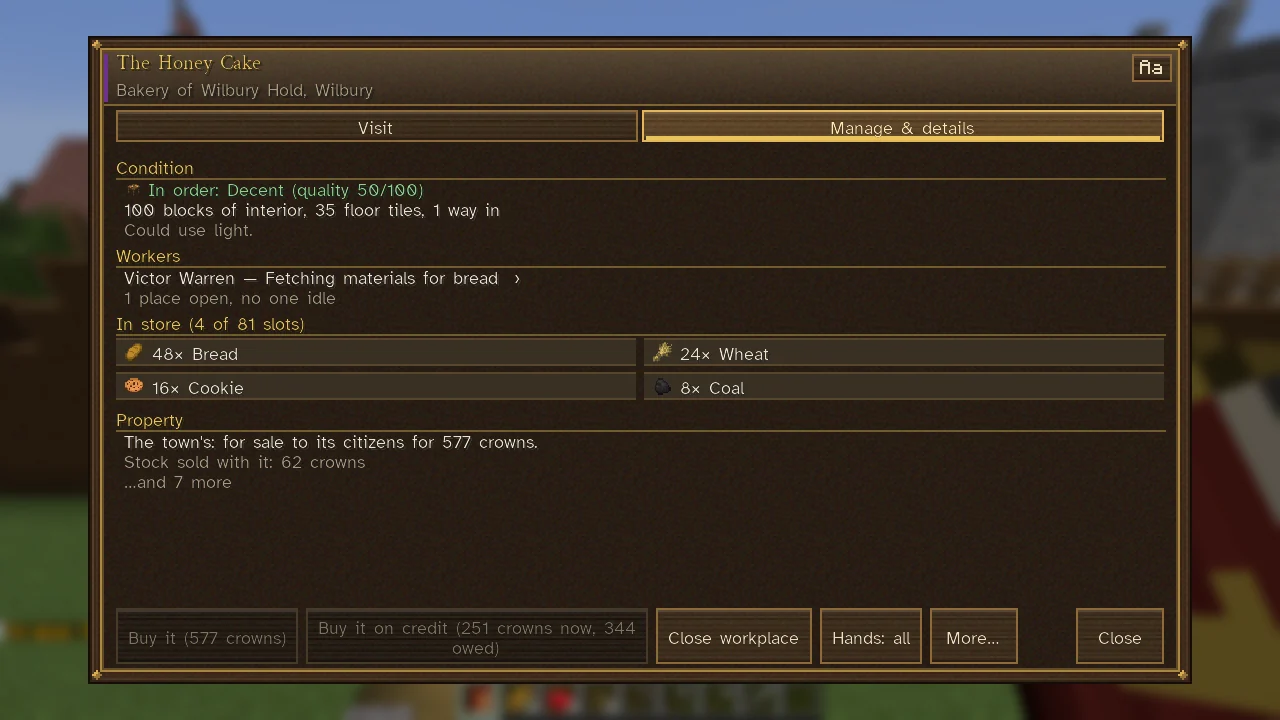
- Open its Details page (Manage & details for its owner or a steward) and find the Property section. If it is for sale it says so, with the asking price and how much of it is for the stock sold with it, and for a farm, pasture, apiary, fishery, saltern, bakery, smithy, joinery or masonry whether its trade would pay here ("Its trade: " and a few words, why on its hover) and what it would make a week (below). Hover the greyed button to learn why you cannot buy.
- Choose Buy it (N crowns) and confirm. The price goes into the town's treasury and the deed is yours. Its workers stay on as your staff, paid from its till. The till comes empty: put in a week's wages (Put cash in…), or its hands go unpaid from the first morning.
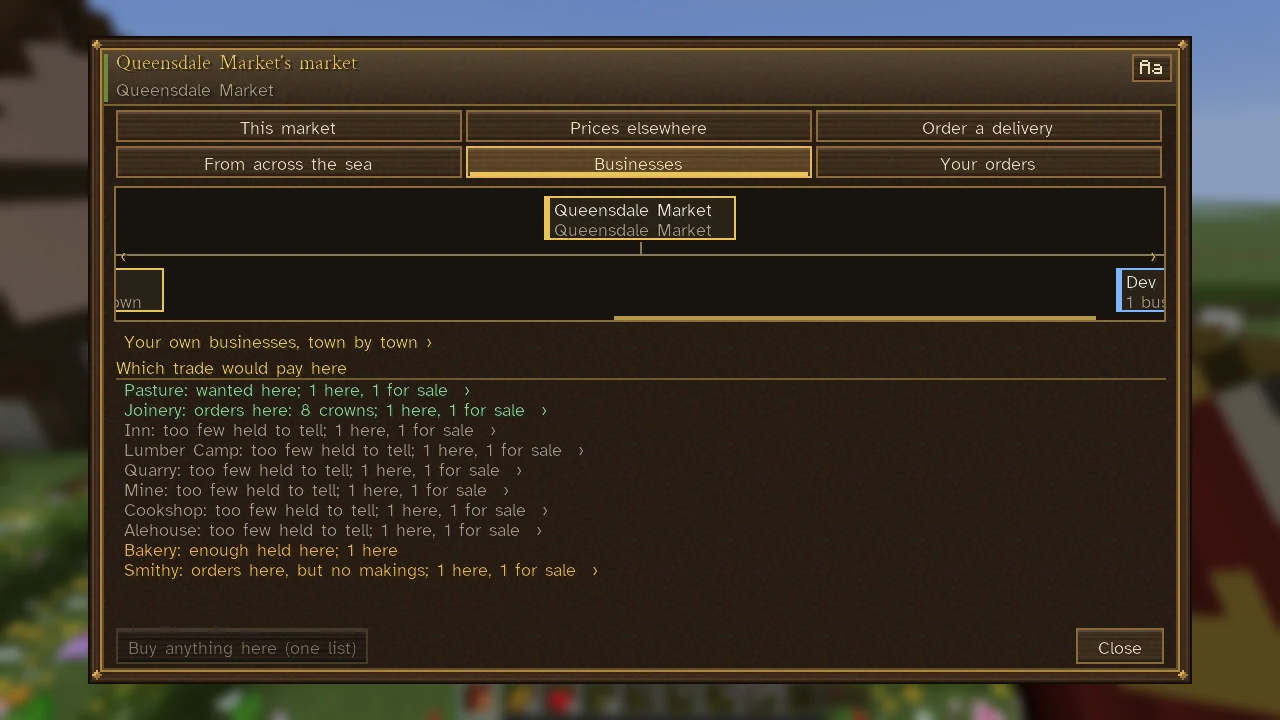
Ask the Companion or your Your Steward "Which business here should I buy?" while in a town and they name the best for sale there, its price and what it would make a week, with the town's Businesses tab a click away. A market's Businesses tab (/realm market) charts who owns each of the town's businesses, the crown and every owner, with the week's profit and the hands in each. Under Which trade would pay here it ranks up to ten trades you may own there by what the town wants now: first the trades whose goods it would buy ("wanted here", the most wanted first; for a smithy, joinery or masonry, "orders here" and what of them can be made of what the town holds), then the rest by what a hand of each earns a week in the world, and last those it wants none of now ("enough held here", "no wheat to bake here", "no orders here", "orders here, but no makings"). Each line says how many of its trade the town has and how many are for sale, a click away. Your own businesses, town by town is a link above it once you own one.
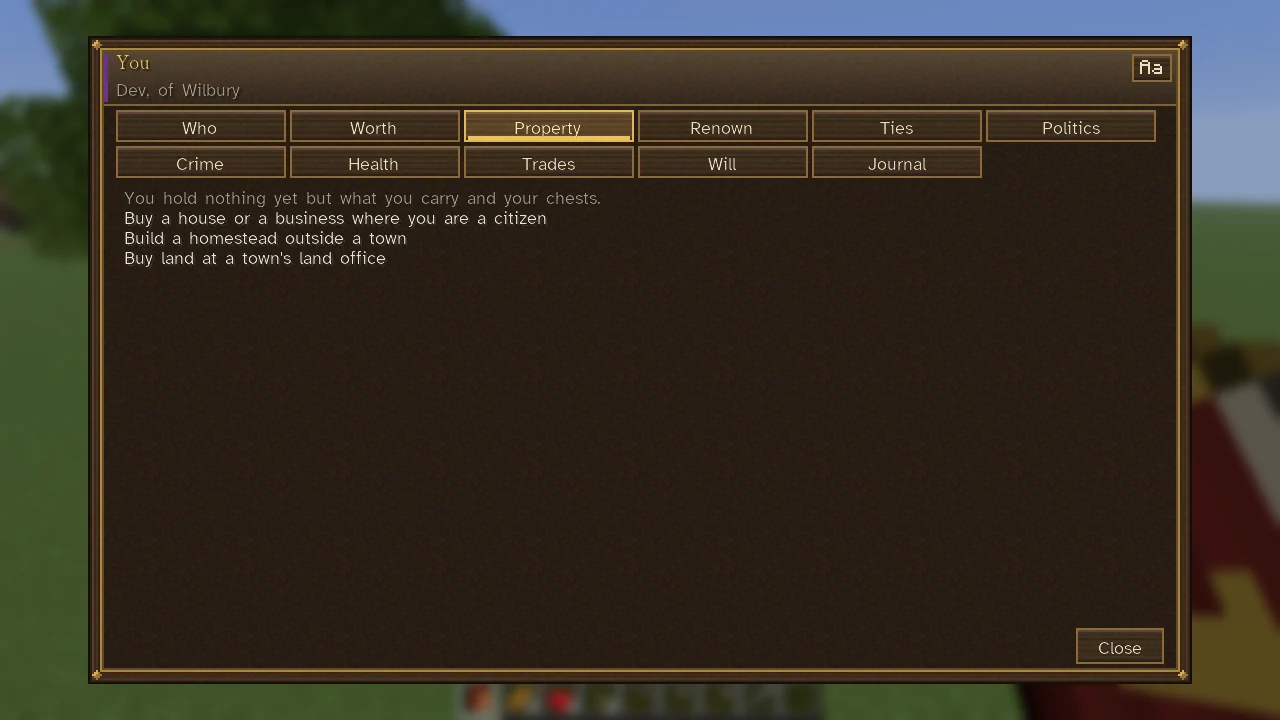
The Property page of your You sheet lists your deeds. Before you own anything it names three ways to hold something: buy a house or a business where you are a citizen, build a homestead outside a town, or buy land at a town's land office.
What it would make
Under Property, a farm, pasture, apiary, fishery, saltern, bakery, smithy, joinery or masonry for sale says what it would make a week if it were bought now: "Would make about" so many crowns "a week here" (or, reckoned by its trade's record, "a week, as its trade does elsewhere"), "Would lose about" so many, or "Would about break even here", its working on the hover, which ends "A reckoning, not a promise: the weather, the town's wants and its prices change it." The same reckoning chooses which of a trade's premises the Businesses tab and your steward name: the one that would make the most, and of those about alike the cheapest. Each trade is reckoned by what decides its sales:
- A farm by its land. Its tilled plots ripen about every six days on ordinary ground, slower on poor soil, and rich soil bears more. Its harvest is counted by the crops standing in its fields (a sheaf of wheat or a beetroot to the plant, two or three potatoes or carrots), or, where its fields cannot be read, by what its town sows: mostly potatoes while the town holds under twenty days of food. The town is counted to buy at the market's price only what it lacks of its eating beyond what its other fields and trade bring in, and never more than this farm's share of a week of the town's eating ("…'s other fields and trade feed it" says so); the rest it takes for its stores at the glut price (below), as far as its market has room. Then its hands' wages, and how many others of its trade the town has.
- A bakery by its ovens: about forty loaves a day a baker, as far as its share of the town's wheat and its own chests' allow and while the town buys bread, each clearing what a loaf fetches over its wheat; less its hands' wages.
- A trade whose goods the town buys none of now: its hands' wages lost.
- The rest by its trade's record: what a hand of its trade makes a week, the middle of such businesses held a month and more in every realm, for each of its places. An inn's, an alehouse's or a cookshop's working also says whether it stands near where the town buys.
A trade too few of whose businesses have been held a month and more is not reckoned: its page shows no week, and your steward and the Companion never name it as the best buy (see Your Steward).
The price
A building costs what it would cost to build again: the blocks it stands in at their worth, the builders' days to lay them, and its plot, which is dearer in a bigger town and dearest in a realm's seat. A business is priced also on its standing trade; one with a fortnight's books is worth what it earns, at the yield a going concern is expected to give. A finer finish costs more. Its stock goes with it and is paid for apart.
Buying on credit
Where the crown lends, a business may be bought on credit: a third of its price down (a quarter for one in good standing), its stock in full and a fee, with the rest owed the crown and paid from the business's profits within a term. See Credit and Moneylending. Two weeks short and the crown takes it back.
Running it
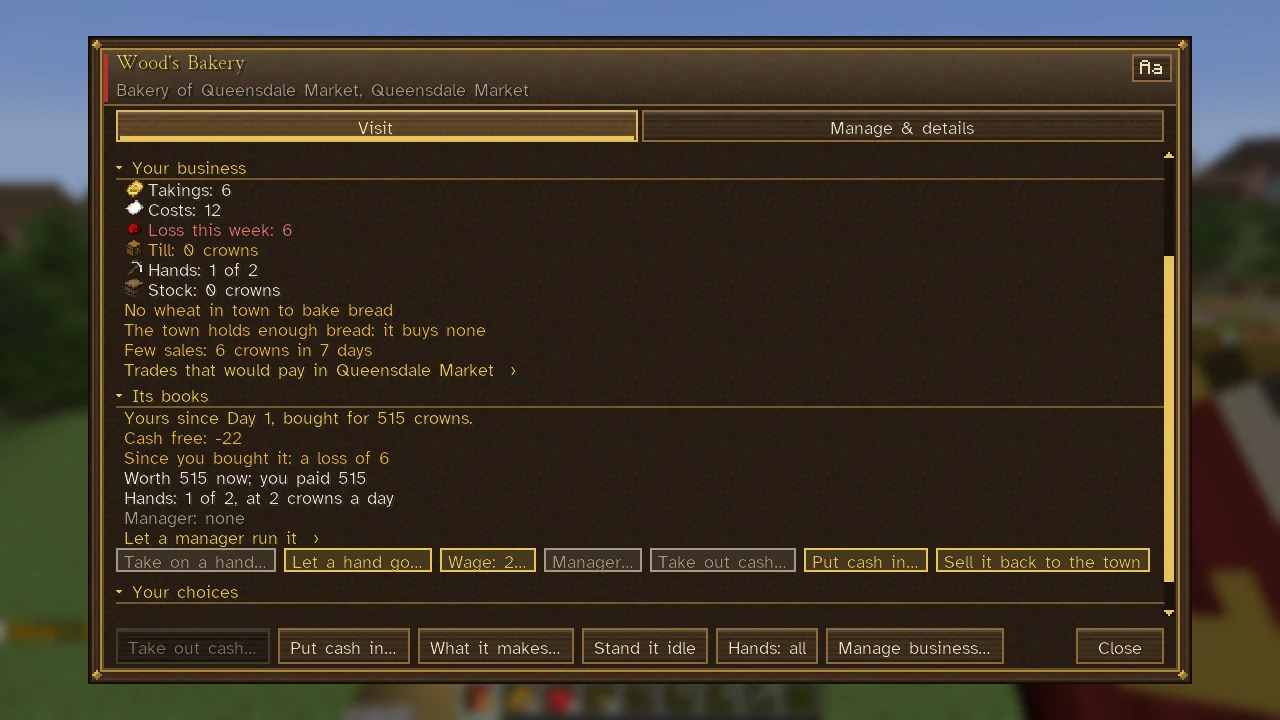
A business's Visit page opens on its card ("Owned by …", and its state on a chip) and its tiles, as any building's does (see Buildings). For its owner, the section Your business comes first there and on Manage & details: six lines for its last seven days, each with an icon and its detail on hover.
| Line | What it shows |
|---|---|
| Takings | What it sold for; its hover says who paid it (its town, households, merchants, other towns' orders, players). |
| Costs | What the goods it sold had cost it, its wages (paid and owed), its manager's pay and its taxes. |
| Profit this week / Loss this week | Takings less costs: green for a profit, red for a loss (No profit or loss this week when they are even). |
| Till | Its cash, from which the wages come each day; its hover tells apart what you put in this week. |
| Hands | How many work there, of its places. |
| Stock | What it bought in and holds unsold, at what it cost: crowns it will have back as it sells. |
That week's result is the one profit figure the business is given everywhere: under the same words on these lines, your Property page and Take out cash…, and in what your Your Steward knows of it. Its stock is not a cost, and what you put into its till or take out is your own money, no part of its profit or loss.
Why it loses
In a losing week, the dearest causes of the loss (up to three) stand under those lines, each in a few words, with the reckoning and what to try on its hover. With none standing out it says "No one cause stands out: a small loss". The causes it weighs (where the trouble is the town itself, its makings, its stores, its orders or its prices, the hover also offers a trade the town wants):
| Cause | What to try (on its hover) |
|---|---|
| No wheat in town to bake bread, or Little wheat for its ovens: so many sheaves a day (a bakery whose bakers have less wheat a day than a loaf a head of the town, or its share of that beside other bakeries, up to a baker's day of loaves, at three sheaves a loaf; its bakers fire what else the town holds, for far less) | Wheat, where it is to be had: bought at the stalls here and brought to its chests (its bakers use what is there first), or brought from a market in reach (Order a delivery) |
| Too little iron (wood, stone) in town for its orders: a smithy, joinery or masonry | The makings, where they are to be had: at the stalls here, from a market in reach (Order a delivery), from the lumber camp, mine or quarry for sale here (its logs, ore or stone for its chests), or from the far ships at the town's harbour |
| The town holds enough of what it makes: it buys none (the hover gives what is held, what is wanted, and what its market pays a piece against its usual price) | Sell where it is short (Wanted elsewhere, in its Details) |
| No orders of its trade in town | Take other towns' orders |
| Its wheat costs more than a loaf fetches here, or A loaf clears too little here (a baker's day of loaves earns less than a hand's wage) | Wheat for less, where it is to be had |
| Its goods fetch little here, well under their usual price | Sell where they are short |
| Each piece costs more to make than it sells for, or no one in town uses what it makes (a workshop set to make one thing) | Choose another thing to make, or only what orders call for (Your choices) |
| Its sales pay for fewer hands than it keeps | Let a hand go, or lower the wage; take one on again when sales grow |
| Nothing sold in 7 days, or few sales | Other towns' orders, stock a shop's racks, or a trade the town lacks |
| Its till ran dry: wages owed to its hands | Put cash in, or let a hand go |
| Its manager's wage: so much this week | One who asks less (Manager…), or see to it yourself |
| Nothing on its racks to sell (a shop of your own goods) | Stock them, or leave its hands the makings |
| Others of its trade in town share its trade | A trade the town has fewer of, or sell further off |
| A poor spot: far from where the town buys (its heart or its market) | Premises nearer the market, or sell further off |
| Taxes took much of its takings |
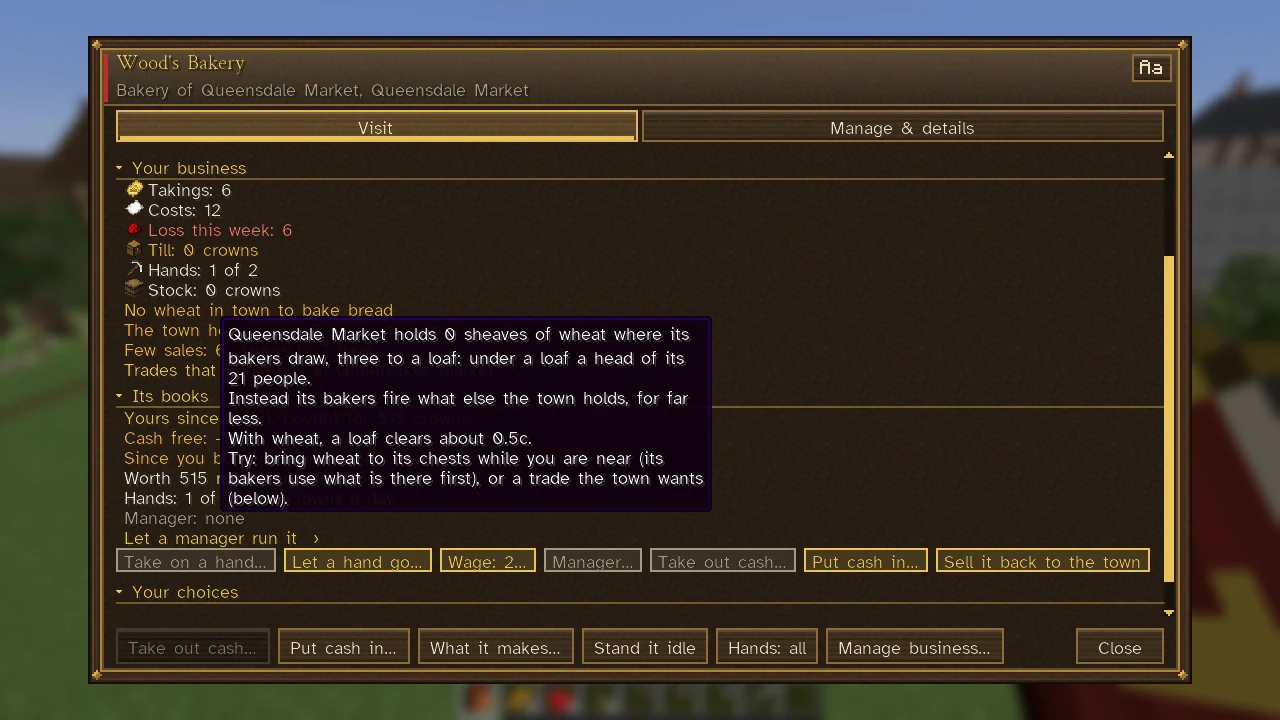
Under the causes, Trades that would pay in (the town's name) opens that town's market at its Businesses tab, its trades ranked as above.
Its books and the controls
Under Its books: since when it is yours and what you paid; Cash free (its till, less its wage reserve and the week's hearth tax); Since you bought it, the profit or loss of its own trade since; Your cash: put in N, taken out N, the coin you moved between your purse and its till, shown apart; and Worth N now; you paid N, a valuation and not coin. In a week that did not lose, wages its till could not pay are shown as owed. Then the hands and the manager, and the controls:
- Take on a hand… lists only those of the town free to take on now: up to eight of its idle grown people of working age, the most practised at its work first (never the crown, a regent or the crown's consort, who keep no trade). If one cannot be taken on after all, it says why in a few words: every place is filled, they have taken other work since, they are leaving town, away on the road or serving under arms.
- Let a hand go… frees one. The town gives them no work for 3 days, so you may take them back.
- Wage may be set to 0, 1, 2, 3, 4, 5, 6 or 8 crowns a day. A new owner's hands start at the realm's wage for that trade. Yours stays as you set it; a business owned by one of the world's people moves its wage to the realm's wage for its trade once a week, and pays a skilled craftsman more, as the crown does (see Work and Professions).
- Take out cash… takes Profit this week, not yet taken, or All but the wage reserve (three days of its hands' wages, twenty crowns at the least).
- Put cash in… puts crowns into the till for wages (10, 50, 100 or 500).
Under Your choices, a smithy, joinery, masonry, bakery or powder mill has What it makes…: one of its trade's goods its hands make when no order calls, until its chests hold 16 (4 of what does not stack), or Only what orders call for; each choice says how many the town takes now and what a piece clears, after its makings and its maker's hours. Stand it idle lets its hands go and keeps the building (no wages, nothing made, its chests still sold from), and Open it again takes hands on again. Hands sets the most it takes.
Skilled pieces (firearms, plate, cementation bars, siege engines, great guns and great bombs) are made at a workshop's stations over hours, not at a crafting table. In a workshop you own, whose realm knows the craft, you may lay a piece's makings out at its station and work its hours yourself, or leave it to the hands, who work it at their wage; see Firearms.
A manager
A manager is one of the town with a head for trade who runs a business for its owner. A person's trade runs from 0 to 20, its ranks novice, able (from 2), skilled (6), expert (11) and master (16).
A business with no manager shows "Manager: none" under Its books and offers Let a manager run it, with the share they would take ("Let a manager run it (24% of what it clears)"): the town's best at trade who is free to take it on, named on its hover with their terms, runs it from then on, with Manager may let a hand go when trade is slow on. Manager… chooses one yourself, or No manager. It offers the four best at trade who are free, idle or at other work (a manager runs it beside their own work), and after them the one who would cost least; each is listed by name, trade and share ("trade 4, takes 24%"), their terms on hover. To be free they must be grown and under retiring age, at home, not under arms, not the crown, its regent or its consort, none of its own hands, and managing no other business.
Their pay. A manager takes a share of what the business cleared over its last seven days before their pay, that is what it sold, less what the goods had cost it, its hands' wages and its taxes: 20% at trade 0, a point more for each level of trade, 40% at trade 20. A seventh of it is paid each morning from its till, as its hands are paid, but never less than a small retainer, a quarter of the realm's going wage for the business's trade (a crown at the least), however little it clears, and never more than a wage that fits their trade: the going wage and a tenth more of it for each level of trade, three times it at trade 20. Each one offered says so on its hover ("Takes 24% of what it clears before their pay, from" the retainer "to" the most "a day"). What its till cannot pay is owed, on its books, and you are told in chat, at most once a day, that your manager "went unpaid today", that its till is short of their day's pay, and to "Put coin in at its counter."
Their mornings. A manager sees to a business only on some mornings of the week, spread through it: a novice three of seven, an able hand four, a skilled one five, an expert six and a master every morning. On their mornings:
- they keep its places filled from the town's idle, the most practised at its work first (on their other mornings no one is taken on for it); while nothing it makes has sold for some days and its goods wait unsold, they let a hand a day go instead;
- while Manager may let a hand go when trade is slow is on, past its first days, they let one hand go (the least practised, never the last) when its sales over its last three days, or the last week for a farm, pasture, fishery, saltern or apiary, cleared less than its hands' wages, and keep its places a hand fewer;
- one skilled at trade or better sets a smithy, joinery, masonry, bakery or powder mill to make what pays when its hands would idle or what it makes loses or cannot be made of what is to be had; one less practised is "too new to trade to judge what it should make".
Each week, on its own day and with the same switch on, they weigh its hands: one is let go after a week whose wages passed what its sales left, or whose work one hand fewer would have done on four days of seven; one is taken back on after a week whose sales left enough for another hand's wage. They leave its hands be in its first week and for a fortnight after you set them yourself, leave your own choice of what it makes for a fortnight, and never close it or sell it. With the switch off, they keep the hands you set, but for the hand a day let go while its goods lie unsold.
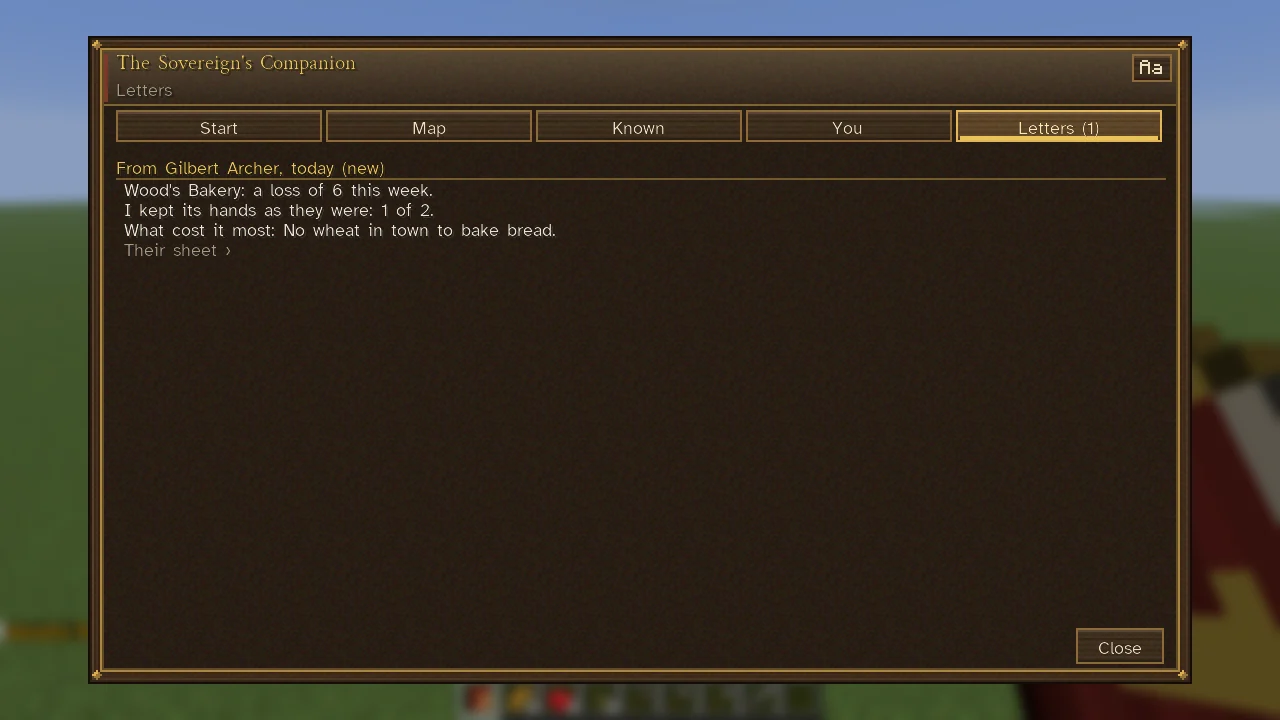
Their letters. About once a week (at most once in six days) they write to you of how it went: its profit or loss, what they changed, and in a losing week what cost it most. The letter is kept in the Companion's Letters, told in one row of chat with the letter on its hover if you are on, and in your return briefing if you are away (see Catch-up Simulation).
On its books stand "Manager:" with their name and share ("…, 24% of what it clears", their terms on hover), Manager's wage this week (and what is owed), and what it has made in their hands since they took it on ("Under" their name ": a profit of" so much). In a losing week their pay may be among its causes ("Its manager's wage: N this week").
If a manager dies, the next morning the town's best free hand takes it on and you are told who and for what share, or that no one of the town is free to manage it.
What needs you
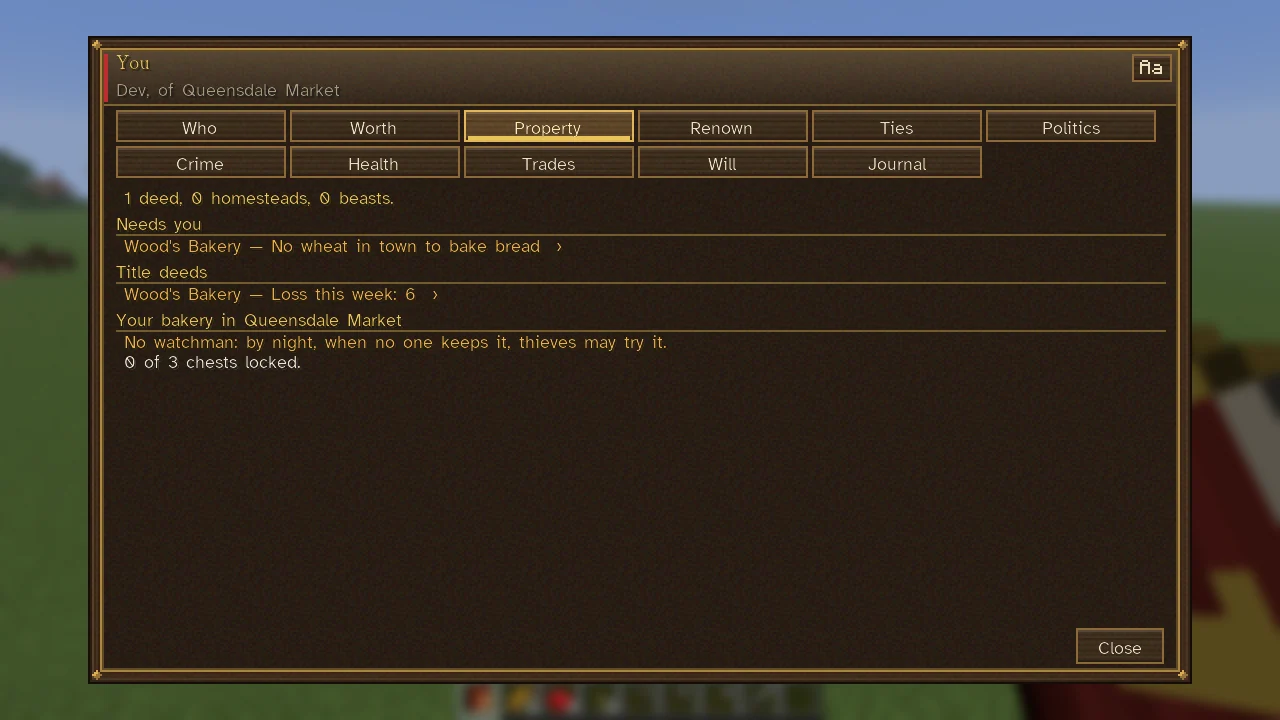
Your You sheet's Property page (press J) shows Needs you first, under the count of what you hold, whenever one of your businesses needs you: each line names it and its one reason, the detail on hover and its page a click away. A business that lost money this week comes first (the dearest loss first, with its page's dearest cause), then one whose till could not pay its wages, a shop with nothing on its racks, and one with no manager to run it ("No manager to run it": choose one on its page). With nothing needing you, the heading is not shown. Under Title deeds each business has a line with its week, "Profit this week" or "Loss this week", its price, books, hands and manager on hover.
The same lines, in the same order, are among what your steward names when you ask what needs you (the three most urgent things of all), and in the Needs you now of your return briefing.
Where the money comes from
What a workshop makes stays in its chests (the porters leave it be). Each morning the town buys of it what it will use beyond what it already holds, at its market's offer: three quarters of the market's asking price, dearer where the town lacks the thing. What the town does not want stays in the business's chests, for you to sell at a market or send where it is short. The realm takes its market tax on the sale (see Markets and Trade). Takings also come from households and players at the business's counter, from merchants who carry its goods off, and from other towns' orders, as the Takings line's hover tells.
A farm offers the town its wheat, beetroot, pumpkins, melon slices, potatoes and carrots. Two rules help the food trades:
- A farm's food the town does not want at its market's offer is taken into its stores all the same at the glut price, three eighths of the food's worth (the least a market asks, half its worth, less the merchant's quarter), for its carters to send on: as much as brings its market's stock up to twice what the market keeps, and as much again as the towns its merchants trade with lack of it for their tables, less what it took so today. Only what is left past that stays in the farm's chests.
- A bakery's bread is paid no less than its baker's due: what the loaf's wheat costs at the town's price, a tenth more on it (a food maker's margin), and a fortieth of a baker's daily wage in its realm, a baker's day being about forty loaves.
Where no player is near, a bakery with no wheat, or no buyers for more bread, bakes the town's potatoes for the rest of its bakers' day, buying them of its stores while a baked potato sells for more than its potato and the fuel to fire it, and offers them to the town at its morning sale; in sight, its bakers fire what else the town holds, bought of its stores.
A town's merchants also buy of its businesses what other towns lack (see Merchants and Supply Trains).
Goods for its work can be ordered from another town's market straight into its chests: on the market's Order a delivery page, choose Where to… and the business (see Markets and Trade). They go on its books as bought in and as your money put in, and its hands use what is in its chests first; a bakery's bakers bake the wheat in its own chests before buying the town's, whether or not anyone is near.
An inn of your own
An inn that is someone's business (its marker the Tavern Keg; see Lodging) keeps what it takes in its own stores, its till, and on its books, where the crown's inns send theirs to the treasury:
- Its evenings. Townsfolk who spend the evening there each put a crown in its keg for a drink, and one who is hungry pays for a bowl from its larder too, at what the town's market asks for that food (a crown at the least): Takings from households. Where no one saw the evening, it is reckoned the next morning: those of the town whose evening it was by the day's roll, who were not at the alehouse, had a crown about them and live nearer this inn than the town's others, drink and eat as they would have, paid alike. There is no evening out under a curfew, and none is reckoned without an innkeeper at work.
- Rooms and meals. What players pay for its rooms and hot meals goes into its stores (Takings from players), and what travellers on the road pay to sleep in its beds and eat its meals is its own as well.
- Its larder. Each morning its larder is filled up to twelve pieces of food from the town's granary and storehouses, hot meals first and then whatever is eaten, bought from its till at what the town's market pays for them. It takes none of the crown's food, and its innkeeper carries none of its takings to the treasury.
Shops of your own
A tinker's shop, apothecary, enchanter, builders' merchant, clothier or scribe's shop is a shop of its owner's own goods. The town does not buy what it sells. Its hands work and sell only what is in its own chests: stock its racks (its chests) with the trade's goods, or leave its hands the makings. It sells at its counter and takes nothing from the town's stores. The crown's own shops of these trades are not for sale; you start one on your own land. A shop's takings go into its till: come by to take the profit.
Thieves
Thieves eyeing your place
The thieves of a town's The Underworld may try a house, shop or business of yours, but only while you are on the server and away from it. Before any try they eye the place, and you are told in one row of chat ("Thieves have been eyeing your bakery in" the town), its hover saying what keeps them off and a click opening the Property page of your sheet. They may try it on any of the six nights after. A watchman of your own (Hire a watchman (7 crowns a week)…) turns most of them away, as does a golem set to keep it, a post of the watch near it or the watch's patrol past its door; a lock slows them. See Stealth and Thievery.
A warning is followed through or called off. If those nights pass with no try, you are told "Thieves have stopped eyeing" the place, and why, on its hover: you were there when they came by, your watchman or your golem kept them off, a post of the watch stands near it, the watch's patrol passes its door, they never try it while you are off the server, or no night suited them. A place found worth their while again later is eyed, and warned of, afresh.
Keeping watch for a thief
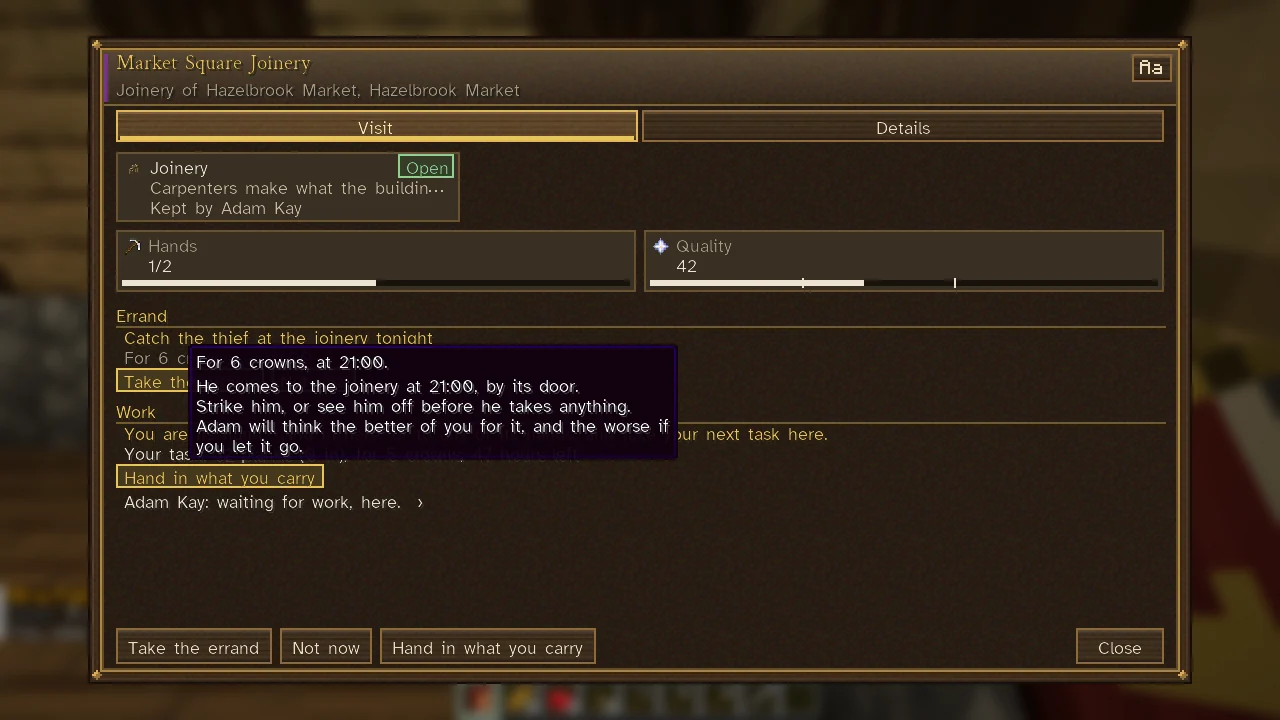
A player who works for hire at a workplace (see Work and Professions) is now and then given an errand by its master, and one of them is a night's watch: Catch the thief at the joinery tonight. It is offered only while the workplace keeps goods in chests inside its walls, under Errand on the workplace's page and when you talk to the master, with Take the errand and Not now. Its hover names the hour the thief comes, nine, ten or eleven at night by the sky's clock, or a later hour for a watch offered late ("He comes to the joinery at 21:00, by its door."), what it pays, and that the master will think the better of you for it and the worse if you let it go.
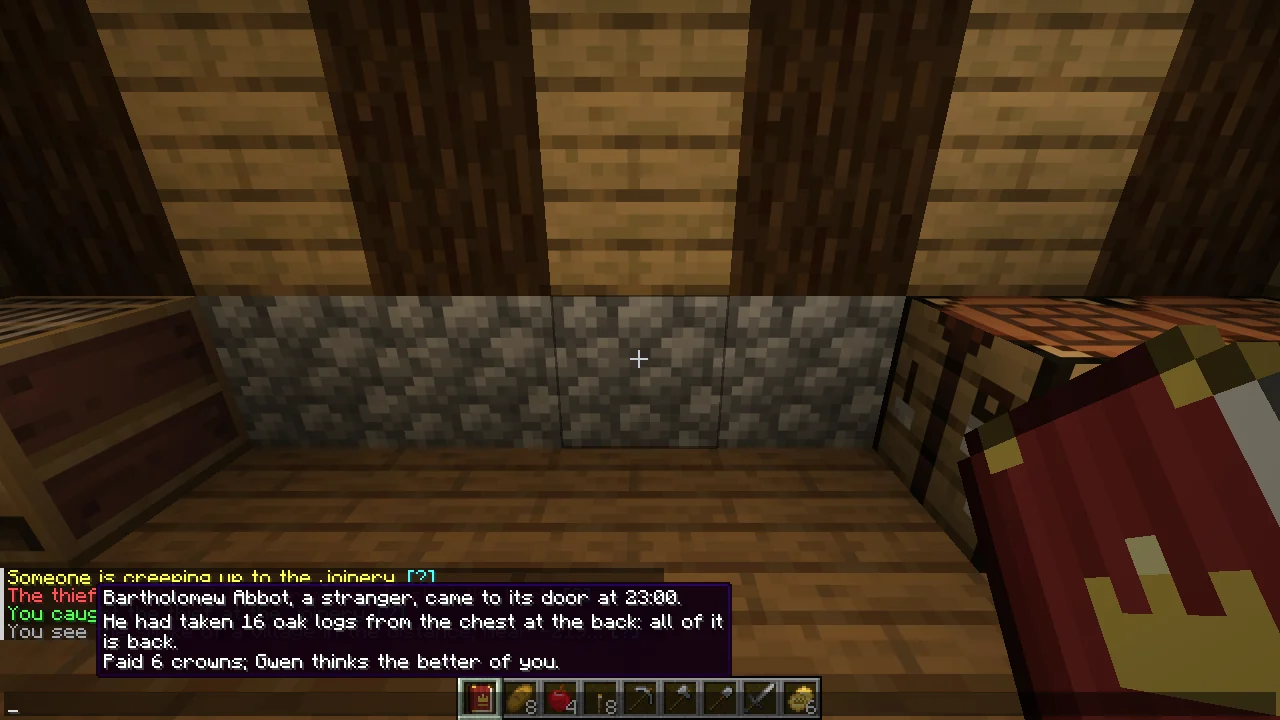
Be at the workplace (within about 24 blocks of its marker) at that hour, or in the two hours after it while it is still dark, and the thief comes in the flesh. He steps out of the dark a few blocks from its door, where no one is looking, and you are told "Someone is creeping up to the joinery." He comes in by the door (a workshop's lock for the night is no bar to him) and makes for the fullest unlocked chest inside the walls; left at it a few seconds, he takes a share of one good (a third of its stack, sixteen at most) and makes off by the door he came in at, and you are told what he took and from which chest ("the chest at the back", "the chest by the door"). He never takes through a wall or from a chest outside the walls. If you are near and in his sight (about seven blocks, or three while you crouch), he runs. Strike him before he gets away and he drops what he took, which goes back into the chest it came from.
When it is over, one line says what came of it. Its hover tells who came (his name once he is caught, else "a stranger" or "an unseen thief"), at what hour, what was taken and from which chest, what was got back, the pay and what the master thinks of you:
| Outcome | What follows |
|---|---|
| Caught ("You caught the thief at the joinery.") | All he took is back; the errand is paid. |
| Seen off, or he left with nothing | Nothing taken; the errand is paid. |
| He got away with goods | The master thinks the worse of you. |
| You were not there in his hour | An unseen thief takes from a chest inside its walls ("No one kept watch at the joinery: a thief took" so much); the errand counts as left undone. |
| No thief came | Told "No thief came to the joinery tonight." with why: its chests are locked, its owner's watchman kept him off, or there was nothing left worth taking; or "your watch kept him off" when you were there all his hour. A watch kept is paid. |
A player who owns the workplace hears of it as well: a thief caught, seen off, or what he took from it.
Starting a business
- Buy a plot at the town's land office (see Land, Estates and Landlords).
- Build the workplace yourself and set its marker inside, or have the town's builders raise one: the land office lists the trades that would stand on your plot and at what price. The trades it offers are a bakery, a cookshop, a smithy, a joinery, a mason's yard, a tavern, a tinker's shop, an apothecary's, an enchanter's and a builders' merchant's.
- It is deeded to you with the land. Open its sheet to take on hands from the town's idle and set their wage. The town buys what a workshop makes each morning.
On land you hold, the town's building code applies; see Land, Estates and Landlords.
Taxes, sale and failure
- Hearth tax. Once a week, on the town's tax day, each house or business you own there owes a share of its worth (one per cent by default; the realm sets it). A business's tax never exceeds a tenth of what it kept over its goods' cost that week, and is nothing in a week that kept nothing. You are told in chat with a link, and the tax sheet opens of itself, at once or at the next moment it would break off nothing you are doing (not in a fight, riding, asleep, at a chest or reading another page).
/realm taxesshows and pays what you owe, from wherever you are, in crowns or in goods at the town's market bid. Unpaid, a bill is a tenth more after a week, and after three weeks overdue the bailiff takes it from the business's till. See Treasury and Taxes. - Selling back. Sell it back to the town pays seven tenths of its price and its stock at the market's offer; goods the town would not use stay in its chests and go with it, so take out what you would keep. A building on land you hold goes with the land title and is sold with the land.
- Death. Houses and businesses pass by your will or the law; see Dynasties and Succession.
Working for others
You do not need to own anything to earn. Ask a hand at a workplace for work, take a turn at a knack, or sell at a market bell. A business's hands also learn the trade from its owner. See Work and Professions and Households and Wages.
Workplaces the crown runs
A workplace no one owns is the crown's, and the crown keeps its books as an owner keeps a business's. Its Details page shows its last seven days under Property:
- "Last week:" what it took and its wages, and the profit or loss they leave ("a loss of 20 crowns."). What it took is what the crown paid each morning for what it made or gathered the day before, at the town's market offer as it buys of a business someone owns, and what households paid at its own counter (a shop's, a bakery's, a cookshop's, the market's stalls, or a farm, camp, mine or other producer selling from its chests). A thing is booked once: sold at the counter, or bought by the crown the next morning, never both. The crown takes no market tax at its own counter.
- "The crown's:" how much of its wages the treasury carried: "The crown's: 40 of its 140 crowns of wages came from the treasury this week", "The crown's: it paid its own wages this week" or "The crown's: it paid no wages this week". Its hands are paid from what it took first; what that did not cover, the treasury paid.
- "Who paid it:" its takings by who bought ("Who paid it: its town 80, households 40.").
What it takes stands to its name as a till kept at the treasury, not as coin in its chests, which are the town's (porters empty them and households buy from them). Each morning the treasury takes back what stands above three days of its hands' wages (20 crowns at least). These are books, not new coin: its hands are paid each morning from the treasury as before, and the books say which of the crown's workplaces earns its wages and which the treasury carries. Once someone buys it, the crown's books of it end and the owner's begin.
Businesses of the world's people
In a world realm, citizens of means buy workshops where the law lets them: a citizen who can put a third of the price down buys a craft or a lesser food trade the crown can spare (it keeps its farms, woods, quarries and mines). They take their profit weekly; one with three is an oligarch. A business that cannot pay its way fails, sold to an oligarch under free trade or back to the crown. Where a few hold most of a town's coin, those who lean to the common granary resent it. See Factions and Demands and Government and Law-making.