Armies and Soldiers
DiscussFrom the Sovereign Realms Encyclopedia
An army in Sovereign Realms is made of real people. A realm's soldiers are its own townspeople, enlisted at a barracks, trained as a troop type, armed from the town's armory, paid from its treasury and fed from its stores. They are organised into companies, one or more to a town, which garrison the town by day, keep its watch by night and march to war when ordered. The dead are really dead, and an army exists only as far as the realm can keep it: a barracks with bunks, wages in the treasury, food in the stores and arms on the shelves.
You command the soldiers of your own realm through the Army tab of the The Command Table and the Army page it opens, with the Command Horn in the field, and with the Battlefield Orders keys. Only a member of the realm with the Marshal rank (or the Sovereign) can give them orders; see Citizenship and Ranks.
Barracks and armory
A Barracks is declared by its marker, the  Barracks Drum (see List of Building Types). It needs at least two beds and a ration chest. Each bed quarters one soldier, so the beds are the town's ceiling on its garrison. The barracks improves in four levels, and each level opens more troop types:
| Level | Name | What it adds |
|---|---|---|
| I | Barracks | Basic soldiers |
| II | Drill hall | Men-at-arms, pikemen, halberdiers, crossbowmen; drill goes faster. Needs hay bales (straw butts) and a grindstone |
| III | Fencing school | Knights, grenadiers and the firearms troops; drill faster still. Needs banners, an anvil or smithing table, more hay bales |
| IV | War college | Captains who command more; plans campaigns. Needs a cartography table, a lectern and bookshelves |
The Armory, marked by the  Armory Rack, stores weapons, armour and arrows, and recruits are equipped from it. Fitted out with iron bars and no fire inside, a second-level armory becomes a Magazine where powder is kept safe (see Gunpowder). A town's workshops (smith, gunsmith, joiner, bowyer) are asked to make what the armory lacks. The armory also keeps the town's siege stores: ladders, engines, petards, bombs and shot that the Army page tells it to hold, so that a war band setting out against walls takes what is there (see Siege Engines and Campaigns).
Enlisting soldiers
Open a townsperson's page (see Sheets) and choose Enlist, under Service… on its bar. You pick the troop type from a list. The game refuses, and says why on hover, when:
- your rank cannot command soldiers;
- the person is not an adult;
- no barracks in the town has a free bunk;
- they will not go: a craven person will not take up arms, nor one who thinks ill of you, nor one who has lost faith in the crown.
If the Magistrate has proclaimed conscription (the Law tab), the unwilling are pressed into service instead. They go, but start with little heart (see Morale) and resent you for it. Separately, at war the crown may call out the levy by decree: one in five of each town's able commoners, for forty days or until peace (see The levy, below).
Recruiters raise men for a company themselves. Set a company's recruiter and its plan on the Army page, and each morning they retrain and recruit toward the plan. Recruiters raise soldiers only while there is a bunk, three days of wages in the treasury, three days of food in store, and arms for those already raised.
Raising soldiers at once
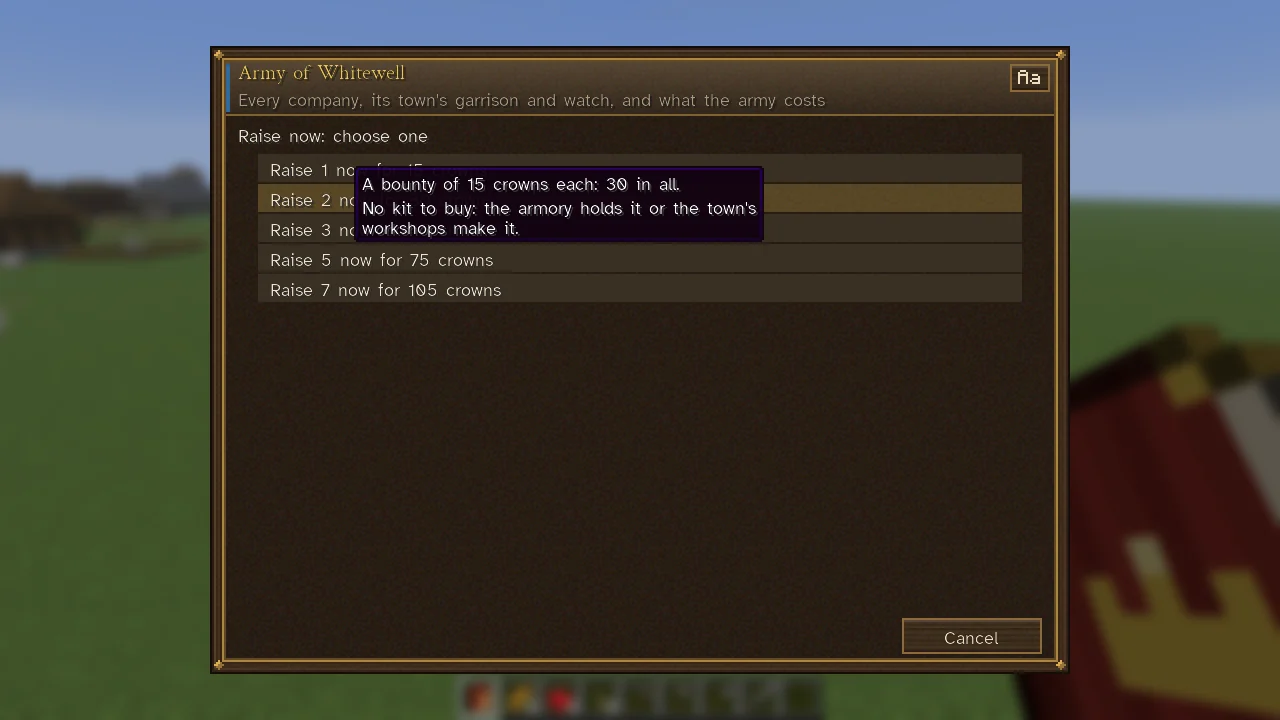
A company's section of the Army page has Raise now…: so many of the town take up arms today, each paid a bounty on the spot. The list offers to raise 1, 2, 3, 5, 8 or 12 of them, as far as so many can be raised now, and the most that can, each with its price ("Raise 5 now for 75 crowns"). The bounty is five days of a soldier's wage, ten crowns at least. Kit is bought from merchants, at its customary value and a fifth more, only where the armory holds none spare and the town's workshops cannot make it; each offer's hover gives the bounties and any kit to buy. The bounty makes the hesitant readier to go, but every other check still stands: a free bunk for each, the treasury holding the bounties and kit and three days of the soldiers' wages besides, food in store, and arms for those already raised. Where the list stops short, its hover says why ("No bunk is free in the town's barracks."). Each is raised as the type the company's plan is most short of, or else as its usual kind. Choosing asks once more with the total; the second choice pays from the town's treasury, the bought kit goes into the armory, and the recruits are armed from it.
The steward's recruiting
Your Your Steward can raise men for you, with or without counsel: Recruit… on the steward's page lists each of the realm's companies with its soldiers, and offers to raise it by 2, 5 or 10, or to the number its plan wants. Each morning of the company's town the steward asks up to two of the town's able to take up arms, by the same rules (bunks, pay, food, arms), keeps how it stands on the goal ("Raising company: 4 of 5, held by bunks"), sends you word of it, and stops when the company numbers so many. Only the realm's Marshal or Sovereign may set it.
Troop types
Each type carries a loadout, slot by slot, best first: soldiers draw the best the armory's chests hold for each slot. Recruits drill at the barracks' straw butts on garrison days until trained as their type; until then they fight at less than a trained soldier's worth. Drill takes the number of days shown, fewer at a better barracks.
| Type | Carries | Drill | Needs |
|---|---|---|---|
| Levy | A spear, no armour | none | none; called out in war by the levy (below) |
| Spearman | Spear, shield, leather | 1 | none |
| Footman | Sword or axe, shield, leather or mail | 2 | none |
| Archer | Bow and arrows, a blade at the belt | 3 | none |
| Light horseman | Spear or sword, leather, a horse and saddle | 3 | a stable |
| Man-at-arms | Sword, mace or warhammer, shield; mail or iron | 4 | Drill hall; armourer's shop |
| Pikeman | A pike, iron helm and breastplate | 3 | Drill hall; armourer's shop; polearms |
| Halberdier | A halberd or woldo, iron | 3 | Drill hall; armourer's shop; polearms |
| Crossbowman | Crossbow, bolts, a pavise | 2 | Drill hall; bowyer's; the crossbow |
| Knight | Lance, sword, shield, plate, a horse | 5 | Fencing school; a Stud; steelworks |
| Champion | A longsword, claymore or Dane axe; mail or iron | 4 | Drill hall; armourer's shop |
| Grenadier | Sword and six grenades; iron | 4 | Fencing school; powder mill; gunpowder |
| Sapper | Axe and two petards; mail or leather | 3 | Drill hall; powder mill; gunpowder |
| Arquebusier | Arquebus or musket, 20 cartridges, a sword | 3 | Fencing school; steelworks; firearms |
| Musketeer | A musket, 24 cartridges, a sword | 4 | As above, and steel |
| Dragoon | A pistol or wheellock, 12 cartridges, sword; rides | 3 | Stable level II; steelworks; firearms |
| Gunner | Sword; serves the great guns | 3 | Fencing school; foundry; founding |
| Engineer | Axe; sets up engines and raises ladders | 3 | Drill hall; siege workshop; siegecraft |
| Captain | The best sword and armour to be had | none | made from the company's sheet |
The workshop levels are those of the smithy (Forge, Armourer's shop, Steelworks, Foundry) and the joinery (Joinery, Bowyer and fletcher, Siege workshop); see Buildings. The knowledge named in the last column is a technique that the realm must know. In a world whose wealth is spread by province (the Known World) techniques are learned by skilled workers, by working the right workshop, or from a Book of the Craft (see Book of the Craft); the Sunlanders know powder and founding from of old, the Marchers siegecraft, the Heartlanders the crossbow and polearms, the Northfolk steel (see The Five Peoples). In other worlds everything is known.
The pike outreaches the sword and takes horsemen at double damage. The halberd, the crossbow bolt and the gun's ball each go partly through armour. A lance couched on horseback strikes by the horse's speed.
Companies, plans and brigades
A company is a squad or a platoon of troop types, led by a captain. A town keeps six companies at most. The Army page lets you Raise a company… from a plan, or Raise a brigade… of several companies together. The usual plans are:
| Plan | Make-up |
|---|---|
| Watch squad | Spears to hold the gate, bows to reach |
| Skirmishers | Bows, and a blade to keep them |
| Horse squad | Light horse to scout and chase |
| Sappers | Petards and grenades for gates and walls |
| Levy platoon | Numbers, cheaply armed; they break easily |
| Line platoon | A spear line, bows behind, swords to close |
| Heavy platoon | Men-at-arms, pikes and crossbows |
| Pike and shot | Pikes to hold, arquebuses to fire behind them |
| Knights | The charge that breaks a line |
The usual brigades are the Shire levy (two levy platoons and a watch squad), the Field brigade (two line platoons, skirmishers and horse) and the Iron brigade (two heavy platoons, pike and shot, and knights). A realm can copy a plan and set its own numbers. A brigade can be ordered as a whole from the Army page (Order all of …): sent against an enemy town, its companies muster at the one of their towns nearest the target and march from there as one host (see Campaigns).
A company's page gives its standing orders: return to garrison, hold where you stand, escort you, march, patrol a route, or raze an enemy building. It also sets its posture, how it is drawn up, and whether its shot hold fire. These are described in Battlefield Orders. Orders to companies far from you go by courier (a rider who must reach them) unless the realm's policy sends them at once.
Pay, food and heart
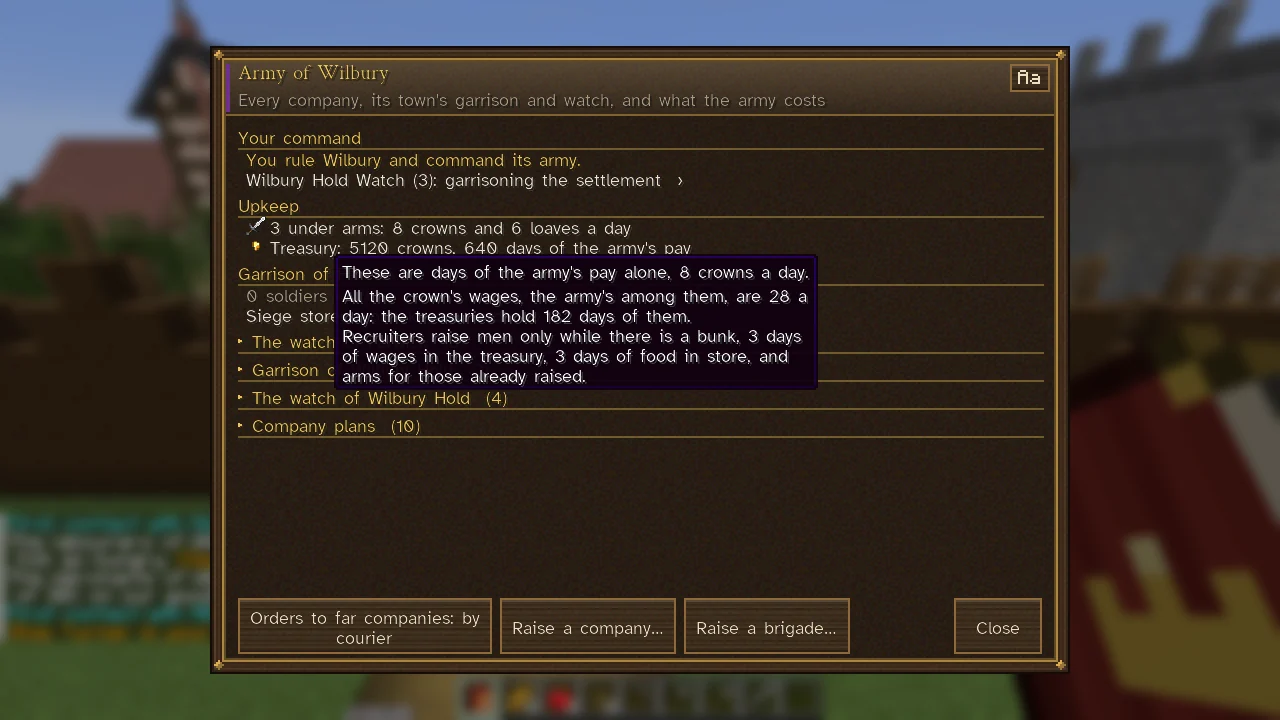
Each soldier is paid a daily wage from the treasury, set in the realm's policy (3 crowns by default, 8 at most), and eats from the barracks and town stores. Ranks multiply the wage: sergeants 1.5, captains 2, majors 2.5, colonels 3, generals 4 (see Military Career). The Army page's Upkeep lines show what the army costs a day and how many days the treasury can pay it; its hover compares the army's pay alone with all the crown's wages. A realm whose treasury cannot pay its soldiers loses their heart first and then the soldiers (see Morale and Treasury and Taxes).
The levy
At war, a crown may call out its levy: from each of its towns, one in five of the able commoners (grown, well, at home, free and not already serving) leave their work for arms, for forty days or until peace. A town calls the idle first, then the land's hands, then the crafts, the stronger first, and sends sixty at most; it spares its officers, priests and healers, scribes, the watch, smiths, those who keep its stores and trade, and sailors. Each serves in the town's own levy company ("town Levy") with a spear from home if they carry no weapon, sleeps in their own bed, and is paid half a soldier's wage from the treasury (2 crowns a day at the default wage of 3). The brave and the faithful of a faith of the sword go gladly; the rest think the less of the crown for some days after the call. The world's realms call their levies by the same rules.
Before the call
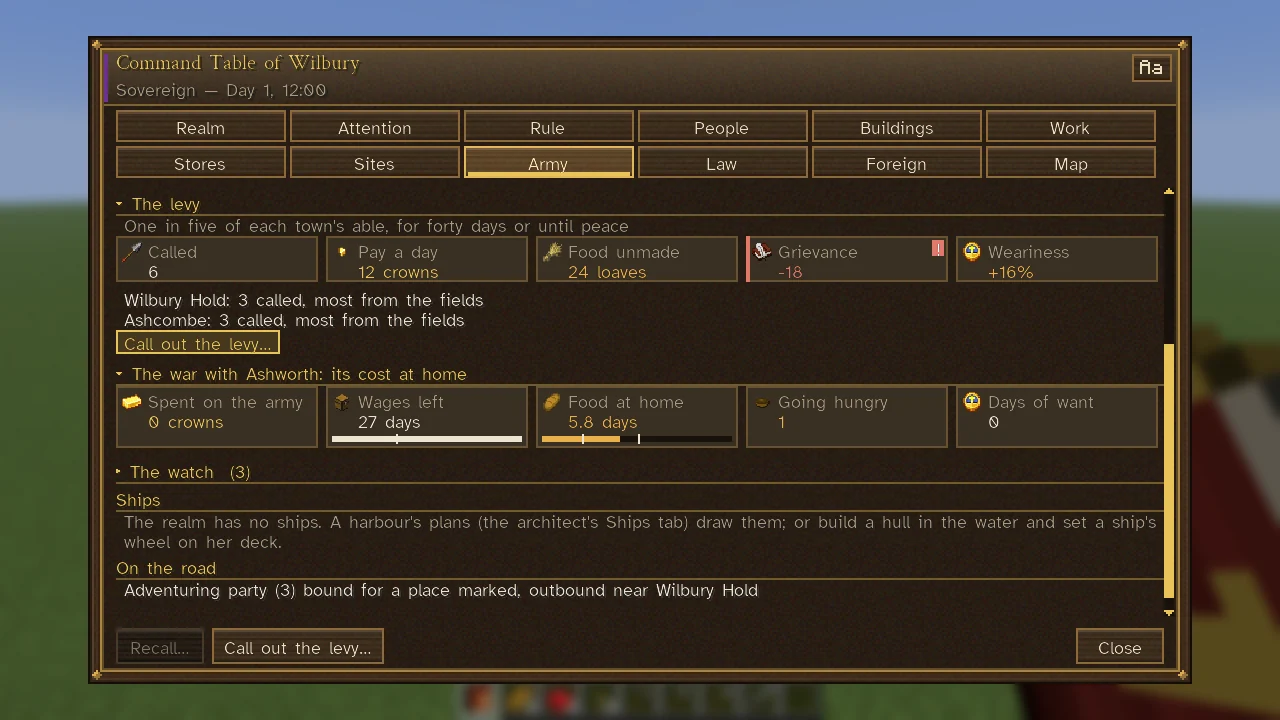
At war, The levy stands on both the Army tab and the Rule tab of the The Command Table, forecasting what a call would come to now, each tile with its detail on its hover:
| Tile | What it forecasts |
|---|---|
| Called | How many would come out, of how many able, by the work they would leave: idle, the fields, the herds and nets, the woods and pits, the workshops. |
| Pay a day | Their pay a day and a week, what the treasuries hold (a week of the levy's pay must be there), and how many days the crown's wages last now and with the levy's pay. Amber under seven days. |
| Food unmade | About how many loaves a day of the towns' own food go unmade by the food hands (fields, flocks, nets and hives) called; and the workshop hands called. |
| Grievance | What the interests would hold against it while it is out, by their share of the realm's grown people: the labourers (−6 to −25), the landed (−4 to −20), the craftsfolk (−3 to −12). The tile shows the worst; the hover also counts those who resent it and those who go gladly. |
| Weariness | What it adds to the realm's weariness of the war by the twentieth and fortieth day out, as a share of what the realm bears (see War and Peace). |
Under the tiles stands a line for each town ("town: 3 called, most from the fields"; six at most, the rest on one line), then, under a council or an assembly, how it would vote on the call now, and where the call would be refused, why.
Calling it out
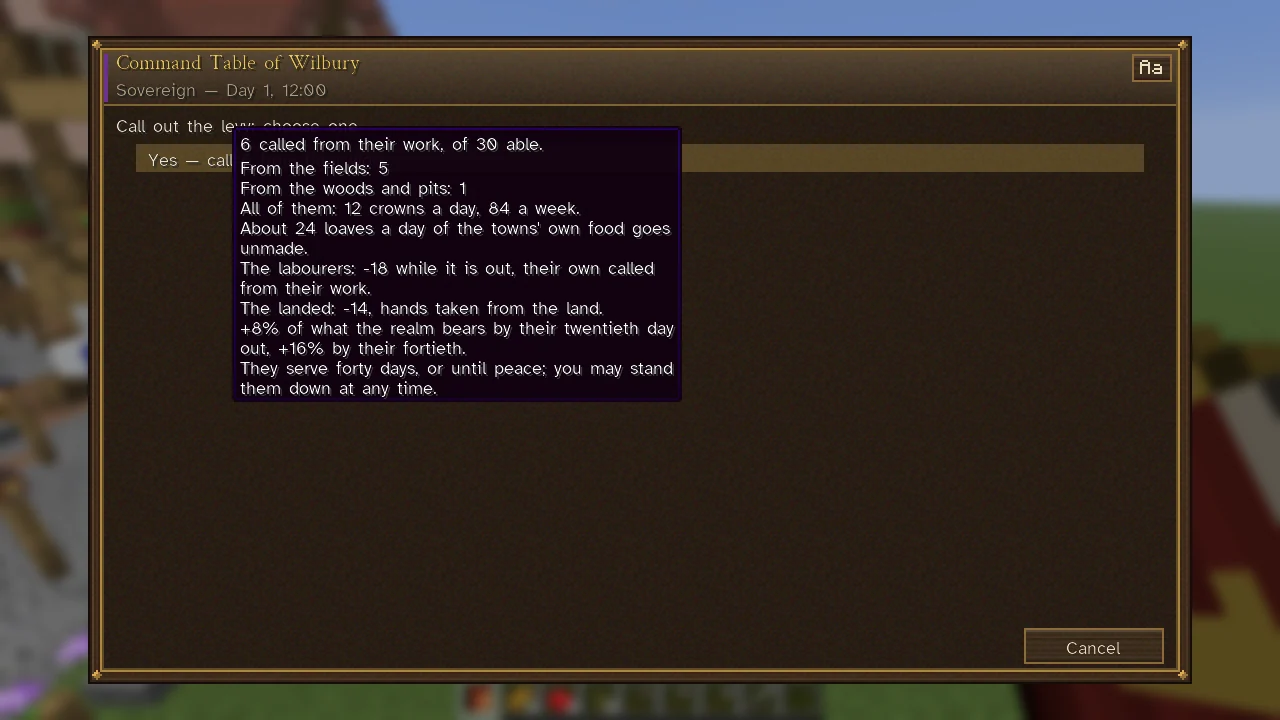
Call out the levy… opens a choice, Yes — call N from their work, whose hover gives the call in short. It is a decree (see Government and Law-making): only the sovereign or a steward may make it, once a week, and under a council or an assembly it is put to the vote. It is refused, saying why, at peace ("The levy is called out only in war."), while the levy is out, when no town has the people to send, or when the treasuries do not hold a week of its pay ("The treasury holds N crowns: a week of the levy's pay is M. The levy is not called to go unpaid."). Once called, the realm's players are told who comes from which towns, its chronicle keeps it, word goes abroad, and the next morning's report gives it.
While it is out
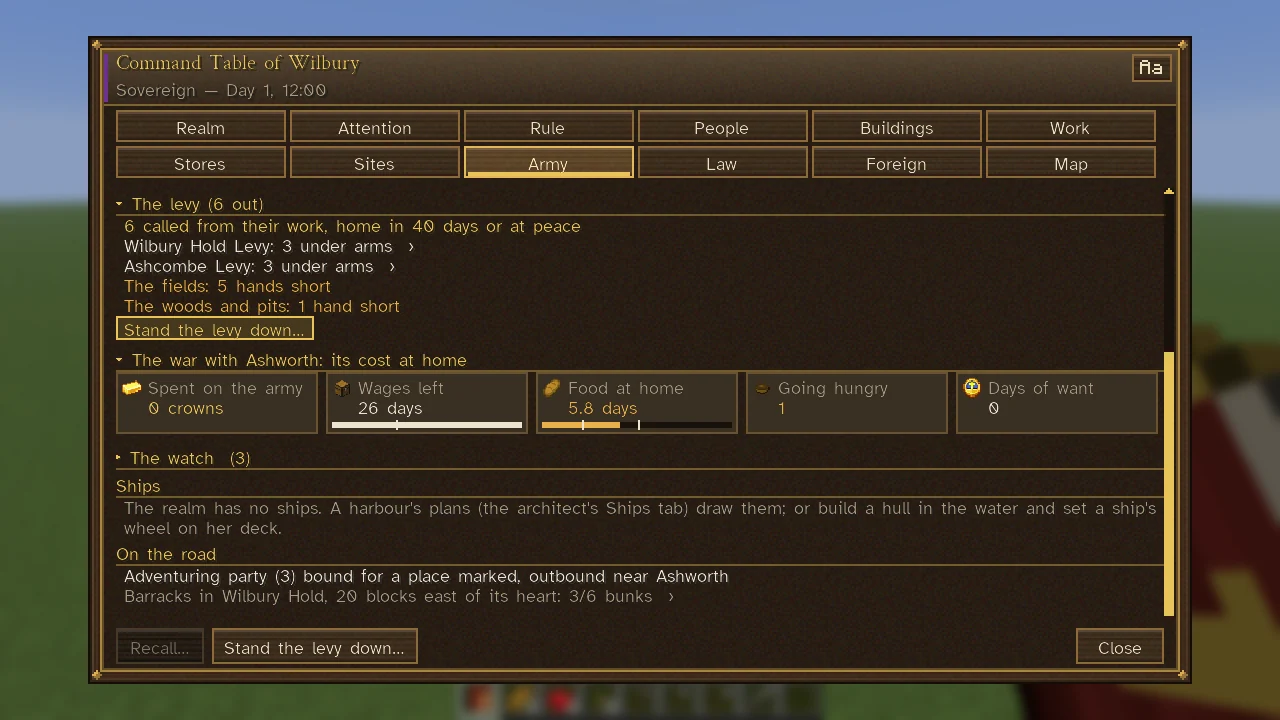
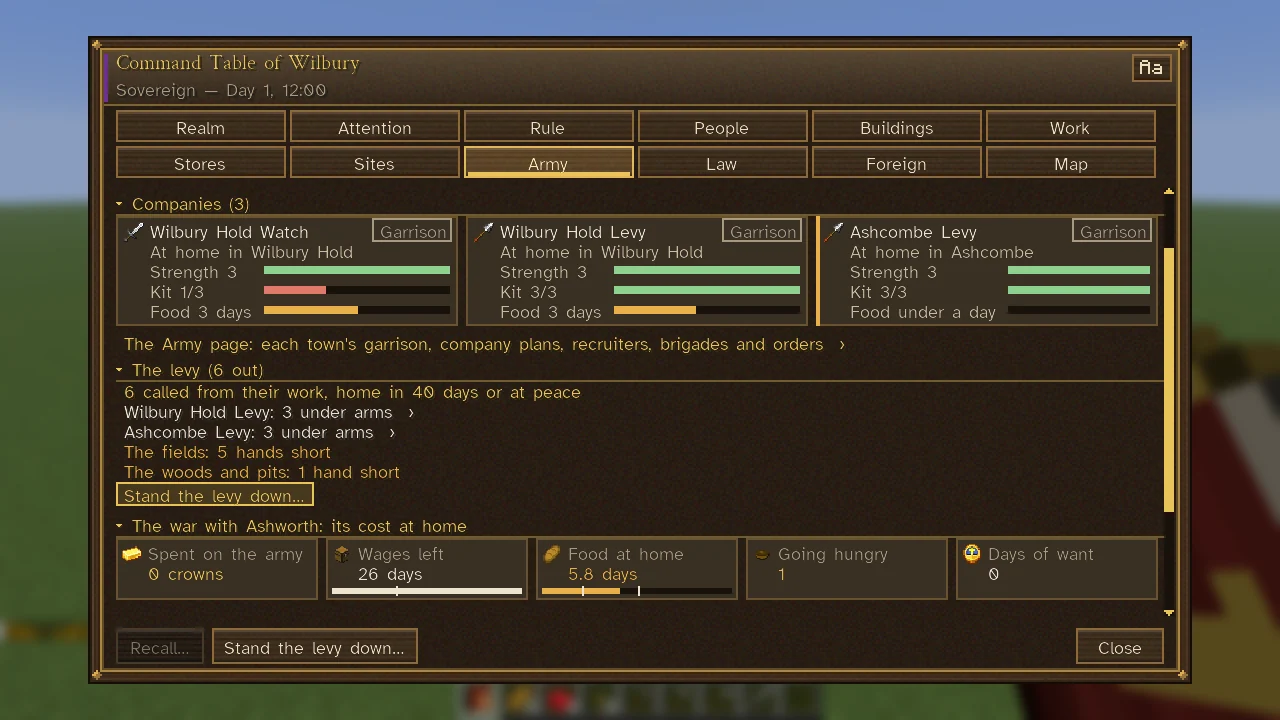
The section becomes *The levy (N* out): when they come home ("6 called from their work, home in 40 days or at peace"; on hover who called it and when, the work they left, their pay so far and the fallen), a link to each town's levy company, a line for each work short of hands ("The fields: 5 hands short"), and Stand the levy down…**. The levy companies stand among the realm's companies as cards and take orders on their page like any company: to keep the town, or to march with the war bands (see Campaigns). Their work waits: a field untended goes unreaped and unsown, a workshop short of hands makes less, in towns no one is near as in those in sight.
Coming home
The levy comes home at peace, after its forty days, or when stood down: Stand the levy down… may be chosen at any time by the sovereign, a steward or a marshal, without a vote. Those at home go back to their work at once, those away with a war band when it is home; each takes up their old place if it still has room for them, or looks for work. When the last of a call is home or fallen, the realm is told its account (how many served, fell and came home, and what their pay came to), kept in its chronicle and given in the next morning's report.
The Army tab
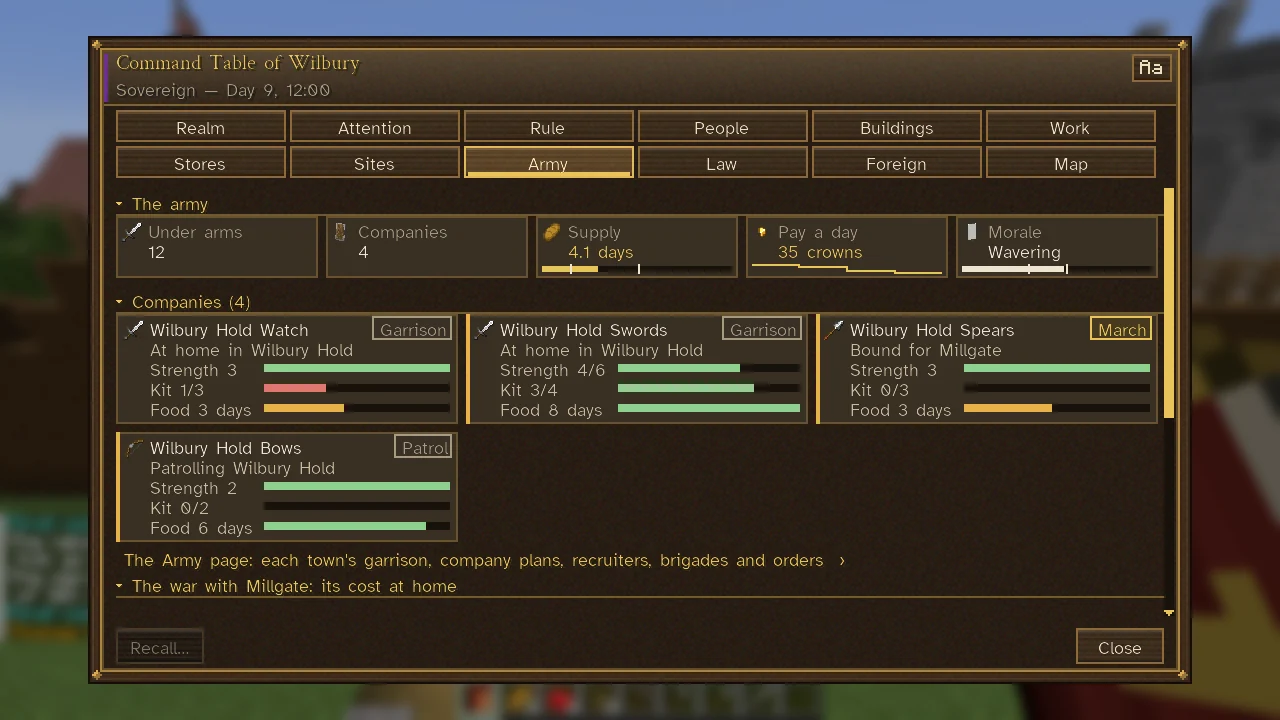
The Army tab of the The Command Table answers what the realm can field and whether it can feed it. It opens on five tiles, each explained on its hover:
| Tile | What it shows |
|---|---|
| Under arms | The realm's people in service, with how the count moved since the morning before; players enlisted are on the hover. Opens the Army page. |
| Companies | How many companies the realm keeps. |
| Supply | The days the soldiers' packs and their barracks' ration chests would feed them, on a meter marked at 2 days (short) and 7 (well stocked). |
| Pay a day | What the soldiers are paid a day, each by their rank, with the books' last days of the army's pay as a small chart. |
| Morale | The army's heart on the whole in a word, on a meter marked at wavering (35) and steady (55); the hover says how many refuse orders now. See Morale. |
At war, any siege the realm lays or stands under comes first under the tiles, as a card of its own with its orders under it (Storm now, Offer terms, Hold the siege, Lift the siege for the besieger; Sally and Ask terms for the defender): see Walls and Sieges.
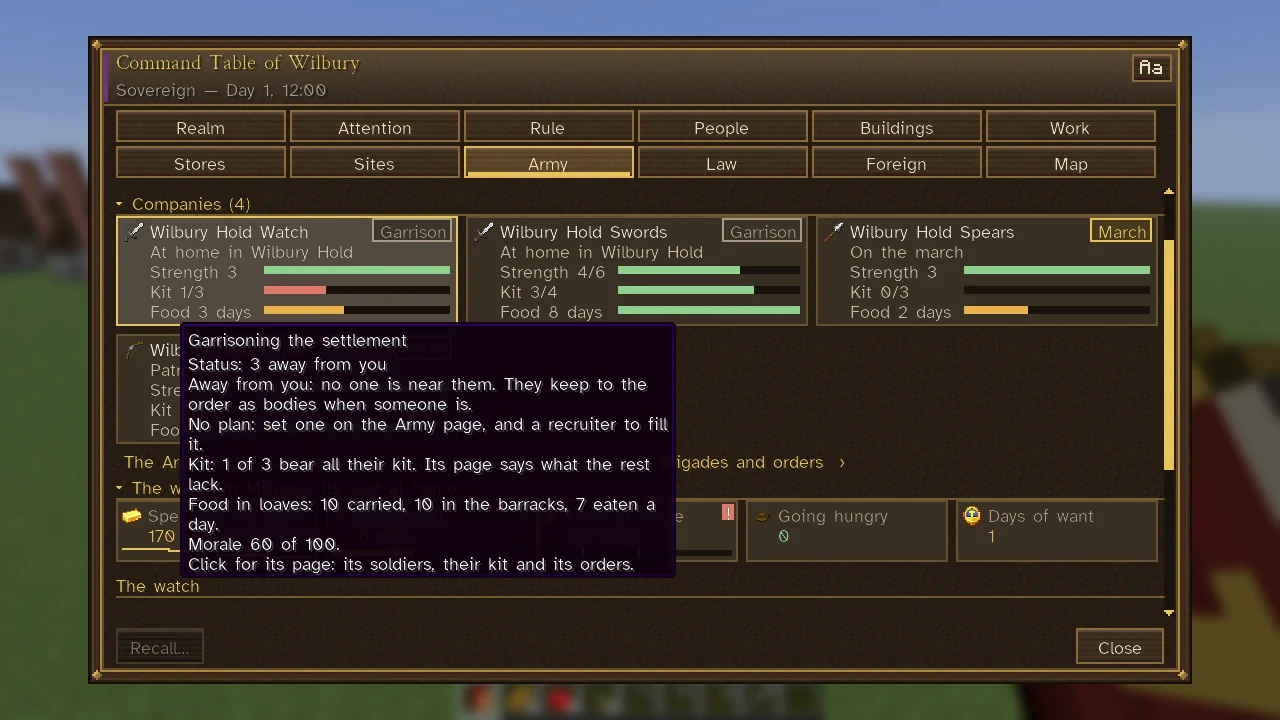
Under the tiles, each company is a card: the picture of the kind most of its soldiers are, its name, its standing order on a chip (March and Raze in gold, Garrison and Patrol muted), and where it is ("At home in…", "Besieging…", "Patrolling…", "Bound for…", "Holding by…", "Escorting", "On the march", or, while its soldiers are about, "Near…" or how far they are from a town). Three meters follow, each green, amber or red by how full it is: Strength against its plan ("Strength 4/6"), Kit, how many bear all their kit ("Kit 3/4"), and Food, the days its food would last. A company that is hungry, unpaid, refusing orders, or short of food or heart has an amber edge. Its hover gives its orders and who gave them, how they are going, its plan, its kit, its food in loaves, its morale out of 100 and each trouble on a line; a click opens the company's page.
Under the cards stand the link to the Army page, at war The levy (see above) and the war's cost at home as five more tiles (see Campaigns and War and Peace). Then come the watch (sentries, jailers and each town's armory), the realm's ships, its parties on the road, and each barracks with its bunks. Recall… calls back supply trains, war bands and hunting parties on their way out or already there.
The Army page
The Army page ("Army of …", from the link on the Army tab) holds the rest: Your command (the companies you may order), Upkeep, Contracts (a company of yours hired out to another realm, or a free company in your pay, a short row each: "Hired by realm · n crowns a day · n days left"), Serving in the ranks for a player under oath (Military Career), each town's garrison with its companies, bunks, rations and siege stores, each town's watch, the brigades, the chain of command and the company plans. Under each company stand its plan and recruiter, its last word, and Plan…, Recruiter…, Raise now…, Order… (its standing orders, and the enemy towns it could march on) and Put in a brigade…. Its bar sets Orders to far companies (by courier or at once) and has Raise a company… and Raise a brigade….
A company's page
A company's page gives its orders and status, then its soldiers, its morale, its food and its wages, which are what each soldier is paid by rank, summed. Under them its troubles stand a line each ("1 unpaid", what kit it is short of). Its roster gives each soldier one short row, officers first: name, rank and the day's pay as the treasury pays it ("Name · Soldier · 3 crowns a day"), and one word for the worst trouble: hurt, unpaid, hungry, or shaken or broken for a soldier losing heart. The row's hover gives their troop type, health and morale, what they are doing, their kills, the day they enlisted and the reasons for their morale; a click opens their page. A player who holds a post in the company (a sergeant's section, its captaincy, a regiment it heads) has a row of their own, and a player who leads a company of their own reads "· Captain · no army pay".
What the army does
- Garrison. By day companies garrison their town, keep a rotating night watch, and answer the alarm (see The Watch and Watchtowers).
- Defend. They man walls, towers and guns, and the town's defences (see Walls and Sieges).
- March. At war a company, or a brigade as one host, can be sent against an enemy town to raid it or to take it (see Campaigns).
- Fight in the field. A company you lead fights where you take it, by the Battlefield Orders; hosts that meet on the road fight it out, seen or unseen.
- Hunt. A hunting party of soldiers is sent after outlaw bands that rob the realm's people (see Outlaws and Raiders).
You can also serve in an army yourself, as a recruit, and rise in rank (see Military Career).