Sea Charts and Navigation
DiscussFrom the Sovereign Realms Encyclopedia
A Sea Chart is a sheet of paper on which the lanes to a group of islands are drawn. In a world of islands, a voyage that must go out of sight of land to waters other than its own wants a chart of them. Without one it may lose its way at sea. For a player, a chart is also a way to learn a distant sea: reading it puts the lands and harbours of its waters on your own map. A chart has no crafting recipe: charts are drawn, bought, taken, sold and lost with the stores.
Charts exist only in worlds of islands (the Archipelagos, Continents, Small Seas and Known World generators). In an ordinary world there are no island waters to chart. See The Known World.
Getting a chart
- Buy one. A merchant or scribe at a market in island waters sells a chart of their own waters for 60 crowns (their sheet's Buy a sea chart of ..., under Maps). Stand by them to haggle. They draw it on paper from their own stock, so one without paper cannot. The chart is read at the stall as you buy it, so its lands and harbours go on your map at once.
- Take one home. A voyage that has been to far waters and comes home brings one back: if the town has no chart of those waters, its navigator draws one from what they learned and leaves it in the harbour's boathouse or the stores.
- Find or take one. A chart is a real thing: it can be taken, bought, sold, or lost with the stores. A market reckons one at about twelve crowns' worth.
Reading a chart
Use the chart (right-click). The lands of its waters that anyone has charted are drawn into your map book, and the harbours on them are marked. Your map draws those lands as the chart's maker drew them, by the kind of country (wood, grass, sand, snow, rock, water) and, in the two Known World maps, the rise and fall of the ground and the rivers too, a little fainter than land you have walked; the map's key calls them From a map. The game tells you how many things on it were new to you, or that nothing is. Lands that no one yet knows (where no village stands) are not drawn. See Maps, the Corner Map and the Compass and the Companion's Map tab.
What charts do for voyages
A town's parties bound over the sea (settlers, caravans, envoys, war bands) sail in the town's ships. A voyage that must pass out of sight of land, meaning more than about 160 blocks of open sea on its way, to waters it has no chart of, may lose its way. A chart of those waters must be kept at the home town: in the harbour's boathouse, a warehouse, the treasury or the yard. Its own home waters need none.
- The longer the open sea, the likelier the loss: the chance starts at about one in five and rises with the distance, to no more than about seven in ten.
- A party that has lost its way is carried far off its course (more than a hundred blocks aside) before it finds it again, and comes ashore somewhere it never meant to. The realm's chronicle notes it.
- Having a chart in the stores removes the risk.
This applies to the world's voyages and to your realm's own, so a realm that means to trade or settle across the open sea needs charts kept at its harbours. See Merchants and Supply Trains and Outposts. These rules govern the voyages the game sails for a town. A ship you steer yourself goes where you steer her. See Ships and Sailing.
Finding your way
- The corner map and the full map show where you are and the towns you know. Press the map key to open it, and mark a place to make the compass point to it. See Maps, the Corner Map and the Compass and Controls and Key Bindings.
- Ask anyone in a town the way to the harbour: they tell you how far and which way, and one who likes you may walk you part of the way. See Talking with People.
- Harbour towns are recorded on your map once you have heard of them. Ask anyone you talk with about other towns, or buy a merchant's map of the country about, to learn of more; see Maps, the Corner Map and the Compass. A Great Lighthouse is a tower of three stages with its fire at the top, seen far out to sea. The Admiralty is a Great Building that wants charts (cartography tables) and a globe in its board room, where the realm's fleets are read.
Trading across the sea
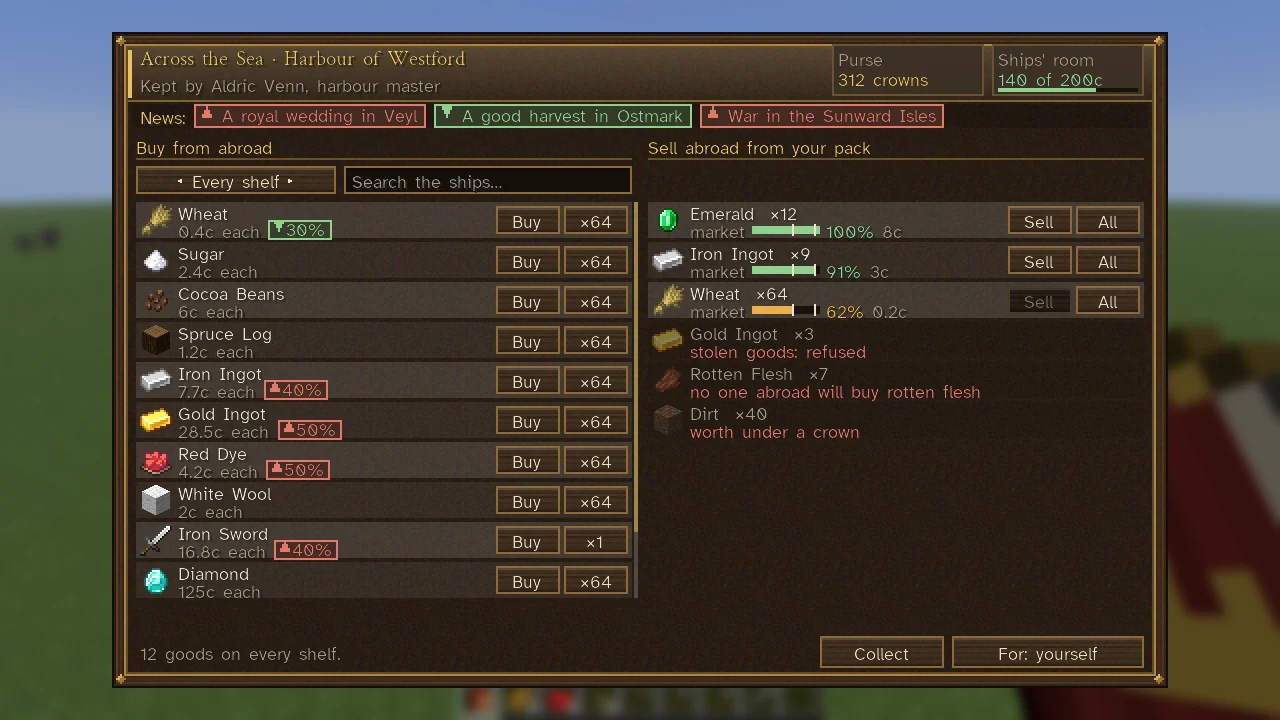
At a harbour of the second rank or higher, Trade across the sea... (on the harbour's sheet, or with its harbour master) opens the counter of the far ships, the one market beyond the world's edge; it needs no chart. Its head shows your Purse and the Ships' room left this week as tiles, the room on a meter. The news from abroad that moves the prices stands in a row of chips: red with an upward arrow where it makes goods dearer, green with a downward arrow where cheaper, each told whole on its hover. Under Buy from abroad each good shows its price and, where the news has moved it, the change on a chip beside the price. Under Sell abroad from your pack a meter shows how much the market abroad still wants of each thing you carry (green while it wants it, amber as it fills, red when it wants little), with what it fetches; what will not sell says why. For one of the town's realm who may see to its economy, For: yourself switches to ordering for the town's treasury, delivered at the far ships' next call.
See also
Ships and Sailing, Harbours, Maps, the Corner Map and the Compass, The Known World, The Sovereign's Companion.