Merchants and Supply Trains
DiscussFrom the Sovereign Realms Encyclopedia
Merchants and supply trains are how goods move from a town that has them to a town that wants them. A merchant is a person of a market town who buys where a thing is spare and cheap and carries it where it is dear. A supply train is a realm's own party of porter, donkey and goods, sent by its steward. A caravan is a town's surplus on a donkey, sent to the best market within reach with coin to buy what the town lacks.
All three are physical. The goods are taken out of real stores, carried by real people along the roads, and can be robbed on the way.
Merchants
The merchants of the world's own realms trade on their own coin and at their own risk, and so prices pull goods across the map: a town that holds twenty iron ingots it does not want and a town that is short of iron are brought together by the gap in what each asks.
Each morning a town's merchant weighs the markets within 4,000 blocks that would deal with it (its own realm's and those of realms it knows and is not hostile to; the eight nearest are considered), and takes the best chance that clears its costs. A run is one of three kinds:
- Fetching: buy where a thing is spare, sell it to the home market.
- Taking to market: carry the home market's spare to a market that is short of it, where it sells dear. A stranger's market keeps back its toll.
- An order: carry the home market's spare to a town that ordered it (see below).
Merchants carry what towns make for one another: bread and wheat (only of a town's food beyond twelve days of its eating, never of a hungry town's), iron ingots, raw iron, coal, leather, string, feathers, flint, white wool, copper ingots and salt, and the surplus of businesses' own making. They do not carry coin or gold. A donkey's load of one good is 64. A run must clear at least six crowns and a sixth of its outlay, after carriage, toll and the risk of the road; a war or an outlaw camp across a road turns a merchant elsewhere. A merchant of a town no one is near takes its load and coin from the town's stores and sets out at once: stores whose land is out are reached by the ledger the world keeps of them (see Catch-up Simulation).
A merchant also sells maps; see Markets and Trade.
Caravans
A world realm's town loads its surplus on a donkey with a trader and a guard and sends it to the best market within 1,500 blocks, with coin to buy what the town is short of. A town with less than seven days of food put by is hungry: it sends a caravan every day, whatever its realm's temper, with up to 2,000 crowns to buy food, and it will go as far as 4,000 blocks to a realm it knows. A day's carriage costs the caravan a porter's wage for the road there and back. A caravan, supply train or carter coming to a town in famine, or home to one, puts its load into the town's stores at once though no one is near, by the same ledger.
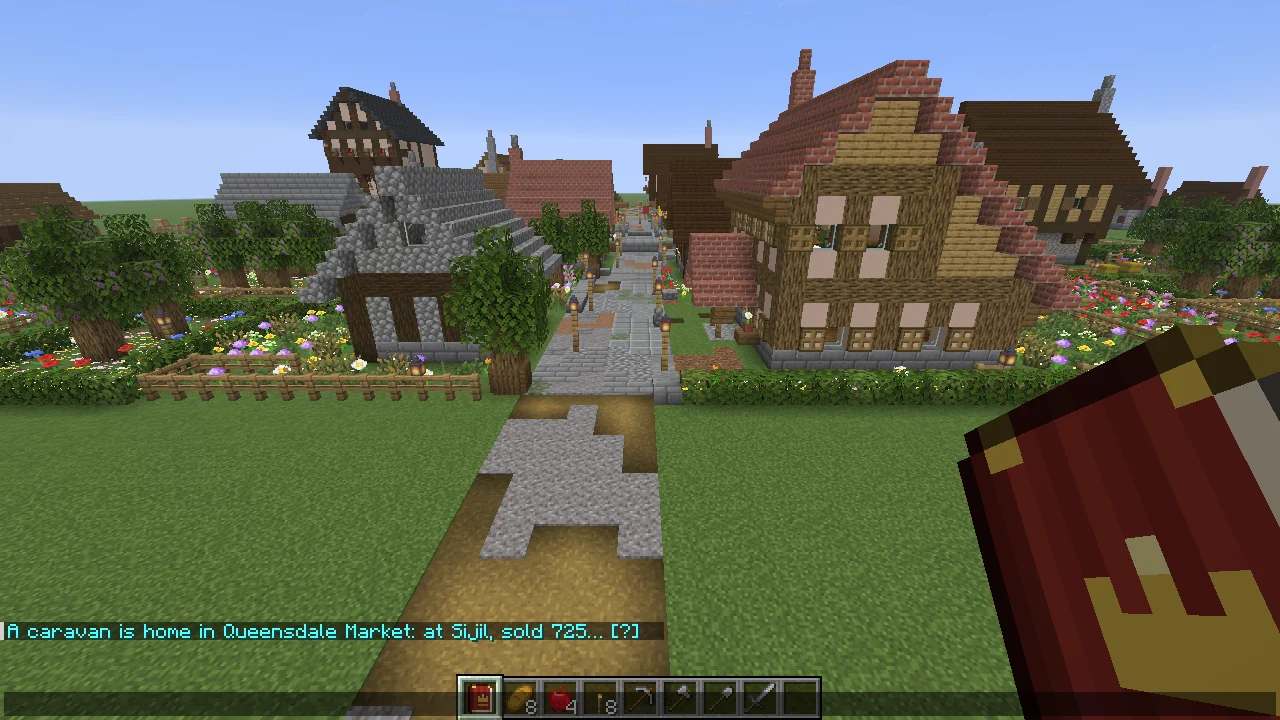
When a caravan of your realm comes home, the realm's chat says so in one row: where it is home and the start of its report, ending in [?]. Rest the pointer on the line for the whole of it: where it sold, how much of its load and for how many crowns (and what tolls kept back), what it bought, and what it found none of to spare.
Caravans from other realms bring their surplus, sell it into your stores and carry your coin home. Their arriving counts as meeting the realm. A caravan on the road is also what outlaws look for; a caravan with a strong escort is let by. While someone of the guild's Iron rank or above is in the world, a caravan bound from a guild chapter's town for a market 300 blocks off or more may wait at home, until evening at most, for the escort the guild posts for it (see Adventurers' Guild).
Now and then a party comes to grief on the road (a lame donkey, a load come loose, a broken strap) and stands by the way for some hours putting it right. Talk to one of them and lend a hand: they go on at once, think the better of you, and may press a coin on you for your trouble.
Supply trains of your own realm
With two or more towns, send goods or coin from one to another: open the Command Table, the Stores tab, and choose Send a supply train… under Between settlements. You need the right to move the realm's stores (the steward's rank, see Citizenship and Ranks).
- Choose where it sets out From and where it goes To. Each list gives every town of the realm with how far it is from the other end and the days of food it holds, the nearest first ("Harrowgate: 2369 blocks, 32.0 days' food"). The same sheet lists foreign market towns you know and are not hostile to, marked "(to sell)".
- Add goods from the source's stores: the granary, the storehouse, the armory and the yard. Choose a stack or all of a kind. Coin goes by value, out of the treasury.
- Send it, on the bar beside the load. A porter, or whoever is free, leads a pack donkey carrying exactly what you chose. A donkey carries up to 15 stacks.
- At the far end the goods are stored where they belong: food to the granary, arms to the armory, coin to the treasury. What finds no room comes home again.
Under The road the sheet gives the two towns and the blocks between them, when a train would arrive ("Arrives about Day 1, 13:00"; an unseen train covers about 2,600 blocks a day, its halts and all, and one walking in sight goes slower), and the food on hand at each end, in days. A train that would take food out of a town whose own people go hungry (a tenth or more of its grown people, or under two days of food) brings a warning in amber, "Aldhaven's own people go hungry", and goes only when Send it is chosen a second time.
A train to a foreign market town sells its load into that town's stores and carries the coin home. The foreign realm keeps its toll from what your people are paid there. The sheet's On the road section follows every train out: where it is, what it carries on the line's hover (what was loaded, not its people's own food for the road or their tools), and under it why it set out, such as "sent by" the one who sent it, "by the standing route", "food for Millbrook, which runs short", "timber for Millbrook's builders" or "coin for Millbrook's wages". The Stores tab's Goods on the road counts a train's load the same way.
Relief for a hungry town
When a town of the realm goes hungry with its stores short, or runs under two days of food, and another of its towns has food to spare, the town's Going hungry or Food running out card on the Attention tab, and its food page, offer "Send food from" the nearest such town. The card's hover gives that town's distance, its days of food and when a train would arrive. Clicking it opens this sheet already filled in: from that town, to the hungry one, loaded with about five days of the hungry town's eating, its most filling food first, with the road, the arrival and each end's food. Choose Send it.
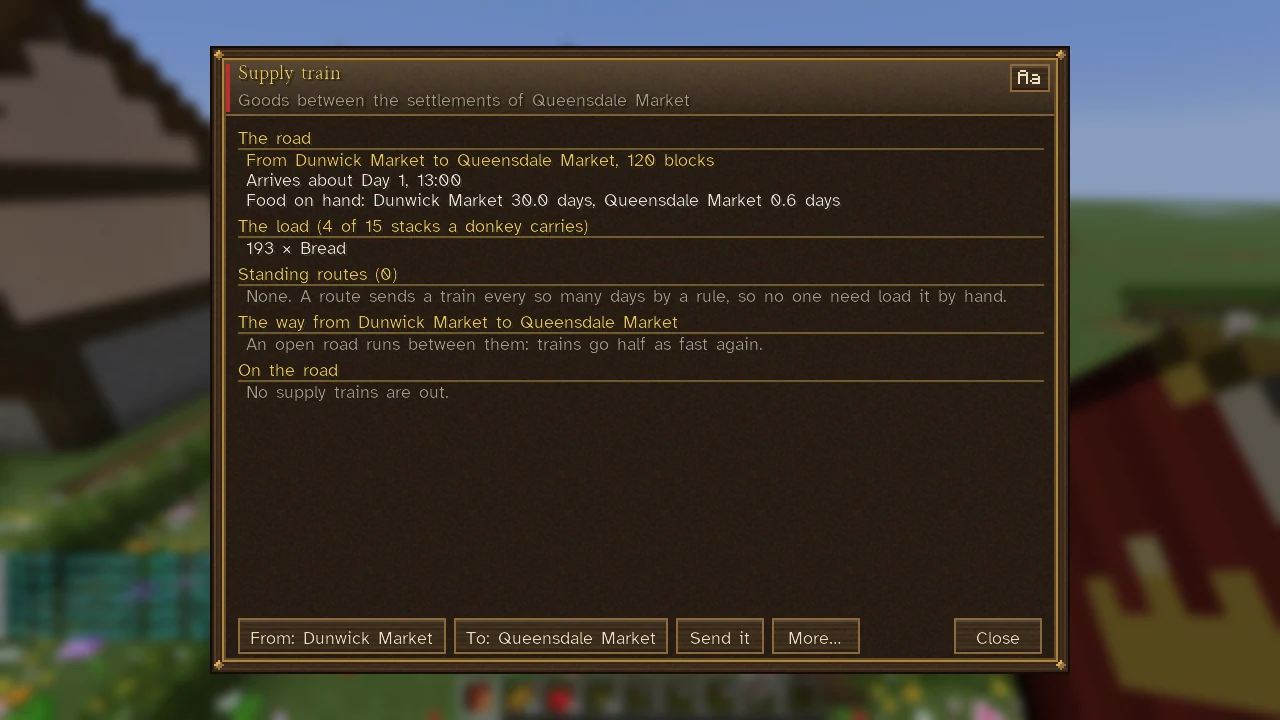
A granary of a realm with food to spare has its own Send a train of food to... for a town of the same realm that calls for food; the carters' hire is paid. The Companion's Where is food wanted? names which towns call. See Food, Granaries and Hunger.
Timber for builders
Where a realm's stores run themselves (the world's realms, and a player's realm that leaves its stores handed over), its towns send one another timber as well as food. A town with no lumber camp of its own, or whose building sites wait on wood its camps do not bring in, and that holds under 48 logs' worth of timber (four planks to a log), is sent a train from the town of the realm, in the same world, with the most to spare over the 128 it keeps for its own builders: up to 96 logs, some planks where that town has plenty, glass panes where the town sent to has no joinery, and stone where it has no quarry or mine. A town is sent such a train only while no other supply train is on its way to it; under On the road it reads "timber for" the town's "builders", and the realm's chronicle tells of it. Like the realm's other trains of relief, it loads at once from a giving town no one is near, by the ledger of its stores (see Catch-up Simulation). See Construction for how a town short of wood also fells for itself.
Standing routes
A route sends a train every so many days by a rule, so no one needs to load it by hand. A steward adds one under New route... once two towns are chosen. The realm may keep 24 routes at once.
| Rule | What it does |
|---|---|
| Keep 10 or 20 days of food in the town | Every three days, if the town holds less, the shortfall is sent. The sending town keeps four days of its own. |
| Send the town's food above 15 days' worth | Every three days, whatever it holds beyond fifteen days' eating. |
| Keep 128 timber or 128 stone | Planks and logs; cobblestone and stone. |
| Keep 4 tools, or 6 arms and pieces of armour | Sent as the town runs short. |
| Keep 50 crowns in the treasury | Coin sent to the town's treasury. |
| Export: sell food above 20 days' worth, timber or stone above 256, tools above 8, arms above 12 | To a foreign market, every three days. |
A food route from a town whose own people go hungry is held while they do, its line saying why ("Held: Aldhaven's own people go hungry.").
Each route can be given an Escort of up to three soldiers from the garrison, up to four Stops on the way (spots where a steward stood, which its trains pass by), be paused and resumed, or given up. Its line shows the last run, including if it was robbed or lost.
Orders by carter
A player may order goods from another town's market (see Order a delivery in Markets and Trade): the goods are paid for at the other market's asking price, taken from its stalls and carried by a real carter of that town. They are held for you at the market you ordered at, or, chosen under Where to…, carried on to the door of a business or house of yours, or your homestead, and put into its chests; what does not fit waits at the market of its town (at a homestead, or where its town has no market, in a crate by it). Goods brought into a business go on its books as bought in. The cost is the goods, the carter's hire (about a crown for every 250 blocks to where they go, two at the least, more for a big load) and a fee for each guard you ask for (three crowns for each, and more on a long road), which is paid to the crown that keeps them. The carter goes unseen along the roads when no one is near, and in the flesh, with a loaded donkey, when someone is. You are told when the goods come. Goods lost on the road are your loss.
A homestead is also called on by a pedlar's cart from the nearest market town, which buys its surplus produce and sells it bread when its stores are short of food; see Homesteads.
Guards and the road's dangers
How safe a road is depends on what the one who asks knows of it:
- outlaw camps known near the way;
- lawless country where no one has found the camps;
- enemy armies seen near the way;
- the land of realms at war with the sender's;
- open sea.
Guards make every danger on land less likely to cost the goods. A party's size and guard grow with the worth of its load and the danger of its road: a few crowns' worth on a safe road goes with no guard at all, a rich train through outlaw country goes with a company. A party has as many donkeys as its packs need (fifteen stacks each, four at most) and at most eight guards.
A road leaves marks. A grave by the road is where someone died on a journey, a wreck is where outlaws robbed a party, and a wreck or the grave of one slain by outlaws means trouble on that stretch; travellers tell of it for twenty days. See Outlaws and Raiders and Roads. If highwaymen stop you, a white banner in hand is a flag of parley.
A town under siege takes nothing in. Caravans, supply trains, carters, deliveries and pedlars bound for it, of any realm but the besieger's, find the enemy before its gates and turn back with what they carry, and no supply train can be sent into it or out of it until the siege ends ("Town is under siege: no train can go in or out."). See Walls and Sieges.
Tolls, borders and embargoes
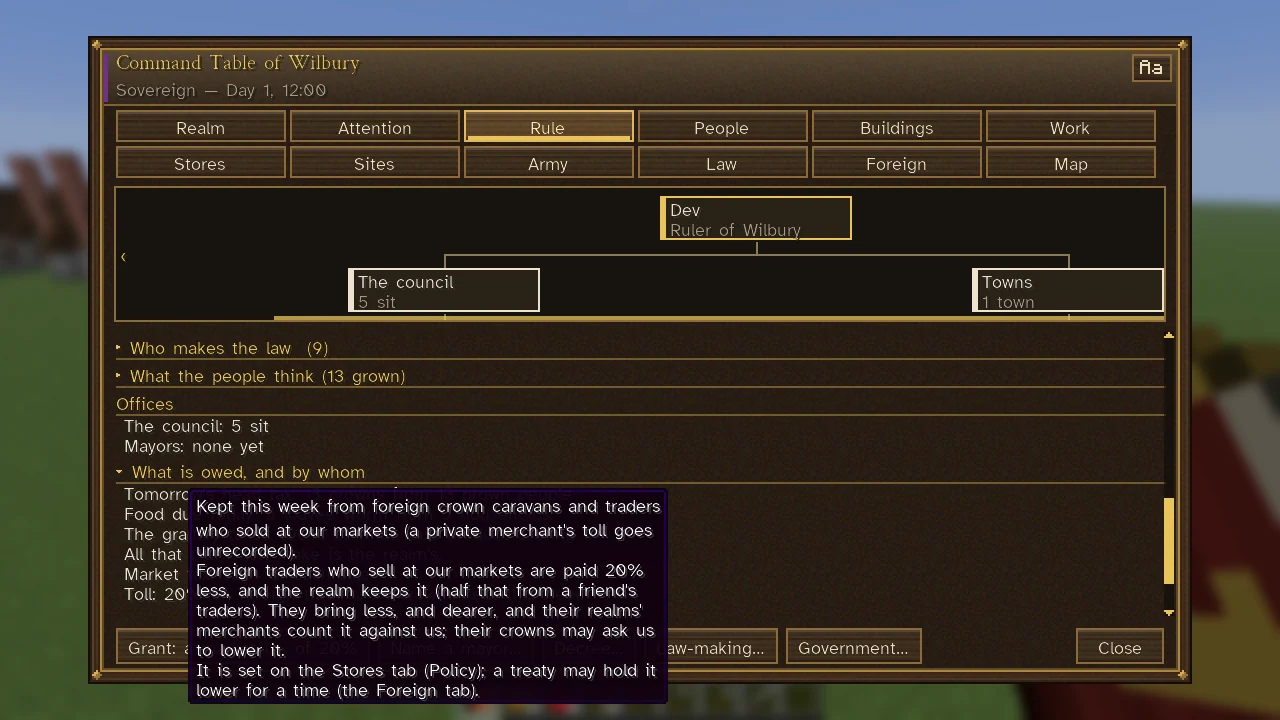
A realm's toll is a share of what its markets pay a foreign trader (a caravan, a merchant, a player), kept for its treasury; its own people pay none. A realm that has a trade pact or an alliance with the trader's realm keeps half of its toll. Where a road enters a realm's land from another's, the realm marks its border with a stone pillar flying its banner, with a plaque that names the realm and the toll it keeps; on a road of cobbles or better, or on a border with a hostile realm, it also keeps a border post. For your own realm, order a border post from the Command Table's Sites tab, under Roads.
The sovereign or a steward sets the toll on the Stores tab, under Policy… (0, 5, 10, 20 or 30 per cent). It can be lowered for a time by treaty, or an envoy may carry terms lowering a realm's toll (see Diplomacy and Envoys). A realm may also lay an embargo on another from the Foreign tab: no trade either way. A market holiday decree gives three days with no market tax or tolls. See Treasury and Taxes.
See also
- Markets and Trade: the market bell, counters and prices.
- Resources and Scarcity: why goods are carried at all.
- Minecart Lines: rails and carts between towns.
- Ships and Sailing and Harbours: what goes across the sea.