Talking with People
DiscussFrom the Sovereign Realms Encyclopedia
Talking is how you learn anything in Sovereign Realms and how you ask the people of the world for what you want. Right-click any person, whatever you are holding, and a conversation opens on its own screen. Nothing you carry is given or used by a stray click; to hand someone an item you choose Give… from their sheet on purpose. (To read a person's sheet without talking, sneak with an empty hand; its bar keeps Talk, Give…, Ask for…, Praise and Rebuke out front and the rest under buttons such as Work… and Heart…. See Townspeople.)
The talk screen
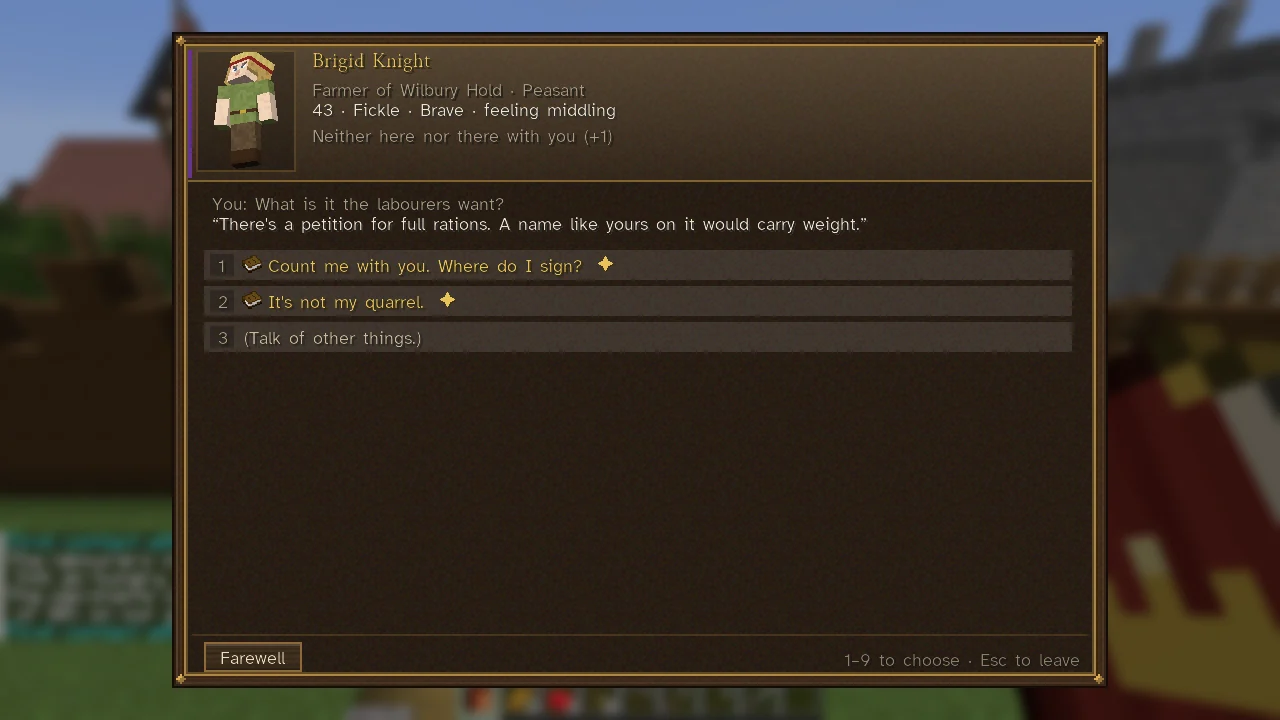
At the head of the screen is the person: their portrait, name, trade and town, their age, some of their traits, hurt or badly wounded where they are hurt enough for a healer to tend, how they feel today, and how they feel about you. Beneath is what they say, typed out (a click, Space or Enter shows it whole), and under it what you may say in reply.
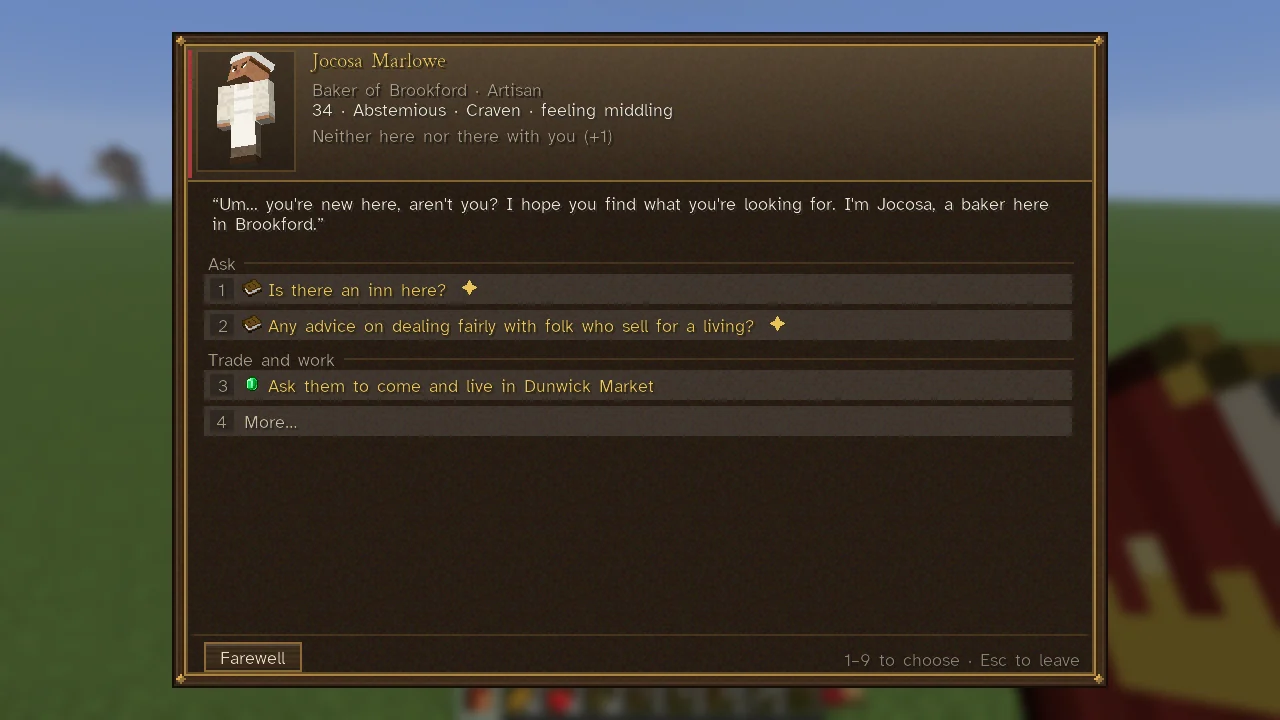
- Choosing. Click a choice, or press 1 to 9. Esc, or the Farewell button at the foot, takes your leave.
- The front. The first page offers at most four things that matter most now (work, the news, the way, trade, the person, the realm, or whatever presses, such as someone calling you over), chosen for who is speaking and what is true between you.
- By what they do. Each choice has its kind's picture after its number, and the kinds stand in order: the law's first (a stop by the watch is never hidden), then Ask, Trade and work, Favours, Heart and Pressure. Where all of it fits without scrolling, each kind has a heading; on a small screen the pictures alone tell them apart. More… and ‹ Back come last, in a quieter hand.
- More… opens the topics, a grid of picture buttons, three to a row where the screen is wide: Them, Work, The town, The realm, Politics, People, Business, Heart, Favours, Faith, Ties and Tongues. A topic appears only where there is something to say under it, and shows at most six choices a page.
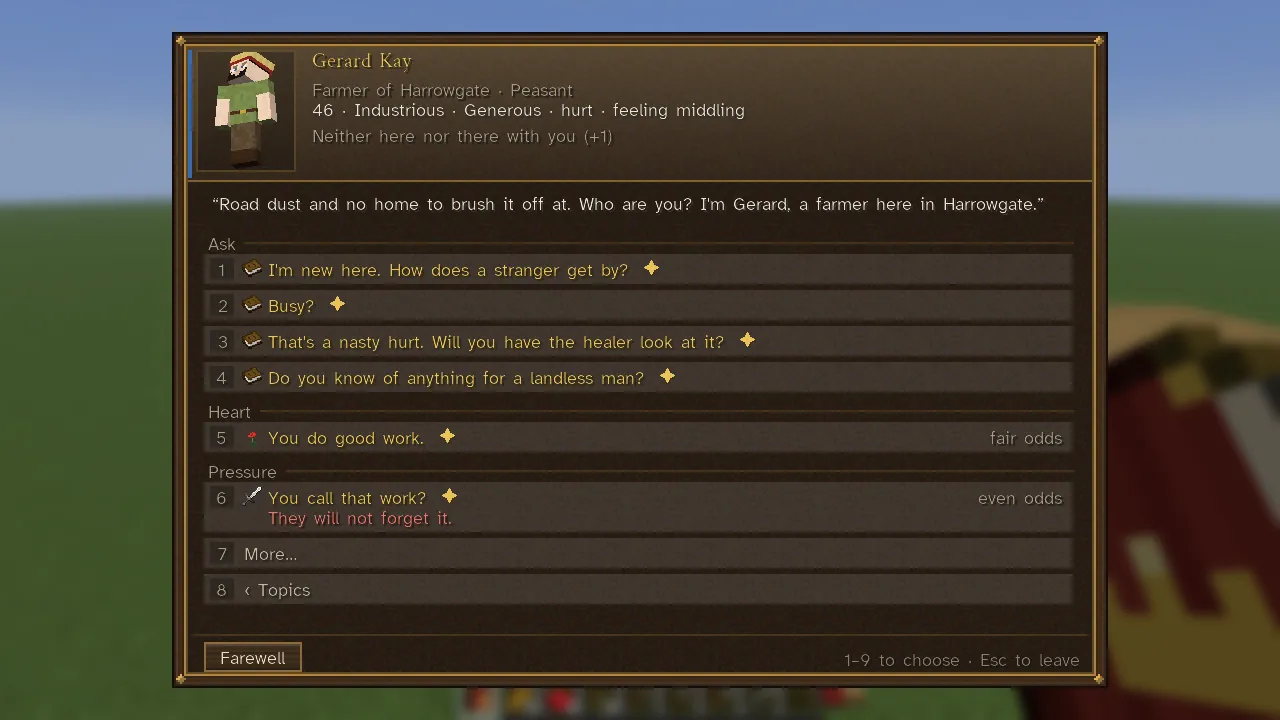
- Marks. A star beside a choice means you have never said it to this person (its hover says so: "Not yet said to them"). A word at the right (likely, fair odds, even odds, unlikely, a long shot) is the world's own estimate that it will go well; a price, where there is one, is shown with it. Hover a choice for what it means.
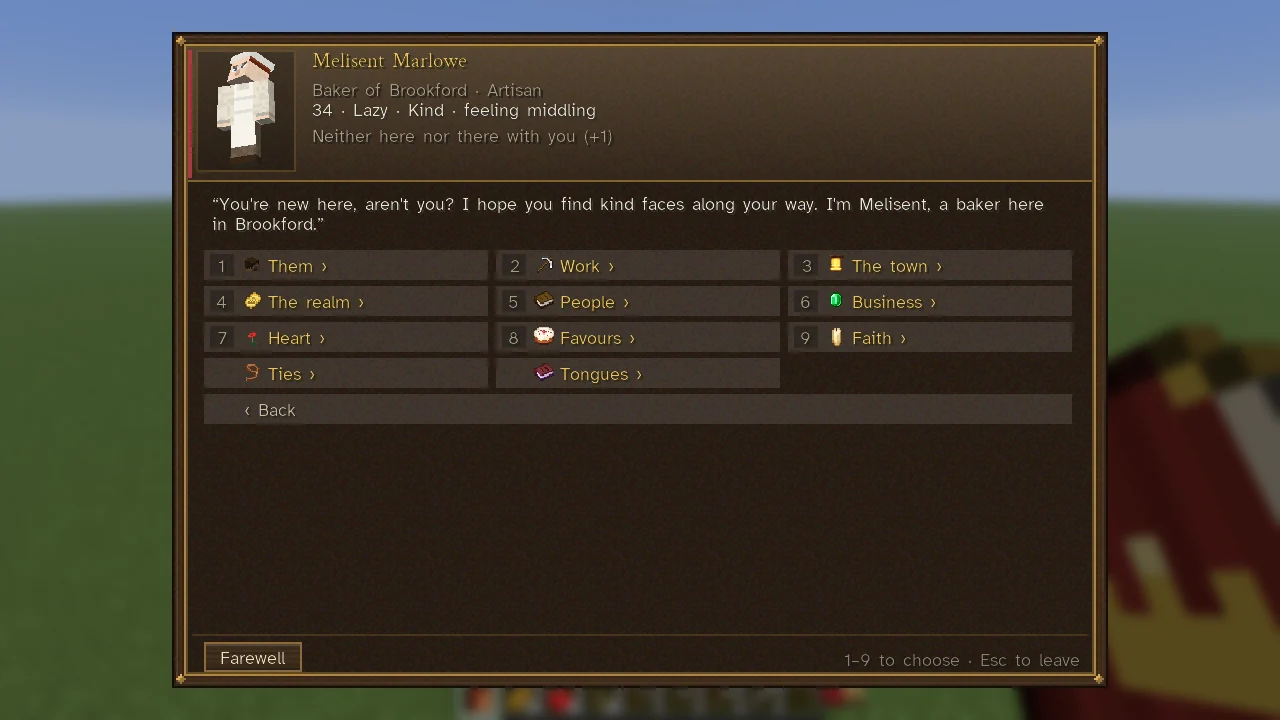
Everyone greets you as what is between you, and as they are: a crass smith, a shy baker, a pompous clerk. They may say no, and those who like and trust you give way more often. What they agree to do, they do, usually within a day, and you are told.
Words with an edge
Some choices are threats, bribes or lies, and say so. They are under the topics, never at the front, and stand under Pressure.
- A threat may work, or be defied, or bring the watch. Coin taken by threats is robbery, which the one robbed reports unless too afraid to, as does anyone who saw it.
- A bribe may be refused and reported.
- A lie works until it is found out.
See Crime and Punishment for what becomes of a charge.
Borrowing
A friend may lend you a few crowns in talk. It is owed back whole: a week late, they think the worse of you; a fortnight, and they tell others. No one lends to a person who already owes three, or who is a week behind with a neighbour. For larger loans see Credit and Moneylending.
Asking the way
Ask anyone of a town where the market is, or an inn, somewhere to eat, a healer, the smithy, the jail, the temple or the harbour, by the choices under The town or in your own words. They tell you how far and which way, and what the place stands by; someone who likes you may walk you part of the way. Where the town has no such building, they name the nearest town that has. A healer is an infirmary or an apothecary, never a temple or a shrine.
When a place comes up in the middle of what someone says, they name it with its street ("Try the Golden Loaf, the inn on Mill Street."), and say the way to it in a sentence of its own after ("Some 50 blocks north of here, by the market."). Where the town has no such place, a line that would name it is not said. People speak of a place within 150 blocks of you as near, of one up to 600 blocks off as a fair walk, and of one farther as far.
Whether someone is hurt is read as a healer would see it: a scratch that is mending is no hurt. Only someone hurt enough to want tending shows hurt, or badly wounded, at the head of the talk, and only then do choices about the hurt appear ("You're hurt. Has anyone seen to that?"). Some of them, which send the person to the healer, come up only where one is within 150 blocks of you.
Ask about other towns and they tell you which way, how far, whether a road runs there and in what state, and the worst danger on the way their realm knows of. The towns they name are added to your map (see Maps, the Corner Map and the Compass). Merchants, officers, envoys and soldiers have been about the most and know the most.
Asking about someone
Under People, Ask about someone lists a person's family, friends, rivals and whom you both know. For any of them you can ask what they make of that person, what they like, whether they are spoken for, and what they think of you. You can ask them to put in a word for you, carry a message, or make peace.
Finding people
No marker shows where other players are. A player's name appears only close by, in plain sight, and not while they sneak, hide or wear a mask. Find people as anyone would: look, ask about them, follow the road.
The town talks
You overhear people speaking to one another, and the news in it is true and your own. People greet you in passing, and those with something to say to you call out as you come near; a word in passing keeps up to two lines of chat. Far away, people write: letters come by runner, and you read them on the Companion's Letters tab or with /realm letters. How much of the town's talk reaches your chat is set on the Companion's You tab; callers, letters and your own conversations always reach you.
What you have heard, and from whom, and everyone you have talked with, is kept on the Companion's Known tab (see The Sovereign's Companion).
The town's paper
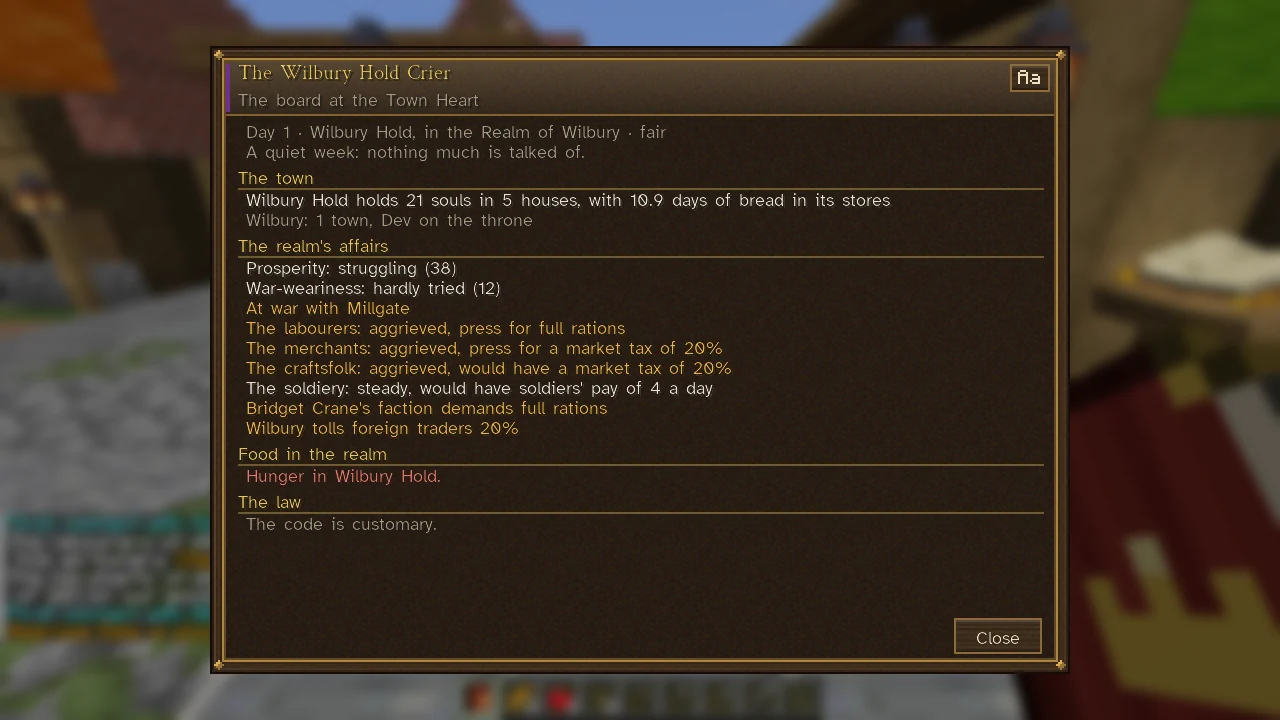
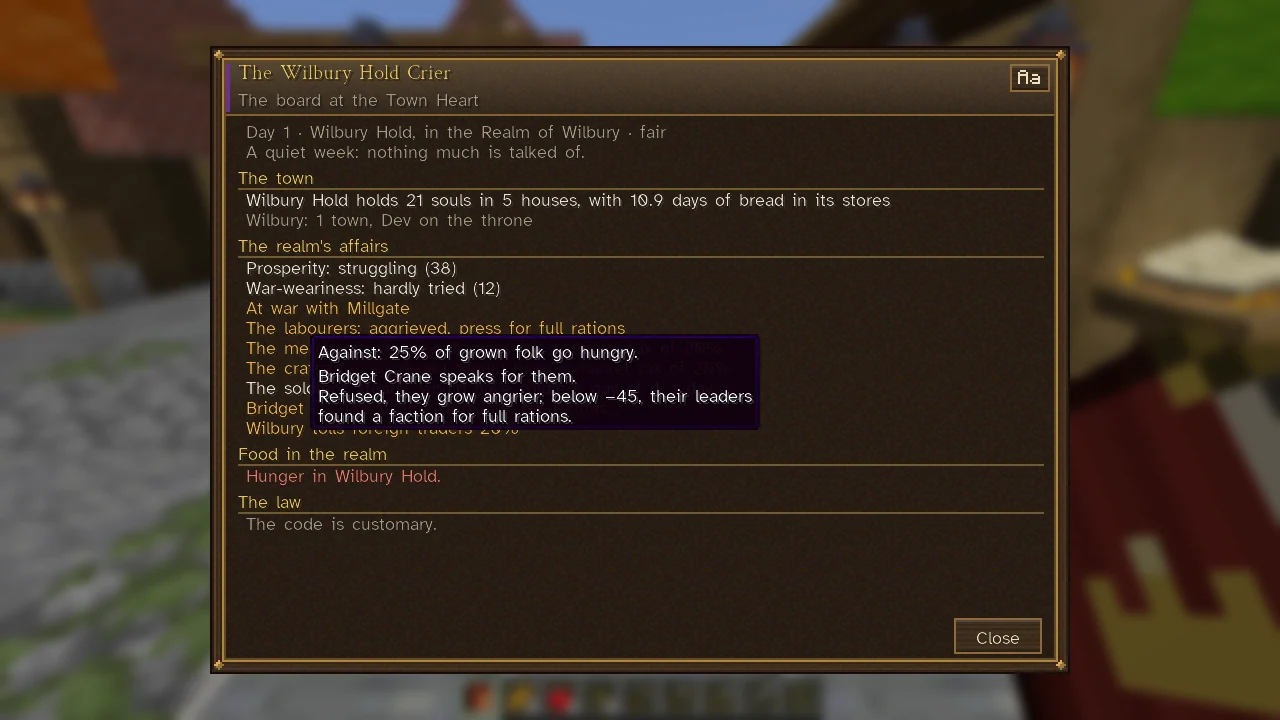
Every town posts a paper on the board at its Town Heart, named for the town in its people's fashion: The Wilbury Hold Crier in a Heartlander town, a Herald among the Marchers, Tidings among the Northfolk, a Gazette among the Sunlanders, a Leaf among the Verdant. Type /news near a town to read it; a printed copy costs a crown at an inn or a market. It prints only what the town's own folk know, in parts:
- The headline: what matters most and is most talked of.
- The town: its people, houses and days of bread, and its realm's towns and ruler.
- The realm's affairs: the realm's prosperity; its war-weariness, where it is tried or at war; each war and for how long ("At war with Millgate, 12 days"); its interests that are heard, the angriest first, with what they press for; any faction that has sent its demand or risen ("Lora Moore's faction demands full rations"); and its toll on foreign traders.
- Then: the realm, word from abroad, this morning's market, food in the realm (granaries calling for food, towns short of it), across the sea, the law and the wanted, births, weddings and deaths, work wanted, deeds, and the talk of the town.
Hover a line for why it stands so: an interest's line tells its worst grievance, who speaks for it and what refusing it would mean. An interest too small to be heard is left out, and a faction still gathering is kept secret. The paper is written in the realm's tongue: a reader who has none of it makes out only the names and figures, though a town with a market prints the trade tongue beneath (see Tongues). See Factions and Demands and Government and Law-making.
What people remember
Everyone remembers you: what you said, what you gave, what you did before them. Favours are owed both ways, promises are kept or broken, and a lie may be found out. Word of your deeds goes about (generous, a hero, cruel, a thief) and reaches towns before you do. See Renown and Following.
Other things to ask for
- Work. Ask a farmer, forester, quarrier or miner at their workplace for work: you are set tasks and paid in crowns from the town's treasury. See Work and Professions.
- Rooms. Ask an innkeeper for a room, or a household head "Have you a room to let?" See Lodging.
- Settlers. With a town of your own, ask people of other towns at peace with yours to come and live in it. The idle, the homeless and the unhappy come most readily, and those who think well of you; the loyal and those with households to uproot least. Those who are half won think it over: ask again another day. There must be a free bed for each who comes.
- Support. Under Politics ask where someone stands on a law, or whether they would stand with a faction (see Factions and Demands).
- Tunes. A bard or a town's minstrel offers Learn a tune › under Business, its hover saying what they play: each tune you do not know yet, at 5 crowns (see Music).
- Confession and blessing. A town's priest hears confession and blesses (see Faith and Temples).
- Faith. To a grown person of another faith, a faith's founder, its head and its devout followers may Speak of it, to win them to it: once a day each, with the odds shown before you try. An inquisitor who has summoned you puts the question in talk, with your three answers under Answer the inquisitor. See Religion.
- Courtship. Under Heart, and through the Heart… button on a sheet (see Courtship and Marriage).
- Language. If you share no tongue with them, see Tongues.
Talking to your steward
Your steward is a person too, but you speak to them by name in chat, with /steward <words> or on their page. See Your Steward.
Asking the book
Type ? and your question in chat, or /ask followed by it, and the Companion answers from its book in a row or two of chat, the whole answer on the hover of its aqua [?]; where the book has nothing on a question, it says "I have nothing written on that." and offers to search the book for your words. Asked who speaks English here, it names the town's best speaker and the way to them (see Tongues). Search the book… on the Companion's bar finds where the book explains something. See The Sovereign's Companion.