Fast Travel
DiscussFrom the Sovereign Realms Encyclopedia
Fast travel is the set of quick ways across the world for a person on a long journey. There are three that move you from place to place: the old stones that stand beside natural wonders, the waygates that great cities raise, and the coaches that run between towns, by the roads, across country or, between two ports, by ship. A fourth, the way home, takes you once a day to a bed or a seat of your own. Two more help you go far on your own feet: an autopilot ride along the roads on a horse, with post stations to change tired horses, and the dark road in the Nether.
The rule they share is that people go fast and things do not. A quick way carries you and what you carry on you. It never carries a mount, a cart, a soldier or a beast on a lead, and where cargo is allowed it is charged freight. Goods and armies still go by Roads and Ships and Sailing; see Merchants and Supply Trains and Armies and Soldiers.
| Way | Starts at | What it costs | Where it goes |
|---|---|---|---|
| Old stone | A ring of standing stones by a wonder | 0 to 10 crowns of dues at each end | Other stones you have attuned to |
| Waygate | A great waygate in a city | A toll by distance and freight on your pack | Gates whose ledgers you have signed |
| Coach | A town's coach office, inn or stable; elsewhere, your map (a coach sent for) | A fare by distance, freight, and if you want them an escort and a guide | Towns on your map and the nearest few others, by road, across country or by sea |
| The way home | Your map | Nothing; once a day | A room, house or seat of your own |
| Ride | Your map, on a saddled horse | Nothing | Along the roads to a town you know of |
| Dark road | A realm's portal works | Nothing | By foot between portal works in the Nether |
What any quick way asks of you
The old stones, waygates, coaches and the way home are called the lawful quick ways. For any of them you must not be:
- Already moving, dead, a spectator, or downed ("You lie senseless").
- In the law's keeping: held, imprisoned, in custody, escorted, serving or condemned.
- Stopped by the watch, or in parley, or running from the law.
- Wanted at two or more stars by the realm whose law runs where you stand, or by an ally whose warrants it keeps (out in the wild, by any realm): "no lawful way will carry you, so you must run for it." A coach office asks only of the warrants its own realm keeps, and no coach carries you into a realm that keeps yours.
- In a soldier's place, or sworn to escort a party along the road.
- Riding a mount or a cart ("Get down first").
- In a fight: a blow given or taken with a living thing within the last 10 seconds.
The checks are made again as the screen goes dark, so a fight that begins during the fade stops the move; a coach makes them when you book, and for a coach you sent for, all the while you wait for it. In the dark the far land is loaded and you are set down on safe footing; if that cannot be done you stay where you were and anything you paid is given back. See Wanted and Bounties, Arrest and Jail and Down, Not Dead.
Gates take you only to towns you have visited: stood within a town's reach of its heart, which is 160 blocks as a rule and more for a big city. A town you were set down in by a quick way does not count until you have left its reach and come back. Coaches go to the towns on your map, and to the nearest few others with a guide (see below).
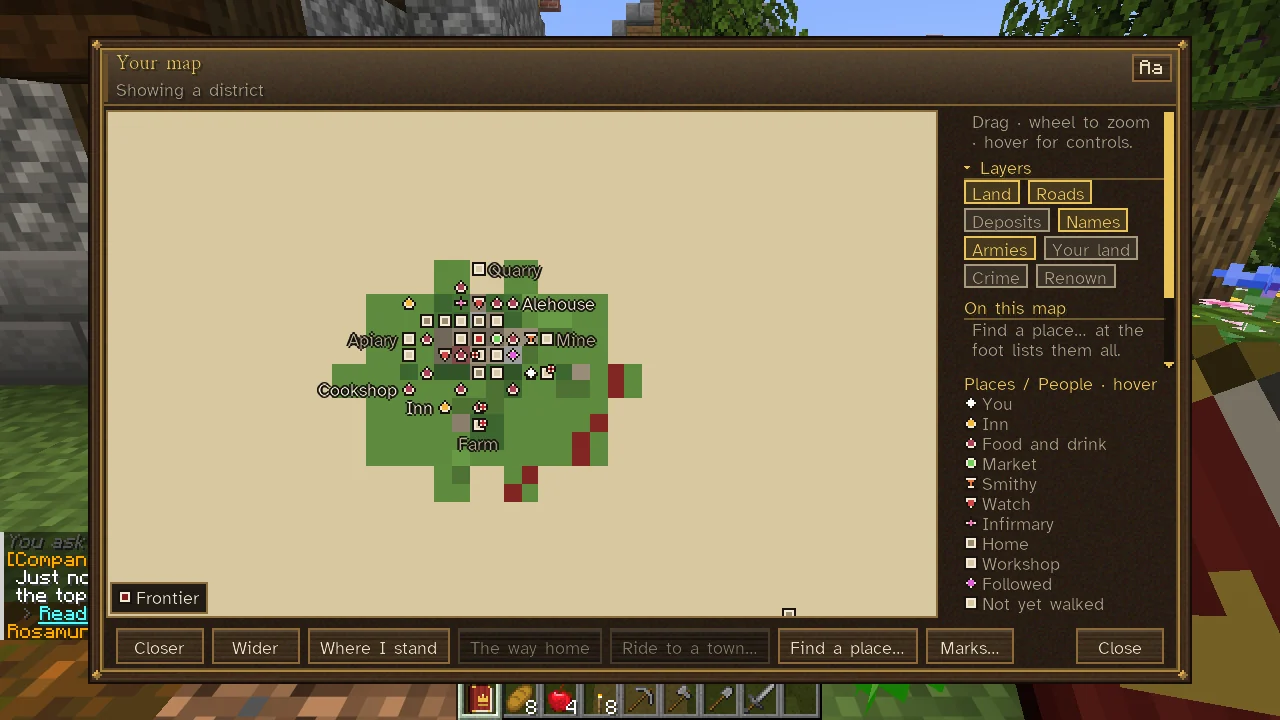
Old stones
About one natural wonder in three has a ring of old standing stones around a lodestone on a chiselled-brick plinth; which ones is fixed by each wonder's name, so they are the same in every world. They stand at least 128 blocks from any town. See Natural Wonders for the wonders.
- Walk to the stone and right-click the lodestone on foot. The first time, you are told you are attuned to it and that it will carry you to any other stone you are attuned to. A rider is told to get down and lay a hand on it.
- You must attune to each stone on foot. A map or a rumour will not do.
- To travel, stand within 6 blocks of a stone and open its sheet, "The old stone at ...". Under "Where it leads" press the entry for another stone: it names the distance and the dues, "free" or "N crowns in dues". A refused entry is greyed with the reason.
- You arrive within about ten paces of the far stone, in sight of anyone near, with a shimmer and a note at both ends. Attuned stones are pinned on your map as "Old stone".
Dues. The stone's holder is the realm of the nearest town within 400 blocks of it, and taking the town takes the stone. You pay the dues of both stones, the one you leave and the one you arrive at, each to its own holder's treasury, from 0 to 10 crowns apiece. They are nothing if you belong to the holder's realm, if no realm holds the stone, or if the town has no treasury. A player's realm asks nothing and is open to all until its ruler sets terms; a realm of the world asks by temper (merchants 3 crowns, martial 2, expansionist 1, pious none). A ruler or steward with the economy powers sets the dues and may close a stone to the realm's enemies; a realm of the world is closed to its enemies by default. A stone closed to its holder's enemies turns away a traveller whose realm is at war with that holder, at either end.
Guardians. About half the stones are guarded by three of the restless dead (husks in the desert, strays in the snow, bogged in swamps, otherwise skeletons with a zombie), woken when you come within 64 blocks. You can attune with them about, but the stone will not carry you away while they stand within 16 blocks of it. Kill them and they return a day later, once a player is near again.
Only you move, with your whole pack and no freight charge. The stone's lodestone cannot be broken.
Waygates
A waygate is a great work of a city: a court 23 blocks square and 20 high, with a gate of obsidian banded with crying obsidian on a dais and a Waygate Anchor set in the threshold. A town may have one. It is raised as a great work by the realm over at least 20 days of works, which cost a great deal; see Construction and Architect's Plans.
The anchor needs three rare makings that cannot be bought abroad:

 Crying-Obsidian Heart


- Waystone Fragment, given by a guildmaster with the pay of an Adventurers' Guild bounty of Silver rank or better (one chance in eight at Silver, in four at Gold, in two at Obsidian).
- Ice-Wraith's Shard, dropped one time in eight by a stray killed by a player in snow country, and twice by a slain Frost Wyrm (Great Beasts and Trophies).
- Crying-Obsidian Heart, crafted:



A gate works only while it stands in order and is kept: two wardens, a clerk of the ledger (a priest, envoy, treasurer or merchant) and coal in its own chests, a piece for each working day. A shut gate cannot be used from or to.
Using it.
- Walk into the gate's town on foot, so that it counts as visited.
- Stand within 8 blocks of the anchor, open the building's sheet and press Sign the ledger, under "The ledger". You sign once per gate, in person.
- At any gate that is linked to one you have signed, press Step through... under "Through the gate" and pick a destination, nearest first. The sheet tells you the toll, the freight and the total; choose it again to pay and go.
- You arrive within 12 blocks of the far anchor, in sight of anyone near.
Costs. The toll is one crown for each 100 blocks between the two gates, rounded up, never less than one. Freight is charged on your pack: 2 crowns for each stack of ordinary goods and 5 for each stack of ores, raw metal, ingots, gems and their blocks, counting what is inside a bundle or box. Coin, worn armour, the weapon or tool in your hand, 8 pieces of food, your Companion and 16 torches are free; the other weapons and tools you carry pay together, as one stack. Toll and freight are paid together to the treasury of the city you leave.
Links. Two gates link if one realm holds both, or two realms with a gate pact that are not at war. A gate pact is offered by an envoy from the diplomacy sheet; each realm's gates open to the other's, and a war breaks it. A realm of the world leans toward one by temper: merchants favour it, the pious and martial less. Realms of the world buy the three makings from adventurers for 12,000 crowns the set. No beast on a lead and no soldier following you passes a gate; see Diplomacy and Envoys.
Coaches
A town with a passable road leaving it, or a treasury to take a fare into, keeps a coach office. Its link, Book passage by coach, is on the Town Heart's sheet, at an inn's or stable's counter, and in the map's side panel when you stand in such a town. You book in person: in the town, or within 96 blocks of its heart. Anywhere else in the world above, the map offers Send for a coach instead (see below).
Passage takes no time. You pay, the screen goes dark while the far land is made ready, usually for a few seconds, and you are set down near the far Town Heart. Nothing of the way is watched and no game time passes: the fare buys speed. The dangers of the way are rolled once, as you book, and if one of them falls on the coach you are set down where it happened instead (see Dangers below).
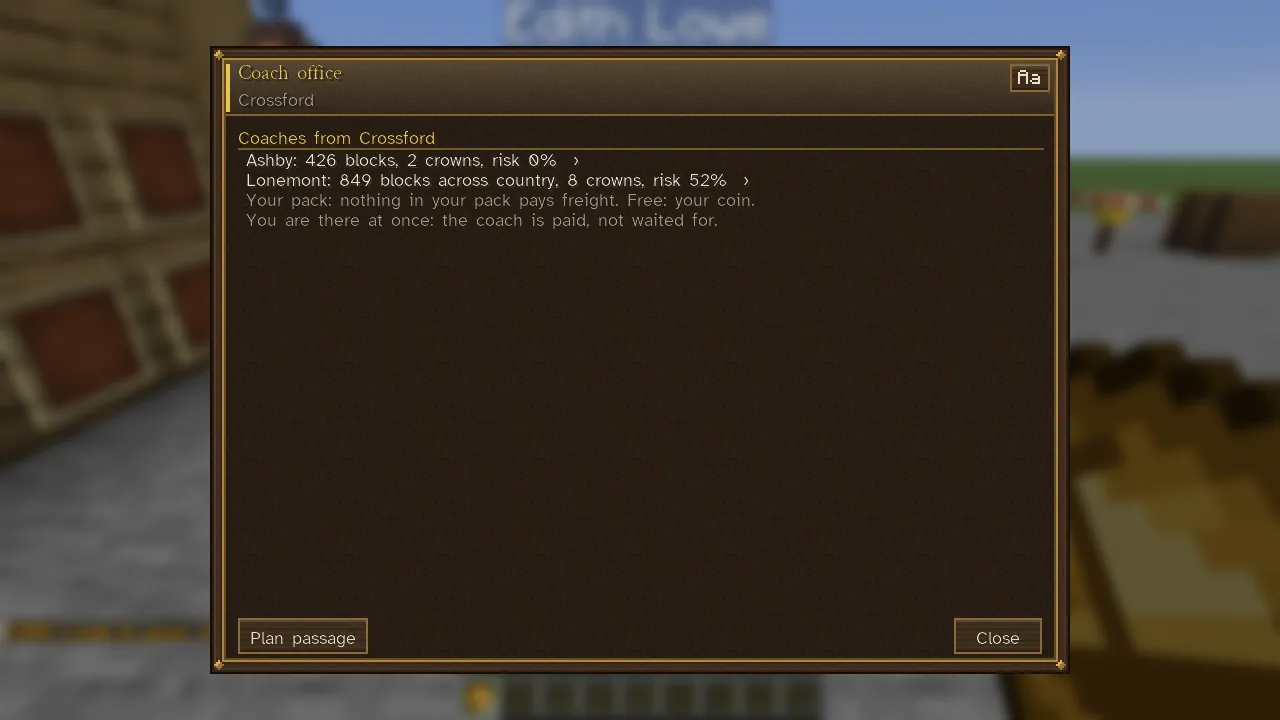
The office. Its sheet lists the towns its coaches go to: the 40 nearest towns on your map (those you have visited or know of: charted in your book, or of your own realm), and before them, however far, the town you came from and the last few towns the list of wars pointed you to; then the 12 nearest towns that are not on your map, each with a guide. The first eight have a line each, giving the town, the distance (and whether across country or by sea), the price with your pack's freight and the risk as a percentage, such as "Ashby: 426 blocks, 2 crowns, risk 0%"; the rest are chosen under Plan passage. A town that no coach runs to says why on its line's hover. Below the towns the sheet says what in your pack pays freight and what goes free.
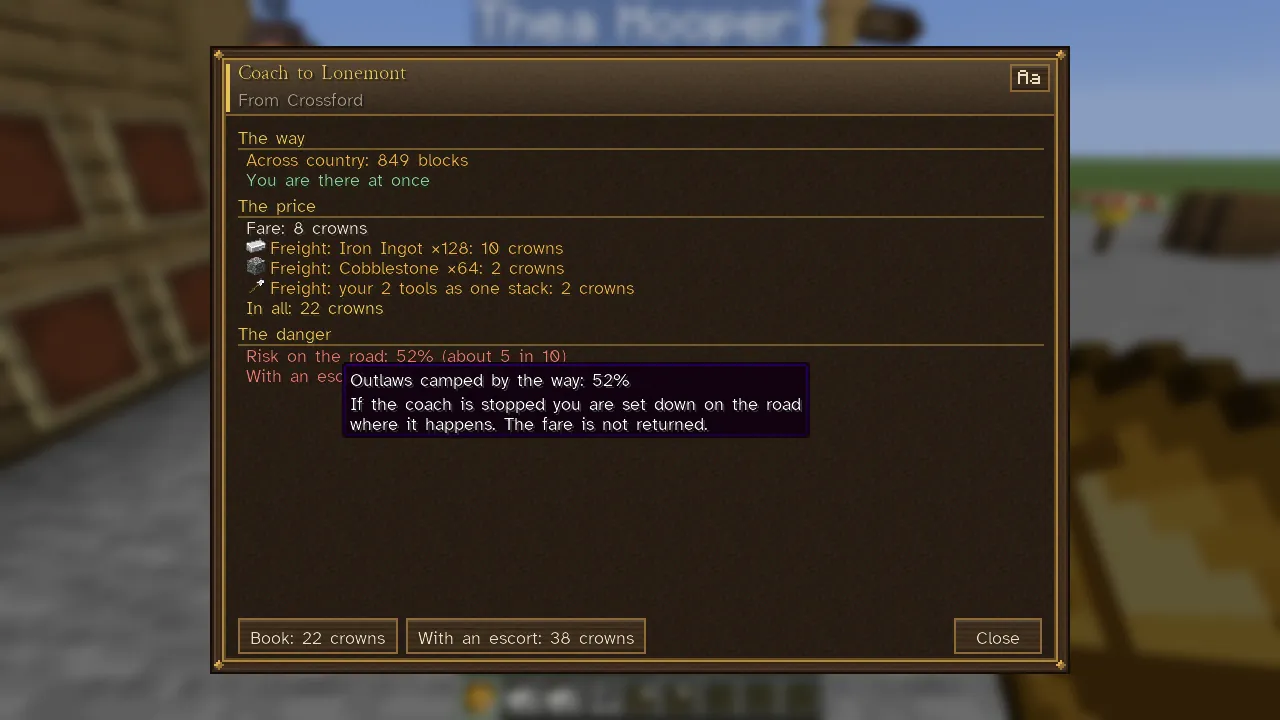
The planner. Choosing a town opens its planner, "Coach to town" ("Ship to town" over the sea), before anything is paid:
| Part | What it shows |
|---|---|
| The way | By road (the towns it passes through on the hover), across country or by sea, with its length in blocks; for a coach sent for, how long it will be in coming; and "You are there at once". |
| The price | The fare; for a coach sent for, the fare of its coming; a guide's fee to a town not on your map; the freight, one line for each kind of thing in your pack with its count and its crowns (your spare tools together as one stack); and the whole in all. |
| The danger | "Risk on the road" (or "Risk at sea") as a percentage with its odds, such as "52% (about 5 in 10)", and the same with an escort and who would ride as escort, or "No escort to be had". The hover on the risk lists each danger by the way with its own chance. |
Its buttons are *Book: n* crowns and With an escort: n crowns**. The escort's button is greyed where no escort is to be had, or where an escort would lower no risk (nothing lies in wait by the way, or a sea whose only danger is its storms).
Prices. All of the price is paid into the treasury of the town the coach leaves from, and the planner shows each part of it:
| Part | Price |
|---|---|
| Fare by road | A crown for every 200 blocks of the way, at least 2. |
| Fare across country | A crown for every 100 blocks, at least 4. |
| Fare by sea | A crown for every 100 blocks, at least 5. |
| A guide, to a town not on your map | As much again as the fare, at least 5 crowns. The town is on your map after. |
| An escort | The town's own company of soldiers in garrison, two or more, at 4 crowns for each 200 blocks; where it has none, the realm's riders (a company in garrison in another of its towns) at 6 crowns for each 200 blocks. An escort halves the chance of an attack. |
| Freight | Your pack, at the waygate's rates above. Leave goods behind to pay less. |
Where coaches go. A coach goes by the roads its realm's people travel, never through a town of a realm at war with or hostile to the departure town's realm; where such a town stands on the only road, no coach goes. Where no road joins the two towns it goes across country, straight from heart to heart, and is as open to the way's dangers as one on foot. Where open sea lies on that straight way, a ship sails between the two towns if both are ports by the sea; otherwise no coach goes there. No coach runs between two realms at war, nor carries you from a town whose realm is at war with yours, nor into a realm that keeps a warrant of two stars or more on you ("no coach will carry you there").
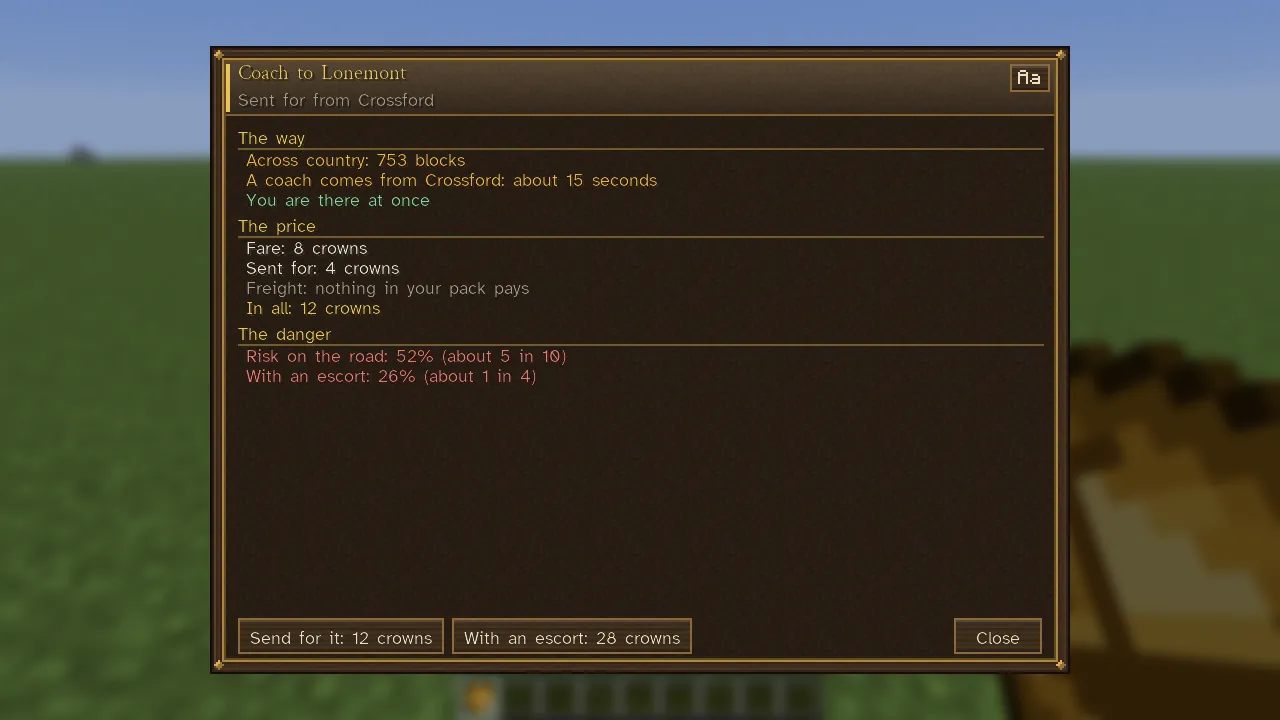
Sending for a coach. Away from a town whose coaches run, the map's side panel offers Send for a coach, where a town that keeps an office lies on your side of the sea: the coach comes from the nearest of them, looking among the 24 towns nearest you. Its sheet lists the towns as an office does, reckoned from where you stand, and says first how far the coach comes and what that costs: "A coach comes from Crossford: 4 crowns more, about 15 seconds". A coach sent for goes across country from your place, at the across-country fare and dangers, and never over the sea. The fare of its coming is the across-country fare from its town to you, and it comes after 10 to 90 seconds, the longer the farther it has to come. Choose a town, then Send for it in its planner, and wait where you stand: nothing is paid until the coach comes, when it is priced again, paid and you go. Walking off more than a few blocks, or a fight, sends it back with nothing paid, as does Send it away on its sheet.
To a war. The list of wars under way (see War and Peace and Mercenaries) names each side's town nearest the fighting, where swords sign on, and those towns go on your map. Under each war it offers a coach only where the office of the town you stand in would book it, with its price and risk ("Coach to town: n crowns, risk n%"), and choosing that line opens its planner. Where none goes there, it offers the coach from here that brings you a good way nearer ("Coach toward ..., as far as ..."), or says why none goes: you are in no town, no coach leaves this one, or the office's own reason on the hover. The last few towns it offered you a coach to stand first in every coach office's list, however far they lie.
Dangers. The way is looked over as you book, in stretches of 120 blocks, and each danger is met where the coach first comes within its reach:
- An outlaw band whose camp lies within 56 blocks of the way (96 when the band is hungry), with at least two of its people at home, may stop the coach: 20 percent and 8 more for each of its people at home, at most 85. A band you have bought passage of lets you by.
- A great beast within 64 blocks of the way, not newly risen at its lair, may fall on it: an even chance.
A coach on the road is open to half of each chance, one across country to all of it, and an escort halves it again. The planner's risk is reckoned from the same list the booking rolls, so the number it shows is the chance you take; a band your realm knows of is named on its hover, any other is "Outlaws camped by the way". If outlaws stop the coach you are set down on the road where it happened, and up to four of the band's men stand across the road a little ahead and hail you as you come up: pay, fight or run. If a beast falls on it, the coach is overturned, its horses bolt and you are left on the road. Either way the fare is not returned. See Outlaws and Raiders and Great Beasts and Trophies.
By sea. A ship's passage is open to pirates (a band camped on the coast within 160 blocks of the open sea it crosses), to the Sea Serpent, and to storms: 2 percent and a point more for every 25 blocks of open sea, at most 15, which no escort turns. Taken by pirates or wrecked by the serpent, you are put ashore at the nearest land along the way; a storm drives the ship back to port, and you are set down where you took ship. The fare is not returned.
Being set down. In the dark you are out of the world at the place where you booked, and nothing can hurt you; anyone within 32 blocks is told that you took a seat on the coach. A town still catching up on its missed days is given up to ten seconds from your booking to do so before you are set down by its heart. If the far land cannot be reached, you are put back where you booked and what you paid is given back. If you leave the game in the dark, or the server stops, you are set down when you come back.
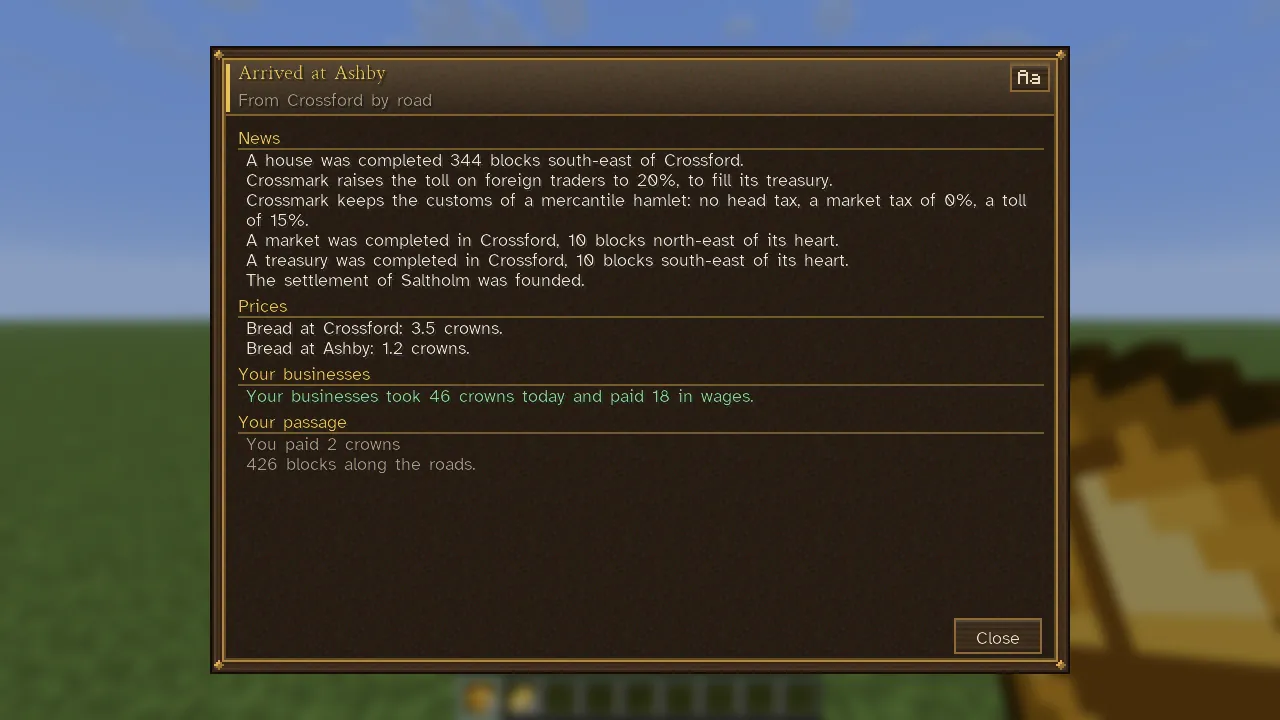
Arriving. Once the screen is light again the passage page opens, "Arrived at town": the news (up to six lines from the chronicles of the realms at either end and your own, over the last day), any war begun or ended since you took your seat, the price of bread at either end, what the businesses you own took and paid in wages (today's, or since the day you set out, each business on the hover), and what you paid, part by part on the hover. /passage shows it again until you log out or take another coach; while you wait in the dark it shows where you are bound and what you paid.
The way home
Once a game day, open your map and press The way home. It lists your homes in order: your inn room, a lodging or rented house, houses you own, your family's house and your realm's seat. Choose one and stand still for five seconds while the screen gathers. It costs nothing, carries your pack free, and does not carry mounts or companions. It is put off, and the day not spent, if you move more than a block, are hurt, strike a blow, open another screen or become refused. See Lodging and Land, Estates and Landlords.
Riding on your own
Mount a saddled horse that you steer, open your map and press Ride to a town.... It lists up to 40 towns, nearest first, that your book has charted or that belong to your realm, and you must be within 48 blocks of a passable road. The horse follows the roads on autopilot at its own speed, through town hearts and never through a town at war with or hostile to your realm, visible to everyone, and costing nothing. Press any movement key to take the reins. They are returned to you also when you or the horse are hurt, a hostile creature comes within 8 blocks, you leave the road by more than 24 blocks, you make no headway for 8 seconds, or you arrive.
Tired horses. A horse you ride tires after 1,500 blocks, and its speed falls by 30 percent; it recovers after two minutes unridden. A post station is a working stable with a paddock, or a tavern with hay and stalls: there you change your tired horse for a fresh one of the station's, for 3 crowns plus whatever the fresh horse is worth above yours. Your own horse is kept for you for 7 days and you can take it back for a price: the difference in worth if you ride in on a horse of your own, or its full worth on foot. Use /post change and /post reclaim, or the Change horses action on the building's sheet. See Buildings and Roads.
The dark road
Realms that are not pious raise portal works in the Nether: a walled court with an obsidian portal, joined to others by a paved, lit road of polished blackstone. It is no quick way, with no fare or instant move. You enter a lit works' portal, then walk or ride the road, where a Nether block is an eighth of an overworld one. The road is beset by bands of piglin brutes and watched by ghasts. In the Nether, the map lists the nearest ends of the road.
If you are seen coming up out of a portal, witnesses remember it, pious realms think ill of you and of your realm, and a realm that bans the dark road charges you with "Walking the dark road". A realm of the world of the pious temper bans it; so does any realm, a player's too, whose proclaimed state faith holds the Nether forbidden, while a state faith that does not hold it lifts the ban. See Faith and Temples, Religion and Crime and Punishment.
Related
Maps, the Corner Map and the Compass, Sea Charts and Navigation for the water, Minecart Lines for rails, Treasury and Taxes for where the dues go, and Natural Wonders.