Adventurers' Guild
DiscussFrom the Sovereign Realms Encyclopedia
The Adventurers' Guild is one guild with a chapter in many towns. Each morning a chapter's board shows the work its town needs done, each notice posted by someone with a reason: a herder losing lambs, a merchant whose road is unsafe, a town robbed by outlaws, a crown at war. Members take the work, are paid in real coin by whoever posted it once it is proven done, and rise through five ranks by merit, from Copper to Obsidian. The world's own people form parties of the guild too.
Chapters and the board
A town keeps a chapter if it is its realm's seat, or if forty or more people live in it. Membership counts at every chapter.
The board stands a few blocks from the Town Heart, facing it: a wall of planks under a little roof, a lantern either side, and up to six notices pinned in frames, with the guild's book on a lectern beside it. Each notice names the work, who posts it, the pay, why, and how far and which way it lies. Once the town has raised an Adventurers' Hall (see List of Building Types), the board stands before its door, and its guildmaster keeps the book at the counter and goes out now and then to see to the notices.
/guild opens the guild's sheet at the chapter you stand at (in its town, or within 96 blocks of its heart); a Hall of the Guilds offers Read the adventurers' guild's board too. Away from any chapter it shows your standing and work, and where the nearest chapter is. Besides your rank, your work and the board, the sheet lists the wars under way nearest you and, in a realm at war, Swords for hire (see Mercenaries).
Joining and taking work
- At a chapter, choose Join the guild here: 5 crowns into the town's treasury, and Copper work to begin.
- Take a notice on the sheet, or strike its paper on the board and it goes into your pack. You may have two in hand at once, of your rank or below; a third is refused, naming the two ("You already have two tasks: ... and .... Finish or give one up first."). Work counts only until it is done: proven, failed, given up, struck out or paid, it frees its place at once, though its pay waits to be claimed and its paper is still in your pack. Its place is pinned on your map under its whole title (see Maps, the Corner Map and the Compass), and you have the work's days from the day you take it. The pin leaves your map when the work is done, failed, given up, struck out or paid.
- Do the work. When it is proven done, the chat says so and where to claim the pay, and its paper in your pack reads "Done: ..." with "Claim your N crowns at the guild's board in ...". The paper of work failed, given up, struck out or paid is taken from your pack; one that changed while you were away is set right when you are back.
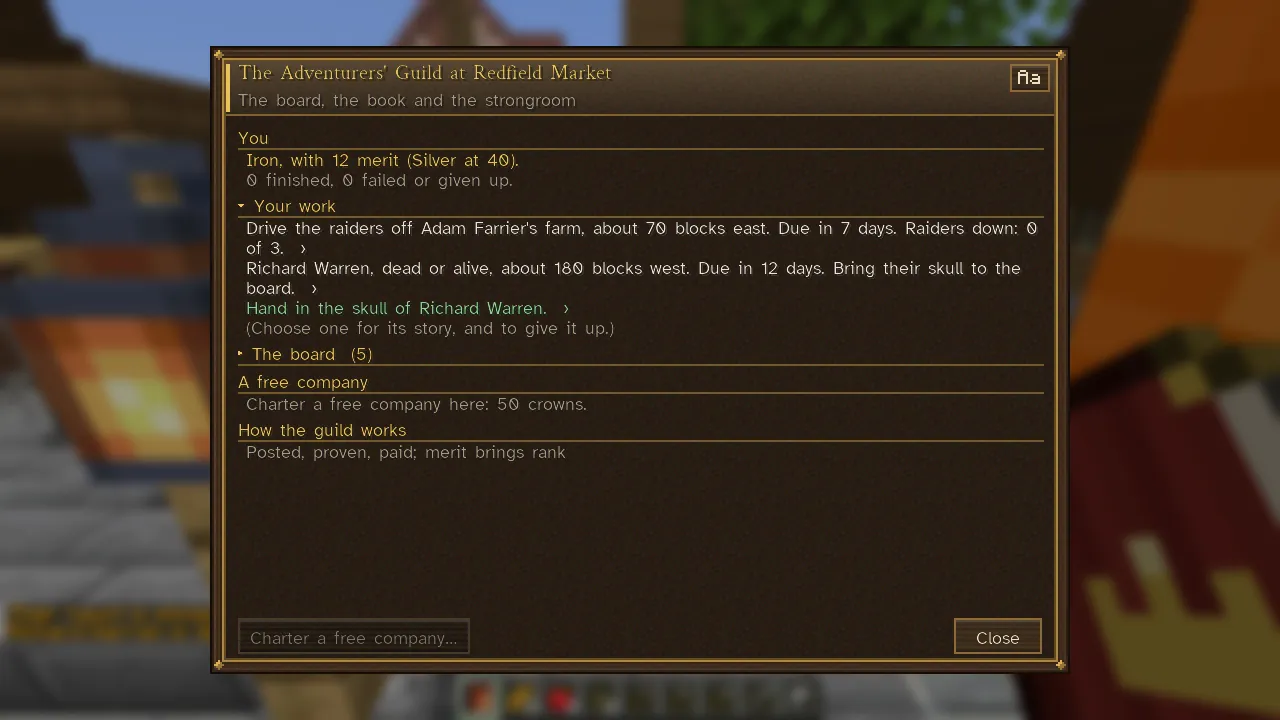
- Claim the pay at the chapter that posted it: on the sheet, by giving the done notice back to the board, or by using the board with no notice in your hand.
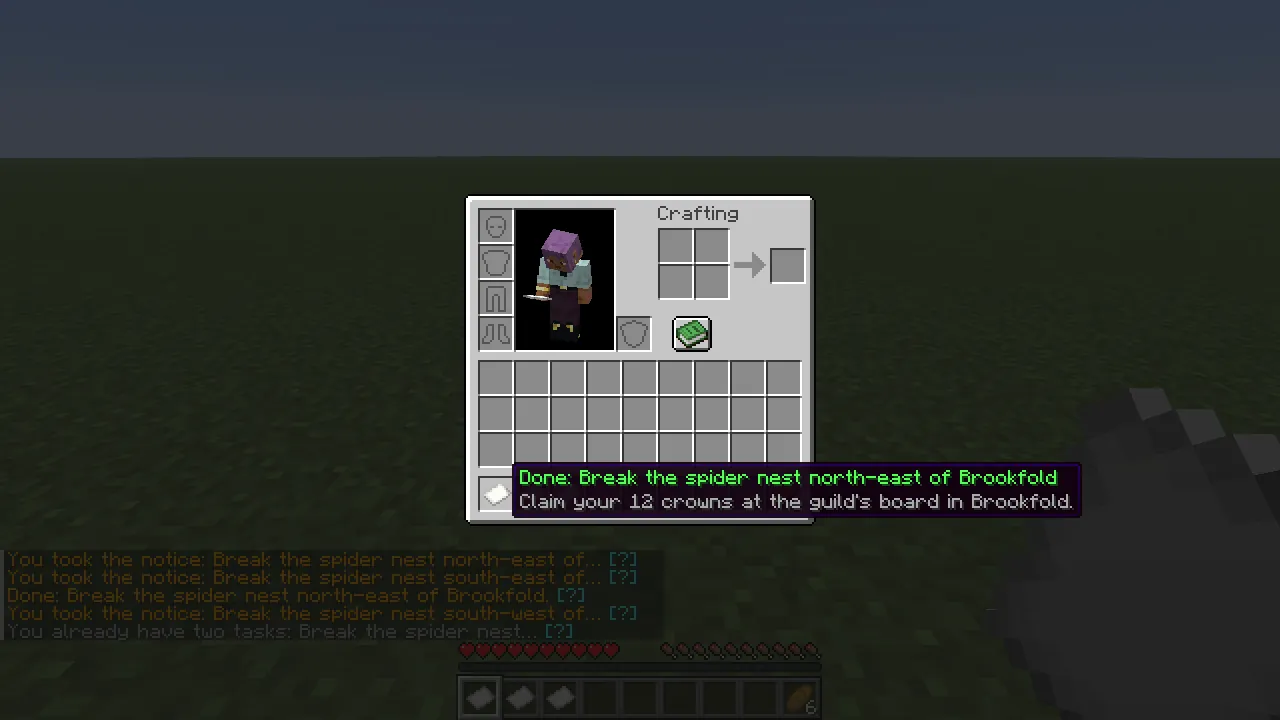
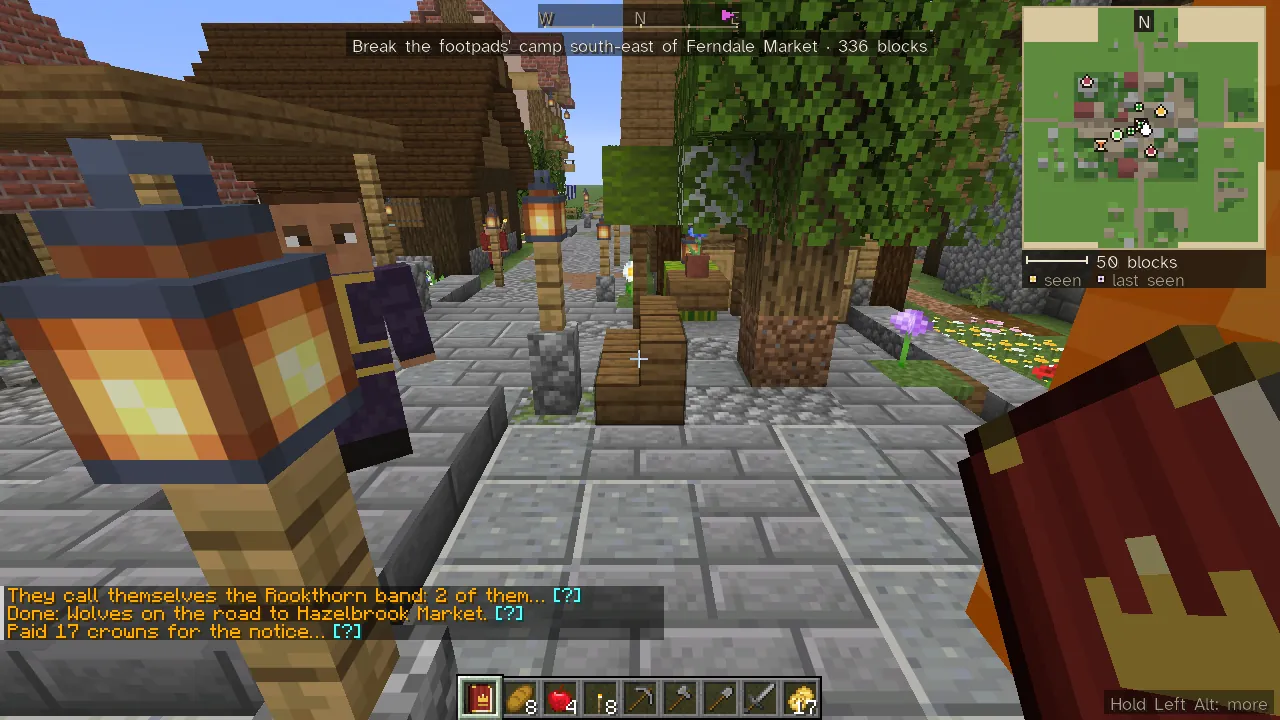
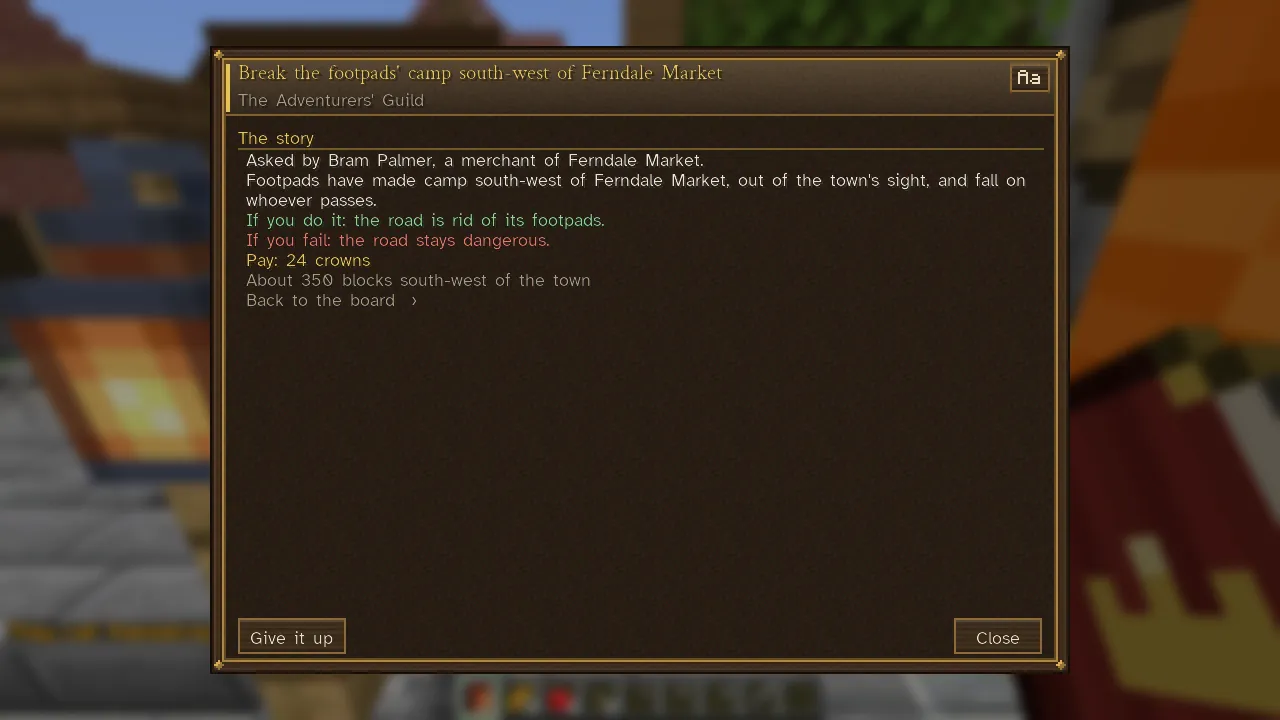
Choosing a notice opens its story: who asks and why, what doing it changes and what failing leaves, and for a chain, the steps done and to come. Give it up there, or give its paper back to the board, and you lose a merit and the giver thinks the less of you. Work whose day passes in your hands fails: two merit lost, and the giver remembers. Work done first by someone else is struck out, with no loss.
Ranks, merit and pay
Merit raises a member from Copper to Iron at 12, Silver at 40, Gold at 100 and Obsidian at 220, and each rank opens its own work (see the table below). Each kind of work brings its merit when its pay is claimed. A band talked in under the realm's pardon, none of it cut down by you, brings 2 more, and laying an outlaws' paymaster's letter before the realm it wronged credits 4. Rising a rank is told in the chat and your realm's chronicle.
A person who posts work pays from their own purse; a town pays from its treasury and never stands behind more than half of it, counting what it has promised already. Where the town stands behind a person's notice, it makes good what their purse lacks; otherwise you are paid what they have and told how much short it came. The giver thinks better of you, and the deed is talked of in the town (see Renown and Following). Bands and footpads broken, great monsters slain, fugitives brought in and a crown's errands go into the posting realm's chronicle, and it thinks better of your realm. With the pay for Silver work, one time in eight, the guildmaster gives a Waystone Fragment; in four for Gold, in two for Obsidian (see Fast Travel).
What a board posts
The board reads by rank, and within a rank its fights first, then the rest, each in the order posted. Each morning a chapter posts what its town needs, as far as those who would post can pay: higher work first, then up to three Iron notices (an old barrow's dead, a crown at war's swords, an outlaw band, raiders at the town's farthest farm, an enemy town to scout, the witness to a stolen heirloom, an outlaw dead or alive, then more bands or a fugitive, as far as room allows), then Copper in this order:
- The town's own troubles: a spider nest near it, and some mornings wolves at a shepherds' fold.
- Fights, until the board holds two: a footpads' camp or beasts on a road, whichever it has fewer of.
- A pedlar's pack lost on the road.
- One letter or word in a feud, if the board has none.
- More fights for any room left of three Copper notices.
Some work is posted as it happens: a nest taking a town's beasts, a pack lost, a granary robbed, an envoy set out, a great beast making for a town, a caravan of the town setting out for a market (Iron; below), the places of higher work as they are found.
Kinds of work
| Rank | Work | What is done | Pay (crowns) | Merit |
|---|---|---|---|---|
| Copper | Wolves at a fold | Kill the 3 to 5 that come as you near the fold | 10 to 17 | 3 |
| Copper | A spider nest | Break its heart | 12 to 27 | 3 |
| Copper | A footpads' camp | Break its band of 2 or 3 | 12, and 4 a head | 4 |
| Copper | Beasts on the road | Kill the beasts that come as you near the place | 8, and 3 to 7 a beast | 3 |
| Copper | A pedlar's pack | Bring it into its merchant's own hand | 10 to 19 | 2 |
| Copper | A letter | Give it into its addressee's own hand | 6, and 1 a 150 blocks | 2 |
| Copper | A word in a feud | Carry the word, then the answer back | Up to 20 a step | 2 a step |
| Iron | An outlaw band | Break it: strike at it, or be there at its end; or bring down its captain | 30, and 10 a head | 4 |
| Iron | Raiders at a farm | Be at the town's farthest farm when they come, and break them or put them to flight | 30, and 10 a raider | 6, and 2 more if the farm loses no one and nothing |
| Iron | A caravan to see safe | Ride with the town's caravan through the ambush on its road to market | 30, and 1 for each 40 blocks of the way; at most 90 | 6 |
| Iron | An outlaw, dead or alive | Bring them to the realm's cells, or their skull to the board | The realm's reward for them, 30 to 90 | 6 |
| Iron | The barrow's dead | Slay their king | 45 to 84 | 5 |
| Iron | A fugitive | Bring them to the realm's cells | 30, and 12 a star; at most 90 | 5 |
| Iron | Swords for a war | Hand in three enemy soldiers' skulls at the seat's Heart | 49, besides the skulls' price | 6 |
| Iron | An envoy | Ride beside one until it comes through, or stop a rival's | 40 to 90 | 5 |
| Iron | Stolen goods | Give the food back to the robbed town's people | 20, and 1 a loaf; at most 90 | 4 |
| Iron | A war's errands | Scout an enemy town, then run the crown's food to the front | 30 to 80; 20 to 60 | 4 each |
| Iron | An heirloom | Find who saw it taken, then bring it into its owner's hand | 8 to 13; 40 to 90 | 2; 5 |
| Silver | A broodmother; a necromancer | Slay her in the old mine; put him down in his crypt | 110 to 169; 140 to 219 | 7; 8 |
| Silver | A drowned chart; a smugglers' cache | Bring the chart to its scholar; the cache's book to the law | 100 to 169; 120 to 209 | 6 |
| Silver | A great beast at a town | Wound it until it turns for its lair | 150, and a quarter of its health; at most 500 | 8 |
| Gold | A saint's bones | Bring them up from a sunken chapel | 360 to 599 | 10 |
| Gold | A great monster | Wound it, and it is slain | 400, and half its health | 12 |
| Gold | A captive sovereign | Open their cell; they follow you home | 350 to 1,200 | 14 |
| Gold | A crown to bring home | Bring it back to its realm's court | 300, and 150 by standing | 10 |
| Obsidian | The ghasts; the Nether's goods; the dark temple | Slay the Ghast Matriarch; bring the goods asked; slay the high priest | 900 to 2,399; 900 to 1,299; 1,500 to 2,999 | 16; 14; 20 |
A notice stays on the board for its days (4 to 30 by kind), and you have as many from taking it. A spider nest lies 140 to 420 blocks out from its town, clear of every town, road and homestead; one found standing within a town is cleared by its townsfolk, and its notice is struck out as if another had broken it. For the places see Great Beasts and Trophies and Wilderness Discoveries; for bands, Outlaws and Raiders.
Fights on the road
A footpads' camp lies 150 to 400 blocks out, a little off a road out of the town where it has one, out of every town's sight and off held land; a board shows one at a time. Take it, and two or three footpads take to the camp, the chat naming their band and which way. It is proven when the band is broken and you struck at it or were within 128 blocks at its end. If the camp was pitched elsewhere, the notice and your pin move with it. Once its notice is no longer out (failed, or its days on the board gone by), any of its men still standing break up out of everyone's sight.
Beasts on the road trouble a stretch 150 to 400 blocks along one of the town's roads, else on the way to the nearest town or a track out of it; no road, way or track has more than one such notice at a time. They are the country's: white bears in snowy or frozen land, great spiders in jungle, swamp, mangrove and dark forest (wolves there in a world set to Peaceful), wolves elsewhere. They come out of the land beyond the place when you are within 48 blocks, with your scent, and are counted as they die ("Wolves killed: 1 of 3.").
Iron's fights
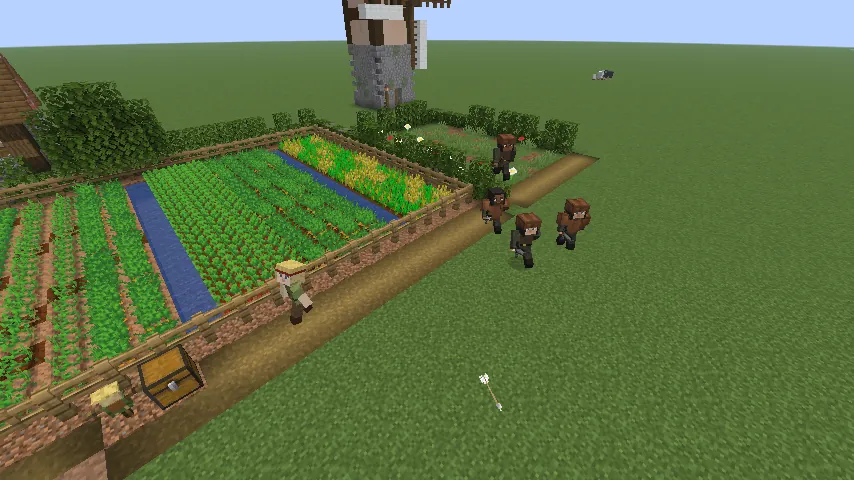
Iron's own fights are raised only when the one who took the notice is there to fight them. A band raised for the guild's work never carries anyone off for ransom: one it strikes down is robbed and let go (see Outlaws and Raiders).
- Raiders at a farm. One of these at a time on a board: raiders out of the wild seen watching the town's farthest farm, posted by its farmer from their purse, else by the town. The notice names the farm and its farmer, with where they are found as a letter's does. Nothing comes of it until you are within 80 blocks of the farm: then three or four raiders, a band of their own, come out of the country on its far side, fight the farm's people and whoever strikes them, and go through its chests. When half of them are down the rest break and run; when all are down they are broken. Either way the notice is done if you struck at them or were within 128 blocks at the end, and its story tells what the farm lost ("It lost 1 of its people. They carried off 3 loads."). Kept whole, with none of its people lost and nothing carried off, it brings 2 merit more. If they make off with its stores, the notice fails.
- A caravan to see safe. While someone of Iron or above is in the world, a town's caravan setting out for a market 300 blocks off or more has its escort posted at the town's chapter (one at a time), paid from the town's treasury. The caravan waits at home for its escort until evening, half a day at most; once taken, it sets out when you come within 24 blocks of it (or without you, if you are long in coming), and your pin goes with it. You have the days of its road and a day over. Out on the road, with you beside it, the outlaws who wait for it fall on it from ahead, three to five of them (its guards and two more). Beaten off, and the caravan come to market with you, the escort is done; if its people all go down and its load is robbed, the escort fails.
- An outlaw, dead or alive. A realm's declared outlaw of the world's people, at large and keeping within 2,000 blocks of the town (a band's captain first, then the most wanted), is posted by the realm's magistrate with where they keep: the band's camp, else where they were last seen. The pay is the realm's reward for them, 30 to 90 crowns from the town's treasury. Bring them down and carry them to the realm's cells as a fugitive, or kill them yourself: then their skull, "Skull of" the outlaw, "wanted by" the realm, lies where they fell, and you hand it in at the board that posted the notice (Hand in the skull of … on its sheet, or use the board), which settles the realm's charges against them and pays you there. The realm's own reward for them is not paid you a second time, and their skull is no soldier's skull to sell in a war. Dead by another's hand, held by the watch, or no longer wanted, they are struck off the board.
- A band's captain. A notice to break a band of three or more names its captain ("Their captain is … : bring them down, and the rest will scatter."). Bring the captain down yourself, and the rest scatter and the band is broken: the notice is done.
Letters that say where
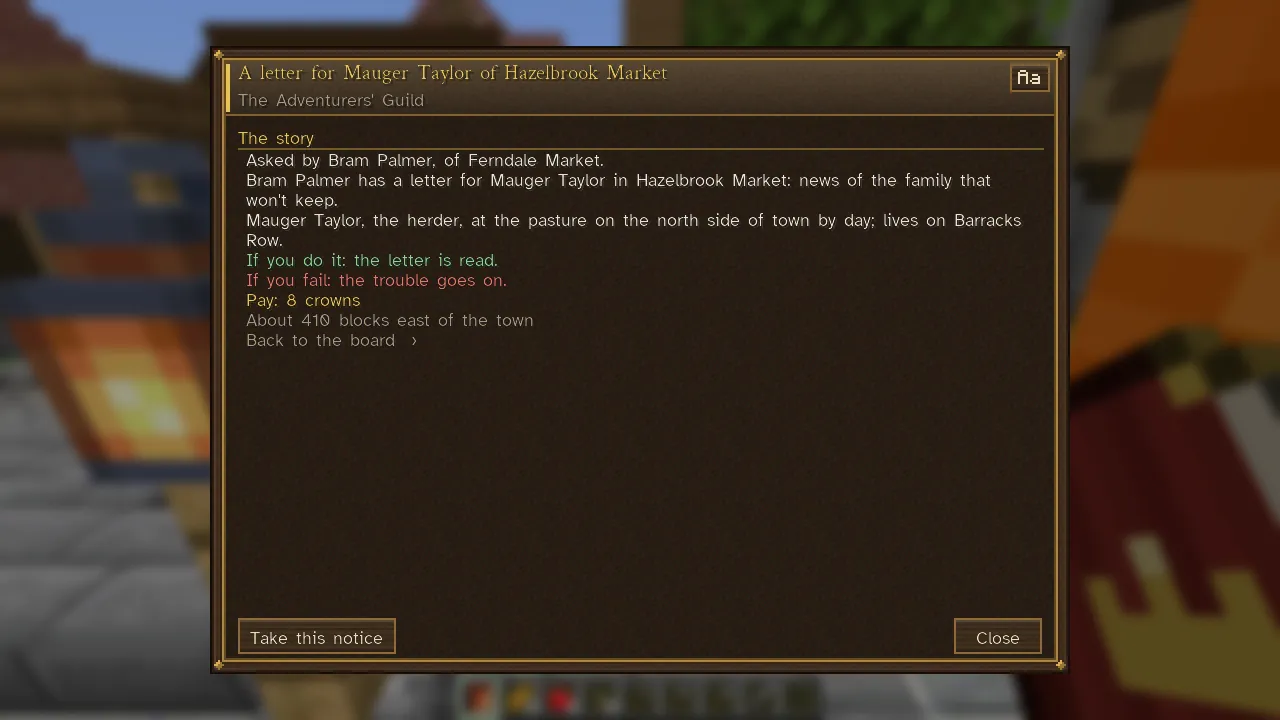
A letter goes to someone in another town 300 to 1,200 blocks away whose home or work is known. The notice, its story and the sealed letter say where to find them: their trade, their work by its name and street (else the side of the town), and the street they live on: "Mauger Taylor, the herder, at the pasture on the north side of town by day; lives on Barracks Row." Your map's pin is on their work's door, else their home's; once you are within 200 blocks of it, it moves with the hour to the door they are likeliest at, their work's in working hours and their home's otherwise. Right-click them holding the letter to give it. On the road it draws robbers (see Outlaws and Raiders); handed over or taken off you, the notice fails.
A word in a feud is found the same way: one of the town at odds with someone within 1,200 blocks sends a sealed word of peace, and the answer comes back as the next step. Peace, if the other is kind, or neither proud nor past forgiving, ends their rivalry.
Rival parties
A chapter town of 24 grown people or more may put up a party of three of them, 45 or under, the brave first, named as guild companies are ("the Grey Company"). Each morning a party at home takes the best-paid notice of its rank among letters, wolves at a fold, bands, footpads' camps and beasts on a road: one on the board, or one a player has held two days without finishing, who is told so. It walks there and mostly succeeds, less often against footpads or a band; beaten off by a band, one of the party falls. Done first, the notice is struck out for its holder and the giver pays the party. Parties rise by merit; the board lists them, and a notice's hover says who else is after it.
Free companies
A member who belongs to no realm may charter a free company at a chapter for 50 crowns into its treasury: a realm of their own with no town. Sign on recruits… takes on the town's idle for an earnest of 6 crowns each, up to 24; with three under arms, Take a contract… lists crowns at war that could pay its retainer, kept in the company's purse at the guild. See Mercenaries.