Renown and Following
DiscussFrom the Sovereign Realms Encyclopedia
Renown is what the world's people know someone for. Nothing that you do is known everywhere at once: a deed is known where it was seen, and it travels only with people. Travellers, merchants, envoys and soldiers carry news between towns, refugees tell who ruined their town, and bards sing of great deeds. A town may give you a name for what you did: the Bold, the Butcher of a place. What a town thinks of you then changes real things: what it charges you, whether its tavern admits you, how many of its people will follow you, and what its citizenship costs.
Following is the part of renown that counts how readily a town's people would follow you. A following of 25 is one way to the standing to found a realm; a property owner's station or a lived-in homestead are the others.
Deeds, and how they are taken
Each deed is news with a weight from 1 to 10, kept in the minds of the people who know it. It is taken one of three ways:
| Taken as | Words of repute |
|---|---|
| Admired | generous, a hero, fair, kind, devout |
| Feared | cruel, a pirate, a conqueror |
| Despised | everything else: a thief, a liar, faithless, a vandal, a murderer, and so on |
A town reckons what it knows of you as three amounts: admired, feared and despised. A deed counts in full when it is known to the whole town and weighs about 5, or when it weighs 10 and is known to half of it. Fame in a town is what its own folk have in mind; each town keeps its own account.
How far a deed goes
| Weight | How far it is carried |
|---|---|
| Under 5 | Kept at home, in the town where it was seen. |
| 5 to 7 | Carried to the realm's neighbours (realms with towns within about 1,000 blocks). |
| 8 and over | Carried anywhere travellers go. |
A song raises a deed's reach a step. How long a deed stays in minds depends on its reach: 30 days for a small deed, 120 for a deed carried to the neighbours, 240 for a great one; infamy is remembered twice as long, a sung deed half as long again. A past life's deeds, for a player who goes on as an heir, count for a third.
Ways to be known
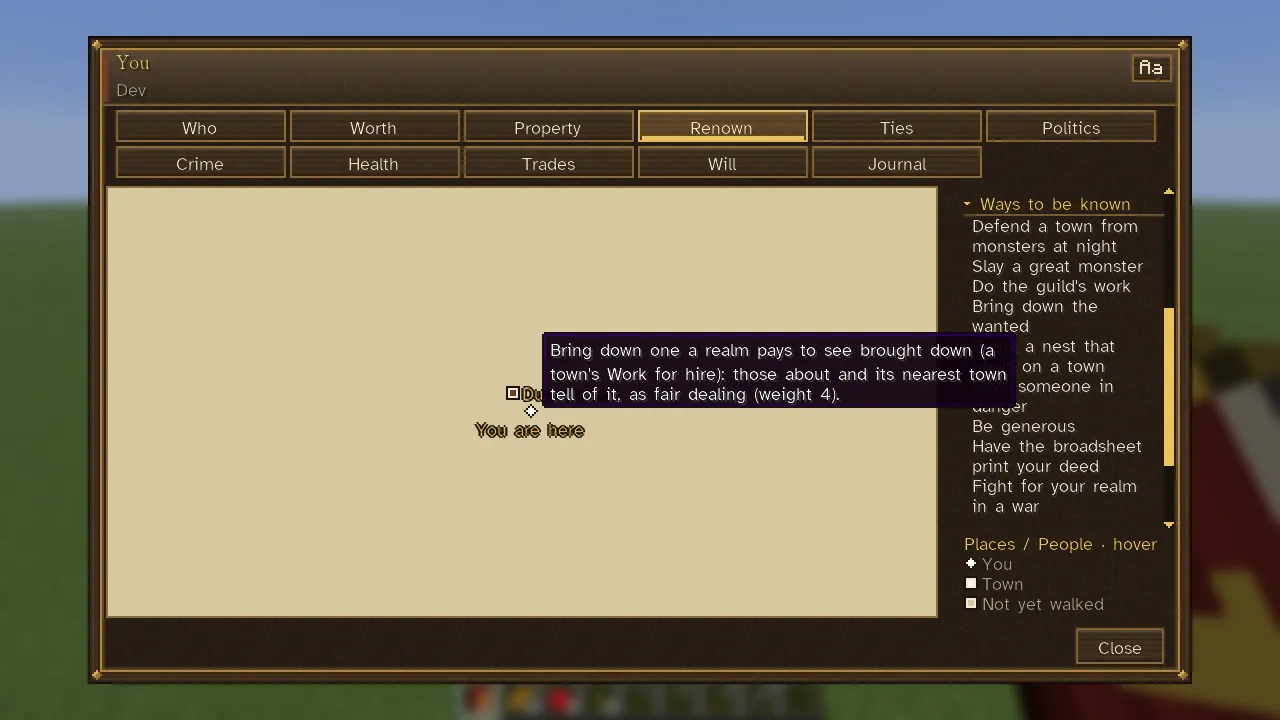
The Renown page lists these under Ways to be known, each with its deed and roughly its weight on the hover. Every one is a deed the world tells of, known first to those who saw it:
| Deed | Taken as | Weight |
|---|---|---|
| Kill monsters on a town's land at night where its folk see you | A hero | 3, once a half-day in each town |
| Slay one of the named great monsters (see Great Beasts and Trophies) | A hero | 9, known to all who fought it |
| Finish a notice of the Adventurers' Guild | Fair, kind or a hero, by the work | 2 for a letter, up to 10 for a temple or a rescue |
| Bring down one a realm pays to see brought down, from a town's Work for hire | Fair | 4, told by those about and the realm's town nearest |
| Break the heart of a monster nest that preys on a town | A hero | 3, told by that town's folk |
| Kill what is going for one of the world's people | A hero | 5 |
| Help a downed person up | Kind | 3 |
| A gift to someone, a round at the inn, alms through a priest | Generous | 2 to 5 for a gift (the first each day to each), 2 for a round, 1 to 4 for alms |
| Crowns given to a town at its Town Heart | Generous | 2 for ten crowns, 3 for 25, 4 for 50, 5 for 100, 6 for 250 |
| Slay enemy soldiers in a declared war, where it is seen | A hero | 3 for the first of a day, 6 for the fifth |
| Bring a corrupt officer or an outlaw's patron to light | Fair | 5 |
| Raise a Great Building in the realm you rule | Generous or devout | 8 |
A crime seen is told too, as ill fame (4 to 8), and remembered twice as long. A nest broken while you hold the guild's notice on it is told by the guild instead, when its pay is claimed. Bringing down the wanted, breaking nests and gifts to a town are told at half the weight for each more of the same kind that day, and after a few not at all: No one will speak of it: you have given enough today.
Giving to a town. A town's sheet offers Give to [town]…: 10, 25, 50, 100 or 250 crowns, given standing within 24 blocks of its heart, go into its treasury ("You give 50 crowns to Ashby's treasury. Its folk will speak of it."). The grown folk about you and up to four more of the town's own tell of it.
The broadsheet. Once a town admires a deed of yours and talks of it, its sheet offers Print your deed in its broadsheet (N crowns), paid at its heart: ten crowns for each point of the deed's weight, into its treasury. The broadsheet prints the deed it admires you for most, and up to 8 more of its folk who had not heard of it read it (half as many for a second notice the same day, and so on): The broadsheet prints it: "..." 8 more of its folk read of it. A town with nothing of yours to admire has nothing to print.
How word travels
News crosses a border only in someone's head. A party on the road that stands in a town (where it was bound, or passing through) trades news with the town's folk once a day: each of its people tells up to two things to each of two of the town's folk (innkeepers and merchants most), and hears as many back. Deeds that matter are told first; secrets stay secret. A deed carried over a border may be retold larger or smaller. Envoys, returning home, bring their ruler the great deeds they heard abroad. Survivors of a grave wrong done to their town tell of it wherever they go: "the man who burned our town". See Merchants and Supply Trains, Diplomacy and Envoys and Talking with People.
Bards
A town of thirty folk or more with a tavern has a bard, one of its own people. Of an evening the bard sings at the tavern, playing tunes on a lute; those who hear learn the song's deed, its reach is raised a step and its fading slowed, and those about are the gladder for the music. A bard also teaches you tunes, 5 crowns a tune, through Learn a tune › in talk (see Music). Now and then a bard sets out to sing in another town, so a song travels at a walker's pace.
You may pay a bard, from the bard's talk screen or under Songs… on their sheet: Make a song of… a deed of yours known in the town (10 to 80 crowns by its weight), which the bard sings for the next three evenings; or Make a song against… a rival (twice the price): a mocking telling of their worst deed, or, if they have none, a lie, which a kindly bard will not sing. A tavern must stand in the town. See Alehouses and Drink.
Names, masks and amends
- Epithets. An epithet takes hold when a single deed's fame passes a threshold (by default known to twenty people across two towns, or to most of one town of ten or more). It is made from the deed and the place: "the Butcher of Swanfield", "Goldhand", "the Bold", "Oathbreaker", "the Sea-Wolf", "the Thief of Oakford". It is lost when that fame falls below half the threshold, replaced by a greater one, and it does not pass to an heir (the house's name does). It is written into the chronicle of the realm it was earned in.
- Masks. A deed done masked or disguised is known by what was seen ("a masked rider in a pumpkin"): an alias with its own renown. Being seen unmasking, or caught by other evidence, links the alias to you. See Stealth Gear.
- Amends. Restitution, a pardon, feeding a town in want and amends paid into a town's treasury before its mayor each soften a despised or feared deed in that town, by a share each day, down to half its weight after a week of good deeds.
- Grievances. Grave wrongs to a town (its stores robbed, its people killed, fire set to it, deeds of war) become the talk of the town by the next morning: every one of its folk knows who did it, and holds it against them.
Houses
Realms are known too: just, cruel, rich, warlike or faithless, from their rulers' deeds. An heir keeps their house's name and a third of its fame. See Dynasties and Succession.
What renown changes
All of these read the same account, town by town:
| What | Effect |
|---|---|
| Prices | A town's merchants price their goods from 0.85 times (the admired) to 1.3 times (the despised). |
| Dealing | A town despised in, and widely, refuses to deal with you at all. |
| Welcome | From shut against you to thrown open. A tavern will not have someone whose welcome falls to −40 or worse. |
| Suspicion | How closely the town's watch eyes you; the despised most, the feared too. |
| Following | See below. |
| The freedom of a realm | Half the usual fee for the admired, up to twice for the despised; see Citizenship and Ranks. |
| Infamy | How infamous you are in a whole realm, by its towns' size: what bounty hunters and hired swords go by. See Wanted and Bounties. |
| Courtship | What a person makes of you as a match; see Courtship and Marriage. |
| Factions | A member's renown raises their weight; see Factions and Demands. |
Following
Following is measured per town, from 0 to 100, in two kinds:
- Recruits to the admired: the felt weight of what is admired, less half of what is despised.
- Cutthroats to the feared: the felt weight of what is feared, plus three-tenths of what is despised.
Fear can raise a warlord, but being merely hated earns no followers.
Following unlocks:
- Founding a realm. The best of your followings over all towns, counting cutthroats at seven-tenths, must be 25, unless you are a property owner or hold a homestead worth 120 crowns whose ground you have stood on within the last 3 days (see Homesteads). See Founding a Realm and Royal Charter.
- Free calls for settlers. A town of the world that holds a following of 25 for you will send a household free when you call at your own Town Heart; later arrivals need beds and food. Without a following, you pay a signing bonus. See Founding a Realm.
Reading your own renown
You learn what is said of you only by talking with people. The Renown page of your sheet (press J) lists, under What they say of you, by town, for each town you have talked in, what it knows you for and the name it calls you by, with its realm and when you heard it on the hover (No town's talk heard yet until you have). It is never the true account: a town not talked with lately is as it was when last heard. Below it, What renown does sums up what praise and ill fame bring (prices, welcome, the watch, followers, a realm's freedom and the reward on your head), and Ways to be known lists the deeds above. The Companion's Known tab keeps what you have heard, and from whom. Each town posts its news at its heart as a paper: /news near a town, or buy a printed copy for a crown at an inn or market. See The Sovereign's Companion and Sheets.