Wilderness Discoveries
DiscussFrom the Sovereign Realms Encyclopedia
Wilderness discoveries are the things you can come upon in the country between towns and that give something back: a stand of great trees, water thick with fish, a salt marsh, a bank of clay, a river that carries gold, a broken watchtower with a chest, a prospectors' camp that sells news, a hermit who knows the country. Some are drawn on the world's map in fixed places; most are made from the seed and appear wherever the ground suits them.
They are the other side of the Natural Wonders: the wonders are there to be seen, and the discoveries are there to be used. Most of what they yield is raw goods that towns want and the Resources and Scarcity of a land decides how plentiful it is.
Marked places
The Greater World's map marks 39 wild places in five kinds. Each is a circle of land in which one rule changes: fish breed faster, clay comes back, a river carries more gold. They work in worlds made with provinces, as the Greater World is. Few have anything built on them, and you find one by knowing the land.
| Kind | Marked | Circle (radius in blocks) | Where on the map |
|---|---|---|---|
| Old growth | 11 | 250 to 600 | The Ringlands (two), the Eastlands, the Cedar Coast, the Highlands, the Verdance, the Lake Country, the Fortunate Isles, the Karpat March, Albion, the Heartland |
| Fishing ground | 10 | 250 to 600 | The Low Countries, the Fjord Coast, the Far Isles, the High Plateau, the Wild Fields, Hellas, the Straits, the Lake Country, the Long Peninsula, Erin |
| Salt marsh | 8 | 90 to 150 | The Heartland, the Uplands, the Padan Plain, the River Land, the Sunset Coast, Almarra, the Wild Fields, the Long Peninsula |
| Clay bank | 6 | 80 to 110 | The Heartland, the River Land, the Low Countries, Albion, the Ringlands, the Padan Plain |
| Alluvial gold | 4 | 80 to 90 | The High Plateau, the Ringlands, the Caucas, the River Land |
Every place regrows at a pace set by the world's scarcity (Abundant renews twice as fast as Balanced, Scarce 0.6 times as fast, Harsh 0.4) and by the world's own regrowth setting; both are chosen when the world is made. See The Known World.
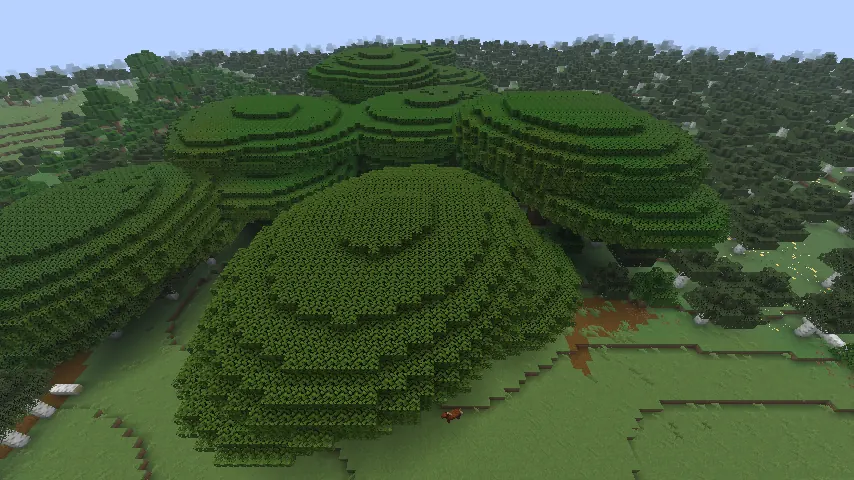
Old growth and Great Timber
Where a wood is old, a felled log can come away as Great Timber, the beam that rams, gatehouses and trebuchets are built on, and that a tar kiln seasons with pitch into the ship timber of a hull (see Ships and Sailing). A log counts as great if it is part of a two-by-two square of the same log (dark oak, giant spruce and jungle giants qualify anywhere), or, inside an old-growth circle, if it is a single trunk at least seven blocks tall. Any axe will do. The first log of a layer comes away as one Great Timber instead of the log, with a one in two chance, or three in four inside old growth. Great Timber cannot be crafted. See Siege Engines and Walls and Fortifications.
Wild woods grow back: saplings are planted on open grass beside wild forest, on land no realm holds.
Fishing grounds
The water is divided into cells, each with a stock of fish. A catch takes a little of it, and the stock recovers by itself, three times as fast inside a fishing ground. The stock is what the town's fishers draw on; a fishery's sheet reports the water as teeming, well stocked, thinning, fished out or all but empty, with a percentage. See Harbours and Work and Professions.
Salt marshes
A marsh is the best ground for salt, and any coast is better than none: pans on another coast yield about a third as much, and none inland. Craft a Salt Pan from bricks (or cobblestone), fill it with water or let sea water run into it from beside, and in the sun, under open sky and with no rain, it dries to salt. Rake it by hand for up to three Salt a day. Hot country dries it faster, cold country slower. See Salt.
Clay banks
Clay dug from a bank is put back after about a week, sooner in an abundant land, as long as the bed is open again and you have not built over it.
Alluvial gold
In a gold-bearing river's circle, breaking gravel or sand within two blocks of the water has a chance of turning up one or two gold nuggets with the drops. Each nugget draws down the place's stock, which recovers by itself, so a river you work hard runs thin. A Panner's Sluice Box, the marker of a sluice, lets a hired panner do the same work for a town; the world's own towns plan one only where gold-bearing river lies at their heart. See Prospecting and Mining and Prospector's Pick.
Ruins, camps and caches
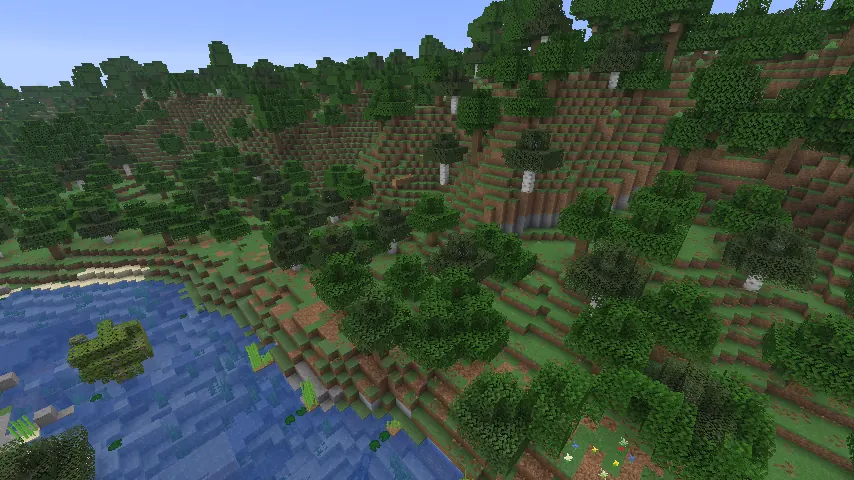
Beyond the marked places, the country holds many small sites made from the seed. The land is cut into square tracts and a tract may hold one; far from towns they are likelier. A site is built when a player draws near, once, and kept; what you take stays taken. They stay well clear of towns, roads and held land. When you come within about 40 blocks, a message says "You come upon..." with a hint, and the site is marked on your book map; sites you only hear of are marked "heard of". Chests and pots are filled once and never restocked.
| Site | What you find |
|---|---|
| Broken watchtower | A ruin on a rise whose rooms can be mended into a home; a chest of arrows, torches, a few crowns and a watchman's tally |
| Burned hamlet | Three or four ruined cottages in a wild orchard; a chest with some crowns, seed and a letter |
| Old battlefield | Rows of graves and tattered banners round a cairn with a plaque naming the field after the nearest town; a captain's strongbox with a worn weapon and some crowns |
| Ancient tree grove | A tree about 20 to 25 blocks tall in a wood, with a nest chest |
| Sinkhole | Ground fallen into a cavern 12 to 16 deep with ore in its wall; a barrel pack of supplies and a skull |
| Standing stones | A ring of stones around a spring; an offering pot beside the tallest |
| Abandoned mine | A hillside mouth and a flooded gallery; ore past the water and a chest of tools |
| Hot spring | A steaming pool whose water gives Regeneration while you stand in it; a chest of bottles and honey |
| Prospectors' camp | Two old townsfolk who sell their news for 50 crowns: the nearest ore deposit within 900 blocks that you did not know of, pinned on your map |
| Shepherds' fold | An old shepherd and a flock; buy wool from them |
| Charcoal burners' clearing | A clamp in a wood and two burners who make charcoal and sell it to towns |
| Hermitage | A cottage, chapel and walled garden; the hermit tells what they know of the country, for nothing |
| Poachers' hide | Two woodsmen who sell venison and hides at half price. The realm reckons it stolen goods, and its guards take it back |
| Waterfall grotto | Falls into a pool, a grotto behind it and a pot of coin |
| Barrow | A mound with a hall and a sealed deepslate chamber behind a chiselled stone door. The coffin chest holds the barrow-king's blade and gold, and opening it raises 3 to 5 skeletons |
| Ruined observatory | A summit tower with records, a chest of instruments and a record that points you to the nearest other site within 1,500 blocks |
| Fallen bridge | A river crossing with a tollhouse and a toll chest |
A barrow and an observatory or bridge are the rare "major" sites: one in ten, and kept 1,800 blocks from each other.
On the roads
About one cell in two of the country carries a small find, beside the roads as well as off them, never within 110 blocks of a town:
- A shrine with a decorated pot of crowns.
- A cairn with a barrel of crowns, bread, torches and a note.
- A traveller's last camp with a diary.
- A broken cart with a barrel of its cargo.
- An old well with a pot at the bottom.
- A lone grave and a fallen statue, a board and a plaque only.
- A hollow log with a bee nest, which yields honey and comb.
Roads keep their own record too: someone who dies on a journey beside a road is buried under a mossy cairn with a board giving their name, how they died and the day, and a field where many died is marked with a plaque. A long road has a shrine at its middle, and on one long road in three a hermit lives in a hut two thirds of the way along. Ask a hermit, once a day each, about the country within 400 blocks: they tell for free of outlaw camps, old battlefields, road shrines and discoveries. See Roads, Outlaws and Raiders and Faith and Temples.
Ruins of towns
A village whose people have all died or left is abandoned after a few days and weathers into a ruin, with its doors hanging off and its lights out. Whatever was in its chests is still there. A ship that sinks at sea washes up on the nearest shore as a wreck with its stores, which finders may take; her owners may send salvagers. See Ships and Sailing and Towns.
Dangerous finds
Some places in the wild are lairs. The Adventurers' Guild posts notices for spider nests, a necromancer's crypt, a risen barrow, a drowned observatory, a sunken chapel and the others, and the great beasts have lairs of their own that stay as landmarks. See Great Beasts and Trophies for those, and The Watch and Watchtowers for the law's part.
Waystone Fragments
A Waystone Fragment is not found in the wild. It is a rare making of the waygates, given with the pay for a Silver-rank or better guild bounty (one time in eight at Silver, in four at Gold, in two at Obsidian). See Fast Travel.