Religion
DiscussFrom the Sovereign Realms Encyclopedia
Religion in Sovereign Realms is the world's faiths and what they ask of their people. Every person holds a faith and keeps it more or less devoutly. Every faith has three tenets that change what its faithful do, a holy day, sacred sites and houses, and is ordered as a church, a fellowship or a priesthood, which sets its ranks and how its head is chosen. Five old faiths belong to the five peoples. A player with standing may found a faith of their own at a holy place, preach it, raise its houses, rise in its ranks and make it the law of a realm, where other faiths may then be tolerated, taxed or hunted as heresy.
The buildings and rites the faiths share (temples and their ranks, priests, confession, blessings, holy water and the forbidden sanctum) are described in Faith and Temples.
What you can do
- See your faith. The Tongues and faith section of your You page says "Your faith:" and how you keep it ("the Dawn, faithful"); the line opens the faith's sheet. Every person's sheet has a Faith: line on its Life tab, and every town's sheet says which faith it holds and which draws it, if one does.
- Take up another faith with Take up on its sheet. You are at least faithful in it at once. The founder of a faith cannot leave it.
- Found a faith at a holy place, if you have the standing.
- Spread it: preach it in talk with Speak of, and give alms in its name.
- Build and serve it: commission its houses, keep and lead its services, give to its offerings, and rise through its ranks and elections.
- Rule by it: proclaim a state faith, decide how other faiths are taken, appoint an inquisitor, declare a holy war, and, as a faith's head, cast a ruler out of it.
A faith
A faith's sheet shows, from the top, what it is (how it is ordered and who heads it), its tenets, its holy day, its sacred sites, who follows it, its last converts, its tithes, your place in it, its clergy and houses, its law and its outcasts, and the world's other faiths, each a link.
How it is ordered
| Order | What it is | Ranks, lowest first | Its head | A founded faith's houses (first, second, third rank) |
|---|---|---|---|---|
| A church | One body under one head | Acolyte, Priest, Bishop, Primate | The primate, for life; the bishops elect the next | Shrine of X, Church of X, Cathedral of X |
| A fellowship | Congregations that keep their own houses and choose their own elders | Member, Elder, Speaker | The speaker, chosen by the elders for 30 days | Meeting-stone of X, Meeting House of X, Great Hall of X |
| A priesthood | Keepers of the holy places, each shrine its own | Novice, Keeper, High keeper | The high keeper: whoever keeps its first sacred site | Shrine of X, Temple of X, High Temple of X |
Tenets
A faith holds three tenets, never two that are against each other. A tenet binds those of the faith who are faithful or devout in it; the lukewarm and the lapsed stray. Some tenets also make the law of a realm whose state faith holds them (see below).
| Tenet | What the faithful do | Against |
|---|---|---|
| Temperance | Do not go out drinking. As law: drink is banned. | Feasting |
| Feasting | On the holy day feast at home and go out drinking that evening the more often. As law: drink is free. | Temperance |
| The day of rest | Do no work on the holy day, save soldiers and sentries, jailers, innkeepers, merchants, healers, priests and acolytes. | |
| Alms | A household with one of the faithful gives a third of what it holds above its reserve in the weekly alms, not a fifth. | |
| Peace | Refuse to enlist unless the law presses them, and lose devotion if it does; recruiters find them unwilling. | The sword |
| The sword | Enlist eagerly, and go to a levy gladly. | Peace |
| Against usury | Will not borrow from a loan shark, at the tables or out of need. | |
| The Nether forbidden | Resent a crown that keeps a sanctum. As law: the dark road is banned. | |
| Fidelity | Keep out of the pleasure houses. As law: adultery is a crime and the pleasure houses are shut. | |
| Against games of chance | Keep away from the tables. As law: the tables are banned. | |
| Hospitality | The faith's towns do not move a stranger on at night. | |
| The ancestors | Grieve the more gently (grief at three quarters). | |
| Pilgrimage | The faith's towns send pilgrims twice as often. | |
| Plainness | Dress plainly, the great as plainly as the least. |
Holy day
The old faiths keep the seventh day of the week, the rest day the world has always kept; a founded faith keeps the day of the week it was founded on. On its holy day the faithful worship of a morning (9 to 11) as well as of an evening, at a house of their faith in their town, and its houses hold their services. Worship on the holy day warms them a little to the crown, turns them a little toward the old ways and adds to their devotion, the more at one of the faith's sacred sites. Followers of a faith their town does not hold go that morning to the nearest sacred site or house of their faith within 160 blocks of them; with none in reach they lose a little devotion. The faith's sheet says how many days off the holy day is, and its hover what the day asks.
Sacred sites
The old faiths' sacred sites are gathered each morning: each faith's cathedrals (its temples of the third rank) and great cathedrals, the pilgrimage shrines of the towns that hold it, and the raised Natural Wonders whose nearest town within 600 blocks holds it. A site stays sacred to an old faith after its town turns to another, as long as it stands: those are the sites holy wars are fought over. A founded faith's sacred site is the place it was founded, and it gains no others. Sacred sites draw the towns about them to the faith, and worship at one counts for more.
Head and founder
A founded faith's founder is its first head. The old faiths have none of old ("No primate is named yet."): a church's or a fellowship's clergy elect one, and a priesthood's high keeper is whoever keeps its first sacred site, where that is a house.
The old faiths
Each of the five peoples has an old faith. A realm holds its people's old faith unless it turns to another or proclaims one; a town holds its realm's faith unless it turns. The old faiths' houses keep the names their people give them (see Faith and Temples).
| Faith | People | Order | Tenets | Houses (first, second, third rank) |
|---|---|---|---|---|
| The Dawn | Heartlanders | Church | Alms, The ancestors, The Nether forbidden | Wayside Shrine, Chapel of the Dawn, Cathedral of the Dawn |
| The High Ones | Northfolk | Fellowship | The sword, The ancestors, Hospitality | Hearth-stone, Hall of the High Ones, Sky-Hall |
| The Sun | Sunlanders | Priesthood | Pilgrimage, Alms, Feasting | Sun Shrine, Temple of the Sun, House of the Undying Sun |
| The Grove | Verdant | Priesthood | Peace, The ancestors, Pilgrimage | Grove Stone, Grove Temple, The Green Sanctum |
| The Watchers | Marchers | Fellowship | The Nether forbidden, Fidelity, Against usury | Hill Cairn, Chapel of the Watchers, Minster of the Watchers |
The old faiths' tenets bind their faithful and their towns but write nothing into a realm's law. Until a realm proclaims a state faith, it keeps the old code of the pious realms (see The Underworld, Crime and Punishment and State faith below).
A person's faith and piety
Someone's piety (0 to 100) is their nature in faith and their devotion together, and the word for it is how they keep it:
| Piety | Word | |
|---|---|---|
| 60 and up | Devout | Bound by its tenets; never turned by a faith's pull; a player may preach |
| 30 to 59 | Faithful | Bound by its tenets |
| 10 to 29 | Lukewarm | Strays from its tenets; open to another faith |
| Under 10 | Lapsed | As the lukewarm, and keeps no service |
- Nature is about 40, give or take 15: loyal +10, kind or gloomy +5, fickle −10, clever or greedy −5; those of sixty years and more +10, those under 25 −5; priests and acolytes +40.
- Devotion runs from −40 to +40. Townsfolk gain it by worship on the holy day (+1, or +3 at a sacred site; worship alone brings no more than 20), by hearing a service (+2, up to 30) and by taking up a faith (+15). They lose it when pressed to arms against a faith of peace (−3), when their town keeps another faith and no house or sacred site of their own is in reach on its holy day (−1), and when cast out of it.
- A player's piety is 40 and their devotion. Confession brings +2 (see Faith and Temples), keeping or leading a service +3, alms in the faith's name +1, a gift to a house's offerings up to +5, and turning someone by preaching +1. Taking up a faith adds 15; a founder starts at 30. A ruler cast out of their faith loses 20, and one who recants starts low in the faith they take up (piety 30 at most).
A player of a realm holds its faith until they take up or found another; one of no realm keeps none until they do.
Founding a faith
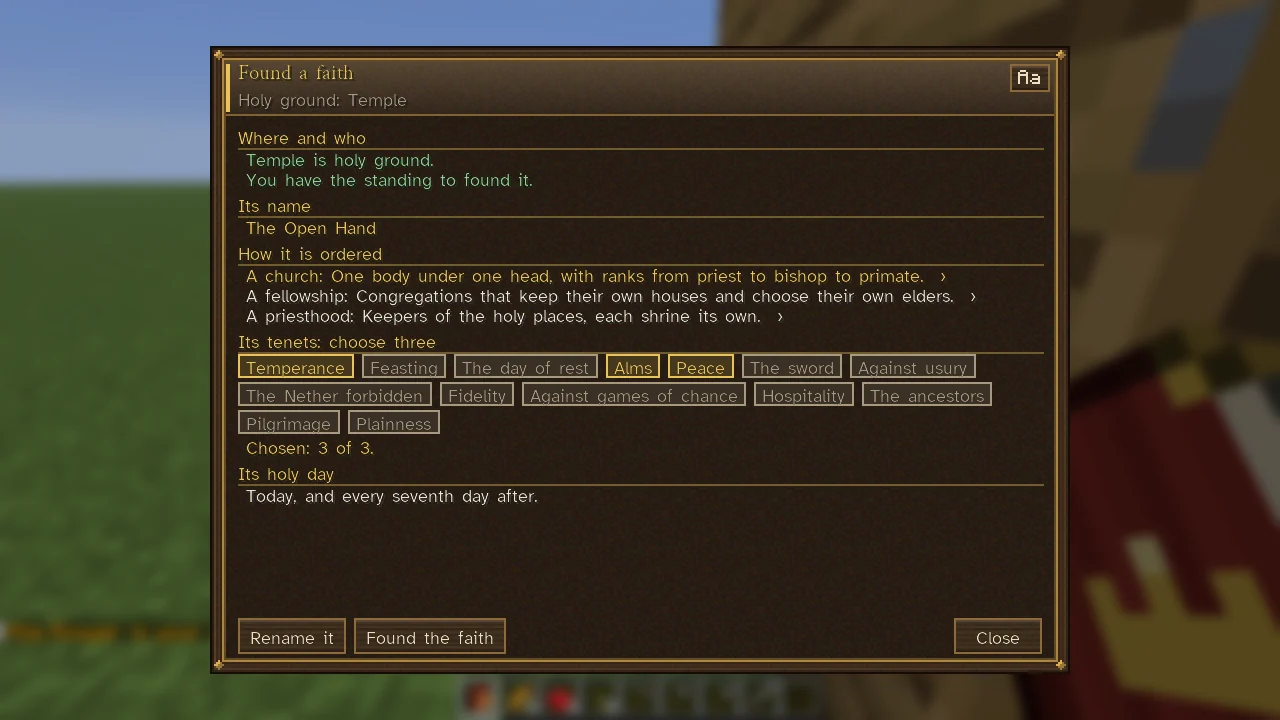
Found a faith of your own is at the foot of a faith's sheet and in Tongues and faith on your You page, and a temple's sheet has Found a faith of your own here. Its hover says why you cannot yet, if you cannot.
- Where. At a holy place: inside or within 8 blocks of a temple of any rank, a great cathedral or a pilgrimage shrine; within 6 blocks of a wayside shrine's plaque (see Roads); or within half the reach of a raised natural wonder.
- Who. You rule a realm; or you are well admired in the town about (see Renown and Following); or you are known there as devout, as three days' confession makes you. No one founds two faiths.
- The sheet. Where and who says whether the ground is holy and you have the standing. Name it opens a box: 3 to 32 letters, numbers, spaces, apostrophes or hyphens, a name no faith has (a leading "the" aside). How it is ordered offers the three orders, each explained on its hover. Its tenets: choose three shows fourteen chips: those chosen are gold, those ruled out are muted, and each hover says what the tenet does. Its holy day says "Today, and every seventh day after." Found the faith is offered when all is in order, and otherwise says what is wanting.
- What happens. You are its founder and head, devout from the first; the place is its first sacred site; the town hears of it. Up to three of the town who think well of you and are lukewarm or lapsed in their own faith take it up at once.
Spreading a faith
Preaching
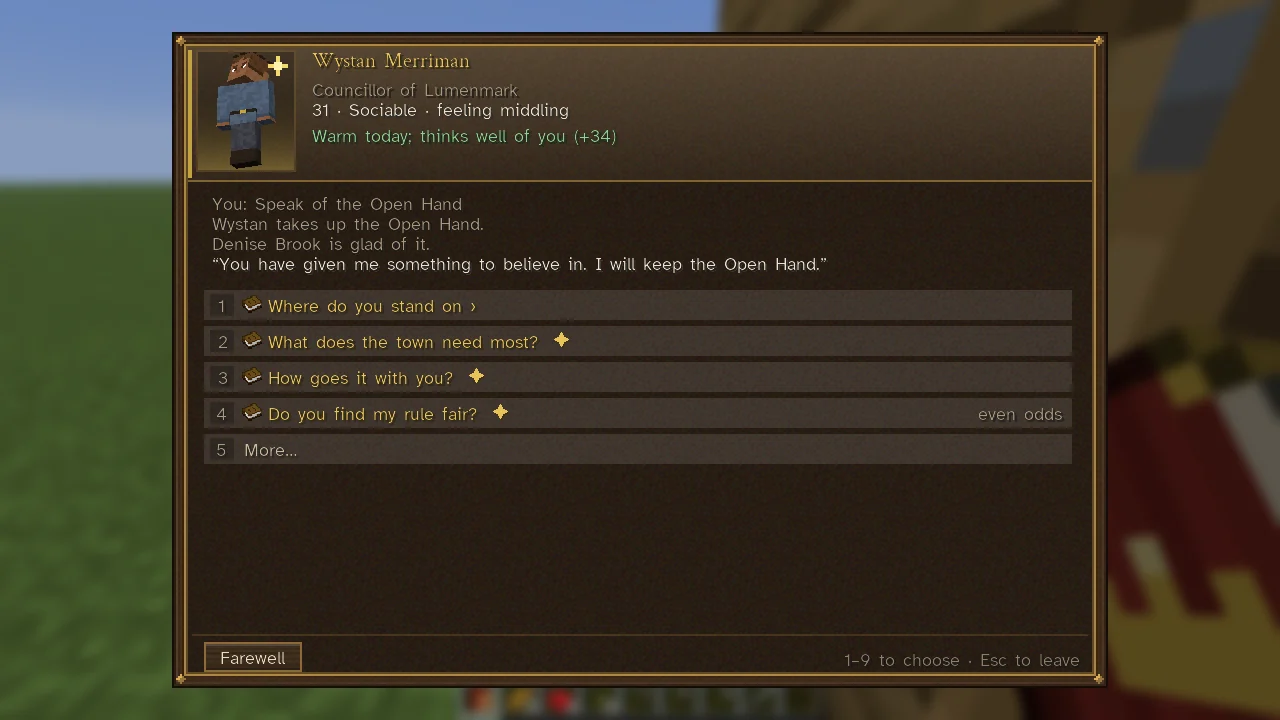
In talk with a grown person of another faith, a faith's founder, its head and its devout followers have Speak of their faith, once a day for each listener. (A follower of a founded faith who is not yet devout sees it with the reason.) Its odds are given in words, such as "fair odds", and its hover gives them as "About N in 100.", with what makes it easier and harder. Where the realm whose land you stand in forbids every faith but its own, a warning, "Heresy here:", stands under the odds.
| What weighs on the chance | In 100 |
|---|---|
| To begin with | 15 |
| Their piety in their own faith | 45 less their piety: the lapsed come easily, the devout hardly |
| They are a priest or acolyte | −30 |
| Their faith has a house in their town | −4 a rank |
| Their faith has no house in their town (which holds another) | +5 |
| A sacred site of their faith near their town | −5 |
| What they think of you | From −25 to +20 |
| You are admired, or despised, in their town | Up to +15, or −15 |
| Each of your tenets that suits their temper, or goes against it | +7, or −7 (temperance against one who likes a drink, peace against one for strength of arms) |
| A new faith, to one who holds to the old ways, or is for new ways | −7, or +7 |
| Alms you gave in its name in their town | Up to +15 |
| Good deeds their town knows you for | Up to +10 |
| Each kinsman or friend of theirs already of it (two at most) | +8 |
| Each time they heard you before (three at most) | +4 |
The chance is never below 2 in 100 nor above 90. Turned, they take up your faith and think the better of you, and their kin react. Not turned, they come the nearer next time; the devout think the worse of you and ask you not to press them again.
Alms in a faith's name
Give alms in its name, on the sheet of your own faith, gives 5, 20 or 50 crowns to the four poorest grown people of the town you stand in or by. They think the better of you, the town knows you as generous, and your devotion rises. The alms press for the faith in that town, a point for each 10 crowns, fading by a tenth each morning, and make your preaching there the easier.
A faith's pull, and towns turning
Each morning every town feels the pull of the faiths it does not hold:
| Draws a town to a faith | Weight |
|---|---|
| Each of its sacred sites | 4 |
| Each of its houses | 1 a rank; a quarter more for each service it has held, up to double, while its last service was within 14 days |
| Alms given in its name there | 1 for each 10 crowns |
| Its followers in the town | 4 × their share of the town |
| Holds the town to its own faith | |
| Its own faith | 1, its own sites and houses about, and 2 × the share of the town that keeps it |
Sites and houses pull at full weight within 48 blocks of a town's heart, and less further out, to nothing at 320. Where a faith pulls harder than the town holds, each point over gives each of its people a chance of 2 in 100 a day of taking it up (at most 20), the less the more pious they are. The devout and priests are never turned this way, and no more than an eighth of a town turns to one faith in a day. Towns far from every player turn all the same.
Between the old faiths a town turns only for a cause, and slowly. A town that holds one of the five old faiths is drawn to another old faith only while its ruler keeps that faith (which weighs as a shrine of it in the square), while a realm of that faith wages a holy war on the town's realm, while a house or holy place of it stands within 96 blocks of the town's heart, or while alms are given in its name there. Under a ruler or a holy war the faith's houses about pull as above; otherwise only those within the 96 blocks count, and followers already in the town add to a cause but are none by themselves. Even with a cause each person's chance is at most 5 in 100 a day, and no more than one in 32 of the town (one at least) turns to it in a day. A founded faith draws, and a town that holds one is drawn, as above.
A town of three people or more turns when more than half of it keeps another faith. The realm's chronicle tells it, and its members, the realms about, players within 320 blocks and the faith's head are told; the town's sheet says "newly turned" for a week, and those who held out keep their old faith. A realm of the world turns when its ruler and most of its people hold a faith; a player's realm turns only by proclamation. A faith's sheet lists its towns one by one ("Lumenford: 1 of 5.") under Who follows it, and its last converts with how each came to it.
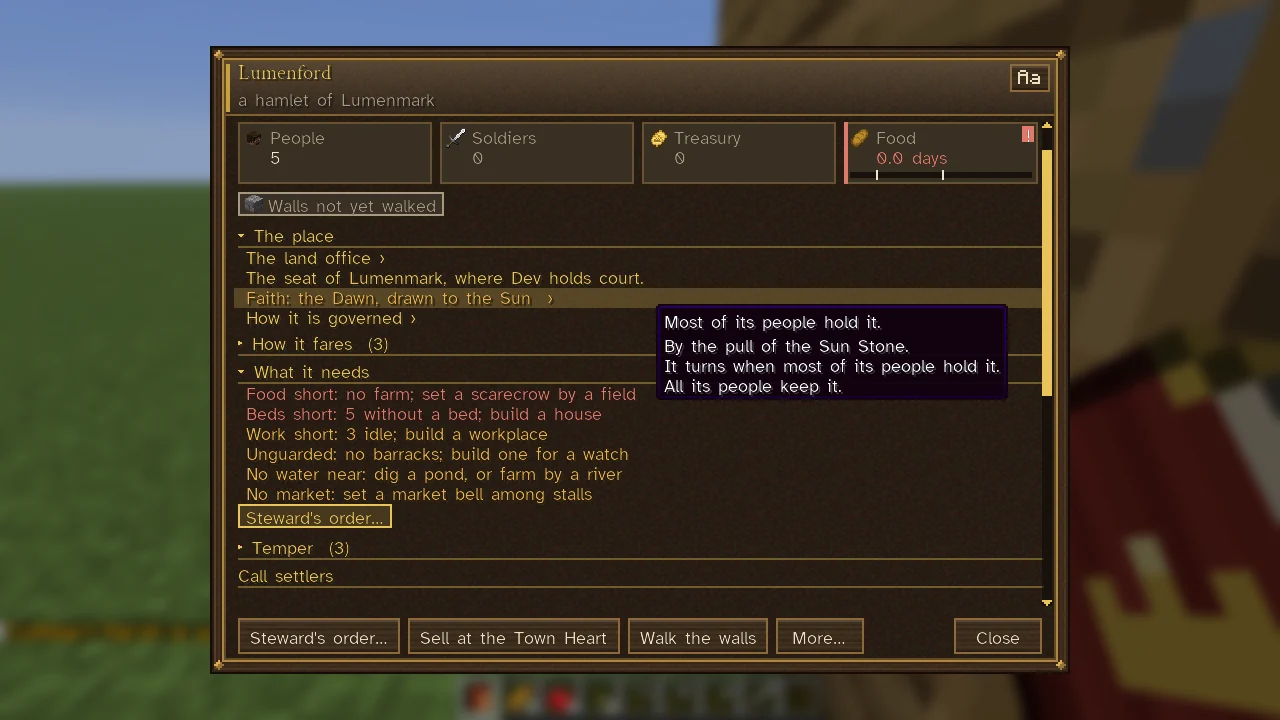
The town's sheet shows a turning as it comes. Its line reads "Faith: the Dawn" while nothing gains on it, "Faith: the Dawn, drawn to the Sun" while another faith gains on it. The hover gives the cause (the pull of a named house or holy place, its ruler who keeps the faith, a realm waging a holy war on it, alms given there, or its followers there), says it turns when most of its people hold the faith, and counts those who keep others.
Followers
- Tithes. A faith whose head is a player takes tithes: on its holy day each grown follower with more than 10 crowns, in the towns players are near, gives one into its coffer. Its tithes says what the last holy day brought and what is held, and the head takes it with Take the tithes.
- Kin. A convert's kin and friends of the new faith are glad of it. Those of the old faith who are devout in it are estranged ("left our faith"), the faithful troubled, the lukewarm unmoved. They speak of it in talk.
- Migrants keep their faith when they move to a town of another.
Houses and services
Every temple, of any rank, and every great cathedral is a house of a faith: of the faith it was raised for, else of its town's. A temple is named for that faith (a great cathedral keeps its own name), by its people's names for an old faith's houses and by its order for a founded one ("Shrine of the Lantern Way"), and its sheet says "A house of" its faith. Its houses, and raising one, on a faith's sheet, lists its houses with their rank, the services each has held and how many each has drawn to the faith.
Raising a house
Under Raise a house, those of the faith whose rank in their realm may order construction can commission a shrine (the world's plan), a chapel (in the way of the town's builders) or a great temple (the realm's cathedral, one of its Great Works). Each line gives the plan's size, its cost in crowns and its builders' days. The first click outlines the ground before you, its door toward you, in green where it will take it and red where not, with why; a second click from the same spot lays it out, and the realm's builders raise it from its stores like any Construction. Built, it is a house of the faith, named by it, and counted to you as a house built. A temple you lay out with the Architect's Plans in a town of another faith than yours is your faith's house too.
Services
On a faith's holy day, from 9 to 11, each of its houses with a priest holds a service: the priest rings its bell at nine, if it has one, and leads it at the altar, saying a line of the sermon at a time to the players within 16 blocks. The town's people of the faith (all but the lapsed) come and stand in the nave; the devout leave their work for it. Hearing it is worship and +2 devotion (+3 where a player of rank led it); those out of sight hear it at the morning's reckoning. Each service also draws up to two of the town who are lukewarm or lapsed in another faith, each at 8 in 100 for each point of the house's pull, and the faith's head is told.
| The sermon | The priest says |
|---|---|
| It begins | "Blessed be this day, and all who keep it." |
| Temperance | "Keep from the cup: a clear head keeps the faith." |
| Feasting | "Eat and drink together tonight, and give thanks." |
| The day of rest | "Lay down your tools today: the day is holy." |
| Alms | "Give to the poor, and what you give comes back to you." |
| Peace | "Put up the sword. Blessed are those who make peace." |
| The sword | "Be strong and fear nothing: the brave are blessed." |
| Against usury | "Lend without interest, and borrow from no shark." |
| The Nether forbidden | "Shun the burning dark below, and all who deal in it." |
| Fidelity | "Keep faith with the one you married." |
| Against games of chance | "Leave the dice and the tables: chance is no master." |
| Hospitality | "Turn no stranger from your door at night." |
| The ancestors | "Remember those who went before, and keep their graves." |
| Pilgrimage | "Walk once to the holy places, and come home the better." |
| Plainness | "Dress plainly: the great and the least are one." |
| It ends | "Go in peace, and carry the word home with you." |
A temple's sheet has Its services: when the next is, how many have been held and heard. Those of its faith may:
- Keep the service: stand in the house during it, once a day (+3 devotion, counted to your services).
- Lead the service (a priest, elder or keeper or above), in the house or within 8 blocks of its altar during the hour, if no one has led it that day: its hearers are the more devout for it, and it is counted to you. A house without a priest holds a service only when someone of rank leads it.
- Give to its offerings: 10, 50 or 100 crowns into its chest, standing in it or within 12 blocks, counted to your gifts to the faith.
Ranks and church politics
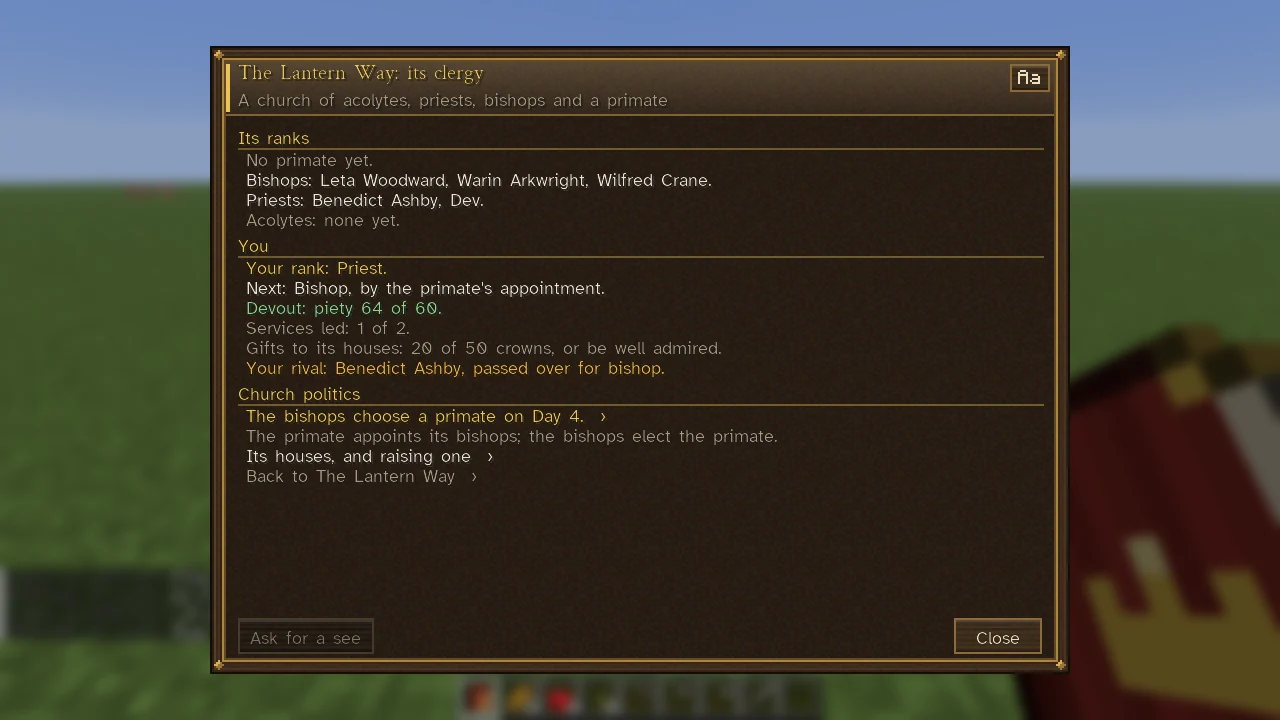
Its ranks, and how to rise shows who holds each rank, your rank, your next and what it wants line by line, the button that takes it, and any rival. The priests of a faith's houses hold their rank by the house they keep: a church's priest at a shrine or chapel is a Priest and at a cathedral a Bishop; a fellowship house's first priest is its Elder until its congregation chooses another; a priesthood's priests are its Keepers.
| Order | Rank | How it is had | What it wants |
|---|---|---|---|
| Church | Acolyte | Take holy orders | Faithful |
| Priest | Be ordained a priest | Devout; three services kept, or a house of the faith built | |
| Bishop | Ask for a see: the primate appoints | Devout; two services led; 50 crowns given to its houses, or well admired in its towns | |
| Primate | Elected by the bishops (its priests, where it has none) when the seat is empty; for life | Be a bishop (a priest, where it has none) | |
| Fellowship | Member | Holding the faith | |
| Elder | Stand for elder here: a house's congregation chooses, every 28 days | Faithful; a house of the faith to stand at | |
| Speaker | Elected by the elders for 30 days | Be an elder | |
| Priesthood | Novice | Take vows | Faithful |
| Keeper | Keep this house | Devout; three services kept, or a house built; a house of the faith no other player keeps | |
| High keeper | Whoever keeps its first sacred site |
A primate who is one of the townsfolk, as the old faiths' elected heads are, grants a see at once to a player who has earned it. A player primate is asked instead, and appoints from the clergy page with Appoint a bishop. No see is given while the primate's seat is empty.
Elections
An election is called when a head's seat falls empty (no head, a townsman head dead, a player head who left the faith) or a speaker's term ends, and for an elder every 28 days or when a player stands. It is held on the faith's holy day, at least two days after it is called, and the realms that hold the faith hear of an election for its head. Its page shows the candidates, each with those who back them as they would vote today, and who chooses. Up to four of the electing rank stand of themselves, the most pious first (for an elder, the house's own priests); players of that rank may stand; a speaker whose term has run stands again. Each elector backs the candidate they think best of, never themselves: by their regard and the candidate's piety, a townsman the more for being a neighbour, and a player by their renown in the elector's town, their gifts and the services they have led.
Rivals. When a player wins a seat or is made a bishop, the cleric passed over becomes their rival for 28 days. Word goes about that the rival speaks against them among the clergy, and electors think the less of them for it.
Faith in law and politics
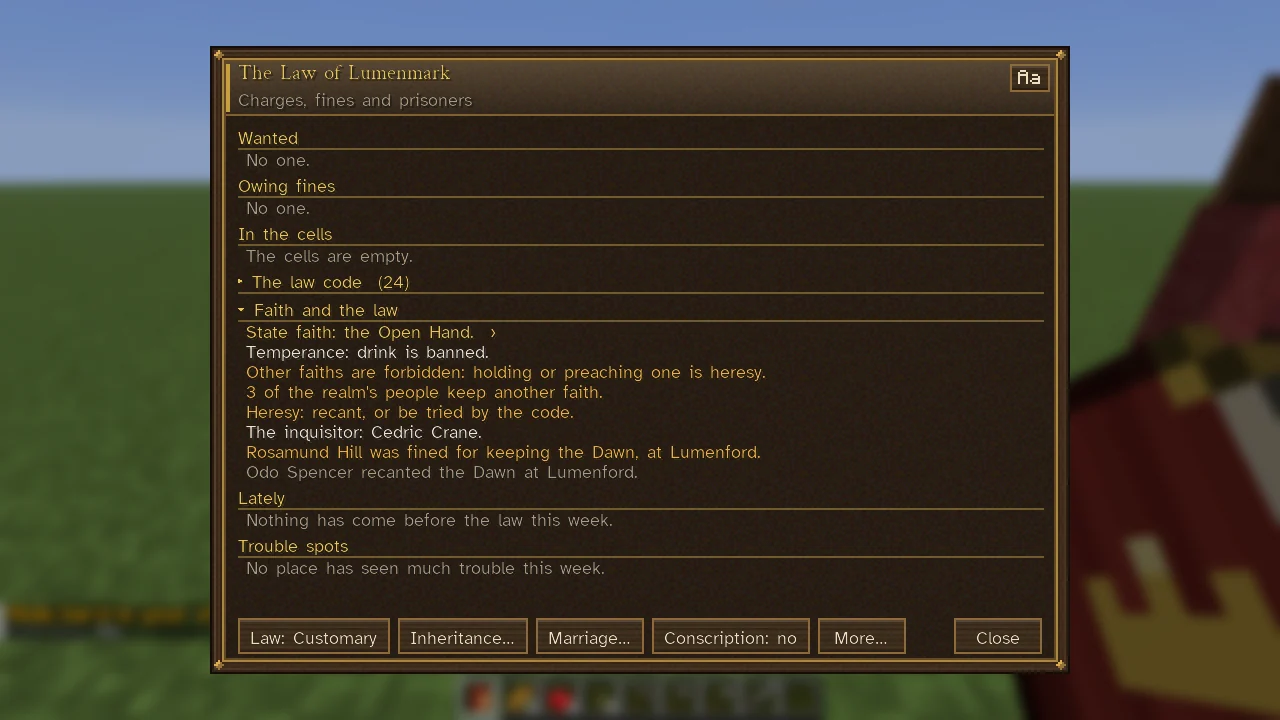
A realm's law book (the Command Table's Law tab, a jail's law book, or /realm law) has a section, Faith and the law, for the realm's members. Its choices are a magistrate's (see Magistrates and Codes of Law); under a council or an assembly they are put to a vote, each voter weighing them by their own faith and piety and their regard for the crown (see Government and Law-making).
State faith
State faith… proclaims a faith (or none). The realm holds it, but its towns keep the faiths they held: proclaiming turns no one, and those who keep another may become heretics under it. Its tenets marked "As law" above become the realm's law wherever the old code of the pious realms had a word on the same thing, and the law book lists them; what the faith does not hold is no longer forbidden by faith. Vice laws the sovereign or a magistrate has set themselves (see The Underworld) stand over it for drink, the tables and the pleasure houses, as a magistrate's own ruling on adultery does. With no state faith the old code stands, save that a pious realm whose own faith is a founded one (one it turned to, or proclaimed before) bans drink or the tables where that faith holds temperance or is against games of chance, and a realm of the world bans the dark road where it forbids the Nether.
Other faiths
Other faiths… sets how the realm takes the faiths it does not keep:
| Setting | What it does |
|---|---|
| Tolerated | Anyone may hold and preach any faith. |
| Favoured | Those of other faiths pay a crown a week into their town's treasury and think the worse of the crown for it. Preaching is no crime. |
| Forbidden | Holding or preaching another faith is heresy: the watch charges preaching, and an inquisitor goes town to town to find and try those who hold one. |
A realm of the world whose crown is of the pious temper favours its own faith unless it has set otherwise, and forbids the rest once it has seen another faith preached three times in a week, or five of one of its towns take up a founded faith.
Heresy and the inquisition
Preaching another faith where it is forbidden is Heresy, charged on the word of those who see it (alms in a faith's name are not). Its customary fine is 6 crowns and its sentence a day; it is petty under a lenient or customary law code and grave under a harsh one. Held for heresy alone, a player is offered Recant among the ways to answer it: take up the realm's faith, and the charges of heresy are dropped. See Crime and Punishment and Arrest and Jail.
Where other faiths are forbidden the realm has an inquisitor: one the magistrate appoints (Appoint an inquisitor…, from those of the realm's faith who are faithful in it among its clergy, priests and watch), else one named in the morning, the highest of the state faith's clergy among the realm's people, else its most devout priest or watchman. Every other day the inquisitor sets out with a watchman to the next of the realm's towns on their round, a journey that may be met on the road, and sits there a third of a day.
| Who | How they are found | What comes of it |
|---|---|---|
| The lukewarm and lapsed of another faith | They confess when questioned | They recant, and take up the realm's faith, cold in it |
| The faithful and devout of another faith | Named by any of the town who are faithful in the realm's faith and do not think well of them; a friend keeps quiet, and only one whom all of those think well of goes unnamed | Lenient code: fined. Customary: fined, or exiled if tried before. Harsh: the faithful recant, the devout are charged as grave and taken to the cells |
The town's devout of the realm's faith approve of the crown's zeal; the friends of the tried think the worse of it; the rest are afraid. The law book lists the last trials.
A player in the town who keeps another faith (keeping none is not the inquisition's business) is summoned if those who know them name them, and always if they founded or head their faith. The summons comes in the chat with [Recant], [Deny it] and [Stand by your faith]; within 24 blocks of the inquisitor, they ask it to your face in talk, and /inquisition answer brings their question up when you are that near.
- Recant: take up the realm's faith, at a piety of 30 at most, and go free.
- Deny it: believed only against a single word, never from a faith's founder or head, and once in each realm; otherwise you are charged.
- Stand by your faith: charged with heresy, and taken there and then by the inquisitor if the law code would exile or jail you and you stand within 24 blocks of them.
- Keep away until the sitting ends, and you are charged in your absence.
Regard
Each morning a realm's people feel its faith laws. The persecuted think the worse of the crown, and a town most of whose people are persecuted seethes. Under favour, the faithful of other faiths grumble. The devout think the better of a ruler of their own state faith, and the devout of the realm's faith the worse of a ruler of another. Between realms, "they keep another faith", "they persecute our faith" and "their ruler is cast out of our faith" rub, the more for a crown of the pious temper, and "one faith is the law of both our realms" binds (see Diplomacy and Envoys).
Holy war
A realm may declare a holy war by envoy, like any war (see War and Peace), only where its faith has a claim: a sacred site of its faith held by a town of a realm of another faith, or that realm's ruler cast out of its faith (the claim is their seat). Taking the town reaches the war's goal. Declared, the realm's faithful are glad of it, warmer to the crown and the more devout, unless their faith holds peace, which troubles them.
Casting out
A faith's head may cast a ruler out of it with Cast out a ruler… on its sheet: a ruler whose realm keeps the faith or who keeps it, never its head. A church's primate or a priesthood's high keeper does it alone; a fellowship's speaker puts it to its elders (the faith's priests), those who think well of the ruler stand against it, and it needs more for it than against. The ruler's faithful subjects think far the worse of them at once and the worse each day; their vassals of the faith think much the worse of them, and a vassal realm of the world that comes to think ill of them holds its oath loosed; the faith's other realms think the worse of them and may make holy war on them. Take back into the faith… lifts it.