Camp-ball
DiscussFrom the Sovereign Realms Encyclopedia
Camp-ball is the old folk football of the towns: a leather ball kicked between two goals. Anyone can play it with a Leather Ball and a pair of goals built from fences or walls, and towns turn out for a match on their own green of an evening, two sides in red and blue caps with a crowd at the touchlines. You can watch, kick a ball about alone, or join a match by kicking the match ball. A town's club keeps a roster of its players and their records, and a realm's clubs play a league for a champion each season.
The Leather Ball
The Leather Ball stacks to 16. It is crafted (the inventory's small grid will do) from two pieces of leather and a slime ball or a block of wool:
| Made from | Gives |
|---|---|
 Leather ×2 and a Slime Ball | 1 Leather Ball |
Leather ×2 and  any Wool | 1 Leather Ball |
A market of the world's towns has a pair among the goods it first opens with, so you may find one to buy (see Markets and Trade); no one makes balls to sell after that, so the sure way to have one is to craft it.
- Set it down: use the ball on the ground and it is placed there. That place becomes its spot, where it is set back after a goal.
- Toss it: use it in the air and it is tossed out ahead of you; its spot is where you stood.
- Pick it up: crouch and right-click the ball. Walking over a ball never picks it up.
Kicking the ball
- Running into it pushes it on ahead of you, faster than you were going. Walking with it carries it along at a walk, so you can dribble it. Townspeople and animals that run into a ball push it too.
- A blow (attacking it) kicks it hard the way you are looking, with a little lift. A fully charged swing kicks harder than a quick one, and a sprinting run-up adds more. Look up to loft it.
- A right click taps it gently along the ground.
- Arrows, snowballs and the like knock it along the way they came.
The ball rolls and bounces off walls. It slows quickly on sand, gravel, snow, mud, wool and farmland, a little less on grass, dirt and moss, and rolls far on paving; on ice it runs on longest. In water it floats and stops.
Goals
A goal is whatever stands on the ground; nothing needs to be declared. It is two posts of any fence or wall, each a column from the ground up, with a crossbar of fence or wall running over the whole gap between them. The open gap under the bar is the goal's mouth: it may be one to five blocks wide and one to three blocks high, and it must stand on the ground, not hang in the air. A ball that passes through the mouth, from either side, is a goal.
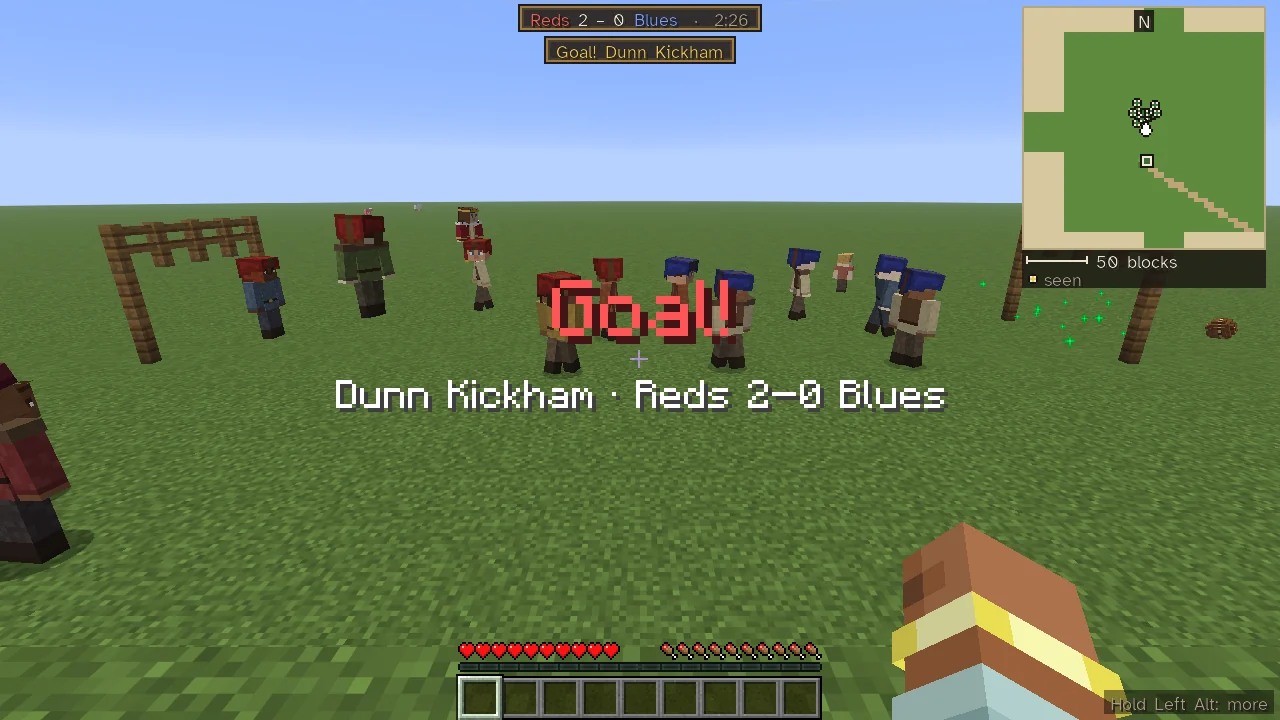
With your own ball, a goal brings up Goal! across the screen of every player within 32 blocks, naming whoever touched the ball last if they touched it in the last five seconds, with the number of goals scored with that ball ("Ada Miller scores (3)"), and the ball is set back on its spot a moment later.
Matches on the green
The green
A town's green is a stretch of level ground with a goal at each end, 22 blocks between the goal lines and 13 across. A town without one marks it out the first time a match is due while a player is near: the nearest open, natural ground under open sky, a little way out from its built core and no more than 64 blocks beyond it, clear of its buildings, fields, streets, walls and sold land. The ground is levelled, bare dirt is turfed, and a goal of spruce fence goes up at each end, its mouth three blocks wide and two high. The town's builders raise nothing on it afterwards. If its goals are pulled down, the town marks out another. A place with fewer than eight people aged twelve or more marks out no green.
When a town plays
A town plays one match a day, in dry weather, and only when a player is within 96 blocks of its green:
- of an evening after the day's work, between 17:00 and 18:00;
- on a holiday afternoon, from 14:00. A holiday is the realm's day of rest, where it keeps one, or a market holiday it has decreed (see Government and Law-making).
When a match is called, players nearby read in chat that the folk of the town are out on the green for a match of camp-ball.
The sides and the crowd
The town's people at their leisure within 80 blocks of the green turn out (not those at work, travelling, held or down). Those aged twelve to forty-nine and in good health play in even sides of three to five, the Reds and the Blues, each in a leather cap of their side's colour; without three a side there is no match. Children, elders, the hurt and anyone not picked make up the crowd, up to twelve, along both touchlines. A match is pressing to those in it: bed, the inn and the evening's errands wait for the final whistle, and only danger or starving breaks it off.
In play, a side of four or more keeps one player in goal, the two nearest the ball go after it in a scrum, and the rest hold places about the field. They carry the ball on, pass to a free player further up, and shoot when near enough, each with a knack of their own. A scoring side jumps for joy, the crowd cheers goals and play at either goal's mouth, and onlookers kick the ball back in when it comes out to them.
How a match runs
- The sides come out and line up in their own halves, the ball on the middle spot; a bell sounds for the first kick-off.
- Play runs for two and a half minutes. The Reds attack the east or south end, the Blues the west or north end.
- After a goal, the sides line up again with the ball back on the middle spot. A ball that stays well off the green, or in water, for a few seconds is called Out of play and set back on the spot too.
- A goal is credited to whoever touched the ball in the last five seconds; if they were of the side it counted against, it is an Own goal.
A match breaks up if either side falls below two, and it ends if no player has been near it for a while.
Joining a match
Step onto the green during a match and the chat says which side to join ("A match is on: kick the ball to join the Blues."). Kick the match ball, or run into it, and you join the side that is short; when the sides are even you join the Blues, and one of the Blues' own steps off to watch so the sides stay even. You are told which end you score at. Your side leaves more of the chasing to you and passes to you when you are free.
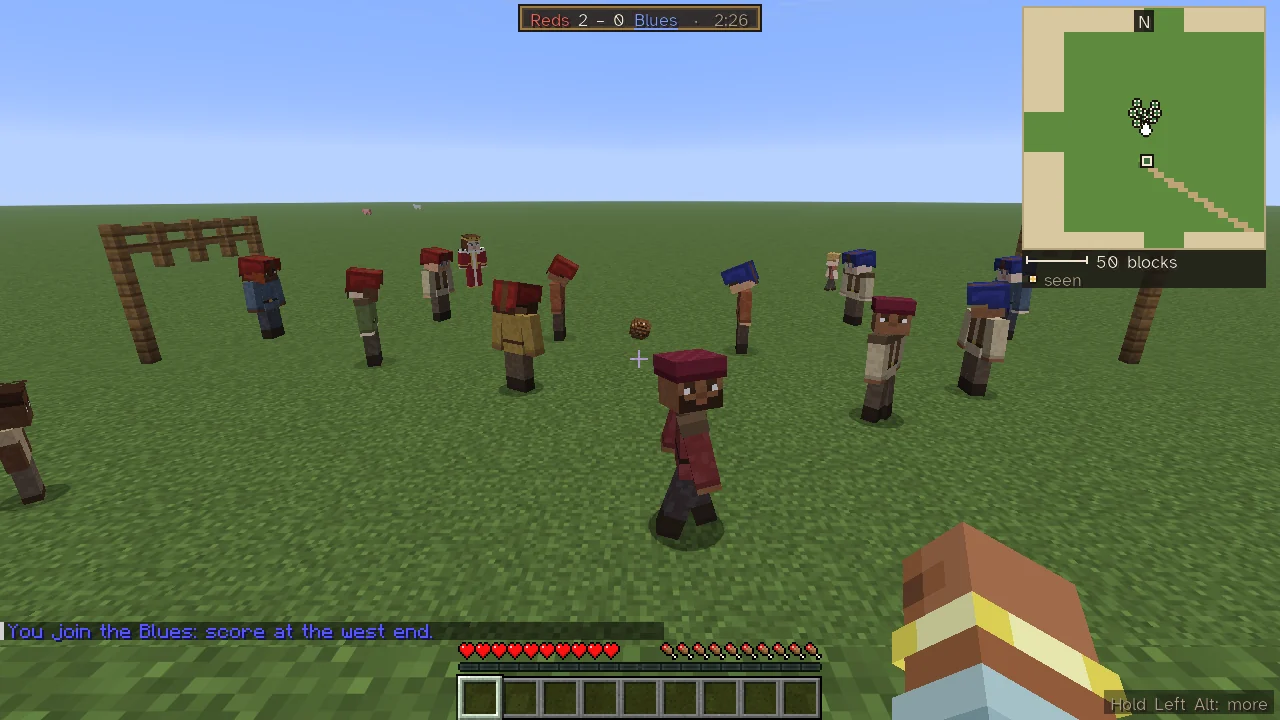
In the scrum, a blow at one of the match's own players or onlookers with the ball at your feet is taken as a kick of the ball, not an assault. To leave your side, walk off the green: after a while away you read "You leave the Blues, off the green." The match ball cannot be picked up while the match is on, and it is gone when the match ends.
The score on screen
Within 48 blocks of a green where a match is on, a small plaque at the top of the screen shows the score: Reds 2 – 1 Blues · 1:45, with the minutes and seconds of play left. Your own side's name is underlined. Under it a second line passes on what is happening: "The sides come out", "Goal! Ada Miller", "Own goal! …", "Out of play". Each goal also brings up Goal! across the middle of the screen, in the scoring side's colour, with the scorer and the score. Holding Left Alt spells the plaque out, with how to join or which side you play for (see Controls and Key Bindings).
After the match
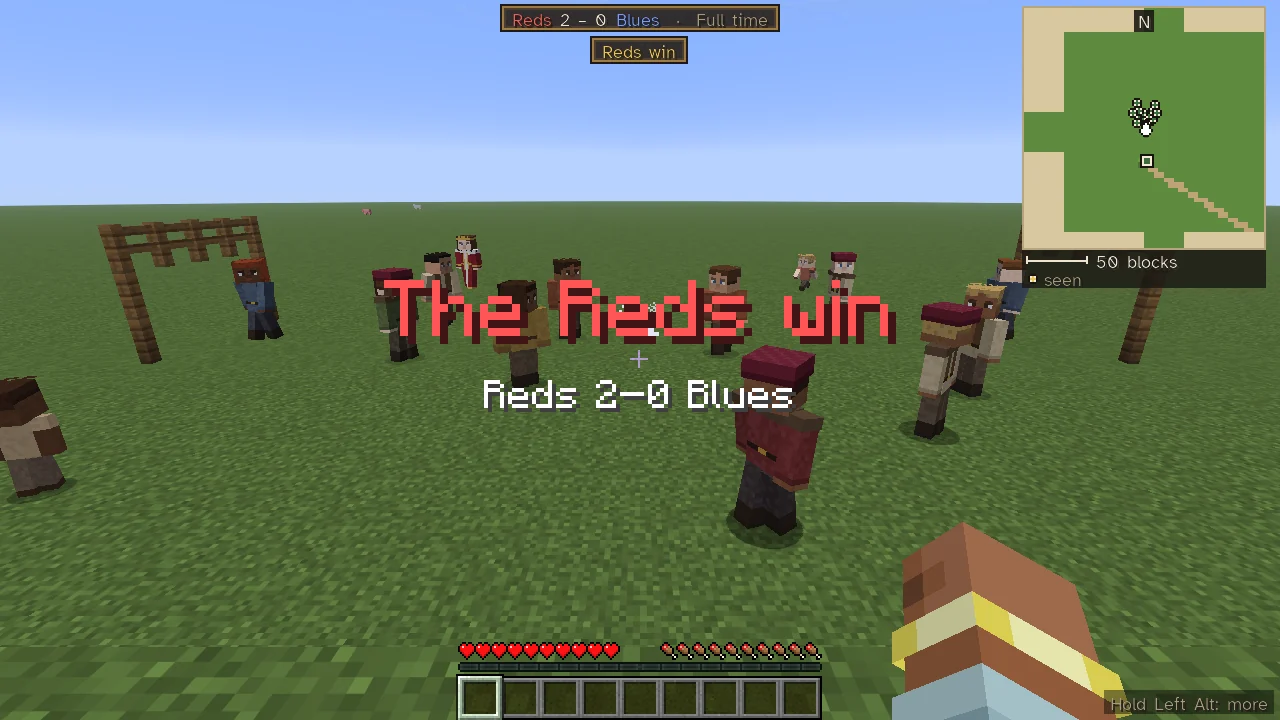
At full time the plaque shows Full time in place of the clock and the result beneath it ("Reds win", "Blues win" or "A draw") for a few seconds, the winner is announced across the screen, and players nearby read the result in chat ("Full time on Kickham's green: the Reds win 2–0.").
A match played out becomes news that those who saw it pass on in talk (see Talking with People), and leaves feelings in those who were there (see Townspeople):
| Feeling | Mood | For |
|---|---|---|
| Scored a goal at camp-ball | +4 | a day |
| Won at camp-ball on the green | +4 | a day |
| A drawn match at camp-ball | +2 | half a day |
| Watched the match on the green | +2 | half a day |
| Lost at camp-ball on the green | −1 | half a day |
While it lasts, the sheet of a townsperson on a side reads "Playing camp-ball for the Reds" (or the Blues), and an onlooker's "Watching the match on the green".
Clubs and the league
A town's club
A town has a club named for it once a match is played on its green or its realm's league takes it in. The club's roster holds up to ten of its own townsfolk, signed as a league season begins: those aged 14 to 45 who live in the town, the best at the game first. Everyone who plays a match on its green to full time goes on its roster too, players included; a player who then plays on another town's green moves to that town's club. The dead and those who have moved away are struck off as the next season begins.
Everyone on a roster keeps a record across matches and seasons: matches played, goals, wins, draws and losses. A match on the green counts in the record of everyone who played in it, if it was played out and not broken off, and each player in it reads their own in chat at full time ("Your camp-ball record: 3 goals, 5 matches, for Kingsmead.").
How well a townsperson plays is their make: best in their twenties, a little by a knack of their own, better if hardy, brave or industrious and worse if sickly, craven or lazy, better again for a swordsman's footwork, and a little better for the matches and goals behind them.
The league
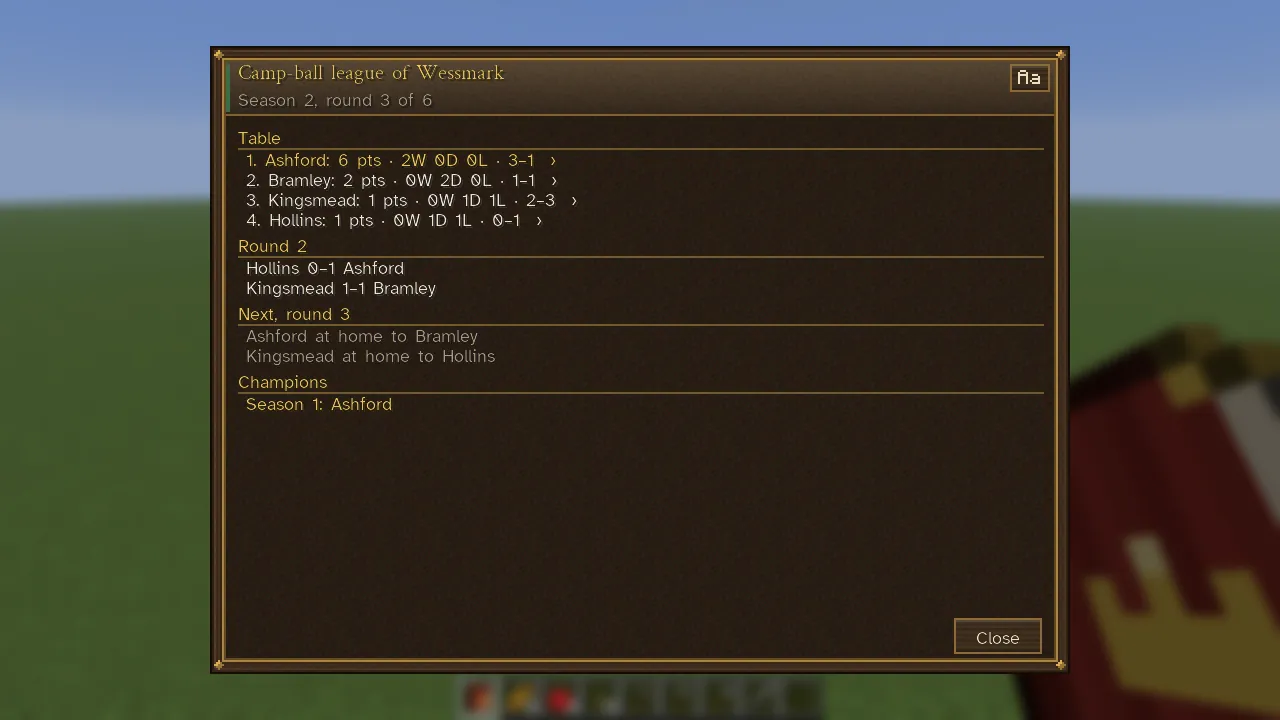
A realm's towns of twelve or more, its eight biggest at most, each field a club in its league, once it has two. A season is every club against every other twice, at home and away, a round a day. A round is played at 16:00 (or at once, where a whole day passed without one). A win earns 3 points and a draw 1; the table goes by points, then goal difference, then goals scored.
League matches are not played out on a green before you: each is reckoned from the best five of each club who can play that day (on its roster, at home in their town, not on the road and not in a match on a green), a side short of five made up with townsfolk of no great skill. The stronger side scores more as a rule, the home side a little more, and each goal goes to one of the five, the better players more often; every one of them has the match in their record. Players play for their club on its green, not in the league. A match is played at the home club's green unless a player is within 160 blocks of the home town's heart and none of the visitors', when it is played at the visitors' green.
After the last round the club at the top of the table is champion. It is told once: in the realm's chronicle and to its members, as news to the realms that know it, and to other players near the town ("The camp-ball league of Wessmark is won by Ashford, with 14 points (season 2)."), and the champion town's people talk of it. The next season begins the day after, with the realm's biggest towns as they stand then.
Reading the league
- A town's sheet, under The place, has Camp-ball: its side and the league › where the town has a club or a green, opening its club's page.
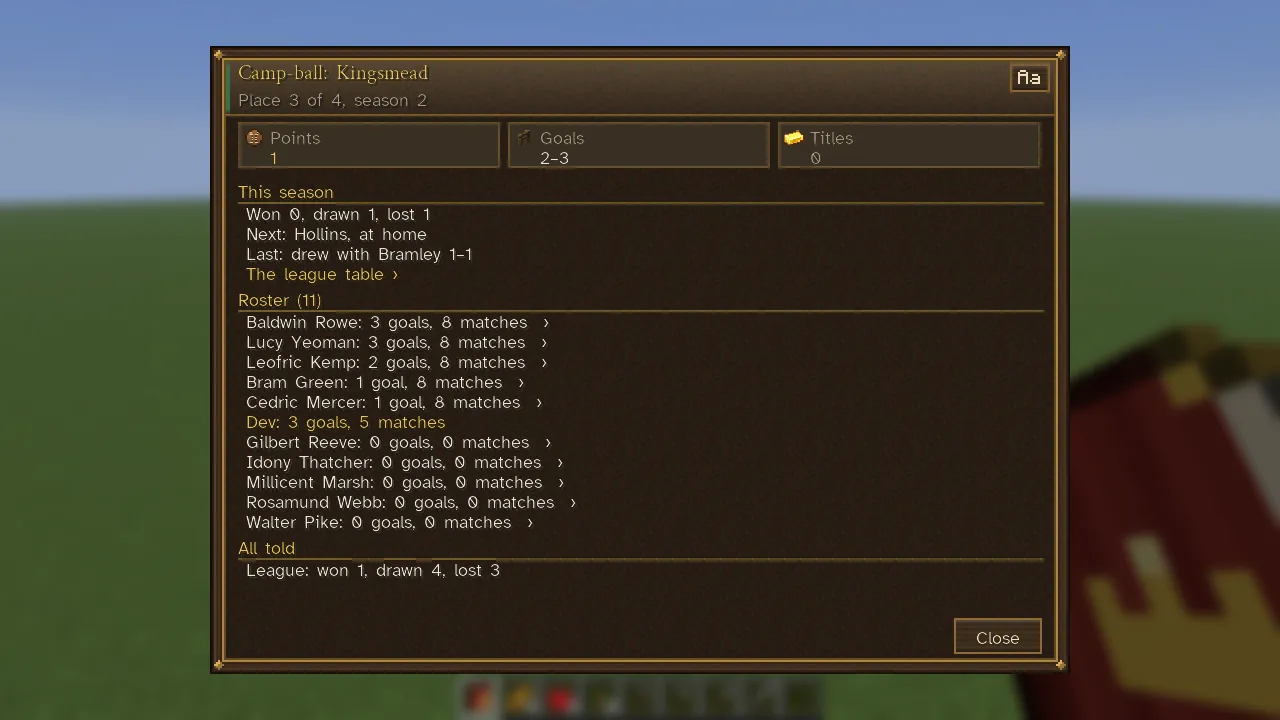
- A club's page (Camp-ball: Kingsmead) gives its place under its name ("Place 3 of 4, season 2", "Champions, season 2", or "It plays on its green" outside a league), then tiles for its Points (a click opens the league table), its Goals scored and let in this season and its Titles. This season has its wins, draws and losses, its next match ("Next: Hollins, at home" or "Next: at Hollins") and its last ("Last: drew with Bramley 1–1"), with The league table ›. The Roster lists those who have played most first, each with their goals and matches; players are in gold, and a townsperson's line opens their sheet. All told has its league record and its matches on its green.
- The league table (Camp-ball league of Wessmark) gives the season and round, the Table (each club's points, wins, draws, losses and goals, a click opening its page), the last round's results, the next round's matches ("Ashford at home to Bramley") and the past Champions.
- Your own record is on the Who page of your You sheet once you have played a match ("Camp-ball: 3 goals, 5 matches ›", opening your club).
- A townsperson's record is on the Life page of their sheet ("Plays for Kingsmead: 3 goals, 8 matches", opening their club).