Government and Law-making
DiscussFrom the Sovereign Realms Encyclopedia
Government is how a realm decides things: who may change its laws, what those laws are, and what its people make of them. A sovereign sets taxes, rations, wages, justice and more; the people, in turn, judge the rule by how well it feeds them and by whether it seems rightful. A rule they dislike is a rule they may petition against, organise against in a faction, or, in a distant town, rise against.
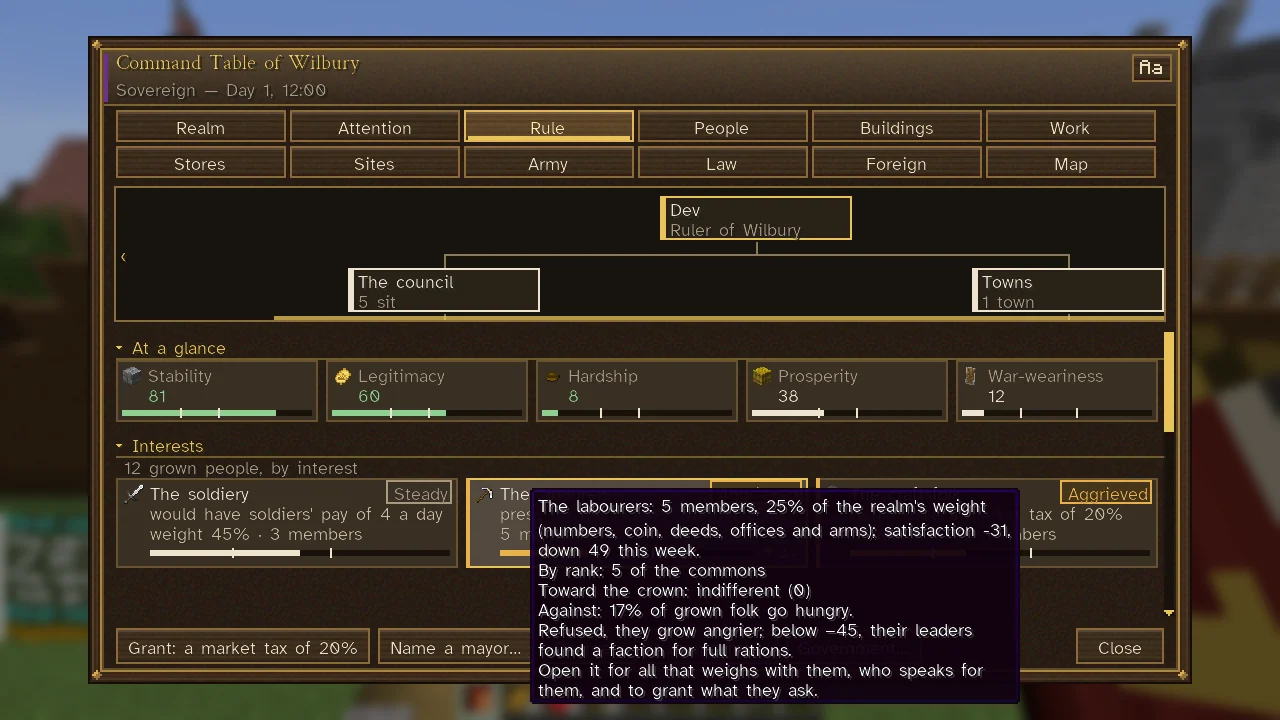
The Command Table's Rule tab is where a ruler reads and changes all this. It answers "who wants what, and what happens if I refuse?" first: under the chart of offices stand the realm's measures as tiles, its interests as cards, and the demand that presses hardest, weighed. Government, the crown, who makes the law, what the people think, offices, what is owed, succession and decrees follow. Citizens of the realm read the same matters from the government page (/realm government, or from a town's heart).
What kind of government is it?
The game never asks you to choose a form of government from a list. It reads it from how the realm is actually run, and the name changes when the laws change. A realm may be several things at once (a feudal command economy, a martial assembly), and each label gives its reasons on hover. The labels are descriptions only; nothing is gated by them.
| Label | What makes it so (examples) |
|---|---|
| Command economy | All the harvest to the granary, stewards setting everyone to work, full rations, households keeping only a week's food, a closed market. |
| Market economy | Producers own their harvest, people choose their work, craftsmen keep a share, no rations, light taxes, open to foreign traders. |
| Authoritarian | The crown's word is law; harsh law; a curfew; conscription; emergency powers; unwritten law that may change any day. |
| Constitutional, Conciliar, Republican, Democratic | A council or assembly shares in making the law; the law is written; a law must stand some days before it changes; no charge on one townsman's word. |
| Feudal | Notables above the common law, tithes, food dues, labour dues, service in arms, officers paid above workers. |
| Social welfare | Full rations, children fed first, a day of rest, short days, care at dangerous work, debts lately forgiven. |
| Martial | Conscription, soldiers paid above any trade and fed first, the watch called out, at war. |
Together with the realm's size and who wears the crown, these give the phrase that heads the tab's Government section (and the Realm tab's How it is ruled), such as "A martial lordship", "An authoritarian command-economy kingdom" or "A commonwealth".
Who makes the law
A realm's governance is one of three. The sovereign or a steward changes it from Government….
| Governance | Who changes the law and decrees |
|---|---|
| The crown's word | The sovereign and stewards, as they please. |
| A council of notables | Changes are put to a council of the realm's notables (its officers, masters of the crafts and elders), who weigh them by their own lights and their faith in the crown; a majority carries them. |
| An assembly of the people | Changes are put to every grown citizen; a majority carries them. The crown cannot give up the assembly without its leave. |
Each voter weighs a change by how well the laws would fit them afterward (see Leanings below), by what it does to their own purse and belly, and by their faith in the crown that asks. A change a majority favours is carried; otherwise it is refused.
The council, mayors and governors
A realm keeps offices, held by its own people and paid a stipend from the treasury beside their trade:
- The council has five, seven or nine seats, by the realm's size. A new realm's council is seated the first time it is called on, as early as the first opening of the Command Table, and its councillors draw their stipends from then (the Realm tab's Wages tile counts them). How seats are filled is a law: The notables (those who stand highest), The crown's choice (the most loyal), The wealthy (the richest citizens: an oligarchy) or Elected (every citizen votes each fortnight).
- A mayor for each town of six grown people or more. How a town comes by its mayor is a law: Reeves of the crown (named, and dismissed if they turn against it), Chartered towns (the town elects each fortnight) or Lords of the manor (the office passes to the eldest grown child; each household owes its lord a crown a week). A loyal mayor keeps a town from rising; a bitter one leads it.
- A governor for each land of the realm (its island or continent) but its seat's, chosen from that land's mayors (else its notables), the most loyal to the crown and highest in station; they keep it while they live free in the realm. A bitter governor in a time of trouble takes their land out of the realm when one of its towns rises.
- Army officers. Commissions are won By merit, By purchase or By birth, by law. See Military Career.
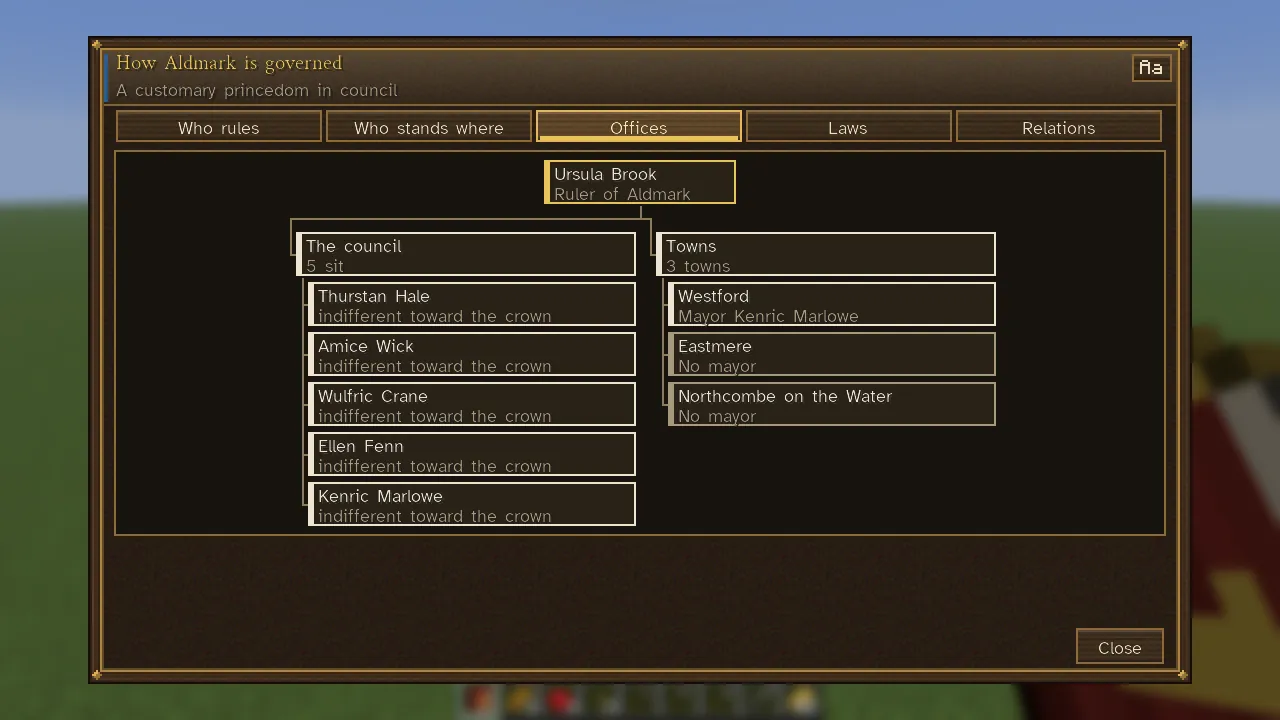
The chart at the top of the Rule tab draws all of these, with the crown above. A chart too wide for its frame is laid tall instead: the ruler across the top, and beneath it the council, the governors, the towns with their mayors, the army's officers and a player realm's officers of rank, each heading a column with its people a step in beneath, every name whole and nothing to scroll sideways. Where room is short each place takes one line, its detail after its name and the whole of it on its hover; a chart taller than its frame has a scroll bar. Each holder opens their page, and a town its own. Under the Reeves of the crown law, the sovereign may Name a mayor… for a town.
The government page
A realm's government page, titled "How Aldmark is governed" for Aldmark, is its government as its people read it. Open it with /realm government (your own realm, or the realm whose town you stand in), with How it is governed on a town's sheet or a click on the town's card, from your own page, or in talk with its lawmakers and officials. Its own people may read it, and so may anyone whose realm knows the realm or who stands within 64 blocks of one of its Town Hearts. Under its title and the kind of rule, five tabs stand in one row:
- Who rules: who decides (the crown alone, the council by name, or every grown citizen), drawn as a chart, with the town's mayor and the land's governor; the petitions before the lawmakers and how they stand as far as you have heard; and what a citizen can do. A player on the throne answers petitions here.
- Who stands where: only what you have heard people say, and when.
- Offices: the chart of offices with the page to itself, laid out as above.
- Laws: each law in plain words, what it does on its hover and a click for who stands for and against changing it; how law is made; what changed lately; and the petitions decided.
- Relations: how the realm stands with every realm it deals with, a card each. See Diplomacy and Envoys.
Changing the law
Under the Rule tab's Law-making… and Government… buttons, the Stores tab's Policy… and the Law tab's choices, a ruler changes the laws. There are dozens: among them the head tax, the wages of workers, craftsmen, officers and soldiers, the market tax, the toll on foreign traders, rations and who is rationed first, the food due, the harvest share and the makers' share, hours and the day of rest, conscription, curfew, the corvée, the market's openness, severity of justice, proof needed to charge, privilege, how households' stores are kept, the realm's enterprise law, building code, its game law (who may hunt its land: by its people's custom, open, licensed or the crown's forest) and more. See Treasury and Taxes, Households and Wages and Magistrates and Codes of Law. The laws of faith, a state faith proclaimed and other faiths tolerated, favoured or forbidden, are in the law book's Faith and the law and are put to the council or assembly, whose members weigh them by their own faith and piety and their regard for the crown; see Religion.
How the law is bound is itself law:
- Written or unwritten. Written law costs a sheet of paper for each change or decree and is trusted the more for it. Unwritten law is whatever the crown, council or assembly carried, as people remember it.
- How long a law stands. Any day, 3 days or 7 days before it may be changed again: steadier, and trusted for it.
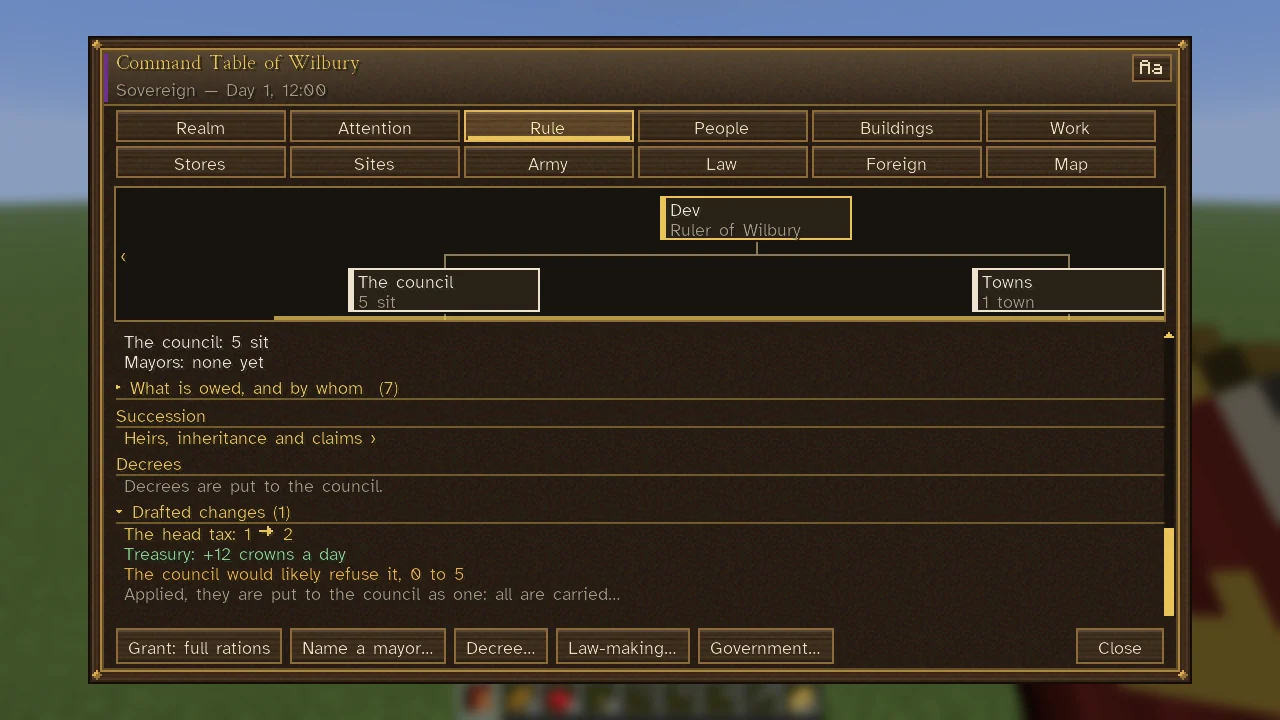
- Drafting. Changes may be made one at a time, or drafted together beside the law as it stands and applied at once. Under a council or an assembly a draft is put to one vote: all carried or none, so a hard change may be carried with a welcome one. The Drafted changes section lists each change ("The head tax: 1 → 2") with what it would do on its hover, what the draft would bring the treasuries a day all told, and how the council or assembly would likely vote on it now, with those against named on the hover.
- Emergency powers. A decree: for seven days the crown changes laws and decrees without a council, assembly or waiting, and a charge needs only one witness. Feared and resented by those who value liberty.
A law the crown promised a faction it would keep cannot be changed for twenty days. See Factions and Demands.
Weighing a change before it is made
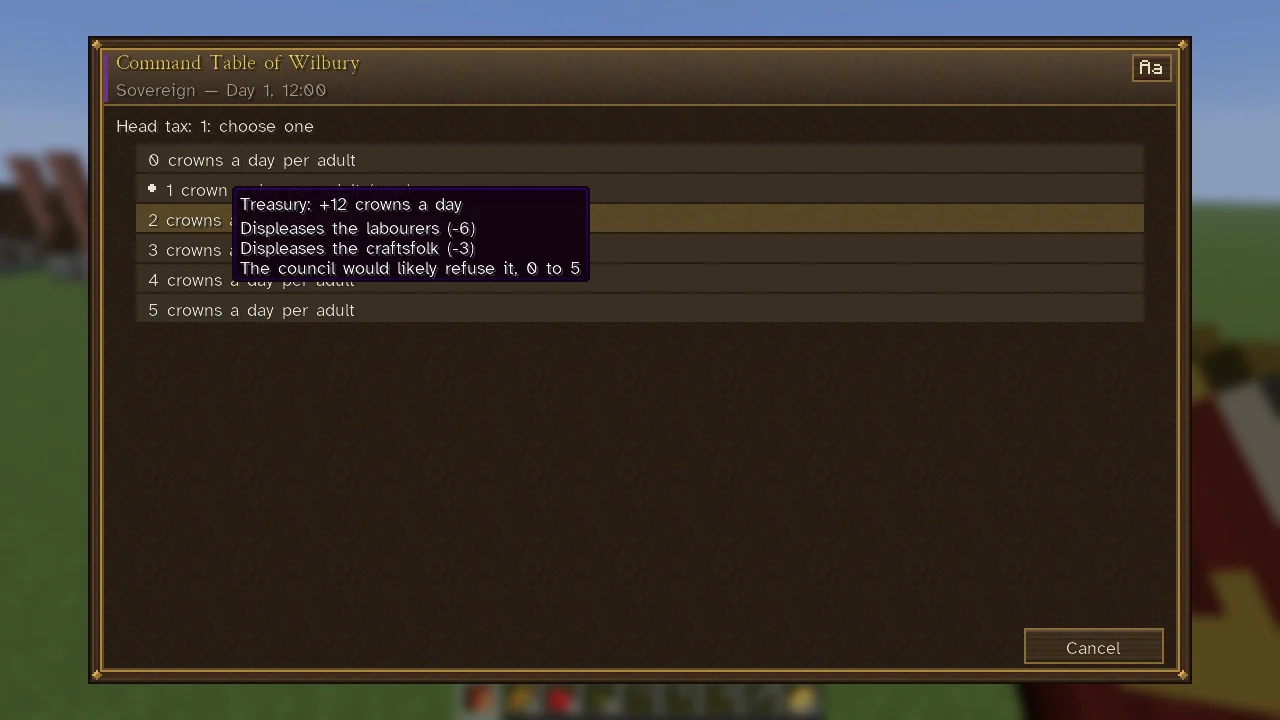
A ruler need not find out days later what a change does. Each option of a law, on the Stores tab's Policy… list and the Rule tab's Government… list, says on its hover what it would do, a line each, as far as it can be foretold:
| Line | Example | What it reads |
|---|---|---|
| The treasury | "Treasury: +12 crowns a day" | What it would bring the treasuries or cost them a day, reckoned from the realm's last whole day of books; where it is not in coin, what it does to the granaries, the work or the levy ("Granaries: run down faster"). |
| The interests | "Displeases the labourers (-6)" | The two interests whose weighing of the realm it would move most: Pleases, Displeases, or Angers for a fall of 10 or more. |
| The vote | "The council would likely refuse it, 0 to 5" | Under a council or an assembly, how those who vote would vote on it now, each by their leanings, their own purse and their trust in the crown. None under the crown's word or emergency powers. |
| The wait | "The law must stand 2 days more before it changes" | Where the law must stand some days before it changes again. |
The forecast changes nothing: the law is tried, weighed and set back. The same likely vote stands on the Law tab's choices, on the grant chips of a demand weighed, and under a draft (see above).
Citizens' petitions
A citizen never changes the law themselves. They may file a petition for a change at the government page, for a clerk's fee of 5 crowns into the treasury, one at a time. It is heard the day after next at the soonest. Under a council or assembly it is put to a vote; under the crown's word a player on the throne is told and answers from the government page, and one left unanswered for three days lapses. Before it comes to the vote, citizens can lobby the lawmakers in conversation, but a second urging the same day only annoys. See Talking with People.
Decrees
A decree is a short, sharp act, each spending something real (food, coin, goodwill, paper) and felt by the people. Press Decree… on the Rule tab. A decree may be made once a day, and each kind once a week (emergency powers once in twenty days). Each asks twice, and under a council or assembly is put to it like a law, and may be refused.
| Decree | Effect |
|---|---|
| A feast | Two days' food for everyone, from the granaries: a day of plenty, and gratitude to the crown. |
| An emergency levy | Two crowns from every grown person's purse into the treasury. Resented. |
| An amnesty of debts | Every household's arrears to the realm forgiven. |
| Open the granaries | Full rations for three days, whatever the law. |
| A requisition | Arms, armour and food beyond two days' eating taken into the town's stores. Resented, most of all in peace. |
| Public works | For three days the idle are pressed to build at the realm's sites and paid three crowns each. |
| A market holiday | Three days with no market tax and no toll on foreign traders. |
| An emergency curfew | Everyone home by dusk for three nights. |
| Call out the watch | For three days the companies at home patrol the streets, paid two crowns more each from the treasury. |
| Call out the levy | In war: one in five of each town's able commoners called from their work to arms, the idle and the land's hands first, for forty days or until peace. Their work waits; the treasury pays each half a soldier's wage. |
| Restitution | Three crowns to each wronged this week. |
| A public hearing | Everyone in the cells for lesser crimes is heard and set free; those held for violence stay. |
| Emergency powers | See above. |
The levy on the Rule tab
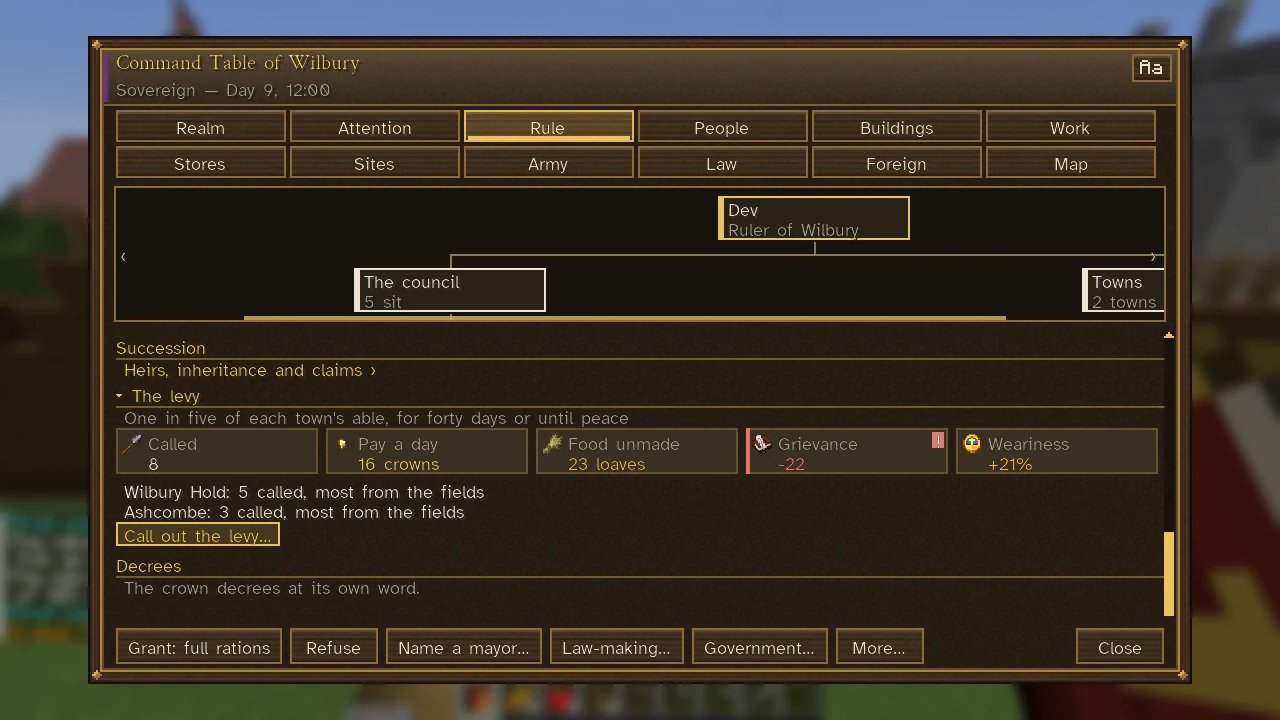
At war, or while the levy is out, the Rule tab shows The levy above the decrees, as the Army tab does: what calling it out would come to now (who comes out of which work in each town, their pay against the treasury's days of wages, the food left unmade, the interests' grievance and the war's weariness), how a council or assembly would vote on it, and Call out the levy…. The decree's own row in the Decree… list gives the same reckoning on its hover. The call is refused, saying why, at peace, while the levy is out, or when the treasuries do not hold a week of its pay. Once the levy is out, the section shows its companies and the hands its towns are short, with Stand the levy down…, which the sovereign, a steward or a marshal may choose at any time without a vote. While it is out, the labourers, the landed and the craftsfolk hold it against the crown, each by how many of theirs or of their hands it keeps from work. See Armies and Soldiers for the whole of it.
What the people think
The Rule tab reads the realm's mind each morning, from each grown person as they are (never set), on a scale of 0 to 100. The reading is kept once a day, and the Rule tab and the Realm tab show the same morning's reading. Three of the measures open the tab as tiles under At a glance: Stability, Legitimacy and Hardship, each on a meter marked at 30 and 50, with how it moved in a week and, on hover, what moves it. All seven are listed under What the people think, with the week's turn and the causes on hover.
| Measure | What it follows |
|---|---|
| Prosperity | How fed, housed and content they are: coin in the purse, wages paid, spirits. |
| Hardship | Hunger, no home, wages unpaid, debts to the realm, heavy taxes, dues they could not give. Worse when high. |
| Legitimacy | How well the laws fit what people want, whether they have a say (a council or assembly), whether the law is written and stands, and whether it was forced on them. |
| Fear | Harsh law, curfew, conscription, emergency powers, the watch called out, and what they have seen of arrests, seizures and the cells. Worse when high. |
| Loyalty | Their regard for the crown. |
| Resentment | The grievances behind it. Worse when high. |
| Stability | Food, legitimacy, loyalty and safety against resentment. |
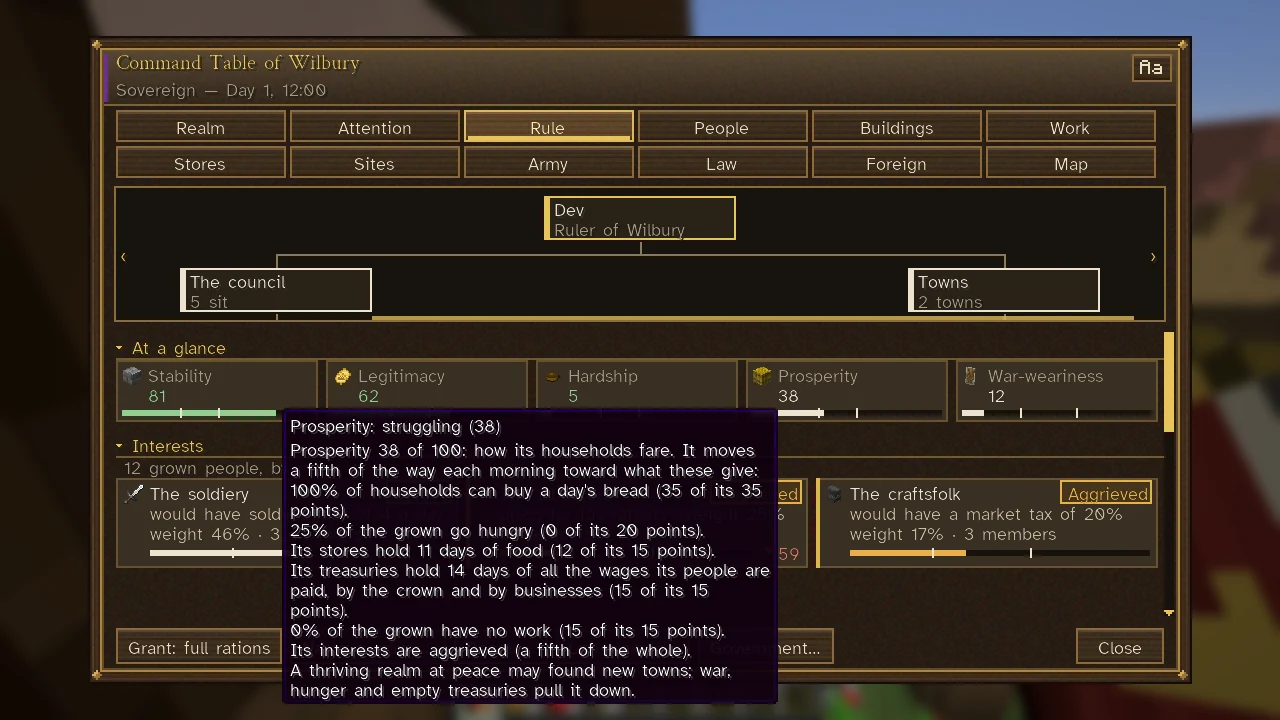
In words: 80 and over is very high, 60 high, 40 middling, 20 low, below that very low. The Prosperity here is as the people feel it, asked one by one; the realm's own prosperity, read from its towns' days, is the tile at the top of the tab (see A demand weighed, below).
Leanings
People lean along four lines: order or liberty, the common granary or their own, arms or plenty, and old ways or new. The laws as a whole lean the same ways: harsh law and a curfew toward order, full rations and a granary that takes all toward the commons, conscription toward arms, the crown's word and notables' privileges toward the old ways. How well the laws fit someone's leanings is how rightful the rule seems to them, and it turns their regard for the crown day by day. The Rule tab shows what people want that the laws do not give them.
Regard for the crown
Each person's regard for the crown is built day by day from wages paid or owed, taxes, hunger the realm let happen, homes, rations, the law's hand, seizures, being pressed into service and feeling safe. The disaffected work grudgingly; the loyal a little harder. They will not take up arms for a crown they have no faith in, unless pressed. A town that turns against the crown gathers at its Town Heart in protest instead of working.
Interests
Each grown person belongs to one interest, by what they live by: the soldiery (who bear arms), the clergy (who serve the church), the landed, the merchants and the craftsfolk (who live by land, trade or a workshop of their own, or a craft), and the labourers (who live by their hands). The Rule tab shows each interest as a card: its mood on a chip (Content, Steady, Uneasy, Aggrieved or Angry), what it wants ("press for full rations", "would have no conscription"), its weight in the realm (its numbers, coin, deeds, offices and arms) and its members, and its satisfaction on a meter marked where it grows angry (−45) and where it is content (20), with how far it moved this week. An aggrieved interest urges its members on, and when its satisfaction falls to −45 or lower its leaders found a faction for its demand. A card's hover says what weighs with the interest, who its people are by rank and what follows a refusal; a click opens its page, which names who speaks for it and offers to grant what it asks. Each morning an interest's satisfaction moves two-fifths of the way toward what weighs with it. See Factions and Demands.
A demand weighed
Under the cards, the Rule tab weighs the demand that presses hardest: of the interests that are heard and uneasy or worse, one that presses (the angriest first), else the unhappiest. Its heading says who asks what ("The merchants press for a market tax of 20%"), with the law as it stands under it. Then two columns of chips, side by side where the window is wide:
- If you grant it: how far each interest's weighing of the realm would move, the asker first, in green or red (the law is tried and put back, nothing changed); what it costs the crown, reckoned from the realm's books (their last whole day) and its towns' last day; and, under a council or an assembly, a chip of its likely vote ("The council 4 to 3"), green if it would be carried, red if refused. A change felt through the realm's days, such as rations, says that the asker's lot eases "in time".
- If you refuse: where the asker's satisfaction is heading as the law stands, and what follows: the faction the crown already knows of for the same demand, a faction founded, or the mark (−45) at which one will be.
Grant: … is the first button on the bar. It asks for a yes, then puts the change to the realm's law-making as any change is (where a council carries the law, it votes at once); the law changes at once and the interest weighs it at the next morning's reading. Until then its page says so. The next morning the morning report gives their answer: how their satisfaction moved ("The labourers: satisfaction -20 → -8.") if they have been read since, or else whether they are glad of it or resent it and how far what weighs with them moved, which their page also gives until they are read again.
The realm's prosperity and war-weariness are tiles at the head of the Rule tab, beside the people's measures. Prosperity is a reading from the towns' days, out of 100: households able to buy a day's bread (35 points), no hunger (20), days of food in store (15), days of wages in the treasuries (15), work for all (15); a fifth of the reading also follows how content the interests are. It moves a fifth of the way toward that each morning, and its tile's hover names the day its causes were read on. A thriving realm at peace may found new towns; war, hunger and empty treasuries pull it down. War-weariness rises with the fallen, hunger, wages owed and each day at war, and fades in peace; its tile opens the Foreign tab.
The morning report
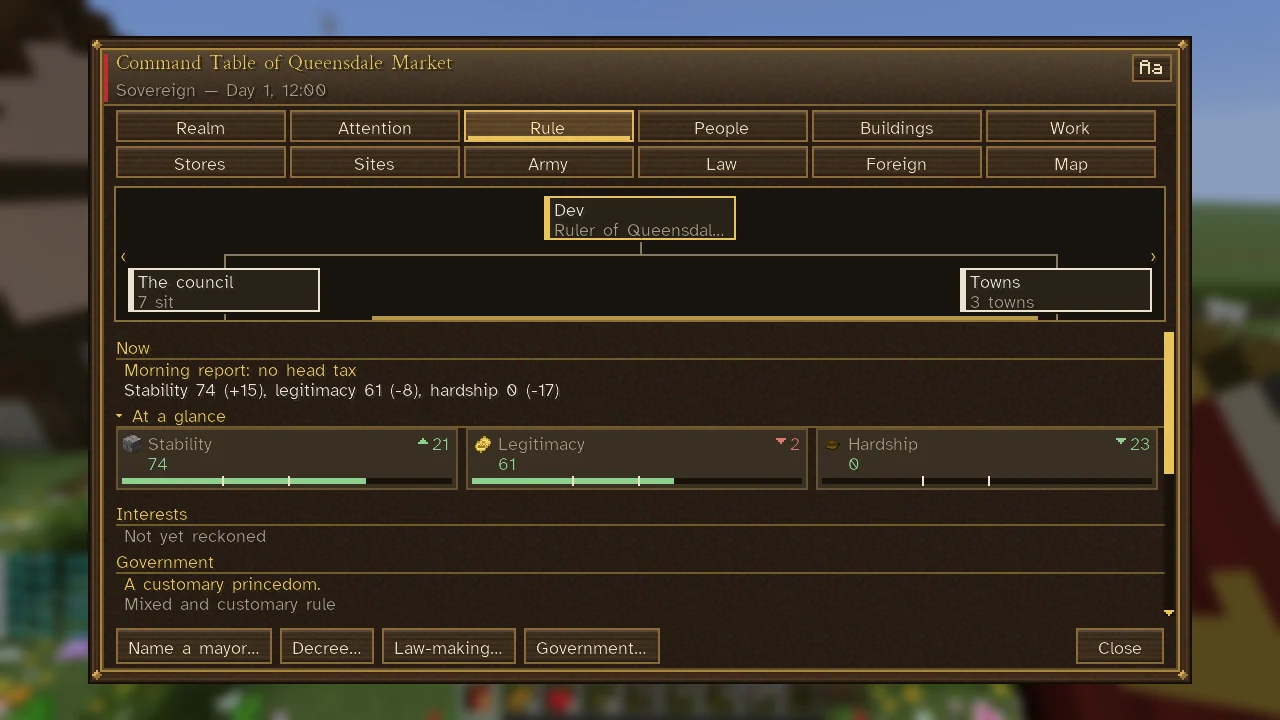
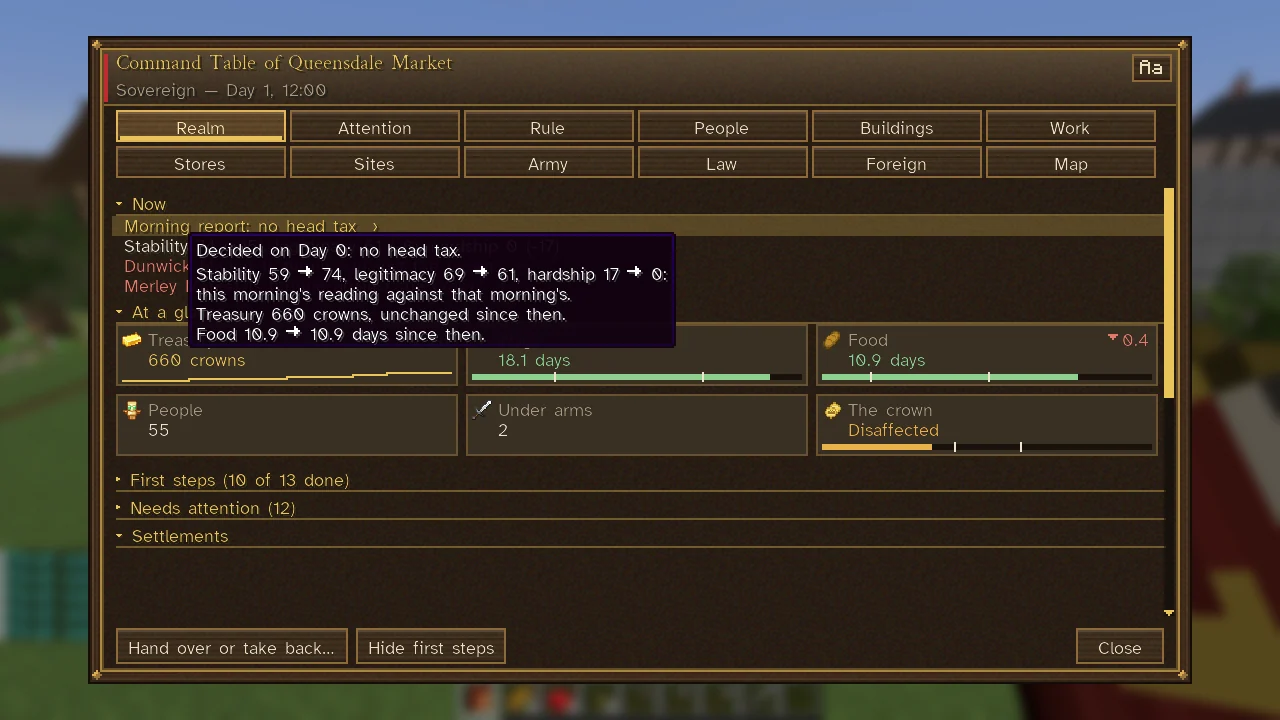
On the morning after the crown changes a law or a tax, grants an interest's demand, calls out the levy or has its levy home, a realm with a player in it hears how its people took it. Two rows head both the Realm tab and the Rule tab, under Now: "Morning report:" and what was decided ("Morning report: no head tax"), then this morning's Stability, Legitimacy and Hardship, each with how far it moved since the morning of the decision, or "(held)". Their hover gives the day it was decided, what a levy's call or its account home came to, each measure then and now, the treasury in crowns and the realm's days of food then and now, and, after a grant, the interest's answer. Its sovereign and officers are told the same in gold in chat; a plain member hears it after choosing to hear all of the realm's affairs (see The Sovereign's Companion). Several decisions on one day are reported together. A decision made before the server restarts is not reported.
When the people rise
A town other than the seat whose grown people mostly hate the crown, with too thin a garrison to hold them, may rise: its lord is warned first, and on a morning it can break away. See Factions and Demands for the people's causes and civil war.
The crown
The crown's own laws, set by the sovereign alone, say what happens when they are away: who rules as regent (the first officer, the consort, the heir or the council), how long until they are presumed dead (never, or after 7, 14, 30 or 60 days), who takes the crown (by blood, election or acclaim), and what a returning sovereign finds (restored, or a pretender). See Dynasties and Succession and Citizenship and Ranks.