Music
DiscussFrom the Sovereign Realms Encyclopedia
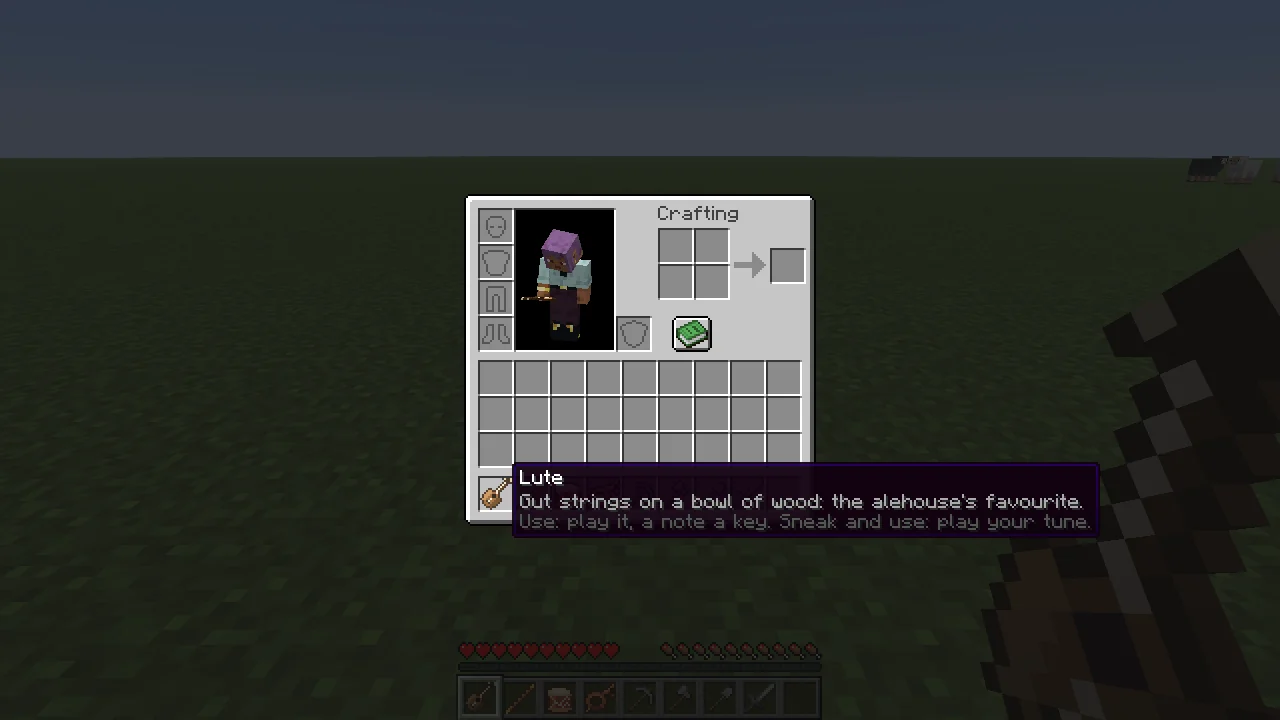
Music is played on four instruments, the Lute, the Flute, the Drum and the Horn, which you can craft or buy. With one in hand you can play notes by key or play a tune you know straight through, and everyone within earshot hears it. The towns have their own musicians: minstrels who play at the alehouse of an evening and in the square on feast days, and the bard who plays the lute at the inn. Townspeople who hear music are the gladder for it, and some will toss a crown to a player who plays well.
The instruments
Each instrument plays two octaves, as a note block does, in a voice of its own. None of them stack.
| Instrument | Voice | Made from |
|---|---|---|
| Lute | Plucked strings, the note block's guitar |  Planks ×3,  String,  Stick |
| Flute | The note block's flute | Sticks ×3 |
| Drum | A tabor: the big drum on the low notes, a snare on the high | Planks ×5, String ×2,  Leather |
| Horn | A deep call, the note block's didgeridoo |  Copper Ingots ×3 |
The recipes are shaped, and any planks will do:
- Lute: a stick in the top right corner; a plank and a string across the middle row; two planks in the bottom row.
- Flute: three sticks in a diagonal line, corner to corner.
- Drum: string, leather, string across the top; a plank at each side of the middle row; three planks across the bottom.
- Horn: three copper ingots in an L, one over two (it fits the inventory's small grid).
Some shops of the world's towns have them among the goods a shop opens with: a joinery in a town of 15 people or more with a lute and a flute, and from 40 people a drum too; a smithy from 15 people with a horn; and a market from 40 people with a lute and a flute (see Markets and Trade).
Playing
Use an instrument (in either hand) and its play screen opens: a small panel at the foot of the screen, with the world still in view and the game not paused. It has two rows of eight keys, each row a major scale over an octave:
- 1 to 8 play the low row (the number pad's 1 to 8 as well);
- Q W E R T Y U I play the high row, an octave up (or hold Shift with 1 to 8);
- a click on a key plays it too. A key lights gold as it sounds, and up to three notes can be struck at once.
Under the keys stand the tunes you know. Click one and it is played straight through for all to hear, its name shown with a ♪ at the panel's top corner. Striking a note of your own breaks it off. While there are tunes you have not learned, the panel says "A bard or a minstrel will teach you more tunes." Its foot reads "1 to 8 and Q to I play notes · Esc puts it away".
Sneak and use the instrument to play your chosen tune at once, without the screen (its name shows above the hotbar); sneak and use it again to stop. Your chosen tune is the last one you played from the screen or the last you learned, and The Morning Bells to begin with. Putting the instrument out of your hands stops a tune.
Every note is sounded for everyone within 16 blocks, with a note mark in the air over the player.
Tunes
Any tune can be played on any instrument, each in its own voice.
| Tune | What it is |
|---|---|
| The Morning Bells | A round everyone sings as children; every player knows it from the start |
| Green Sleeves | An old love song, in the minor |
| The Drunken Sailor | A brisk alehouse tune, for stamping feet to |
| The Herald's Call | A call to open a feast or a fair, on the notes a horn sounds best |
Learning tunes
Bards and minstrels teach the tunes. Talk to one and, under the Business topic, the talk offers Learn a tune ›, its hover saying what they play ("Ada plays the flute."): it lists every tune you do not know yet, at 5 crowns each, paid into the musician's purse. Once taught, the tune is yours ("You learn Green Sleeves from Ada. Sneak and use your instrument to play it.") and becomes your chosen tune. When you know them all, the choice is closed, with the reason "You know every tune they play."
Minstrels and bards
A town of eight grown people or more has a minstrel, one of its own, and one more for every thirty grown people past the first eight, three at most. A minstrel is a grown townsperson from sixteen to sixty-four, not a soldier, and neither the bard nor the ruler; the sociable and cheerful are picked first, loners and the gloomy last. They take up a lute or a flute most often, a drum or a horn less often, and keep their trade.
Each evening, after work and from the eighteenth hour until the twenty-third, a minstrel goes out to play, once an evening, with the instrument in hand, one tune after another with a short rest between:
- at the town's alehouse, or at its inn where it has no alehouse;
- in the town's square, about its heart, on the day of a feast or through the three days of a market holiday (see Government and Law-making);
- at home under a curfew, or where the town has neither alehouse nor inn.
A minstrel who keeps the bar of an evening does not play. Their sheet reads what they are about ("Playing music at the alehouse", "Going to play music in the square").
The town's bard plays the lute while singing at the inn of an evening, a tune at a time (see Renown and Following), and teaches tunes as a minstrel does.
Music and mood
Everyone awake within 16 blocks of music, except the musician, is the gladder for it for half a day. The feeling names where they heard it: "Enjoyed the music at the alehouse", "at the inn", "in the square" (near the town's heart), or "Enjoyed some music" anywhere else. It shows among their feelings on their sheet (see Townspeople).
| Music heard | Mood |
|---|---|
| A tune played through, by a player, a minstrel or a bard | +3 |
| A player's playing by key, for each phrase of sixteen notes | +2 |
| The same, once the player has kept it up for thirty-two notes | +3 |
The playing by key counts as one stretch while no pause is longer than three seconds. A stronger feeling of music is not replaced by a weaker one while it lasts. An evening's music no player saw is still reckoned the next morning: a few of the town's grown people count as having heard it at the alehouse, the inn or the square, and are the gladder for it (+2).
Coins for a good tune
When you play well among townspeople (a tune played through, or thirty-two notes by key in one stretch), grown townspeople within 10 blocks who have two crowns or more may each toss you a crown, each of them once a day at most. A little over a third do so; the cheerful, the kind and the sociable are likelier, the greedy and loners less likely. The chat says who: "Ada Miller tosses you a crown.", or "3 listeners toss you 3 crowns."