Treasury and Taxes
DiscussFrom the Sovereign Realms Encyclopedia
The treasury is the building where a realm keeps its coin, pays its wages and takes in its taxes. Its chests, called strongboxes, are the realm's purse: every wage is paid out of them and every tax is paid into them, as real Crowns and Nobles moving between real containers. If they run dry, wages go unpaid. A realm sets its head tax, wages, market tax, rations and other levies at the Command Table, on the Stores tab, and watches how long its coin will last on the Realm tab's Wages tile.
A treasury is declared with a Counting Table marker (see Buildings). It needs a chest or barrel as a strongbox; barred windows and a lectern for the ledger are wanted. One person works there as the treasurer, who strikes crowns from gold when the strongbox runs low (see Crowns and Nobles). Your people may go anywhere in your realm except the jail and the treasury, and lingering in the treasury after a warning is a crime if someone sees it.
What goes out: wages
Each morning the paymaster pays wages from the treasury. In a town where someone is near, workers also settle up in person: after work they walk to the treasury door, are paid and pay their head tax there. Defaults, which a realm can change, are:
| Wage | Default | Most |
|---|---|---|
| Worker, per day | 2 crowns | 8 |
| Soldier, per day | 3 crowns | 8 |
| Craftsmen (smith, carpenter, mason, baker, builder, healer, cook) | as for workers unless set | 8 |
| Offices (treasurer, merchant, innkeeper, jailer, sentry, envoy) | as for workers unless set | 8 |
Officers in the army are paid by their rank, and a levy is paid half a soldier's wage. A university that works lowers the learned trades' wages by a fifth. Hands at a business someone owns are not paid by the crown: the owner's till pays them (see Businesses and Property). A workplace the crown runs keeps books of its own: its hands' wages are met first from what it took (the crown's purchase each morning of what it made, and what households paid at its counter) and the rest is booked as the treasury's subsidy, so its Details page says how much of a week's wages the treasury carried (see Workplaces the crown runs). The realm's officers (its councillors, governors and mayors) also draw stipends from the treasury each morning (see Government and Law-making).
Unpaid wages make a worker bitter and they remember it; a person who is paid well is pleased, and some temperaments (greedy, proud) are touched more by low pay. The Stores tab's Wages a day tile is what the crown pays its people a day at the wages set; its hover sets the treasuries' coin and gold against the wages and stipends and says how many days of them they hold, and it turns amber under five days and red under two. When the last day's wages went unpaid, an urgent Wages unpaid card on the Attention tab says how much is owed and leads to the Stores tab. With the wages in kind law, the treasury keeps back a reserve (three days of soldiers' wages, ten crowns at least) and makes up the rest in bread from the granary, a loaf's worth for each crown short.
How long the treasury lasts
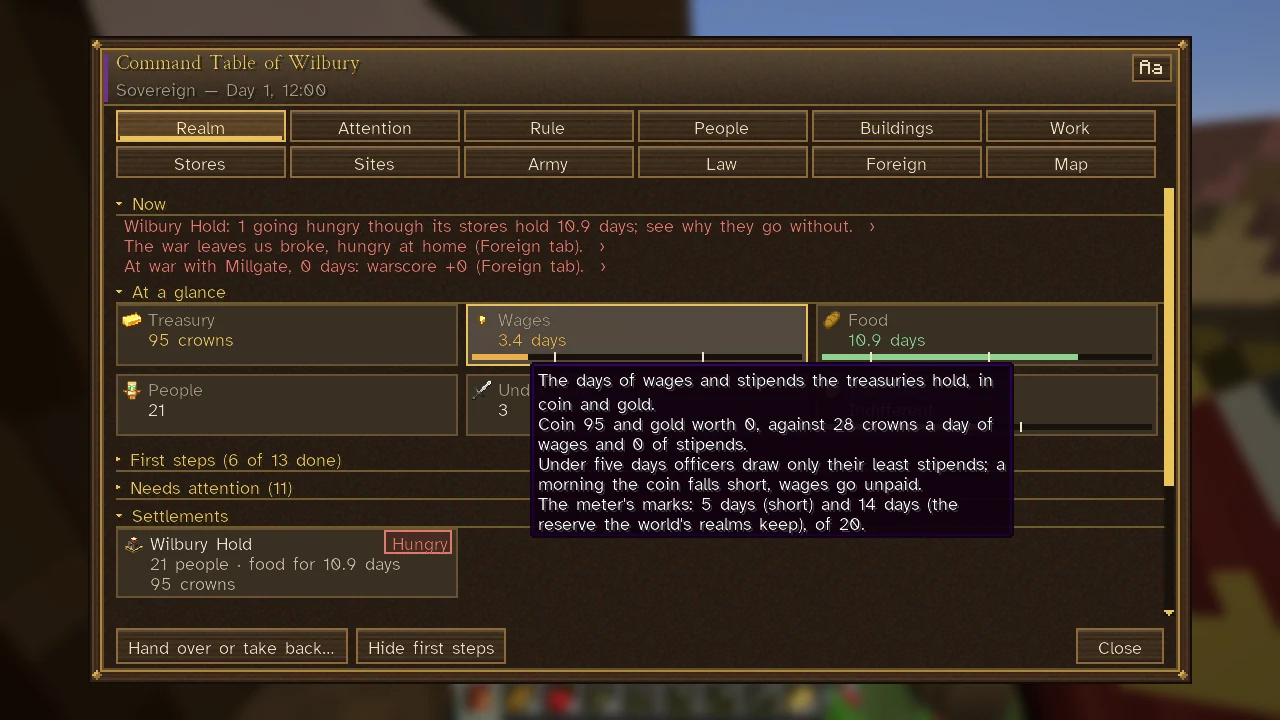
The Realm tab's Wages tile, beside the treasury's, tells a ruler how many days of wages and stipends the realm's treasuries would pay. It counts their coin and the gold waiting in the realm's treasuries and warehouses, which its treasurers strike into crowns as the coin is spent, against what goes out each day: the wages the crown pays at the wages set, and its officers' stipends. It is red under 2 days, amber under 5, gold under 14 and green from 14, on a meter of 20 days marked at 5 (short) and 14 (the reserve the world's realms keep). Its hover gives the figures, and warns that under five days officers draw only their least stipends, and that a morning the coin falls short, wages go unpaid. It opens the Stores tab.
When a player's realm holds under five days, it is warned before the wages go unpaid:
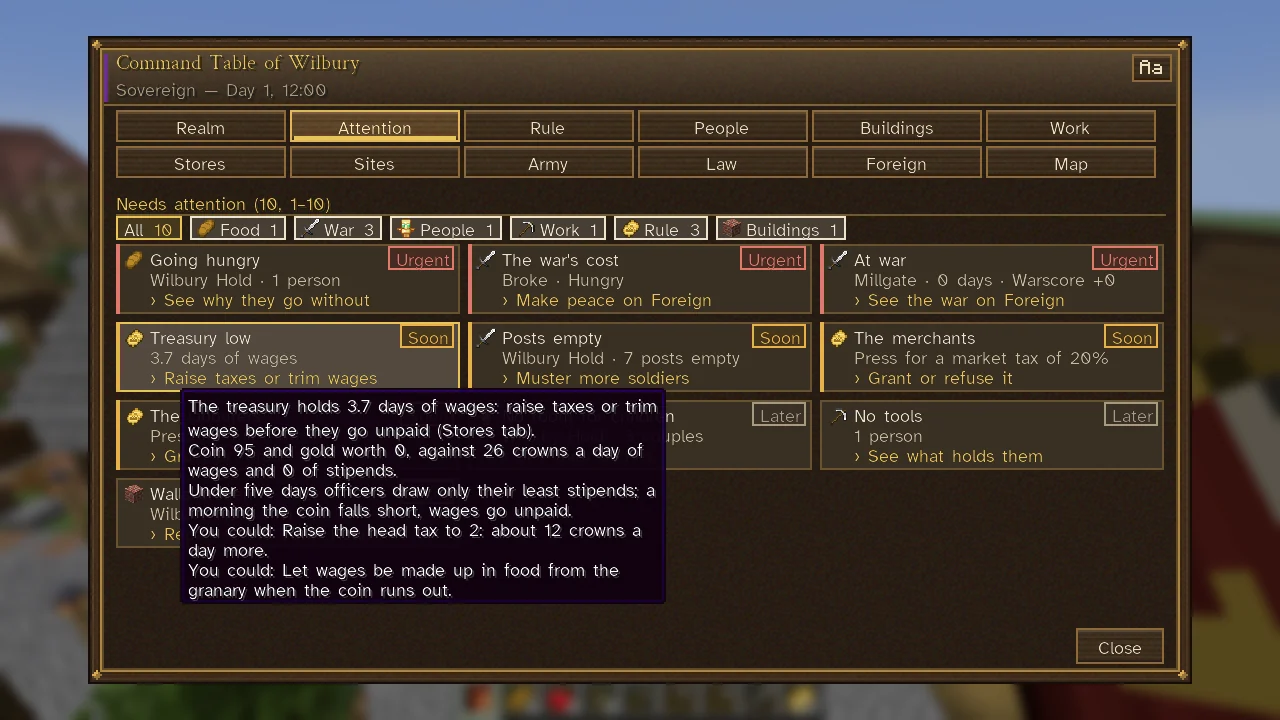
- The Attention tab raises a Treasury low card ("3.7 days of wages", "› Raise taxes or trim wages"), Urgent under two days, leading to the Stores tab. Its hover lists up to three things the crown could do, from what its laws and stores allow, each a "You could:" line: set someone to work at a treasury where gold waits to be struck, raise the head tax a step or the market tax a step (with about how many crowns a day it would bring), trim the workers' wage a step (with about how many crowns a day less would be paid out), or let wages be made up in food from the granary when the coin runs out.
- At the realm's seat each morning, its rulers who are in the world are told in a gold line, "The treasury holds 3.4 days of wages: raise taxes or trim wages before they go unpaid.", with [See the treasury], which opens the Stores tab.
Once wages have gone unpaid, the Wages unpaid card takes the place of the warning. A town's own page lists its treasury among its troubles when it holds under three days of the town's wages: to its realm's ruler with the crown's own remedies (the taxes, the wages, the gold waiting to be struck), to its people with what they can do (pay what they owe the crown, lend it coin at its treasury, trade in its market). The world's own realms keep their own budget, with a fortnight's wages put by.
What comes in: taxes
| Levy | How it works | Default | Most |
|---|---|---|---|
| Head tax | Per grown person, per day, taken out of wages or paid at the treasury | 1 crown | 5 |
| Market tax | A share of each sale at the realm's shops and stalls, paid from the shop's till | 10% | 50% |
| Toll | A share kept back from what foreign traders are paid | 0% | 30% |
| Rent | Per bed, per week, for the crown's houses | by custom | 3 |
| Hearth tax | A share of the worth of a house or business an owner holds, per week | 1% | 3% |
| Harvest share | The part of the food producers bring in that their households draw back from the granary | 0% | 100% |
| Makers' share | The part of what craftsmen make that is theirs; the rest is the realm's tithe | none | 50% |
| Food due | Loaves each household owes the granary every seventh day | 0 | 4 |
Some people pay no head tax: the retired who no longer work (from sixty-five), and, under the privilege law, officers and soldiers and the holders of posts, or further the notables (masters of the crafts, business owners and the crown's house), who also pay half fines. Others find the unfairness resented.
A household short of coin may pay its dues in goods from its pantry, valued at what the market would pay, if the realm allows tax in kind. What it cannot pay is owed as back taxes, up to a ceiling, and weighs on it. The Stores tab's Debts section lists who owes what, and a steward may forgive a debt from the person's sheet. When three or more of the realm's people owe it five crowns or more, a Deep in debt card on the Attention tab says so and leads to the Stores tab, where the head tax, dues in goods and each debt are; an amnesty of debts is a decree on the Rule tab.
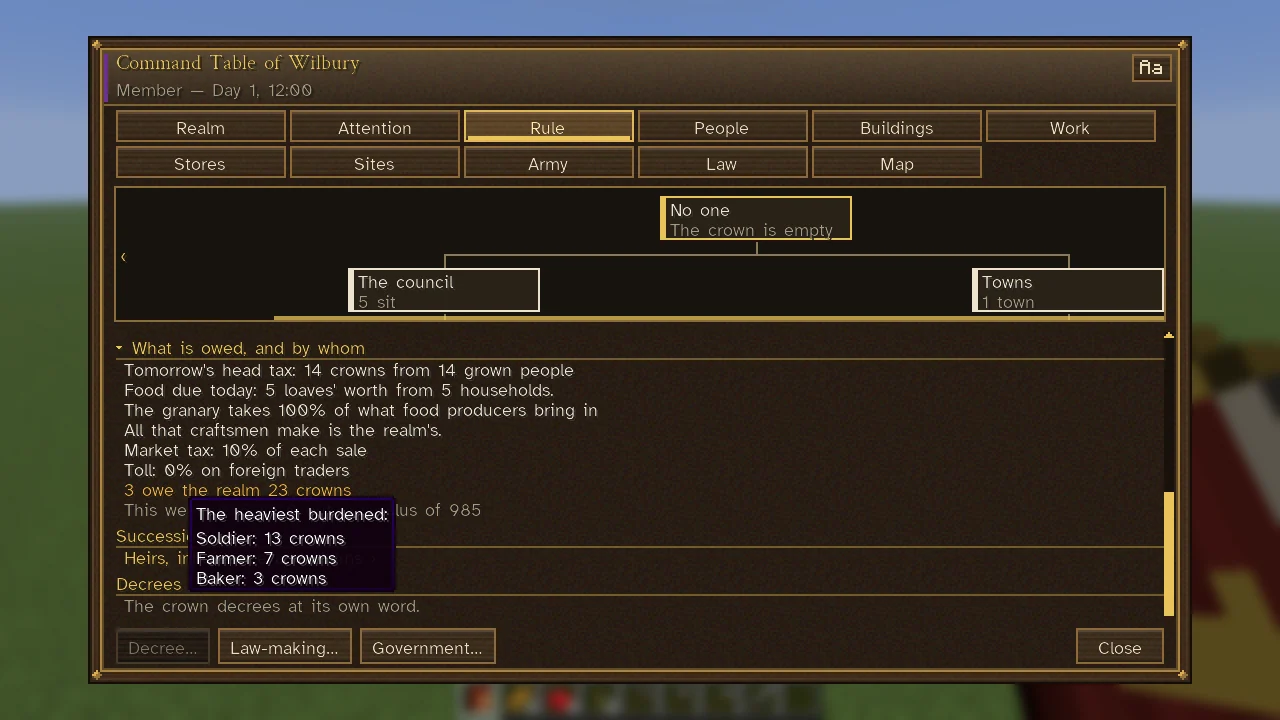
Rent and the hearth tax are reckoned once a week in each town. A house of the crown's pays its rent from its household; the owner of a house or business pays the hearth tax on its worth. A homestead that a realm has recognised in its land pays that realm the hearth tax too, the law's share of the holding's worth (1% by default) each week, into the treasury of the realm's nearest town; what cannot be paid is owed, and the homestead is never seized for it. A homestead in the wild that takes up a realm's protection pays it a tithe instead: a fortieth of its worth a week, at least 2 crowns. The Rule tab's "What is owed, and by whom" shows tomorrow's head tax, food due and who is heaviest burdened.
Taxes on a player's property
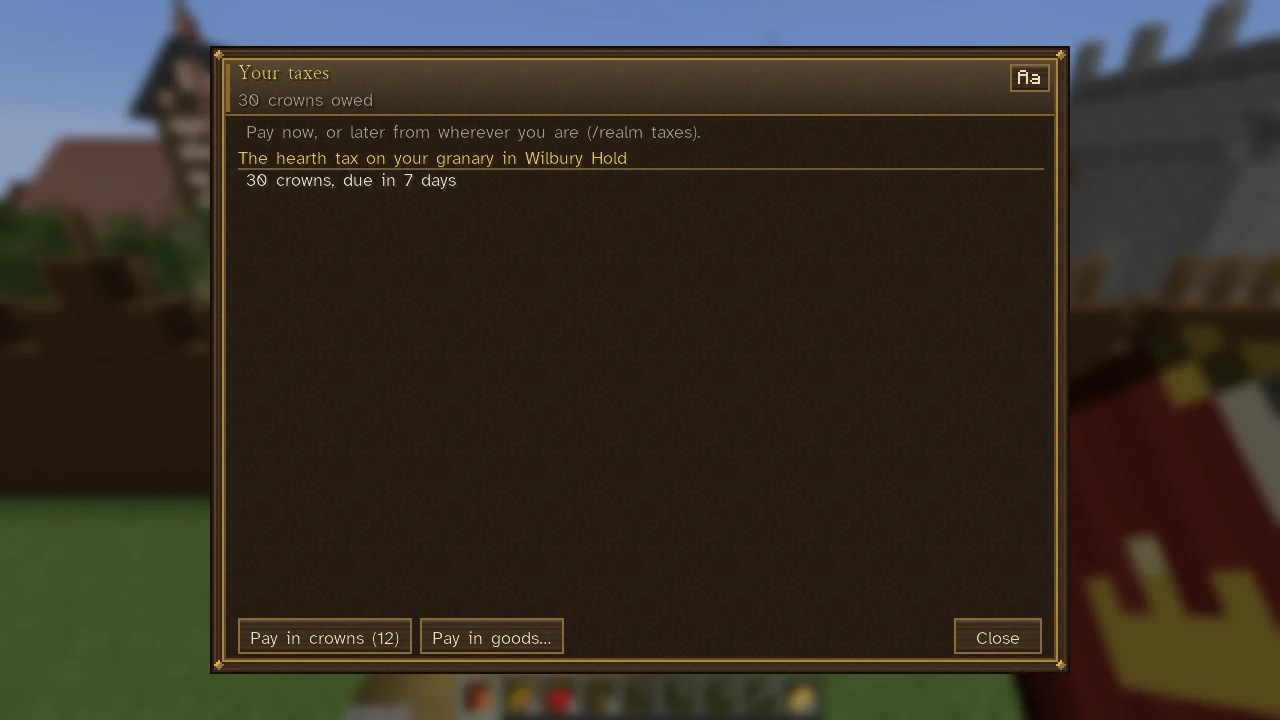
If you own a house or business in a town, you are sent its tax bill on that town's tax day, in chat with a link, and your tax sheet, Your taxes, opens by itself. It opens at once if you are free, or at the next moment you are not fighting (a blow given or taken in the last ten seconds), downed, held by the law, riding, asleep, with a chest, workbench or the like open, or reading another sheet. A bill that came while you were away opens the sheet ten seconds after you come in. The sheet begins "Pay now, or later from wherever you are (/realm taxes)"; each bill is a section with what is owed and when it is due, and Pay in crowns and Pay in goods… pay it. /realm taxes opens the same sheet from anywhere.
Goods are taken at the town's market bid, as many as settle the bill. Where the last of them is worth more than is left owing, the treasury gives back the change in crowns; where that treasury has no change, only as many as do not overpay are taken, and the rest is left owing. Taxes paid in goods are entered in the realm's books as taxes in goods. A bill left a week becomes overdue, a tenth more; after three weeks overdue the crown's bailiff takes it from the business's own till. See Businesses and Property.
Weighing a change
Each choice in the Stores tab's Policy… list (the head tax, each wage, the market tax, rations, the food due, the shares and the rest) says on its hover, as far as it can be foretold, what it would do before you make it: what it would bring the treasuries or cost them a day ("Treasury: +12 crowns a day"), reckoned from the realm's last whole day of books; what it would do to the granaries where it is not in coin ("Granaries: run down faster"); the two interests it would move most ("Displeases the labourers (-6)"; a fall of 10 or more angers them); under a council or an assembly, how they would likely vote on it ("The council would likely refuse it, 0 to 5"); and how many days the law must still stand before it may change. The forecast changes nothing. A draft of several changes adds up what they would bring together. The morning after a tax or a wage is changed, the morning report at the head of the Realm and Rule tabs says how the people took it, and its hover how the treasury moved since ("Treasury 660 crowns, unchanged since then.", or the crowns then and now). See Government and Law-making.
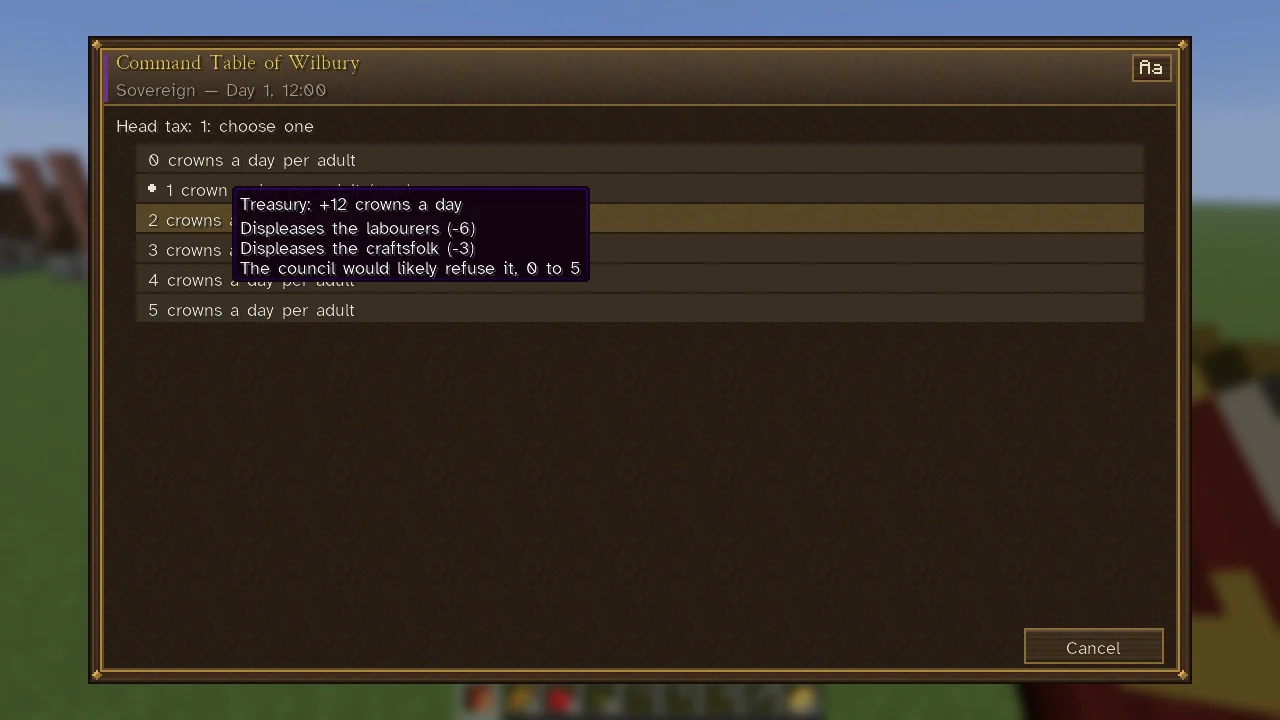
Reading the books
The Stores tab opens on four tiles: Treasury (what the towns' treasuries hold, how it moved since the morning before, and a line of its last mornings), Food, Wages a day and Goods short. Below them each town's public stores open on its short goods and any glutted ones, with the rest by kind, folded, and Find a good… finds one by name (see The Command Table). Further down, Books (recent days) lists each day's wages paid, taxes taken and market takings, with what was taken in goods and anything unpaid or missed on hover; a war shows its cost to the army a day. Where the coin is adds up the treasuries, your people's purses and the market tills. Policy lists the head tax, wages, market tax, rations, shares and food due in force. Lower still, the settings stand in five folded groups, each with a line saying what it holds and a chip for each setting ("Head tax: 1") that opens its choices: Taxes and dues (the head tax, market tax, hearth tax, toll, dues in goods, food due and rent), Wages and shares (the wages, soldiers' pay, what is paid when coin runs short, the harvest share and the makers' share), Food and relief, Work and hours, and Order and trade. The tab's Law-making… and Policy… buttons change these figures; how laws are made is in Government and Law-making. The Realm tab's Treasury tile and each town's card give the same coin at a glance, and its Wages tile how many days it would last (see The Command Table).
Debts to the realm
Fines are never wiped. What was not paid in coin is served as time in the cells; what could not be served becomes a debt to the realm that never lapses and is taken from coin a debtor carries, from what its markets pay them and from their tills and houses. See Arrest and Jail.
The exchequer
At any treasury you can open an account for great sums that no purse could hold. Coin paid in leaves the world into the exchequer's reserve and is never lent or spent; a withdrawal strikes it back one for one. You can also write a draft to bearer, a paper that whoever holds it may cash once at the realm's treasuries. A realm's law-wanted cannot draw on their account there. A draft is bearer's paper: stolen, it pays the thief.
Borrowing
A realm short of coin can borrow; see Credit and Moneylending. Wages, rations and the army's pay are the realm's biggest costs; see Armies and Soldiers and Food, Granaries and Hunger.