Food, Granaries and Hunger
DiscussFrom the Sovereign Realms Encyclopedia
Food in Sovereign Realms is physical. Wheat sits in a chest, bread is in a pocket, and a town eats only what is really in its stores and pantries. The granary is the building that keeps a settlement's food; the whole system of farming, hauling, baking, rationing and buying that fills it and empties it decides whether a town thrives or starves.
What people eat
Every townsperson eats real food. The unit is a loaf, one bread-equivalent: a grown adult needs about two a day, a youth about one and seven-tenths, and a child about one and a fifth. A glutton eats more and an abstemious person less. People eat from their own pantry first, then take rations from the granary if the realm gives them. Raw food is not eaten unless a person is desperate; fine food, such as cooked meat, pies, stews, cake and honey, is liked better. A person with nothing to eat starves: someone at full health lives about five days with nothing, and word goes abroad that people are starving in the town.
Raw food is made ready at a hearth: a potato baked, meat or fish roasted, three sheaves of wheat made into a loaf. A household cooks at its house's fire and soldiers at the barracks' mess fire; anyone with no home, or a home with no fire, cooks at the town's common hearth, the nearest of its barracks, inn, alehouse, cookshop or bakery. The rule is the same whether or not anyone is near the town. So the homeless of a town whose stores hold only potatoes still eat, and the food a household buys, or is given as the crown's relief, may be raw where it has a hearth to cook it at.
Hungry, homeless or lonely people grow unhappy, and people who stay miserable for days pack up and leave, household and all. A person's sheet says how they feel and why (see Townspeople).
Where food comes from
| Source | Who | What |
|---|---|---|
| Farm | Farmers | Wheat and other crops from the fields around the scarecrow |
| Pasture | Herders | Meat, wool, milk and eggs from the animals in the fenced pasture |
| Fishery | Fishers | Fish cast from the shore by the creel |
| Apiary | Beekeepers | Honey from the hives |
| Bakery | Bakers | Bread from grain (grain goes three to the loaf); they also smoke meat and fish |
| Cookshop | Cooks | Hot meals: pies, stews, roasts, fish, baked potatoes and bread, set out for sale |
Porters and granary keepers carry food to where it belongs: harvests go to the granary, and rations go out to homes. See Work and Professions for each trade.
A field raised from a plan is a farm, its farmers at work in it, once its ground and water channels are laid. If the town has no wood for its hedge and gate, the builders finish without them: they stay on the farm's record as missing blocks, for a repair once wood can be had (a town of the world's realms orders it itself). Builders who find no scarecrow in the stores make one by hand at the yard, of four planks or four stones. See Construction.
A town that lays out its own fields (the world's towns, and a player's town whose building is handed over) keeps as many food works going up at once (fields, pastures, fishing huts) as it would take fields to grow what it eats beyond what its land and trade bring in, reckoned at what its own fields yield, once its books cover ten days; and never fewer than one for every 250 of its people (one at least), with more where hands stand idle. A town whose fields yield less than half what a field usually does goes by its people alone: it feeds itself by its beasts, its fish and its trade, not by more fields.
A farm, a bakery or another food trade may be someone's business. Its town buys of it each morning what it will use beyond what it already holds: a farm's wheat, beetroot, pumpkins, melon slices, potatoes and carrots, a bakery's bread and what else it bakes. The town pays its bakery for a loaf no less than the loaf's wheat at the town's own price, a tenth more as a food maker's margin and a fortieth of a baker's daily wage (a baker's day is about forty loaves). Where no player is near, a bakery with no wheat bakes the town's potatoes instead, buying them of its stores while a baked potato sells for more than its potato and the fuel to fire it.
How a realm feeds its people
At the Command Table's Stores tab, with its Policy… button, a ruler chooses how the people are fed (see Government and Law-making); the laws in force are listed under Policy lower down the tab, and the provisioning, rations, ration priority and poor relief also stand in its folded Food and relief group, a chip each (the harvest share under Wages and shares, the food due under Taxes and dues). Every value moves real items or coins.
Provisioning
| Choice | What it means |
|---|---|
| Common granary | Food is shared from the common stores under the ration law. A realm starts here. |
| Bread for coin | Households buy food from the granary and bakers with their wages; poor households receive relief. |
| Free market | Households buy at farms and stalls; the granary offers its surplus. |
The world's realms move to bread for coin by themselves once a town has a dozen grown people and a bakery or a market, and they raise their wages when they do. Where bread is bought, households buy what they need besides food too (see Households and Wages). Who feeds the poor then is a further choice: the crown's relief from the granary, the temple's alms, or no relief at all, which brings hunger, debt and unrest.
Rations
| Rations | Effect |
|---|---|
| None | People feed themselves from home stores or buy at market. |
| Half rations | Porters deliver one bread-equivalent a day to each home from the granary. |
| Full rations | Porters deliver a full day's food to each home. |
When the granary runs low, ration priority decides who is kept first: everyone alike, the barracks first (soldiers), or homes with children first.
Shares and dues
- Harvest share: farmers, herders, fishers and beekeepers may keep a share of what they bring in, drawn from the granary each morning by their households.
- Food due: a weekly due of food asked of every household's pantry.
- Makers' share: smiths, carpenters, masons and bakers may keep a share of what they make; the rest is the realm's tithe.
- Wages in kind: when the treasury runs short, wages are made up in food from the granary.
A ruler can also decree a feast, two days' food for everyone from the granaries, or open the granaries for full rations for three days whatever the law; the granaries are drawn down and people are glad. A market holiday (three days without market tax or tolls) helps buyers.
Watching the food
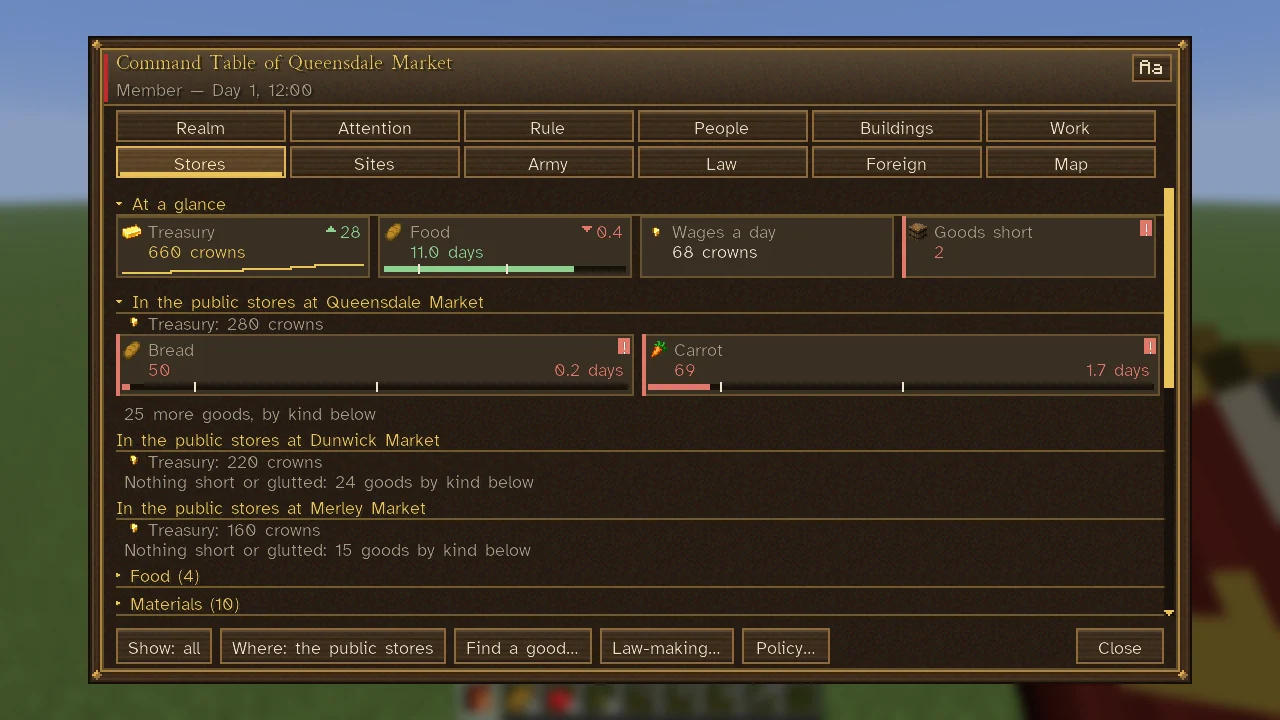
The Command Table's Stores tab opens on four tiles. Its Food tile gives how many days the realm's food lasts at what the realm eats in a day. It counts what its towns' granaries, warehouses, workshops, stalls and yards hold; households' own pantries are theirs and are not counted. Each town is counted as its last kept day found it: a town keeps the figures of each day it lives, and one that has kept none yet is read as its stores stand now. The tile has a meter marked at 2 days (short) and 7 days (well stocked); it turns red under two days, amber under three and green from seven. A small figure in green or red shows how it moved since the morning before, and the hover says the same in words, with the day ("On Day 6: down 0.4 days, to 11.0 days."). The Realm tab's Food tile shows the same figure.
Where a town's figures are older than this morning's, no one being near it, the tile's hover says how many towns are counted so, and the town's card on the Realm tab says how old its own figures are ("as of Day 6"), with why on its hover. The town's own page shows the same figure with its day ("50.2 days (Day 6)"). Below the tiles, each town's public stores open on what needs a ruler: its short goods first, then any glutted ones, each good used this week with its days of supply at the past week's use on the same kind of meter. A good that lasts under two days, or that the town's work has asked for, is short: drawn in red with a mark at its corner. The realm's other goods wait under their kind, all its towns' together, the food under a folded Food heading with its count. Find a good… on the bar finds one by name, bread say, and shows it first, town by town, with how many each holds and its days of supply. The Food chip among the Which goods chips shows the food alone, and the Which stores chips show other stores, such as the households' pantries. See The Command Table and Resources and Scarcity for the rest of the tab.
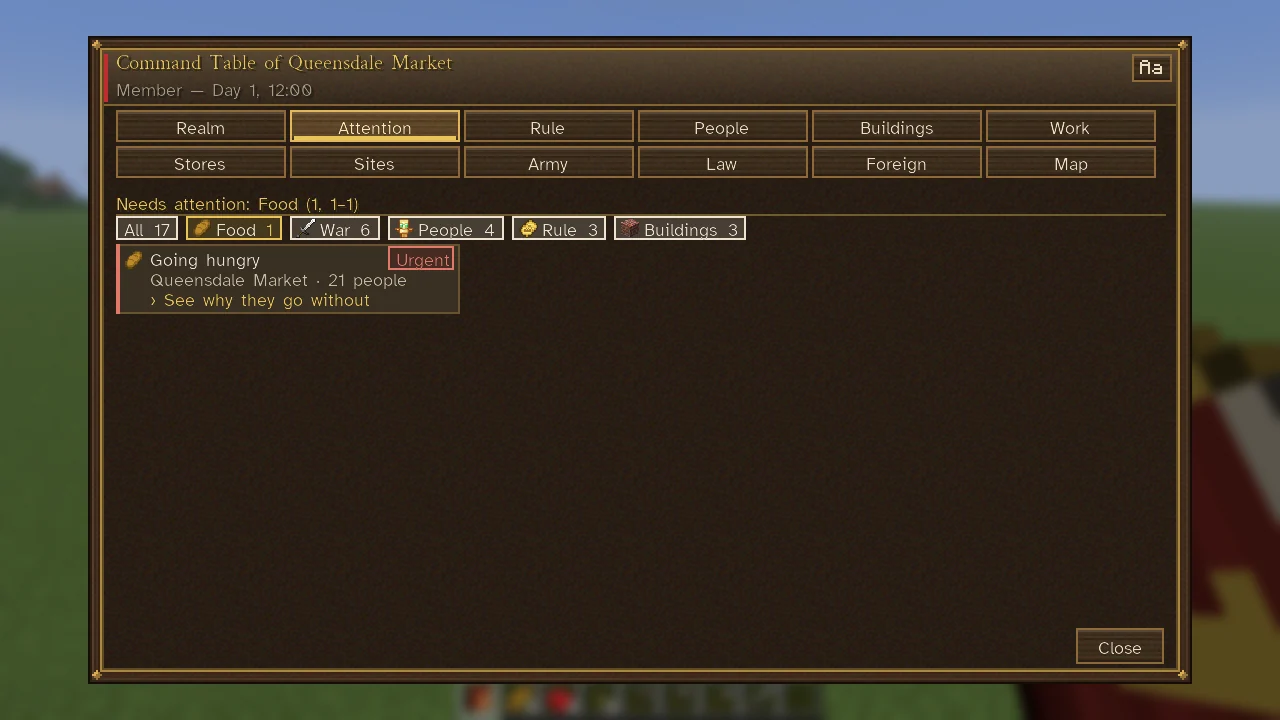
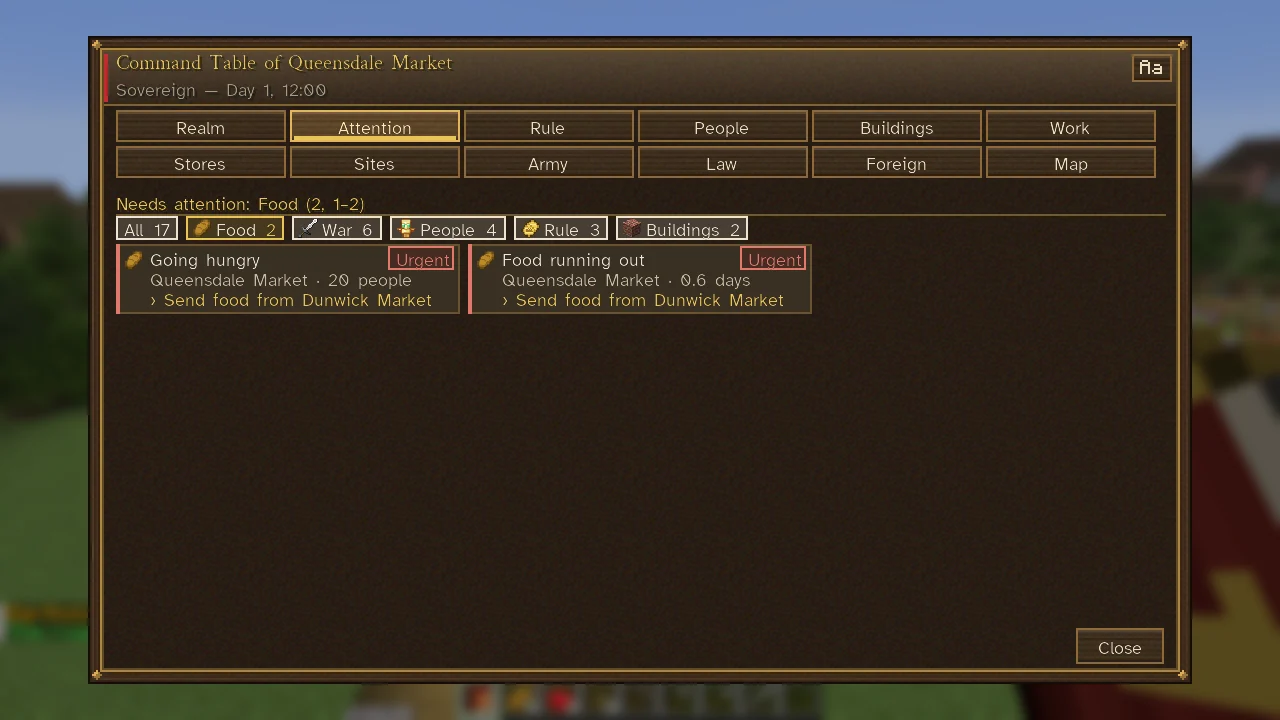
Hunger also reaches the Command Table's Attention tab as cards, each with its town, how many, a chip for its urgency and the one action that answers it. Hungry people are sorted by why they go hungry, since that decides what answers it:
| Card | When | Urgency | Action |
|---|---|---|---|
| Going hungry | People at home in a town go hungry, and its stores are short | Urgent | Send food from the nearest town of the realm with food to spare; with none, Stock the granary |
| Going hungry | People at home go hungry though the town's stores hold two days or more | Urgent | See why they go without |
| Hungry on the road | People of a town go hungry away on a journey | Urgent | See where they are |
| Food running out | A town's stores hold less than two days' food | Urgent | Send food from the nearest town with food to spare; with none, Stock the granary |
| Granary calls | A town's granary calls for food | Soon | Bring food to its granary |
| Soldiers hungry | Soldiers go hungry (filed under War) | Urgent | Stock the barracks' rations |
| Fever | A fever goes through a town, or has killed there in the last three days (filed under People) | Urgent, or Soon while few are sick and none has died | Build an infirmary, or See the sick where the town has a healer or an infirmary |
Food in store that does not reach those at home is held up by their coin, their rations, a door barred to them or work that keeps them from it, and their sheets say which. Those away on a journey eat what they carry: no granary reaches them, and what is at home waits there, so send them out with more food or on shorter roads; they eat again when they arrive.
The Food chip above the cards shows the food cards alone (all but Soldiers hungry and Fever). Clicking Going hungry, Food running out or Soldiers hungry opens the town's food page. It gives the town's food in days, as its card has it ("as read this morning", or "as of" an older day), then what its stores hold now in loaves' worth and what its people carry, the rations in force, the people needing food (each opening their sheet, those away marked "on the road"), its food stores and workplaces, and ways to respond, first among them "Send food from" a town with food to spare. Hungry on the road opens the one person's sheet, or the town's food page if there are more. Granary calls opens the town's Town Heart. Fever opens the town's people with the fever, or the realm's chronicle of deaths when no one is sick now.
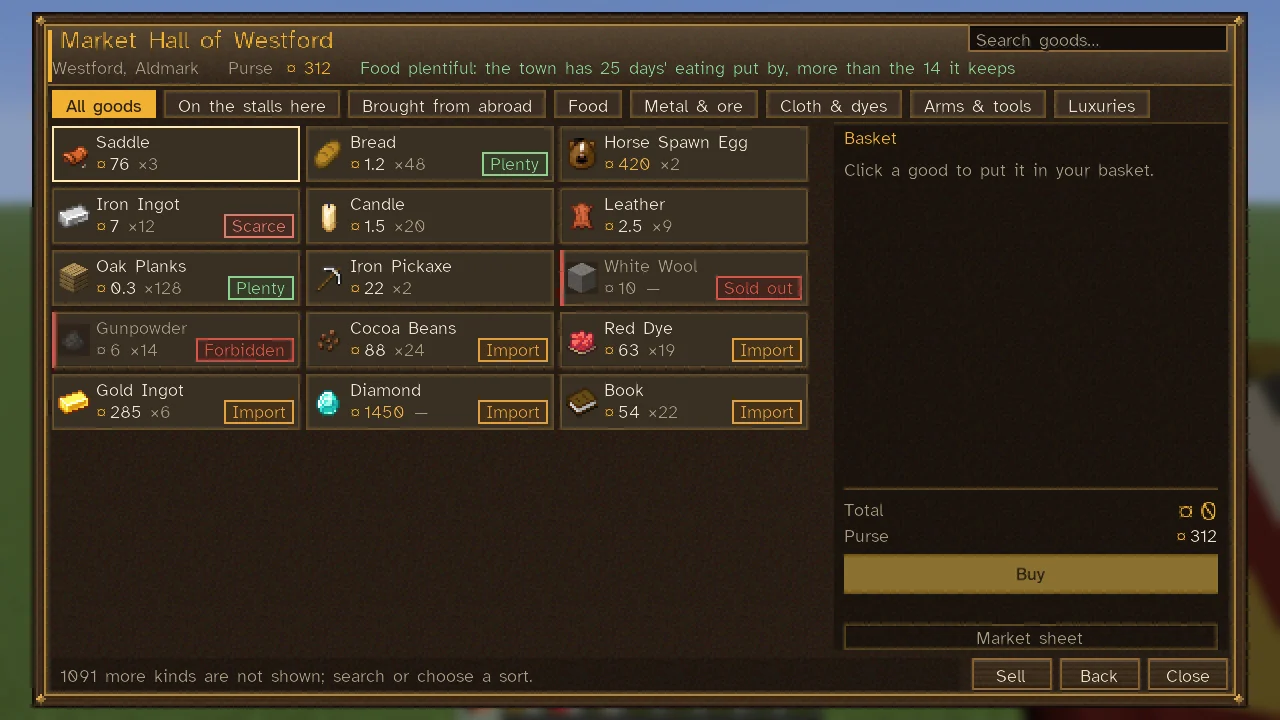
At a town's market, every food's price follows the town's food in store against fourteen days of its people's eating, so the counter says the town's food once, at its head, when it stands off the usual: for example "Food a little short: the town has 10 days' eating put by, and keeps 14". A food's cell may carry one word of its own, Plenty, Short or Scarce (see Markets and Trade).
Relief from another town
When another town of the realm has food to spare, the Going hungry card of a town whose stores are short and its Food running out card name it: "› Send food from Dunwick Market". A town has food to spare when it is in the same world, its own people are fed and it holds more than the reserve it keeps for itself and two days besides; the nearest such town is named. The card's hover says how far off it is, how many days of food it holds and about when a train from it would arrive ("Dunwick Market, 120 blocks off, holds 30.0 days of food: a train from it arrives about Day 1, 13:00."). Clicking it opens the supply train sheet already filled in: from that town to the hungry one, loaded from its granary and storehouse with its most filling food first, about five days of the hungry town's eating (no more than it can spare, and no more than a donkey carries), the road, "Arrives about" the day and hour, and each town's food on hand. Send it on the bar sends it. The hungry town's food page offers the same train first under its ways to respond. See Merchants and Supply Trains.
A town whose own people go hungry (a tenth or more of its grown people), or whose food runs under two days, keeps its food: a train taking food out of it is sent only when Send it is chosen twice, and its standing food routes are held, their line saying why ("Held: Aldhaven's own people go hungry.").
Where a realm's stores run themselves (the world's realms, and a player's realm that leaves its stores handed over, as they are from its founding), relief goes each morning without anyone asking. A town under four days of food is sent trains from the realm's towns that hold more than they keep, the best-fed first, until about five days of its eating are on their way. A town under six days that its realm sends too little buys a train of food abroad, paid from its treasury over three days of its wages. In a famine (under four days of food) a town whose own treasury has nothing to spare is paid for by its realm: the town of the realm with the most to spare, which gives up to half of what it holds over a week of its own wages and twenty crowns.
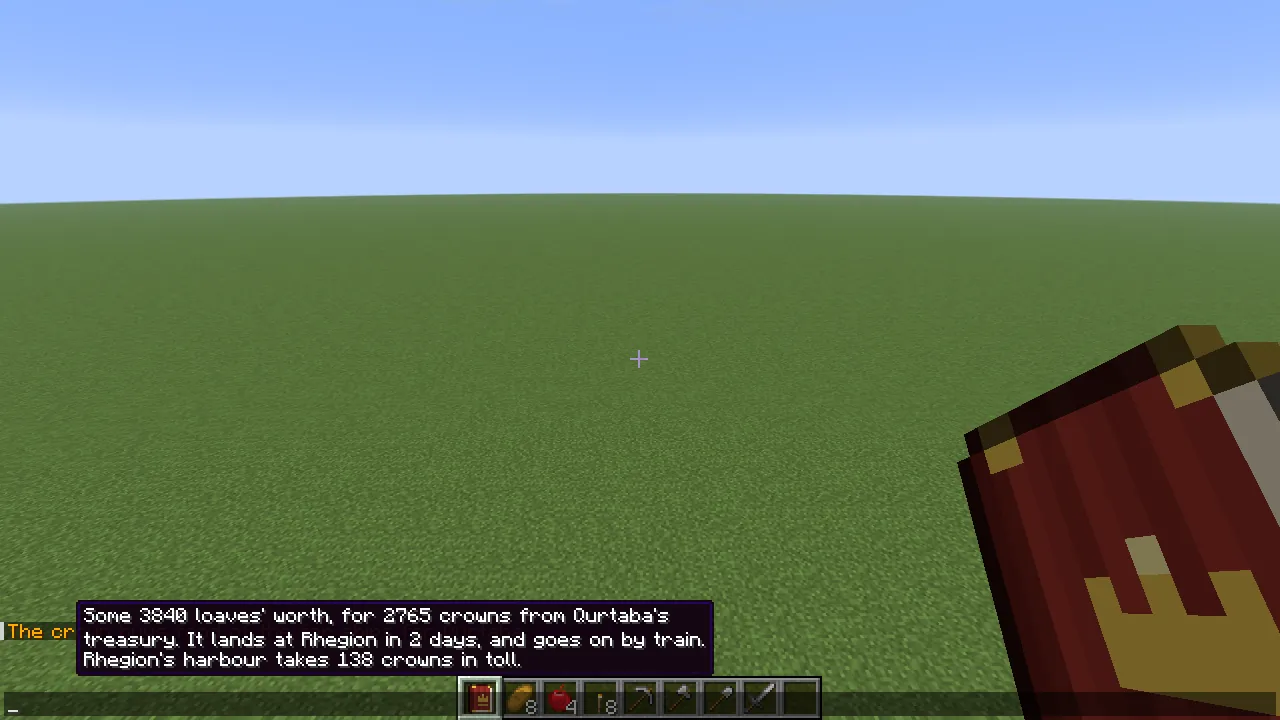
When that falls short in a realm the world runs, because no town of its realm can send enough and no town in the world within reach will sell it food, its crown buys food of the far ships, from beyond the world's edge: wheat, potatoes, cod or bread, whichever is the cheapest loaf at the day's price abroad, up to three ships' holds at once, each a supply train's load. It is paid as the famine's food from abroad is paid, from the town's treasury over its working balance, else by the realm's town with the most to spare, and a realm spends on the far ships in a day no more than a quarter of what all its towns together have to spare by that reckoning. The coin leaves the world. None is bought for a town under siege, and none lands at a harbour under siege: what is at sea stands off, and what has landed for a town besieged since waits in the harbour's stores, until the siege is over. The food lands two days later at a harbour of the second rank within 8,000 blocks whose supply train can reach the town: the town's own, else the realm's nearest, else a friendly realm's, which takes its toll. That harbour's train carries it on (a load no train can take on within three days stays in the harbour's stores). While it is at sea or waits for its train it is relief on its way, and the town's hungry wait for it rather than leave. The realm's members are told in one line, "The crown buys food of the far ships for" the town, with the loaves' worth, its cost, the treasury that paid, where it lands and any toll on its hover, and the chronicle records it.
Stores and spoilage
Food keeps only so long. A town's granaries and storehouses can hold about twenty days of its people's eating safely. What is held beyond that spoils a little each day: bread, cooked meat and fish soonest, fruit and roots slower, grain slowest. The loss is real, the counts shrink, and a large one is written in the realm's chronicle. A glut therefore does not pile up for ever: it is eaten, sold or lost. A town that keeps salt enough for each of its people (see Salt) loses its food half as fast.
A farm's food that its town does not want at its market's offer is not left in the farm's chests to rot: the town takes it into its stores at the glut price, three eighths of the food's worth (half its worth, the least a market asks, less the merchant's quarter), "for its carters to send on". It takes as much as brings its market's stock up to twice what the market keeps, and as much again as the towns its merchants trade with lack of it for their tables, and no more in a day. From its stores, relief can go on to a town short of food (see Relief from another town, above).
The granary's call
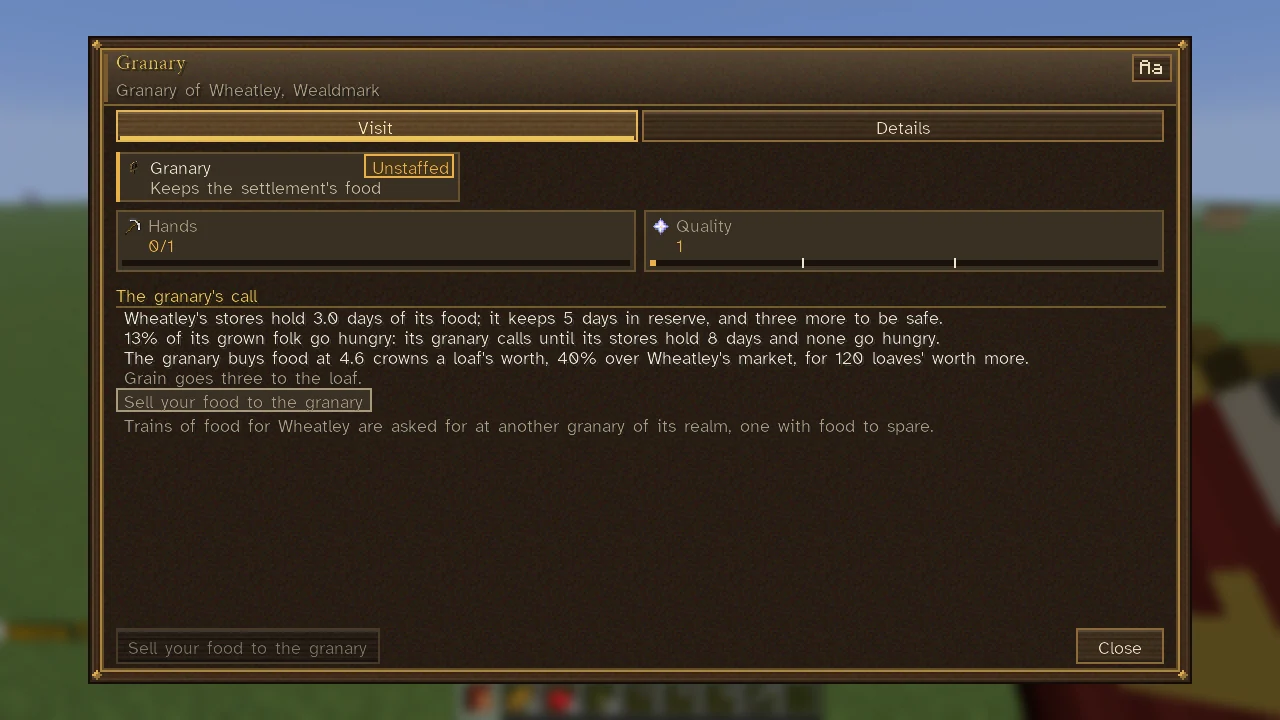
When a town's stores fall under its reserve, or many of its people go hungry, its granary calls for food. It buys what anyone brings to its door at a premium over the market, paid from the treasury, until its stores are back to the reserve and three days more, or a fortnight has gone. A treasury with under 10 crowns cannot call. The call shows on the granary's sheet, in the town's troubles, in its keeper's talk, and on its realm's Attention tab.
As a merchant you can read where food is wanted in the Companion's "Where can I buy...?" page (or /find bread): it lists the granaries that call and what they pay over the market, the towns short of food, and where bread sells dear. A town counts as short with fewer than four days of food stored, and as hungry when 8% of its grown people go hungry. Asked in words, the Companion answers from the same towns, those in want first, and says when a calling granary is only filling its reserve, its town not in want: what it buys then counts as no aid. If the Companion named a calling granary to you, you are told in chat when it stops calling (within four days of asking), and whether the town is still in want.
Food sold to a town in want (its stores under six days, more than one in twenty of its grown people hungry, or fewer than 85% of its households able to buy a day's food) counts as aid, whether sold at its market or to its calling granary. The sale's message says so, and as many of its hungriest as the food matters to the town think better of you. A large gift is written in the realm's chronicle.
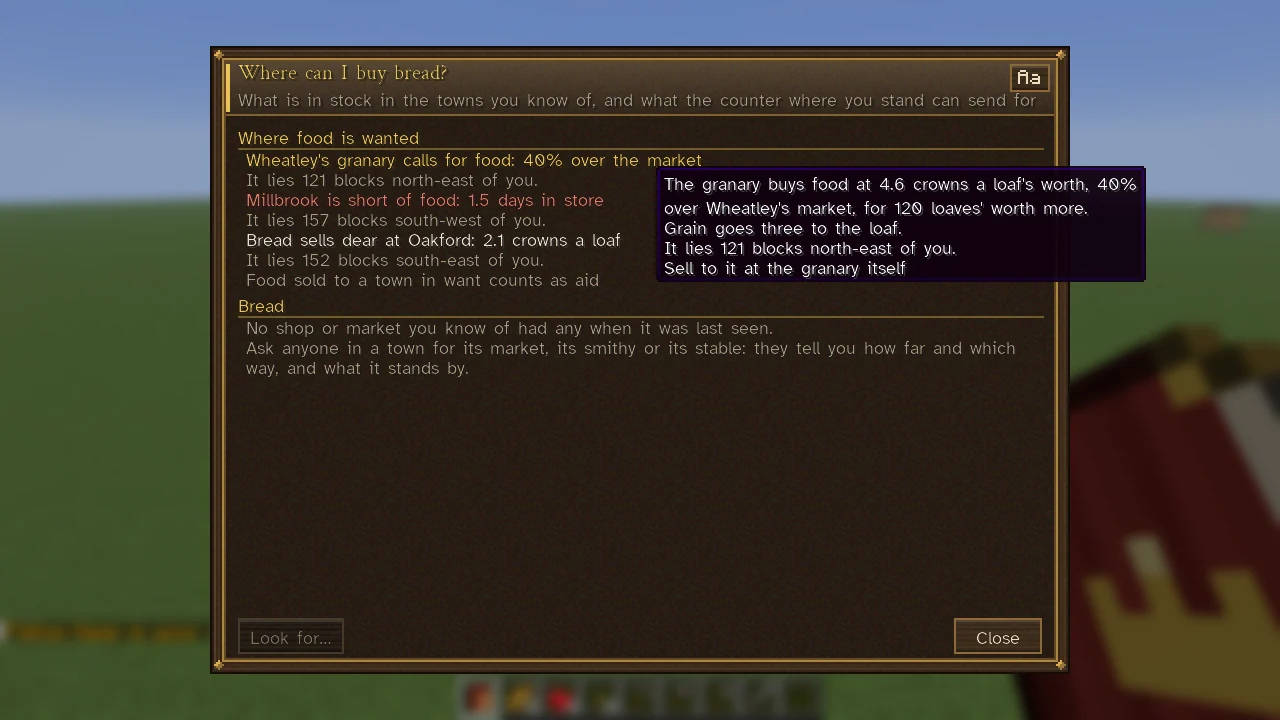
To sell to a calling granary, bring the food to the granary itself and use "Sell your food to the granary". Food you bought at that town's own market, or that your steward bought for you there, is remembered as the town's, and is not bought back at the premium. At another granary of the same realm that has food to spare, its sheet's "Send a train of food to..." sends a calling town of the realm a supply train of food, for the carters' hire (see Merchants and Supply Trains).
Famine and refugee camps
A town is in famine when all its stores hold less than two days' bread for each of its people. Those of its people who went without food since the morning before go, household and all, while they can still walk, to where they would be fed: the nearest town of their own realm, or of a realm open to them and not at war with theirs, with beds and food to spare for them; failing that, any such town within two days' road (8,000 blocks) whose land and trade feed more than its own people, or that has ten days' bread put by for everyone it would then hold; failing that, a town taken in from afar (below). Only with nowhere in the world to go do they make camp.
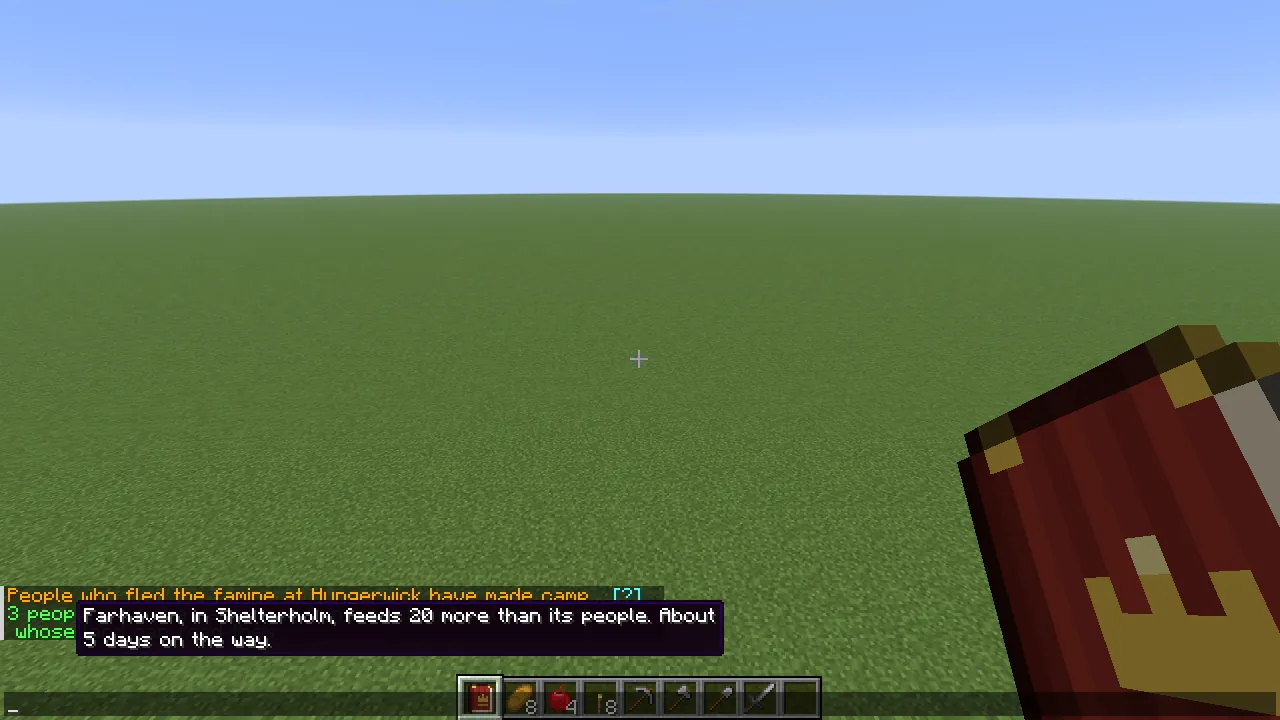
Taken in from afar. The hungry with no town near to feed them, and a refugee camp's households, go to the nearest town in the whole world whose land and trade can feed them: a town of their own realm (counted 3,000 blocks nearer than any other's), or of a realm the world runs or a player's realm with open borders, neither at war with theirs nor hostile to it, and never a town a war band marches on or lies before. That town takes them in with a bed for each, or, with no bed free, where a common hearth (its barracks, inn, alehouse, cookshop or bakery) can cook for them, and a town that lays out its own building raises houses for those without a bed. Where no town in the world can feed them so, a town within 8,000 blocks with a bed for each and ten days' bread put by for all it would then hold takes them in. The way must be open: by land, by a road from their town, or over the sea where either end has a harbour (a camp's households take the boats of the camp's town, where it has any). The town that takes them in sends bread from its own stores to meet them, enough for the days on the way and a day over. The rulers at both ends are told in one line: "12 people from the famine at" the town (or "from the camp near" it) "set out for" the town that takes them, "whose land can feed them." (or "which has bread put by for them."), with that town's realm, how many more its land feeds and the days on the way on the hover; it goes into both chronicles.
A town's room for newcomers is what its land and trade feed beyond its people and those already on their way to it: the larger of what its books show it brought in a day over the last four weeks and what its fields at work bring in now, each field at its own fields' yield and counted from the day it can first be reaped. Food it sends away as relief does not shrink its room. The same room decides who takes in the hungry and a camp's households, how many of the idle may come to seek work (see Work and Professions), and and how fast it grows by children and by newcomers from beyond: at the full pace while its land and trade bring in a quarter more than it eats, slower as the margin narrows, and not at all once there is none. A town too young for ten days of books takes newcomers by the bread it has put by, and its growth is not held back.
A refugee camp stands by the road of a town in famine or under siege, or holds people whose town fell: a lean-to for each household, fires, and a common pot. Each morning its households eat from the pot, two loaves' worth a mouth, those who have starved longest first, and a household that is fed is starving no longer. The world's towns take its households in, as the hungry are taken in from afar (above), up to sixty households a day, those who have starved longest at the camp first. Only a household that no town in the world takes in leaves the camp for lands beyond the known realms: after four days starving at the camp itself (days it starved before it came count for nothing; two days more while food is on its way to the camp), never while its realm's relief is under way, and no more than a tenth of a camp's households in a day, the rest starving on while relief may yet come. A household that has waited a month with no town to take it in goes too, one a day.
A camp's realm hears of it in one line when it has food again ("The refugee camp near" the town "has food again.", how many days its pot holds on the hover) and when most of it is starving ("… is starving."). When a camp of one of the world's realms has less than four days of its eating in the pot, its realm sends it trains of food from its towns with food to spare, the best-fed first, and what they cannot send, the town of the realm with the most coin to spare buys abroad for it; what no town in the world can sell it, the crown buys of the far ships, carried to the camp's pot by the train of the harbour it lands at, and the camp's people stay while it comes. A camp of a players' realm is fed by what people bring: on the sheet of anyone at the camp, Give them food puts food from your pack into the pot, and a ruler or steward may Offer them a home in one of the realm's towns that has beds for the household, which then walks there with leave to enter. A household with nowhere to go may also ask for a place at a homestead near the camp (see Homesteads).
Fevers and fortunes
Now and then a fever breaks out, likelier where a town is crowded, homeless or hungry. It goes through households for some four days, is deadliest to the old and the infants, and a healer or an infirmary halves its toll (see Hurts and Healing). Its outbreak and its passing are written in the realm's chronicle and told in the news, and each death names the town ("died of the fever in Aldhaven"). The town's one Fever card on the Attention tab (above) counts its sick and its dead. Each land also has its fortune each thirty-day season, from blight to a bumper harvest, told in the news.
Keeping a town fed
- Mark farms with Surveyor's Stakes and build a granary and a storehouse (see Buildings and Surveyor's Stakes).
- Build a bakery and, in a bigger town, a cookshop and a market (see Markets and Trade).
- Set rations and provisioning at the Stores tab and watch its Food tile and the bread's days of supply; heed the Attention tab's food cards, and the Work tab for trades and production chains held up.
- Keep the treasury in coin: wages are paid from it each morning (see Treasury and Taxes).
- If a town starves, use its card's Send food from to send a train of food from the nearest town with a surplus, or buy food and carry it to its granary.
By default a town nobody is near lives on in the background, a town a traveller is bound for and those nearest the players first, its meals eaten from its real stores (those whose land is out by the ledger the world keeps of them, the change made in the chests when their land next loads), and any days it is still owed are lived out in the background as someone comes near, none forgiven. Relief sent from such a town, and food it buys abroad, set out at once, and food brought to a town in famine goes into its stores whether or not anyone is near. A town left without food goes hungry (see Catch-up Simulation).