The Command Table
DiscussFrom the Sovereign Realms Encyclopedia
The Command Table is the block with which a ruler sees and runs a whole realm at once. Using it opens the realm's sheet, titled "Command Table of" the realm's name, with a row of tabs: Realm, Attention, Rule, People, Buildings, Work, Stores, Sites, Army, Learning, Law, Factions, Foreign, Chronicle and Map. Each tab answers one question first, with tiles, meters, cards, chips and small charts, and keeps the words that explain them on their hovers (see Sheets). Tiles, cards and rows lead on to the tab, page or sheet they name; buttons ending in … open a list of actions.
Crafting


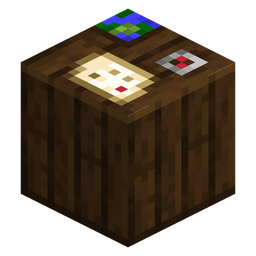

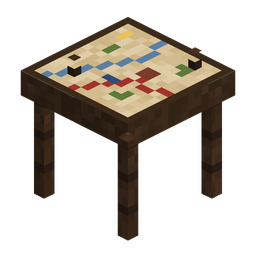
Planks of any wood fill the ends of the top and middle rows, a map and a cartography table sit in the middle column, and logs of any wood make the legs. A Command Table can also be opened from a Town Heart's sheet, and from anywhere with /realm desk. /realm desk <tab> opens a named tab, which is how a notice's link takes you where its matter is.
Using it
- A member of a player realm (any rank) sees the whole realm; what they may do depends on their rank, and a greyed button says why on its hover. The subtitle gives your rank and the day and hour.
- Someone with no realm is told that the maps and ledgers mean nothing to them.
- A citizen of one of the world's realms is told it is for those who rule; their own affairs are at the Town Heart.
What came of your last action shows at the foot of the sheet; grave choices, like war, are asked twice. A young realm's table is short and grows with the realm, a tab appearing once it bears on the realm. On the Map tab the row of tabs folds into one Pages: button.
| Tab | Appears |
|---|---|
| Realm, Attention, Rule, People, Buildings, Work, Stores, Map | From the start |
| Sites | After two days, or once there is building under way, or three buildings, or a road ordered |
| Army | After three days, or once there is a company, a barracks or a war |
| Law | After three days, or once there is a jail |
| Foreign | After a day, or on meeting another realm |
| Learning, Chronicle | After two days |
| Factions | Once your crown knows of a faction (see Factions and Demands) |
How the table reads
Most tabs open on At a glance, a row of tiles: a picture, a label, one number in its colour and, where the realm's mornings are kept, an arrow with how it moved since the morning before; a meter at a tile's foot is ticked where its number turns. A tile's hover says in words the change its arrow shows and the day of it ("On Day 6: down 678 crowns, to 93507 crowns"), then how it moved over the mornings kept. The mornings are read as the realm's seat lives them; when the seat has not lived since, as when no one is near it, the hover says to which day. The people's measures (stability, legitimacy, hardship and the rest) are read once each morning, and the Realm and Rule tabs show the same morning's reading. Below stand cards for what a ruler opens or answers (towns, interests, alerts, laws, companies, crafts, roads), each with its state on a chip; a card in trouble has an amber or red left edge. Standings, filters and choices are chips, the chosen one in gold. Words cut to fit are said whole on the hover. A heading with an arrow folds or opens its section; some sections open folded, their heading and its count a row to click. In a wide window, two sections read together stand side by side, such as a demand granted against refused.
A town's figures are the same wherever they are shown. Its food is the one figure its card, its alerts, the food tiles and its own page all give: what its granary, warehouses, workshops, stalls and yards held on the last day it lived, in days of what its people eat (or its stores as they stand now, before it has kept a day). A store whose land is out, no one being near, is read from the ledger the world keeps of the towns' stores, with what the town's unwatched days have put in and taken out (Catch-up Simulation). A figure older than the last morning says how old it is ("as of Day 6") and, on its hover, why: no one is near the town, and a far town lives its days out of sight, catching up when someone comes near. Idle hands are counted the same way everywhere, too: grown people of working age with no trade who are not in service.
The tabs
Realm
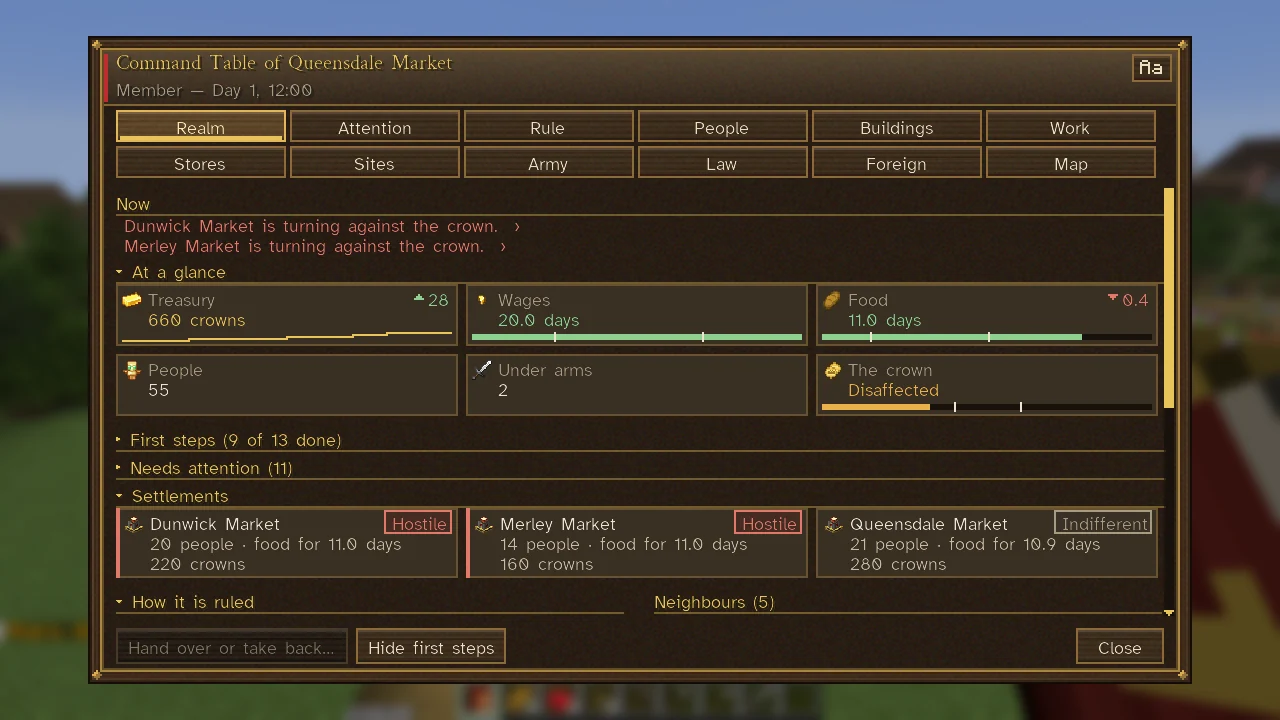
"How is my realm doing, and what needs me?" From the top:
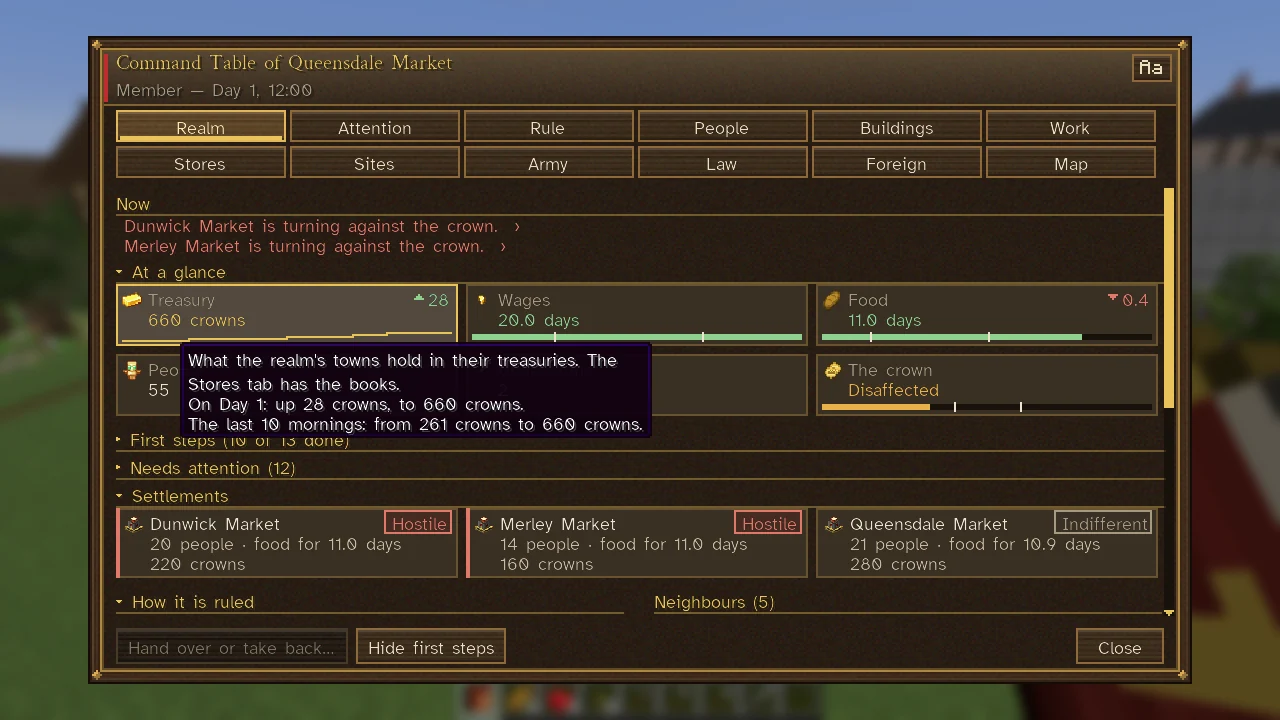
- Now: on the morning after a law, a tax or a grant, the morning report first (see below); then the three most urgent matters (an attack, hunger, a town turning against the crown), with See all … urgent alerts when there are more.
- At a glance: Treasury (a line of its last ten mornings), Wages (how many days of wages the treasuries hold; see below), Food (days of food in the towns' stores, marked at 2, short, and 7, well stocked), People, Under arms and The crown (devoted from 50, loyal from 20, indifferent above −20, disaffected above −50, hostile below). Each opens the tab with the rest.
- First steps, a young realm's checklist of thirteen (see Founding a Realm), and Court when petitions wait (see Court and Petitions).
- Needs attention, with how many alerts there are in all, counted as the Attention tab counts them: the alerts not already under Now as lines, twenty at most; the Attention tab has them all.
- Settlements: a card a town with its people, days of food and treasury, and a chip: Hungry, Empty, or what its people think of the crown. Short of food, its edge is amber; turning against the crown, red. A town whose figures are older than the last morning adds how old ("as of Day 6"); one that has kept no day yet, with no one near, says (unwatched). The towns in want or turning against the crown come first, then the most peopled. In a realm of more than five towns, four cards stand open and the rest wait folded under More settlements (N).
- How it is ruled: the kind of rule, Stability, Legitimacy, Loyalty and Hardship as meters marked at 30 and 50, and a small chart of stability. Beside it, Neighbours: each known realm a chip in its standing's colour, eight at most.
- Then Your steward (see Your Steward); Handed over, what the realm runs by itself, chosen with Hand over or take back…; and Recent events.
The morning report tells a realm with a player in it how its people took a decision. On the morning after the crown changes a law or a tax, or grants an interest's demand, two rows head the Realm tab and the Rule tab alike: "Morning report:" and what was decided ("Morning report: no head tax"; on the Realm tab it opens the Rule tab), then this morning's stability, legitimacy and hardship, each with how far it moved since the morning of the decision ("Stability 64 (+5), legitimacy 64 (-5), hardship 26 (+9)"). Their hover gives the day of the decision, each measure then and now, the treasury and the realm's days of food then and now, and, after a grant, the interest's answer. Its sovereign and officers are told the same in gold in chat ("Morning report: stability 64 (+5), …"), with the same hover; a plain member hears it after choosing to hear all of the realm's affairs (see The Sovereign's Companion). A decision made before the server restarts is not reported.
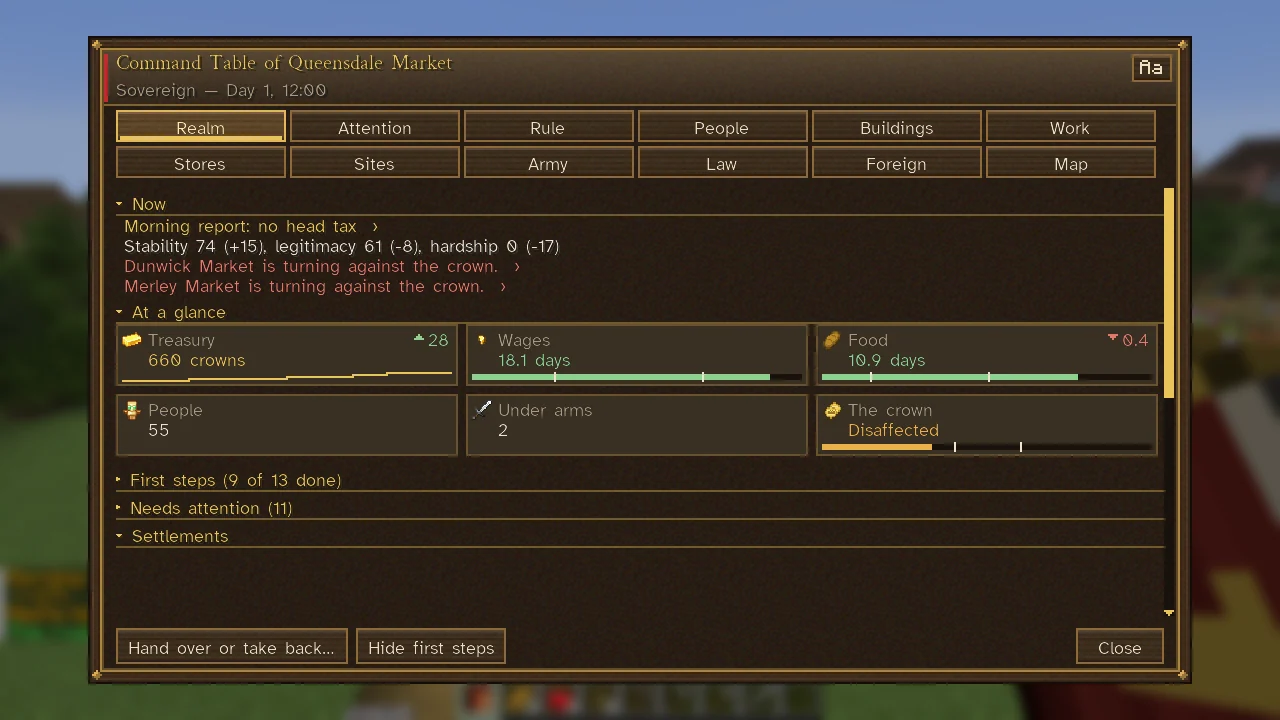
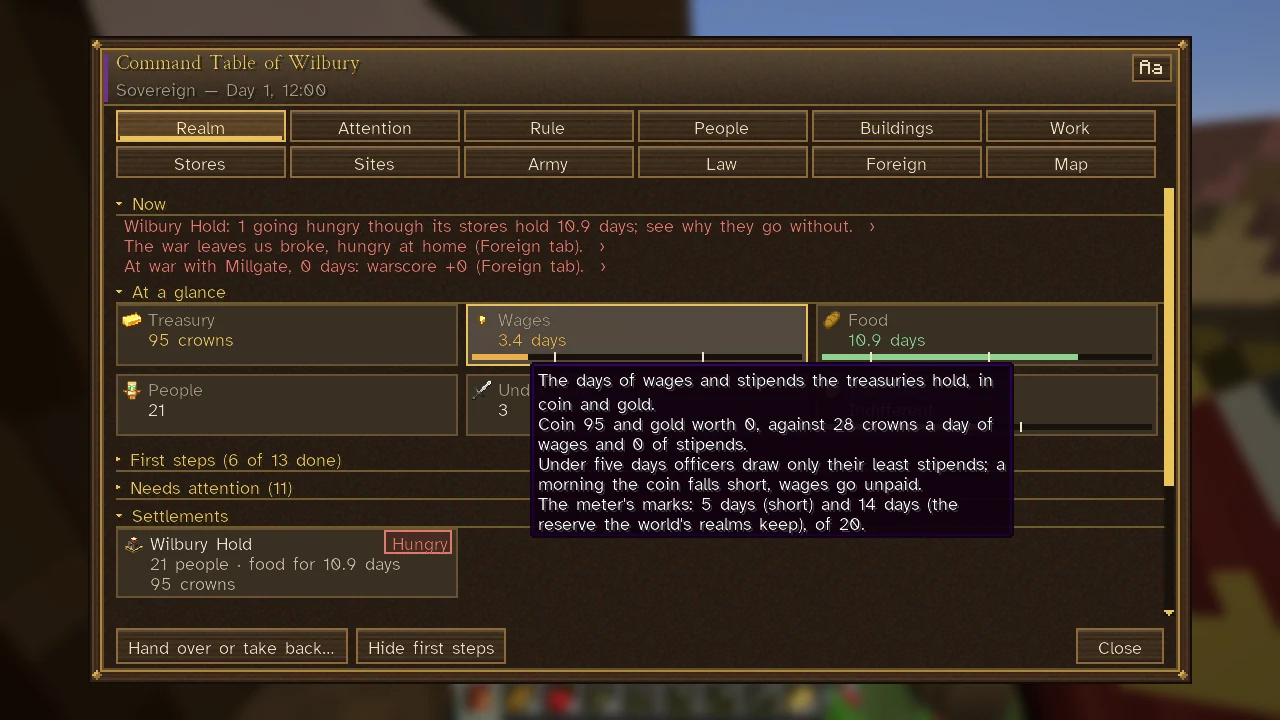
The Wages tile is the treasury's runway: the coin in the realm's treasuries and the gold in its treasuries and warehouses waiting to be struck, over what goes out each day in wages and officers' stipends. It is red under 2 days, amber under 5, gold below 14 and green from 14, on a meter of 20 days marked at 5 (short) and 14 (the reserve the world's realms keep). Its hover gives the figures ("Coin 120 and gold worth 36, against 30 crowns a day of wages and 5 of stipends") and warns that under five days officers draw only their least stipends, and that a morning the coin falls short, wages go unpaid. Clicking it opens the Stores tab. See Treasury and Taxes.
Attention
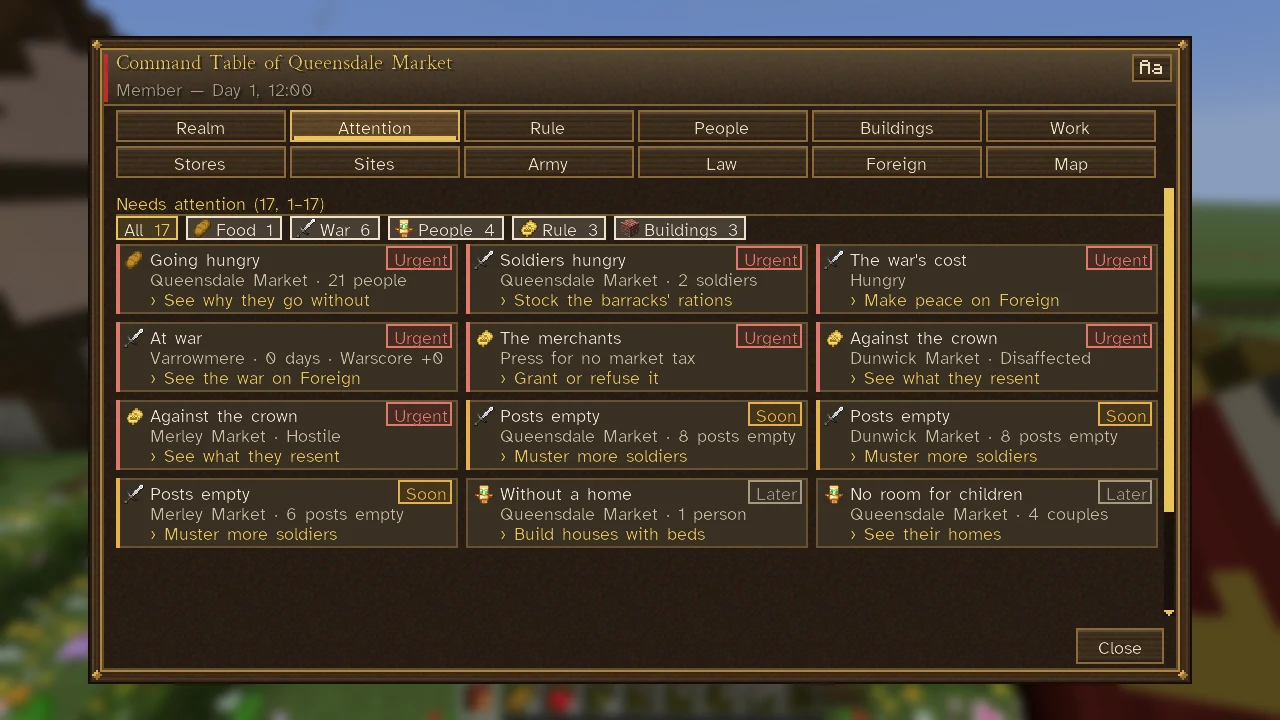
"What must I deal with, most urgent first?", from the realm's first day. Filter chips stand under the heading: All, then each kind that has alerts, with how many; the chosen one is named in the heading. Each alert is a card: a few words ("Going hungry"), the town and how many, Urgent, Soon or Later on its chip, and in gold the action that answers it ("› Stock the granary"), which clicking the card does. Thirty cards to a page. A hungry town's alert opens a page of its food: its food figure and how old it is, what its stores hold now, who is hungry (those away on a journey marked on the road), its rations and the ways to respond.
| Filter | Gathers |
|---|---|
| Food | Hunger, short stores and granaries calling for food. |
| War | Wars and their cost at home, armies on the march, and soldiers hungry, shaken or too few for the watch. |
| People | The homeless, the hurt, the miserable and those leaving, fevers, feuds, and those asking to join. |
| Work | Idle hands, workers held up, bare stalls and supply routes held up. |
| Rule | What the interests press for, towns turning against the crown, its right to rule, debts, wages and a treasury running low. |
| Buildings | Buildings not in order or damaged, broken walls and roads held up. |
| Law | The wanted, trouble spots and outlaws on the roads. |
| Foreign | Envoys awaiting an answer, and what the neighbours have been doing. |
Each alert names the answer that fits its cause:
- Going hungry asks you to stock the granary, unless the town's stores already hold food enough; then it says the food is not reaching them (their coin, their rations, a barred door or work that keeps them from it; their sheets say which) and asks you to see why they go without. Hungry on the road is kept apart: those away on a journey eat what they carry, and no granary reaches them.
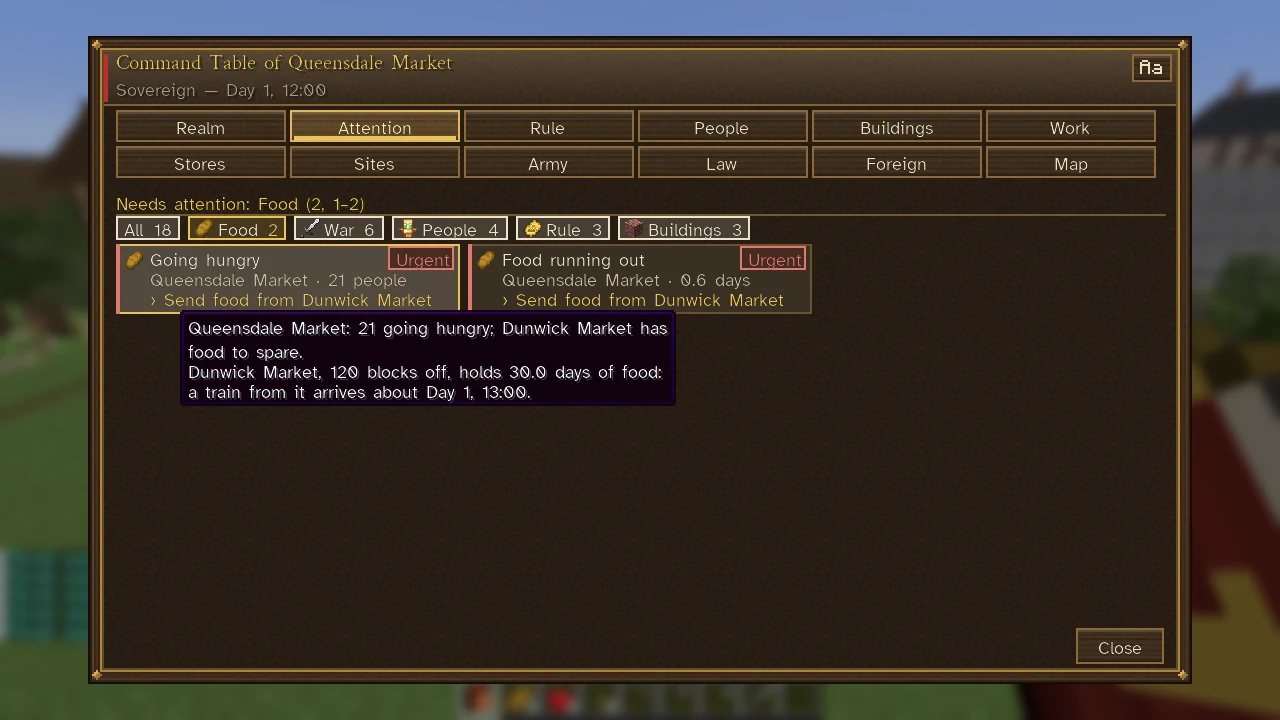
- Going hungry (where the stores are short) and Food running out (under two days of food) offer relief when another town of the realm has food to spare: the action reads "› Send food from" that town, its hover says how far off it is, how many days of food it holds and about when a train from it would arrive, and the card opens a supply train from it already loaded (see Merchants and Supply Trains). The town's food page offers the same train first under its ways to respond. With no such town, they ask you to stock the granary.
- Fever is one card for an outbreak: the town, how many are sick and how many have died of it lately, and See the sick, or Build an infirmary where the town has neither a healer nor an infirmary. A death by fever names the town ("died of the fever in Aldhaven") in the realm's word of it and its chronicle.
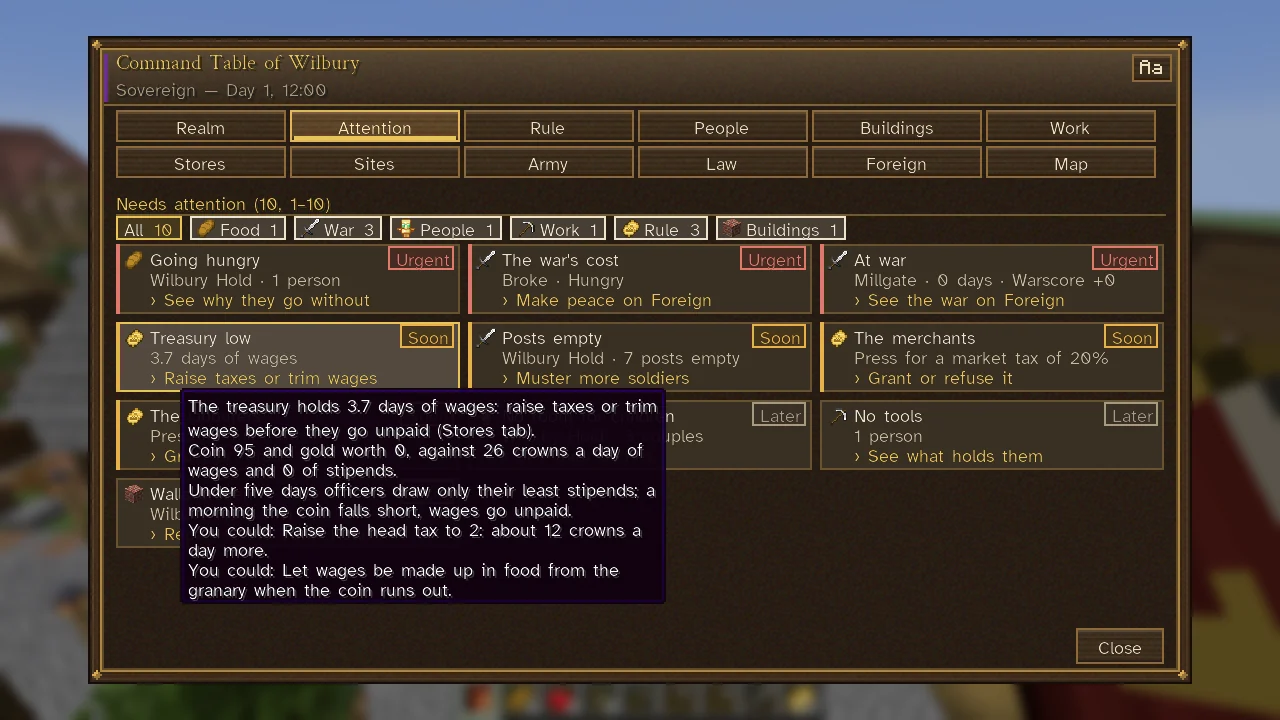
- Treasury low comes before the wages go unpaid, when the treasuries hold under five days of wages and stipends (Urgent under two). Its hover gives the figures and up to three things the crown could do, each a "You could:" line: set someone to strike the gold waiting at a treasury, raise the head tax or the market tax a step (with about how many crowns a day it would bring), trim the workers' wage a step, or let wages be made up in food. Once wages have gone unpaid, a Wages unpaid card takes its place.
- Deep in debt leads to the Stores tab, where the head tax, dues in goods and each debt are; an amnesty is a decree on the Rule tab.
- Soldiers shaken gathers soldiers whose morale is under 35, who may refuse a field order.
Rule
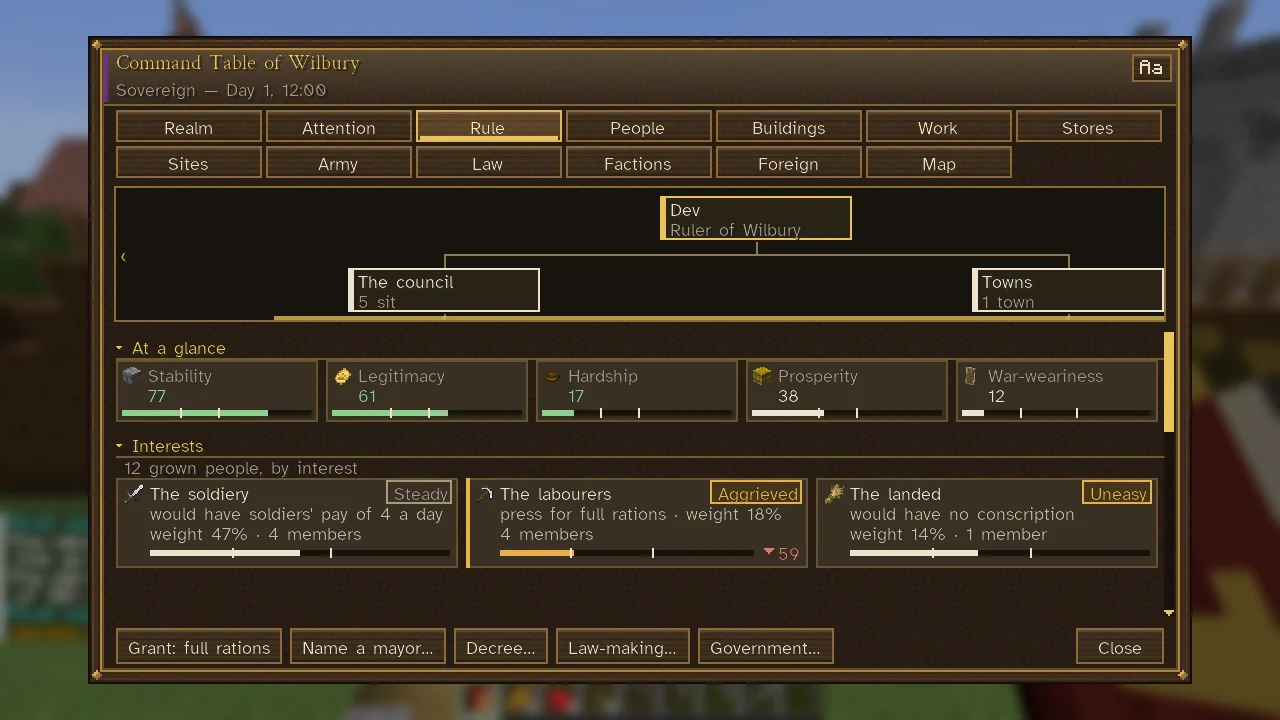
"Who wants what, and what happens if I refuse?" Under the chart of offices, on the morning after a decision, the morning report's two rows stand under Now, as on the Realm tab. Then come Stability, Legitimacy, Hardship, Prosperity and War-weariness as tiles, the first three this morning's reading. Then Interests: a card for each, with its mood on a chip (Content, Steady, Uneasy, Aggrieved, Angry), what it wants, its weight and members, and its satisfaction on a meter marked at −45 (angry) and 20 (content). The demand that presses hardest is weighed: If you grant it (how each interest's weighing would move, the cost from the books, and under a council or assembly its likely vote) beside If you refuse (where the asking interest's satisfaction heads, and the faction that follows), with Grant: … first on the bar. Then come the government, the crown, who makes the law, what the people think, offices, what is owed, succession and decrees, with Decree…, Law-making… and Government… on the bar (and Name a mayor… for a sovereign whose mayors are Reeves of the crown). The options under Government… say on their hover, where it can be foretold, what they would do before you choose one. See Government and Law-making.
The chart of offices is given the room the tab's words do not need (they keep up to three fifths of it). Wider than the tab, it is laid tall: the crown across the top, and the council, governors, towns with their mayors, the army and the officers each heading a column, their people a step in beneath; short of room, each place takes one line, its detail after its name and the whole on its hover (see Sheets). The same chart, with a page to itself, is the Offices tab of how the realm is governed.
People
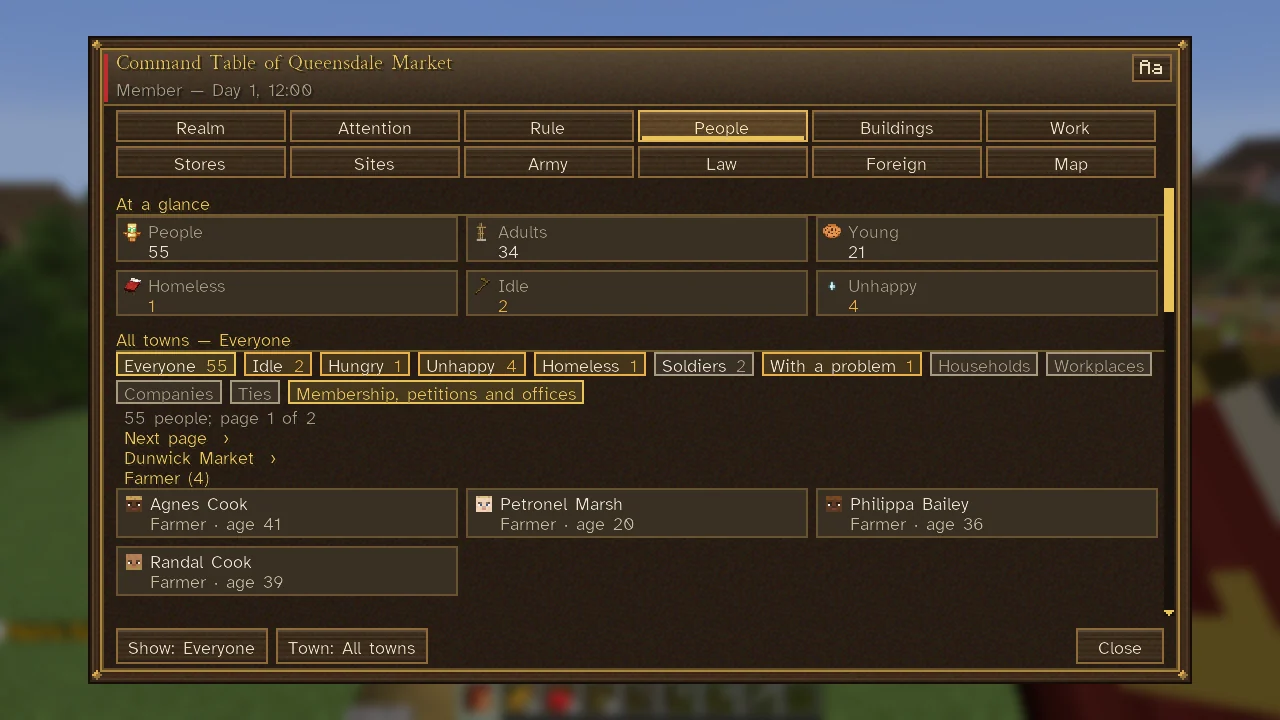
Six tiles: People, Adults, Young, Homeless, Idle and Unhappy. The roster's views are chips with their counts (Everyone, Idle, Hungry, Unhappy, Homeless and the rest, then Households, Workplaces, Companies and Ties); in a players' realm the last, Membership, petitions and offices, opens the members page (see Citizenship and Ranks). Each person is a card with their face, trade and age, and the worst of what ails them on a chip, forty to a page; Show: and Town: on the bar choose the view and the town. A fever's card opens the roster on those With the fever. See Townspeople.
Buildings
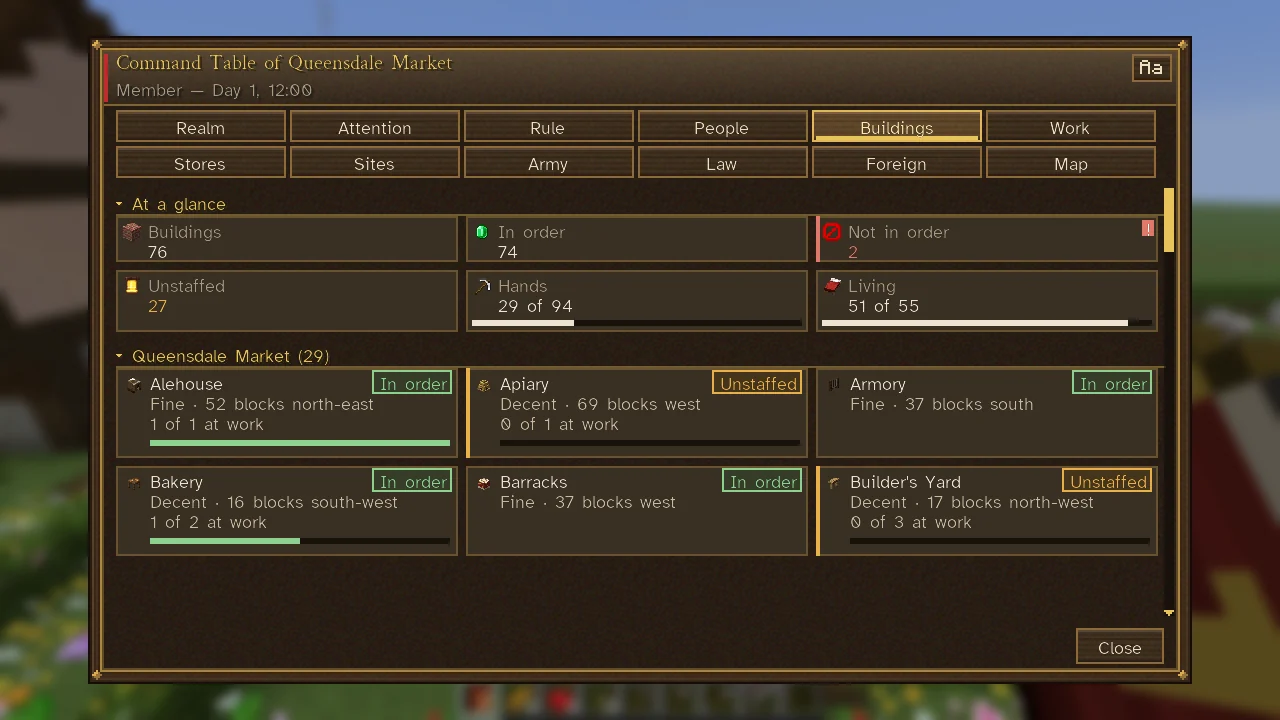
Tiles: Buildings, In order, Not in order, Unstaffed (workplaces with places to fill and no one at work), Hands (at work, of the places) and Living (of the beds). Then each town's buildings as cards: quality (Crude, Decent, Fine or Grand) or what it wants, how far and which way from the heart, how many work or live there on a meter of its places, and its state on a chip (In order, Not in order, Unstaffed, Closed). See Buildings and List of Building Types.
Work
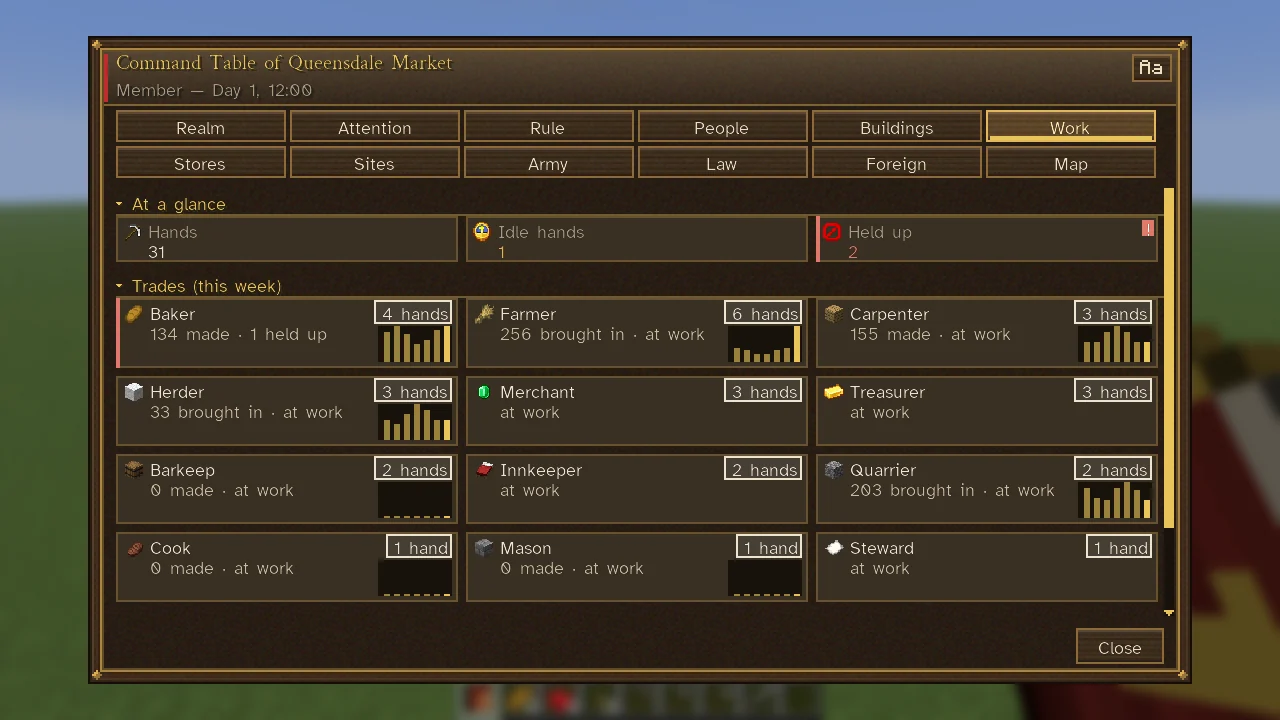
Tiles: Hands, Idle hands (grown folk of working age with no trade and not in service) and Held up. Then the week's trades as cards: hands on a chip, what was brought in or made and how many are held up, and a bar a day of the last seven days' output. The trades held up come first, red-edged; each opens its town's labour board. The production chains and each town's orders, stuck workers, sites and pantries follow as lines. See Work and Professions.
Stores
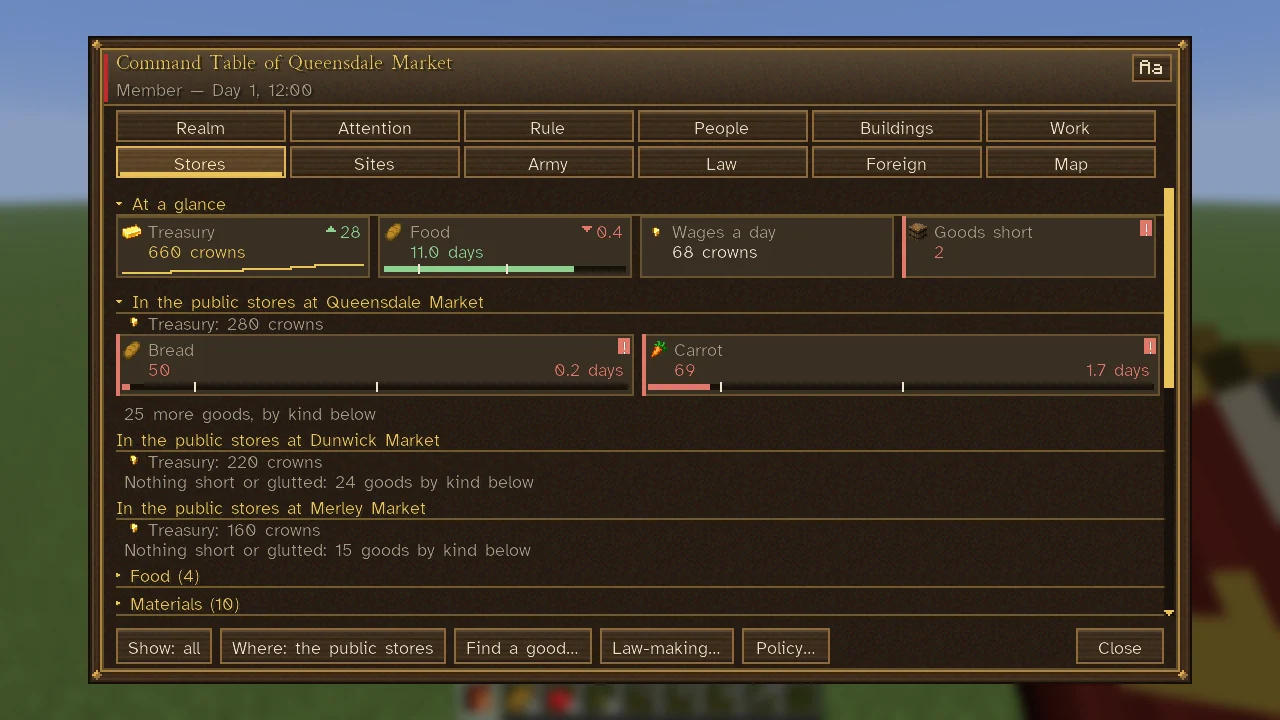
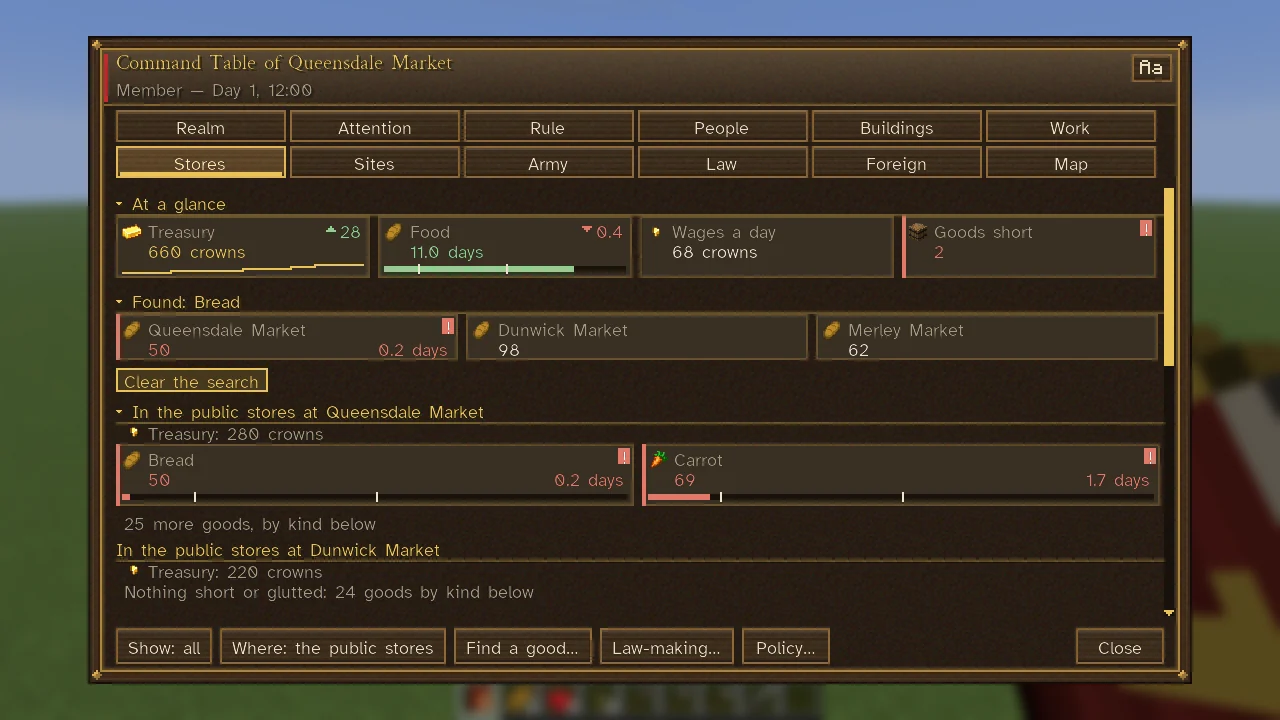
Tiles: Treasury, Food, Wages a day and Goods short. Wages a day is what the crown pays in wages a day at the wages set; its hover gives the treasuries' coin and gold against the wages and officers' stipends and how many days of them they hold, and it turns amber under five days and red under two. Then the public stores, opening on what needs a ruler. Each town's section shows only its short goods first (wanted by the work, or lasting under two days at the past week's use: red, marked "!"), ten at most, then up to five glutted ones (four weeks' worth and more at the week's use, or 640 and more that no one uses: "More than the town uses: one to sell, or to send where it is short"). A town with eight goods or fewer shows them all. A line says how many more goods it holds "by kind below", or "Nothing short or glutted". The three towns with the most goods short stand open and the rest folded. Every other good waits under its kind, Food, Materials, Tools and Arms, each a folded heading with its count: a tile a good, with what the realm's towns hold of it together and, on its hover, which town holds how many.
Find a good…, on the bar and as a chip among Which goods, lists every good in the public stores by name, each with where it is held; typing filters the list. The good chosen stands first under the tiles, under Found: and its name: a tile for each town that holds it, with how many, its days of supply, and red where it is short. Clear the search puts the tab back.
Which stores and Which goods chips (or Where: and Show: on the bar) choose what is shown; other stores and kinds show their goods as a grid of tiles. Below are the Books, Where the coin is, Debts and Policy; where the land holds its wealth by province, the metals the realm lacks and the deposits its survey knows (see Prospecting and Mining); and, with several towns, Send a supply train…. The policy's settings then stand in five folded groups, each with a line saying what it holds and a chip for each setting that opens its choices: Taxes and dues (what the crown takes, in coin and in goods), Wages and shares (what the crown pays, and what makers keep), Food and relief (how the granary feeds the realm and the poor), Work and hours (who hires, the hours, safety and rest) and Order and trade (settling, the curfew, the market and hunting).
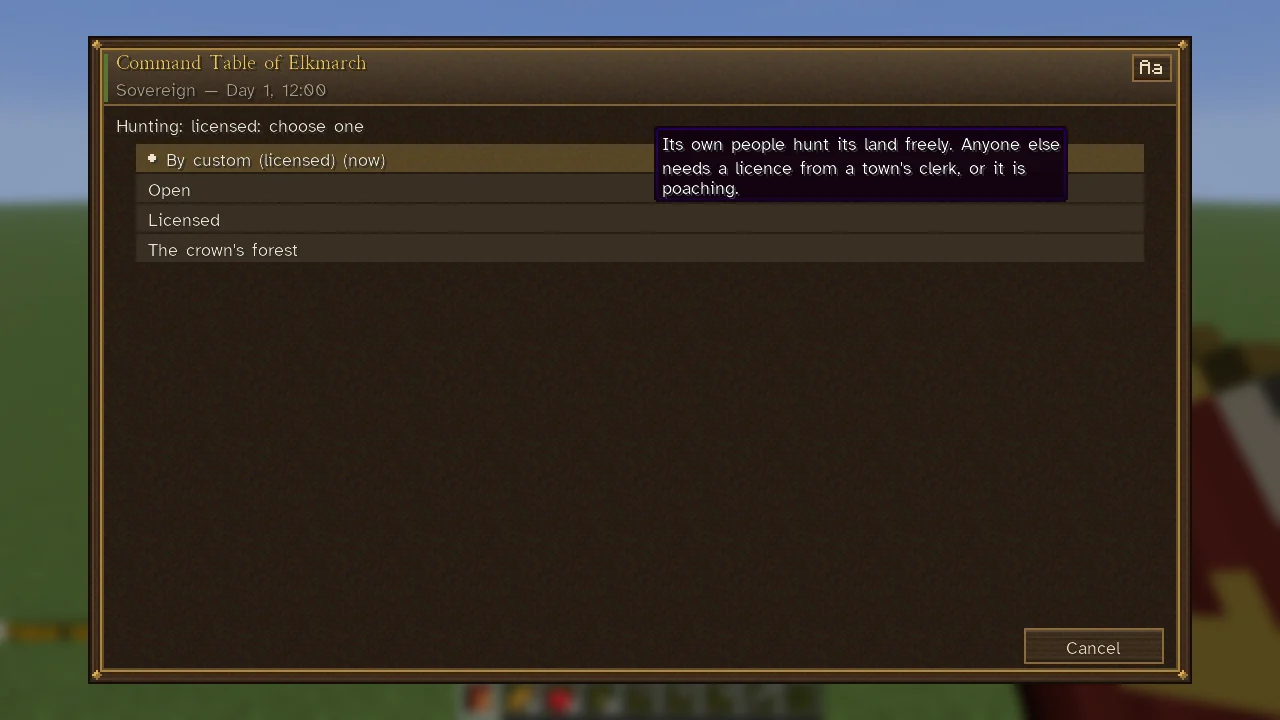
Policy… on the bar lists the same settings, a row each (Head tax, the wages, Market tax, Rations, Hunting and the rest); a row opens its choices, and each choice says on its hover what it would do to the treasury a day, which interests it would please or anger, under a council or assembly how it would likely be voted, and how many days the law must still stand before it may change. The Hunting row is the realm's game law: By custom (its people's custom, named), Open, Licensed or The crown's forest (see Hunting and Game Laws). See Treasury and Taxes, Markets and Trade and Merchants and Supply Trains.
Sites
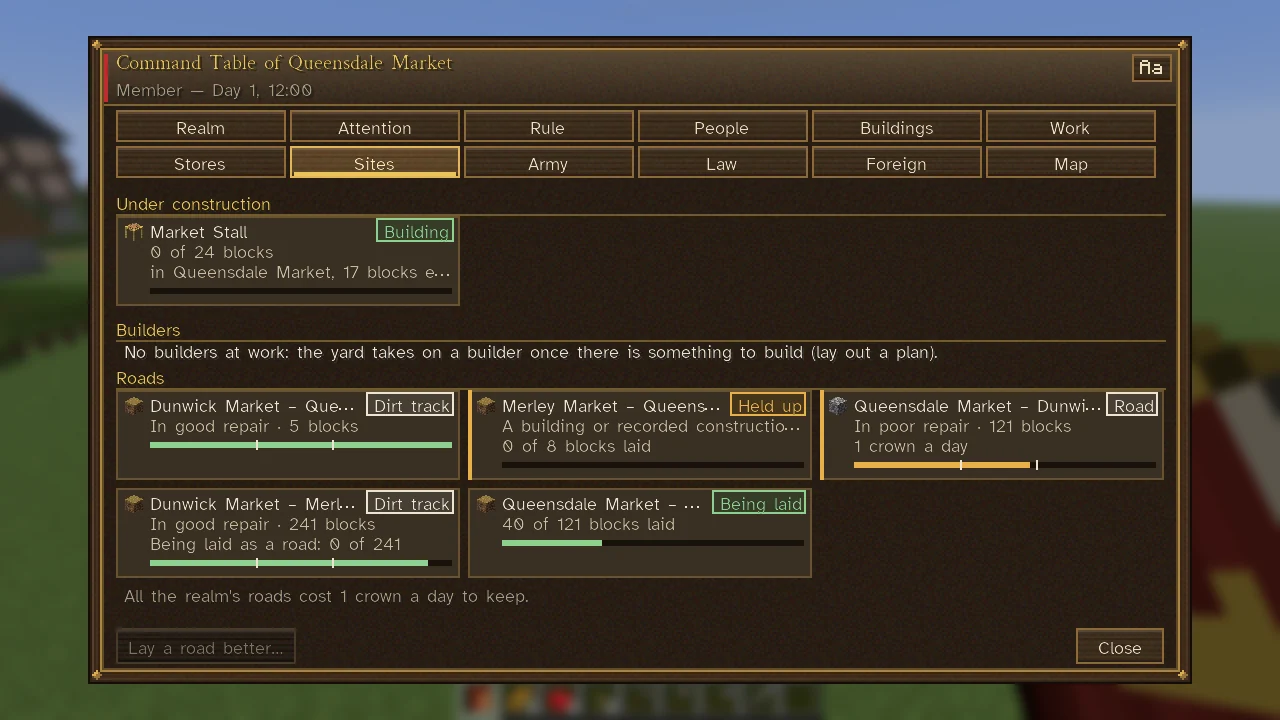
Each building under construction is a card, Building or Held up on its chip, with what holds it up and how much is laid on a meter; the builders follow. Then Roads: a card each, titled by the two towns it joins, its grade on its chip (Dirt track, Road, Paved road, Highway), how well it is kept, its length and its keep a day, with a meter of its keeping marked where it wears (60) and falls into ruin (35); one still being laid shows Being laid or Held up and how much is laid. See Construction and Roads.
Army
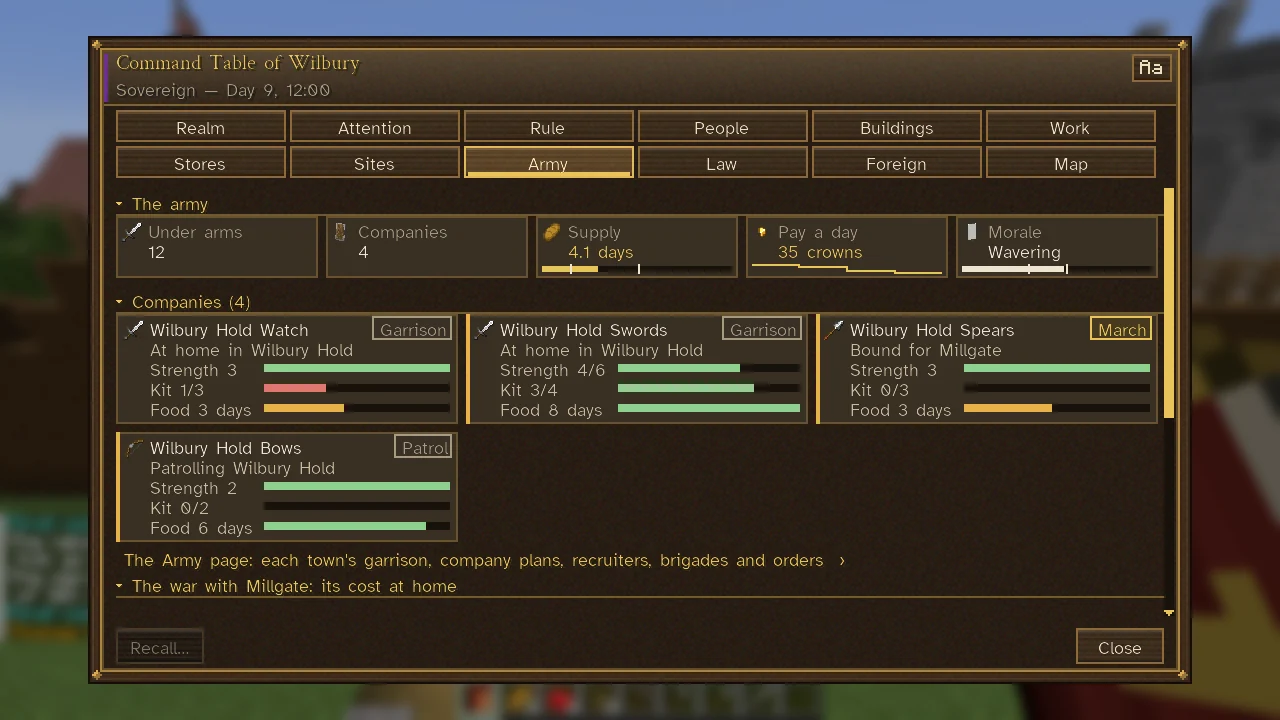
Five tiles: Under arms, Companies, Supply (the days the soldiers' packs and barracks' rations last), Pay a day and Morale. A siege the realm lays or stands under has a card of its own above the companies, with the siege's day, the town's food, the walls and the stores on meters, and its orders under it (see Walls and Sieges). Each company is a card: its orders on a chip (March, Garrison, Patrol and the like), where it is, and meters of Strength, Kit and Food; one hungry, unpaid or shaken has an amber edge. A link then leads to the Army page, which holds what the tab does not: the army's upkeep, each town's garrison, company plans and their recruiters, brigades, and Raise a company…. Each company's section there has Raise now…, which lists how many of the town could be raised at once and the price of each choice before you choose: a bounty for each recruit (five days of a soldier's wage, at least 10 crowns), and kit bought from merchants only where the armory holds none spare and the town cannot make it. Choosing again pays it from the treasury. A steward can also be set to fill a company over days (see Your Steward). At war, five tiles of the war's cost at home follow; then the watch, ships, those of yours on the road and the barracks. Recall… calls back those still out. See Armies and Soldiers, The Watch and Watchtowers and Ships and Sailing.
Learning
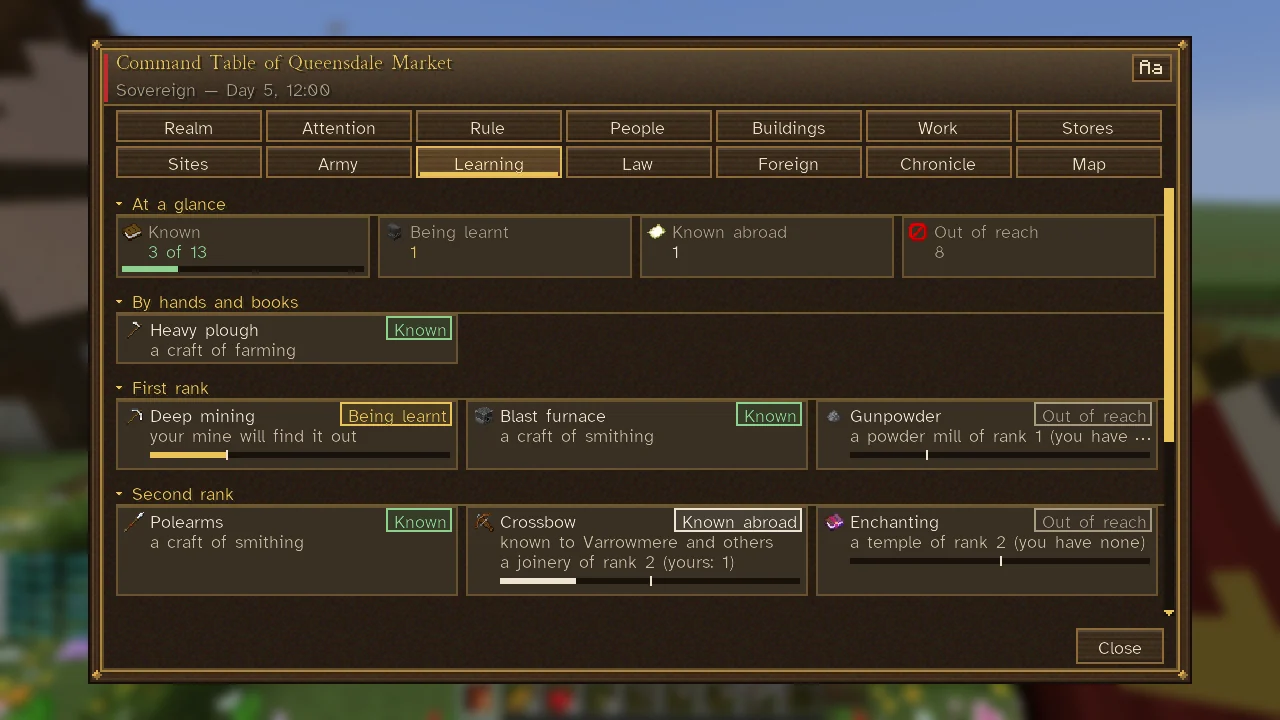
A ladder of the crafts. Tiles: Known (of the thirteen crafts), Being learnt, Known abroad and Out of reach. Then the rungs, by the rank of the workshop that finds a craft out: By hands and books, then First rank to Fourth rank. Each craft is a card with its state on a chip, what it waits for ("a joinery of rank 2 (yours: 1)") and, until known, a meter of the realm's best workshop of its kind, ticked at the rank it needs. With that workshop at work and what must come first known, the realm's workers find a craft out in time. A craft known abroad comes with a skilled hand who knows it, or its book.
Law
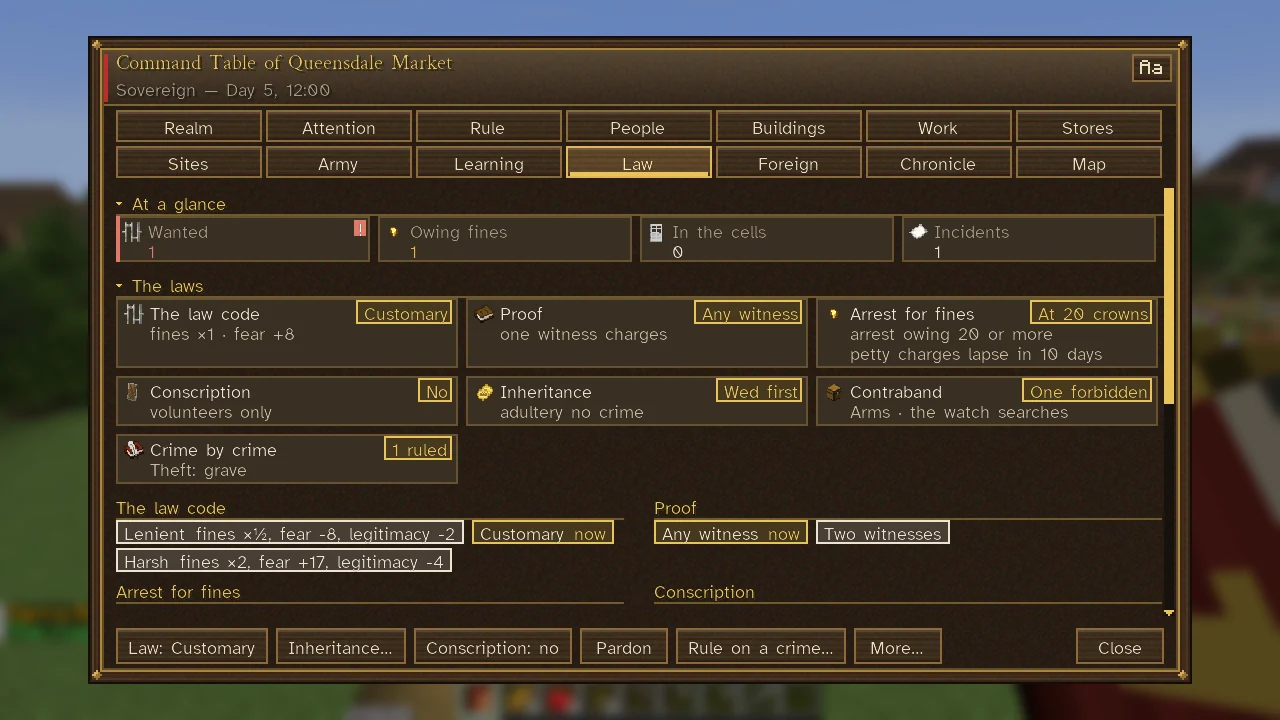
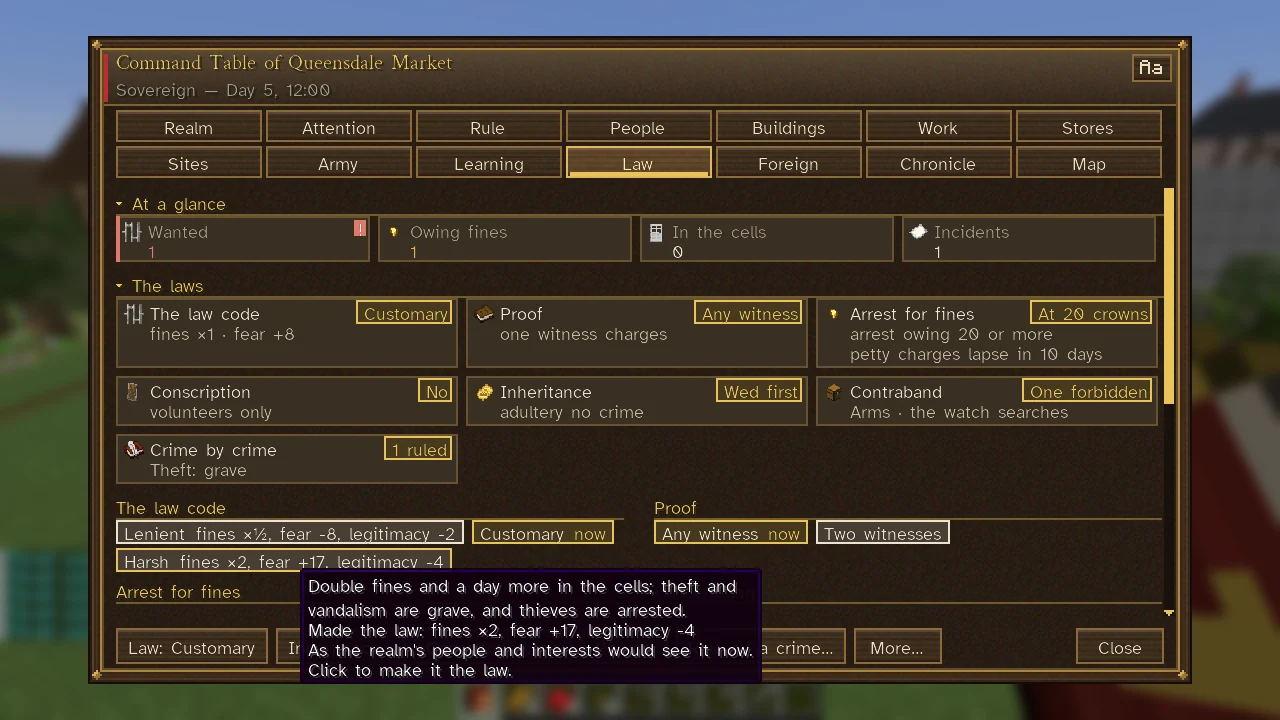
"What are the laws, and what does each cost and gain?" Tiles: Wanted, Owing fines, In the cells and Incidents this week. Then The laws as cards, each with its setting on a gold chip: The law code, Proof, Arrest for fines, Conscription, Inheritance, Contraband and Crime by crime. Under each law's name its choices stand as chips, the one in force in gold with "now"; the others say what making them the law would do to fines, fear, legitimacy and the interests it moves most (Inheritance and Contraband are not weighed), and under a council or assembly, how it would likely be voted. Only a magistrate's click makes a choice the law. The law book follows: the wanted, the fined, the cells, the crimes as ruled, what happened lately and trouble spots. See Magistrates and Codes of Law, Crime and Punishment, Arrest and Jail and Wanted and Bounties.
Factions
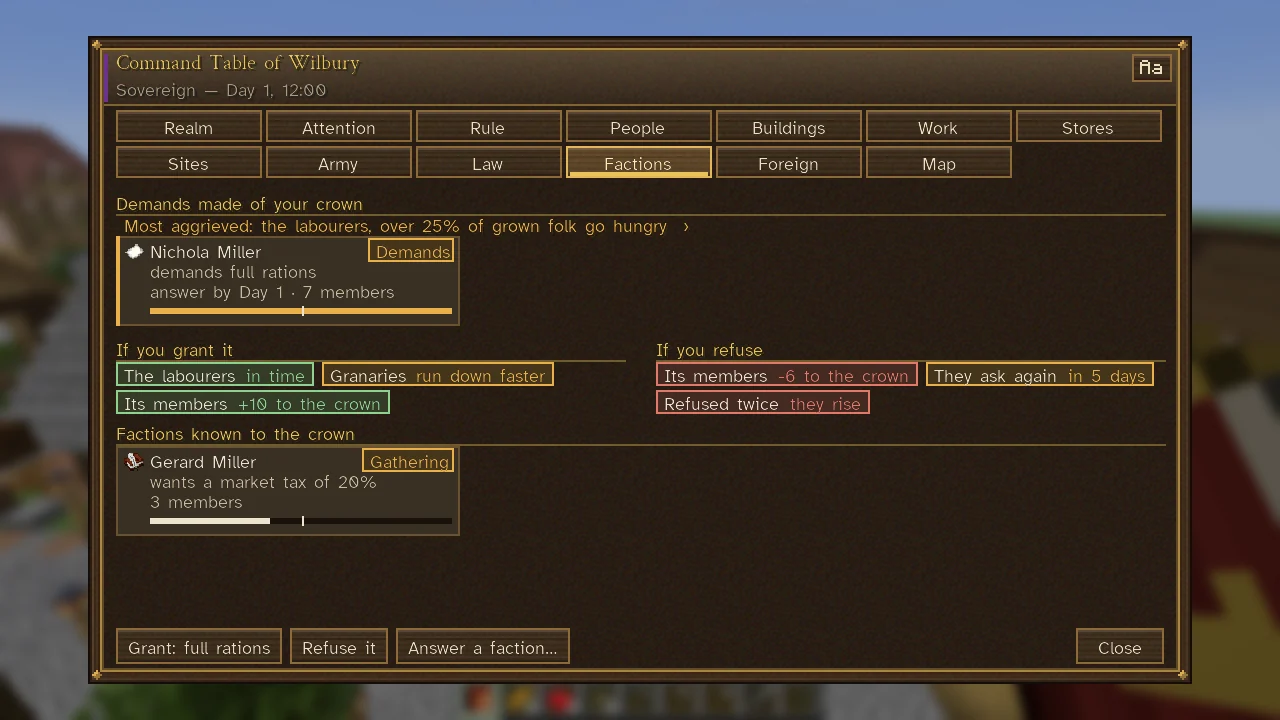
Demands made of your crown opens with the realm's most aggrieved interest. Each demand is a card titled by the faction's leader: what it demands, by when, its members, and its strength on a meter marked at the share of the crown's strength it needs. The demand due soonest is weighed, If you grant it beside If you refuse, with Grant: … and Refuse it on the bar (Answer a demand… when more wait). Under Factions known to the crown, each is a card with its state on a chip (Gathering, Risen); Answer a faction… answers one before it demands. See Factions and Demands.
Foreign
Under a chart of where the known realms stand (laid tall in columns, as the Rule tab's is, when it is wider than the tab):
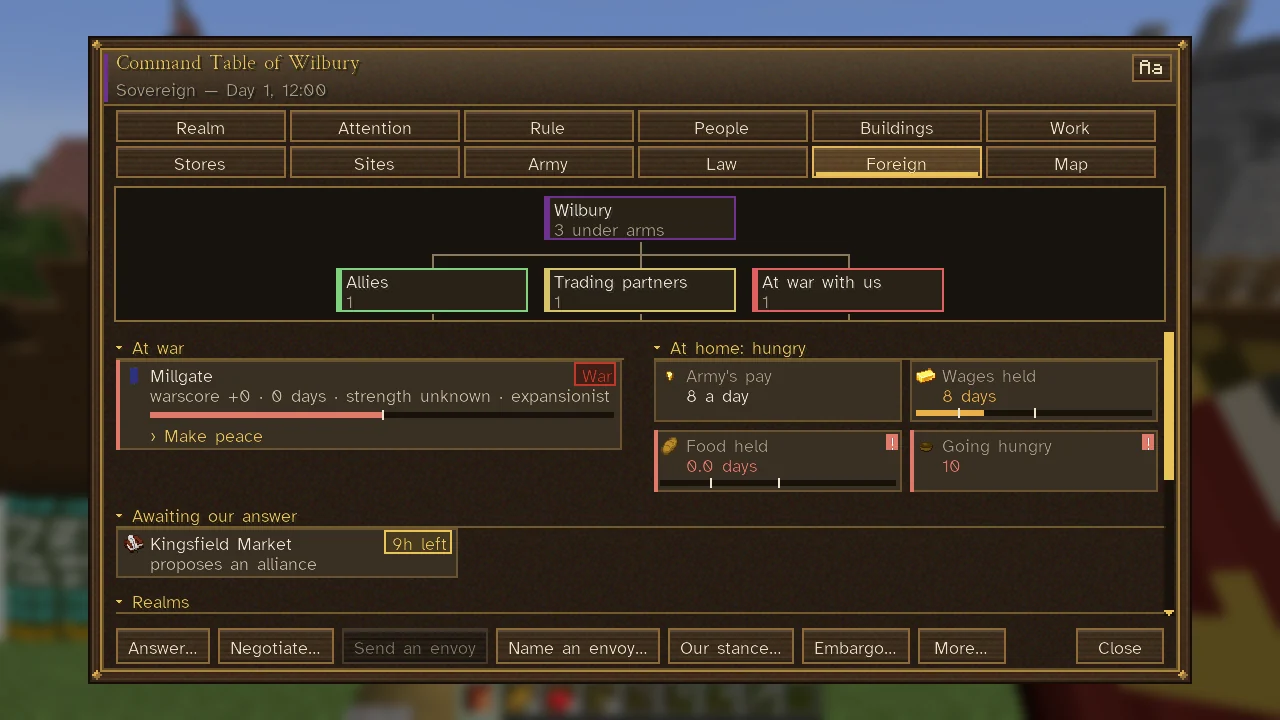
- At war: each war a card with War on its chip, its warscore on a meter and its days, and "› Make peace" in gold, opening the negotiating table. Beside it, At home: Army's pay, Wages held, Food held and Going hungry as tiles.
- Awaiting our answer: each envoy's proposal a card with the hours left on its chip, Answer… first on the bar.
- Realms: every other known realm a card (twelve at most, the rest as chips) with its standing on a chip, how it regards you on a meter, what you believe it musters, any treaty, a world realm's temper, and in gold the errand its standing allows ("› Offer a trade pact").
- Then treaties and trade as chips, wars lately ended, and your envoys abroad.
The buttons include Negotiate…, Send an envoy, Name an envoy…, Our stance…, Embargo…, Send a scout… and Place a spy in…. See Diplomacy and Envoys and War and Peace.
Chronicle
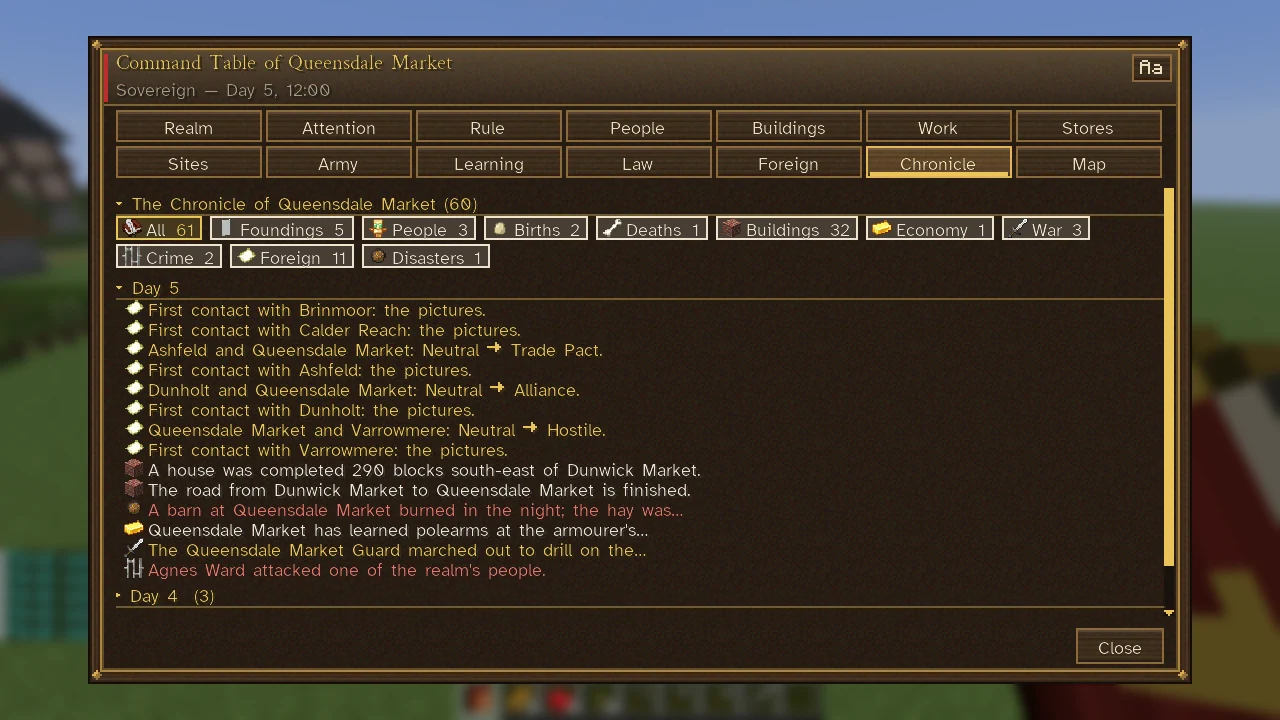
The realm's deeds as a timeline. Chips for All and each kind kept, with their counts (Foundings, People, Births, Deaths, Buildings, Economy, War, Crime, Foreign, Disasters), choose what is shown. The deeds stand under their days, newest first, each with its kind's picture and colour: deaths, crimes and disasters red, births and foundings green, war and foreign affairs gold. It shows sixty deeds at most, over the latest forty days.
Map
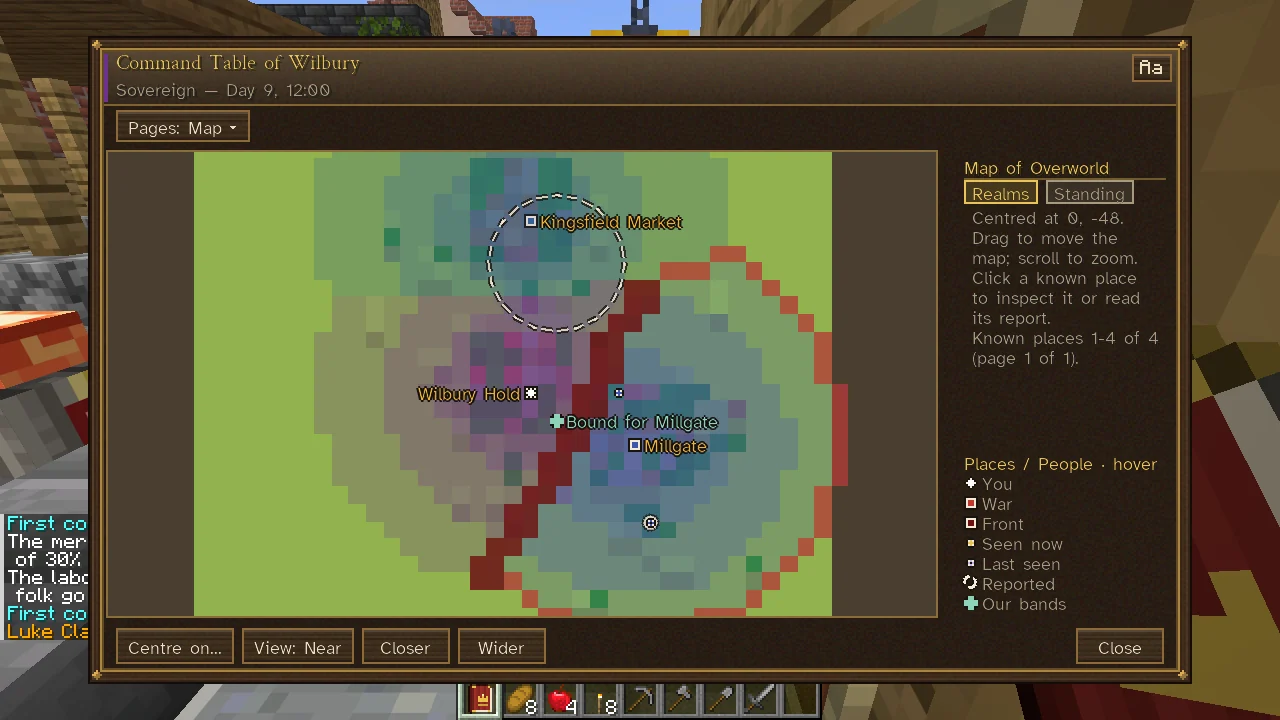
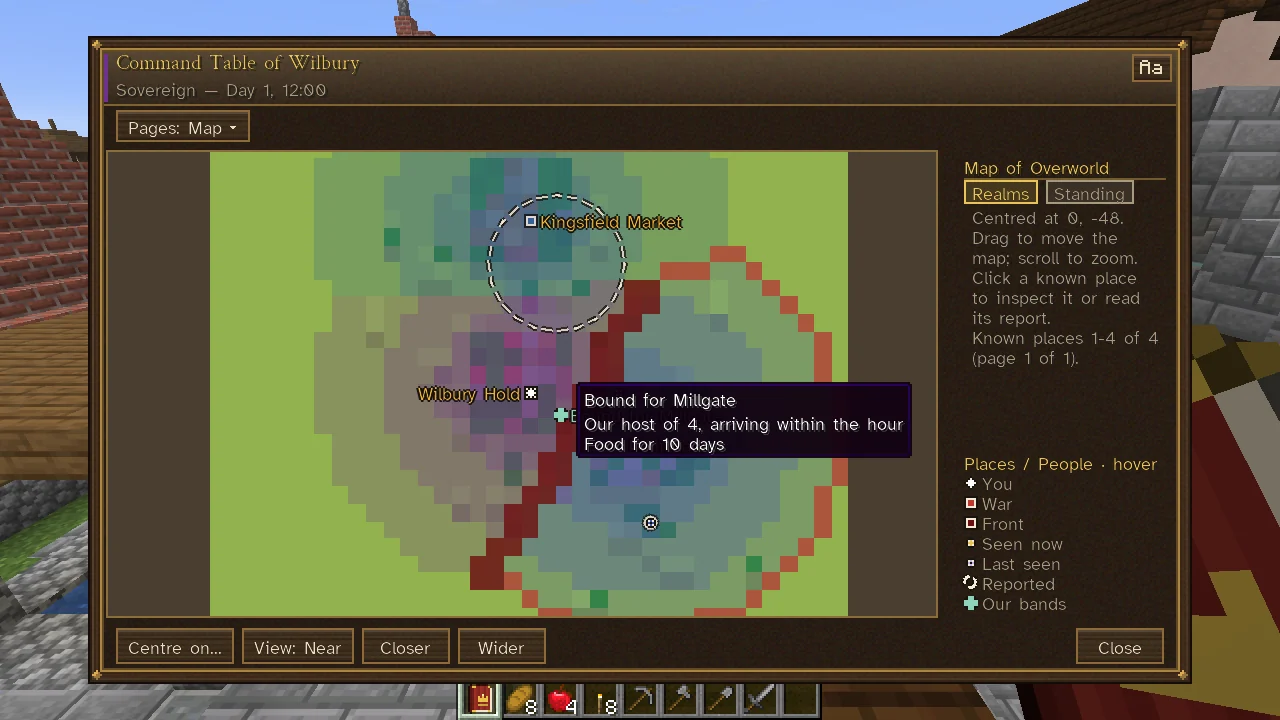
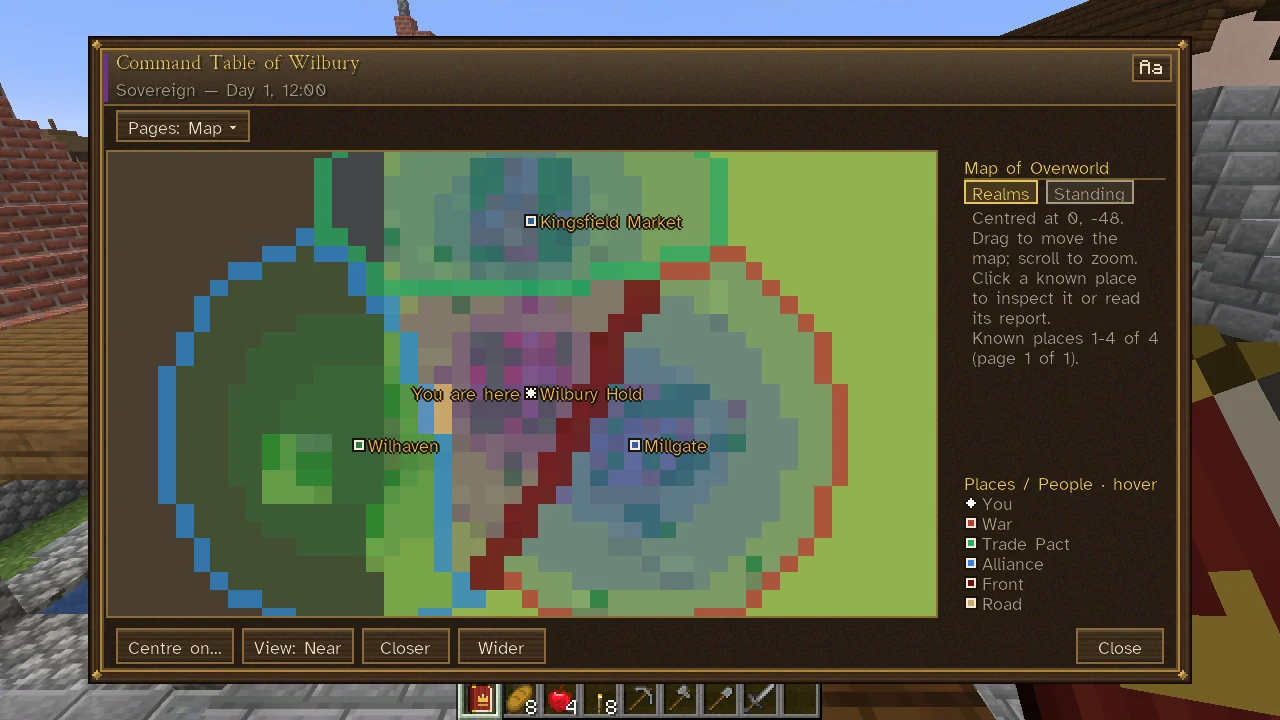
The land as the realm knows it, coloured by whose Influence is strongest, deeper where it holds firmly, with settlements and journeys pinned. Its layers are chips: Realms (each realm in its own colour, one at war, hostile, allied or trading with you ringed in its standing's colour) and Standing (each realm in the colour of where it stands with you, yours in gold). The front against an enemy is dark red; a white diamond marks "You are here"; the key names only what is drawn. Centre on... jumps to a known place, View:, Closer and Wider set the scale; drag to move, scroll to zoom, and click a known place to inspect it or read its report.
Over the land the map draws the war: the forces of other realms as far as your people know them, and your own on the road. How sure the map is shows in how each is drawn:
| Mark | Key | What it means |
|---|---|---|
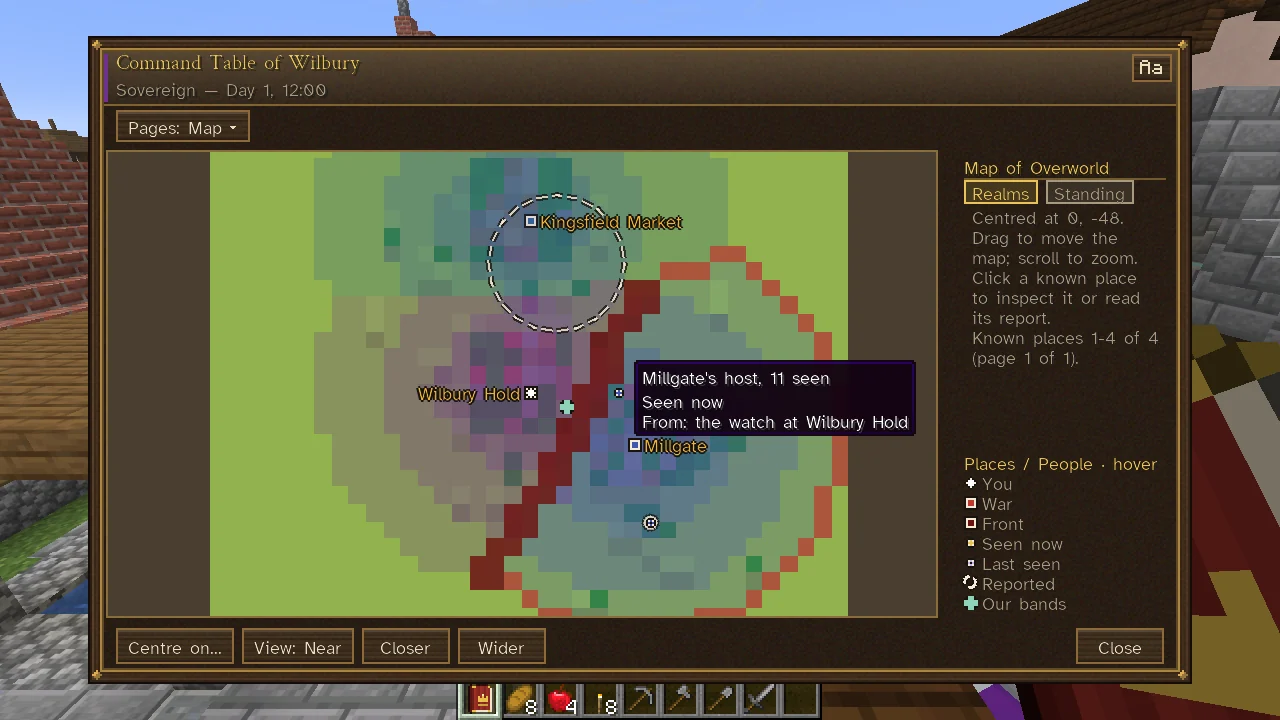
| A solid point | Seen now | In sight of your people at this moment, drawn where it is. |
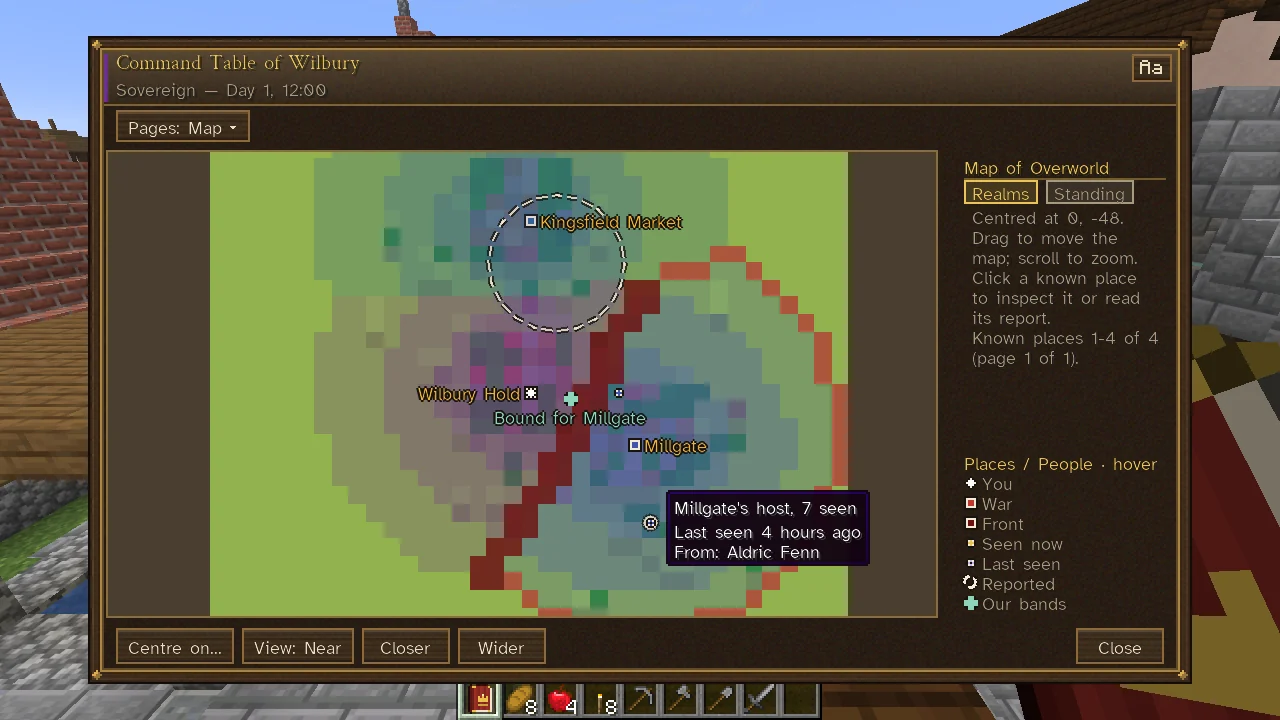
| A hollow point, dulling with age | Last seen | Where it was when sight of it was lost; it has moved since. |
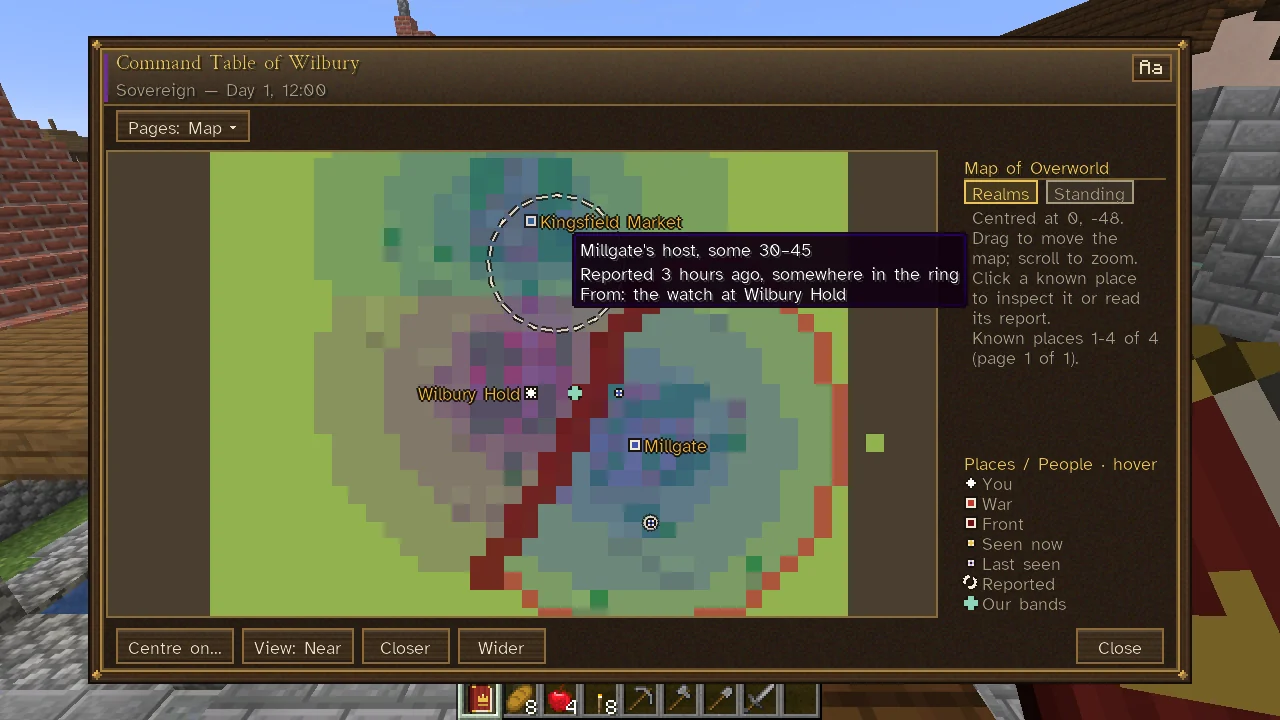
| A dashed ring | Reported | Word of it: it is somewhere in the ring, and the wider the ring, the less is known. |
| A cross | Our bands | One of your own bands, lettered with where it is bound. |
A force no one of yours has seen is not drawn at all, so it may come unseen. Resting the pointer on an enemy says whose it is and how many ("Millgate's host, some 30–45", "11 seen"), whether it is seen now or how long ago it was seen or reported, and from whom (the watch at a town, one of your soldiers, your own eyes). Your bands are lettered "Bound for" a town, "At" it, or "Home to" their own; their hover gives their strength, when they should arrive and how many days their food lasts ("Our host of 4, arriving within the hour", "Food for 10 days"). The key explains each kind in a line, and the contacts are kept fresh while the map is open. See War and Peace and Campaigns.