Dynasties and Succession
DiscussFrom the Sovereign Realms Encyclopedia
Dynasties are how a life goes on in Sovereign Realms. Where the world runs on the dynasty rule, a player who dies does not simply respawn: they choose who of their house goes on, and what they owned passes by the law of their realm and by their will. The crown of a realm passes the same way, by its own law. This article covers what happens at a death, the laws of inheritance, wills, and the line of a house.
The life rule
A world keeps one of three rules for what a player's death means. On a dedicated server the server's lifeRule setting decides; a single-player world keeps what was chosen when it was made.
| Rule | A death means |
|---|---|
| Dynasty (the default on a server) | You go on as your heir, or your closest kin, inheriting what was yours. |
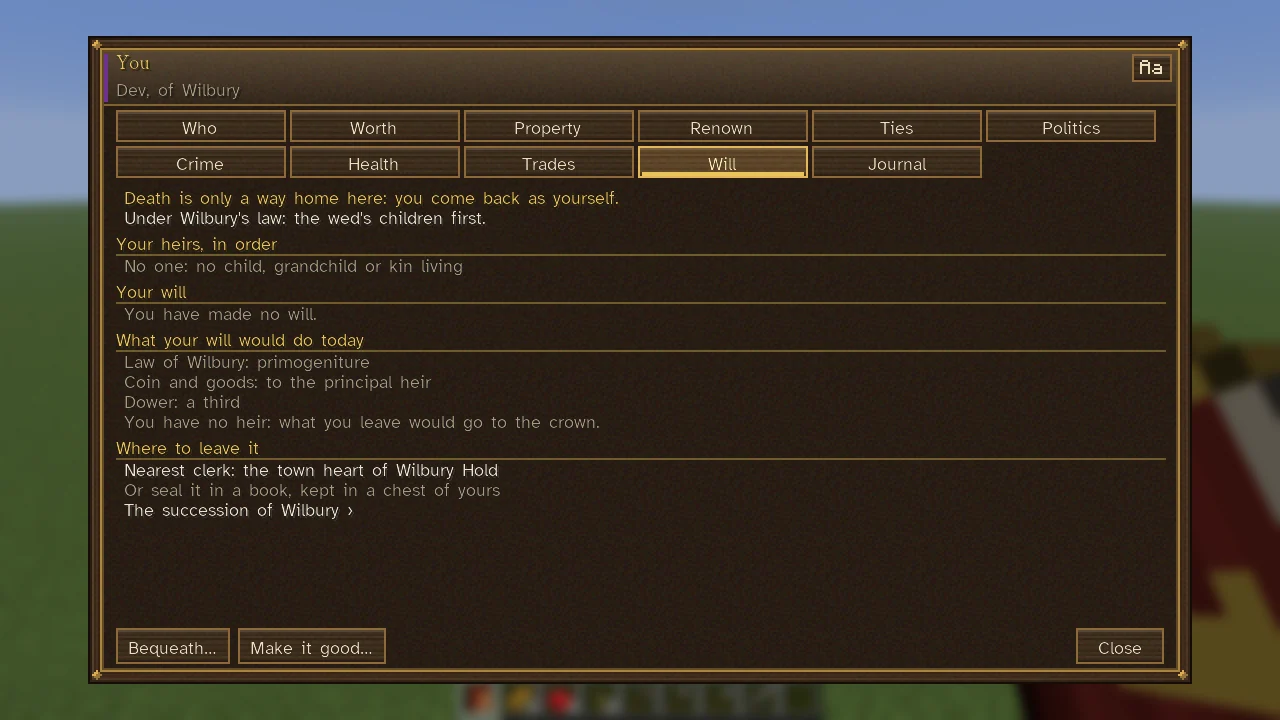
| Normal | You come back as yourself. Your Will page says: "Death is only a way home here: you come back as yourself." |
| One life | You come back as someone new, and the crown passes. |
Where lives run out you also age: a year every four days. Your first life is reckoned twenty-five years old, a life begun anew twenty (a server setting), and one taken up from an heir is as old as they were. From 65 you lose a heart and some speed, from 75 more, and your blows weaken, and past seventy any day may be your last. You never die while away; the days you missed are reckoned when you return. In a dynasty world, from 55 your Will page lets you retire and hand on to a grown heir.
When you die
Whatever you carried drops where you fell, for whoever finds it, and is not taken on to your heir. You are told who you were: your name, how long you lived, what you were known for, your deeds, titles and worth, and how you died. Then you choose who goes on:
- A grown member of your house. Each is shown with what the law would give them. The heir the law names is starred.
- A kinsman long lost, out of the wilderness. They carry the house's name, renown and debts, but take nothing of the estate.
- A new dynasty, a stranger with no past, who owes nothing of the house and answers for none of its deeds (below).
Until you choose, you wait where you woke as a spectator. You have five minutes online to choose, and if you choose nothing the law's heir goes on. Time you spend offline does not count.
Regents
If the law's heir is a child (under sixteen), you go on as its regent: its other parent, or failing that its eldest grown kin. The regency lasts until the child comes of age at sixteen, when you are told it is over.
What passes
All that was yours besides what you carried passes to the heir.
- Debts come first. What your own chests and barrels hold pays them.
- Your charges die with you, but fines you die owing become the estate's debt to the realm, paid from its coin and then its goods; what the estate cannot pay, the heir owes, to be settled at any of the realm's Town Hearts. Stolen goods in the estate are demanded back there too, and an heir who keeps them past three days is charged as a receiver of stolen goods. The heir, or a kinsman long lost, goes on with these debts, and a case the watch has open against you is still theirs to answer.
- What is left is shared by your realm's law of inheritance: your widow's part (the dower), your will's gifts, and the other children's shares, taken out of your stores. The share of the one you go on as stays in them, yours.
- The crown goes as the law says, to you only if the one you chose is the law's heir.
- Houses and businesses go by your will, or else by the law.
- The heir's own houses and home are yours now. Your ender chest stays yours.
- The heir's own family becomes yours: their spouse, children, brothers and sisters. Yours by your old life becomes theirs as they knew you: your widow mourns, and your other children are your brothers and sisters.
- A marriage with another player ends with the death, and they are told.
- A new dynasty takes nothing: your houses, businesses and stores, however hidden, go to the towns about them. Nor does it owe anything of the house or answer for any of its deeds. The estate's debts and the realms' demands for goods it held, the open cases against you (closed, with no charge) and the inquiries into them, what you set down in towns and what the towns hold of yours, the traps you set, word of your crimes still on its way to the law, the towns' complaints and the watch's suspicion all stay in the law's records under the one who died, and nothing more comes of them. A crime the new life commits is its own, charged as anyone's. The same holds when no one of the house can go on and you begin again as someone new.
Keep a sealed will in a chest of your own, not in your pack.
Laws of inheritance
Each realm has laws of inheritance, and starts with its people's custom. Only the sovereign may change the first three, on the succession sheet, through the council or assembly where the realm's governance calls for one, and the heirs who lose by a change resent it.
| Law | Choices |
|---|---|
| Inheritance | Primogeniture: the eldest heir takes the crown, the titles and the towns; younger children take portions of coin and goods, and a house or business each if the estate holds enough. Partition: the towns are divided among the children; the eldest keeps the crown and the seat, and each other child founds a realm of their own towns, tied by kinship. Seniority: the eldest grown member of the house inherits, a brother before a son. |
| Movables | Equal shares among the children, or to the principal heir, with a portion to each other child. |
| Dower | What a surviving husband or wife takes first: none, a quarter, a third or a half. |
| Legitimacy | Children born out of wedlock inherit as the wed's children do, after them (the usual), or never. |
The legitimacy law is the magistrate's instead: it stands on the Command Table's Law tab as the Inheritance card, with its choices All alike, Wed first and Wed only as chips, and a magistrate (or the sovereign) sets it there at once, with no vote (see Magistrates and Codes of Law).
The custom of each people, which its world realms begin with:
| People | Inheritance | Movables | Dower |
|---|---|---|---|
| Heartlanders | Primogeniture | To the principal heir | A third |
| Northfolk | Partition | Equal | A third |
| Sunlanders | Seniority | Equal | A quarter |
| Verdant | Seniority | Equal | A half |
| Marchers | Partition | Equal | A third |
The crown itself passes by the realm's form of succession, set on its Rule tab: by blood (the sovereign's spouse or eldest child; among players, the spouse, then the regent, then the highest in rank), by election (the council chooses the sovereign) or by acclaim (whoever the army follows, the marshal or general). On the Rule tab, each choice of succession, regency and the days before an absent sovereign is presumed dead shows on its hover whom it would please or anger and, where changes to the law are put to a council or assembly, how it would likely vote now. See Government and Law-making.
A sovereign who is away is dealt with by the realm's own laws: a regent after three days, and after the law's days the sovereign is presumed dead and the crown passes, to be given back or not when they return.
Claims
A claim is a right someone holds to a realm's crown, a town or a property. It is strongest in the one passed over first, passes to the holder's children at half strength, and fades if left unpressed. It is pressed by petition to the realm's council, by war (a claim is a cause for war), or by a rising of towns that hate the crown. See War and Peace and Factions and Demands.
Wills
Type /will, or open the Will page of your You sheet (press J), to set out what goes to whom. You can leave a house, a business or a homestead to a person, a share of the coin and goods, a sum or things to a friend, a servant or the faith, and, where the law leaves it open, name the principal heir among your children. It is only a draft until you make it good, one of two ways:
- Deposit it with a clerk within sixteen blocks of a Town Heart, a jail or a treasury (bring a sheet of paper). The realm where it lies honours it, a stranger's as a citizen's.
- Seal it in a book and quill, signed, and keep the sealed book in a chest or barrel you own. It counts only if it is in your estate when you die.
A newer will replaces an older. What goes against the law (property to someone the realm will not let hold it, the crown away from the heir the law names, a child of the marriage left nothing) is contested before the council. /succession shows who would inherit under the law where you live.
The house
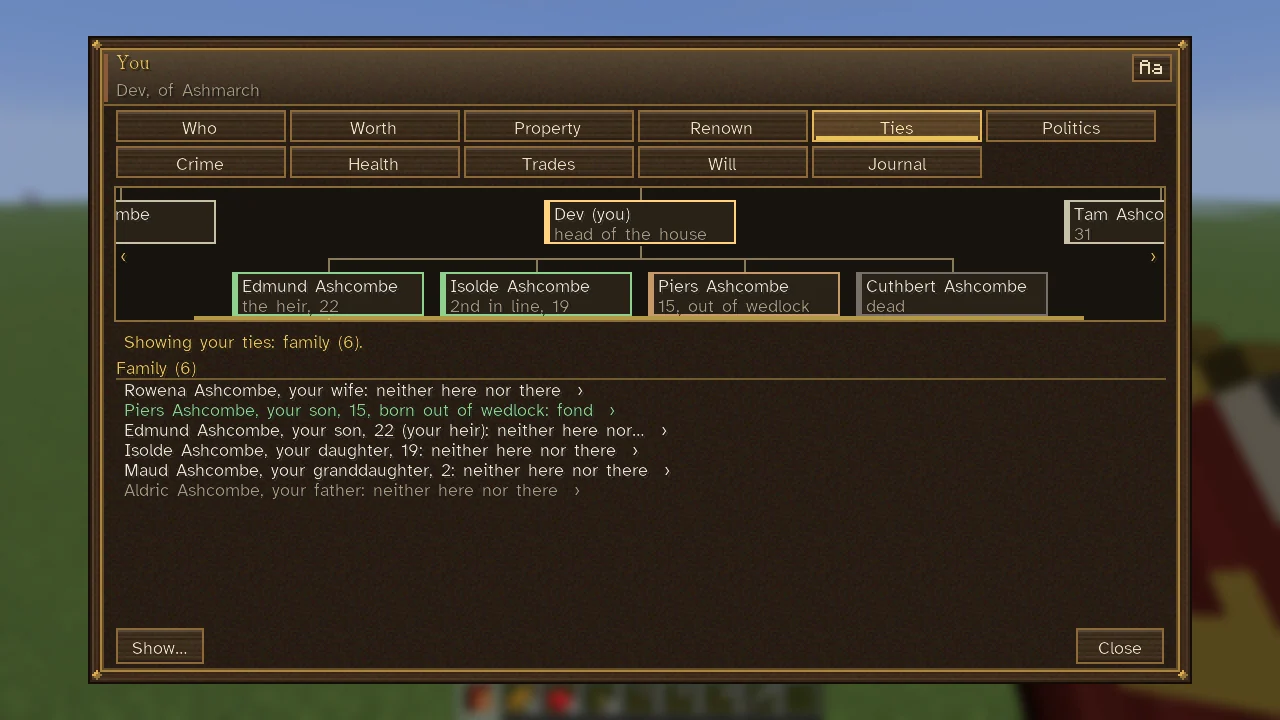
Your You sheet's Ties page, and the succession sheet, draw your house as a tree: forebears, the head, the heir and each place in the line, the dead, spouses and ages. Click a living person to open their sheet. The realm's ruling house is a click from the Command Table's Rule tab, under Succession: "Heirs, inheritance and claims".