Realms
DiscussFrom the Sovereign Realms Encyclopedia
A realm is a ruler, the people who live under that ruler, and the towns they hold, gathered under one name and one colour. Every town belongs to exactly one realm. The realm owns the stores and treasury of its towns, makes the law, keeps the soldiers, and deals with other realms. In the game's own words, a realm is read by what it is: a ruler's crown, its towns, its laws, and what its neighbours think of it.
There are two kinds. The world's own realms are ruled by their own people, who age, marry, die and are succeeded; they keep themselves each morning and answer to a temper. Player realms have a sovereign who is a player, and members who are players; they are run from the The Command Table. A player can also be a citizen of one of the world's own realms without ruling it (see Citizenship and Ranks).
The live world holds 196 towns in 74 realms, about 50,000 people. Sixteen of those realms are the original great realms, written into the world plan; the rest were founded when the world was raised. See The Known World and Regions of the World for the lands they stand in.
What a realm is made of
| Part | What it is |
|---|---|
| The crown | The sovereign, and who rules in their name when they are away. See Government and Law-making and Dynasties and Succession. |
| Members | Players with a rank: Sovereign, Steward, Marshal, Magistrate, Envoy or Member. |
| Towns | Each has a Town Heart, buildings, people, stores. See Towns. |
| Land | Claimed by Influence from hearts, buildings, outposts and roads. Nobody owns land outright. |
| Treasury | Real coin in the treasury's chests. See Treasury and Taxes. |
| Laws | Taxes, rations, justice, who makes the law and more; the people's mood follows them. |
| Memory | Each realm keeps a chronicle, and a regard for every realm it knows. |
Size and title
A realm's title follows its greatness, and the game uses it in names and in the price of freedom:
| Realm of | Called |
|---|---|
| One town | A lordship, its ruler a lord |
| Two or three towns | A princedom, its ruler a prince |
| Four or more towns, or any vassal | A kingdom, its ruler a king |
| Two vassals that are themselves realms of two towns or more | An empire, its ruler an emperor |
Temper
Each of the world's realms has a temper, which shapes how it behaves toward neighbours: how quickly it takes offence, how readily it goes to war, how much it cares for trade, and what it builds as it grows.
| Temper | In the game's words |
|---|---|
| Martial | Proud and quick to arms. Keeps a strong watch and answers insults with steel. |
| Mercantile | Lives by trade. Sends caravans far and forgives much for a fair bargain. |
| Pious | Devout and slow to anger, but long in memory. Values honesty over coin. |
| Expansionist | Hungry for land. Grows fast and eyes its neighbours' fields. |
A realm also has a long memory of what others have done to it: thefts, killings, fair trade, gifts, raids. See Diplomacy and Envoys.
The great realms
The sixteen original great realms, with the people each belongs to and its temper:
| Realm | People | Temper |
|---|---|---|
| Aldmark (seat: Aldhaven) | Heartlanders | Martial |
| Southmere (seat: Kingsbridge) | Heartlanders | Mercantile |
| Westholt | Marchers | Expansionist |
| Greymarch | Marchers | Expansionist |
| Eastmarch | Marchers | Pious |
| Hollin (seat: Hollinburg) | Marchers | Martial |
| Tirrena (seat: Parthen) | Marchers | Pious |
| Frostmere (seat: Frosthall) | Northfolk | Martial |
| Skarholm | Northfolk | Mercantile |
| Varholm | Northfolk | Expansionist |
| Qasr (seat: Qasr al-Bahr) | Sunlanders | Mercantile |
| Zafira | Sunlanders | Martial |
| Almarra (seat: Qurtaba) | Sunlanders | Pious |
| Karsa | Sunlanders | Expansionist |
| Lakemere | Verdant | Pious |
| Elmhollow | Verdant | Pious |
Their capitals include Aldhaven, Kingsbridge, Frosthall, Qasr al-Bahr and Karsa; see also The Five Peoples and Notable Towns. The world also starts with old quarrels between them: Aldmark and Southmere hold each other hostile, for instance, and Eastmarch is Aldmark's vassal. The free fair-town of Fairholm, where players start, stands at the Heartland's crossroads.
Meeting other realms
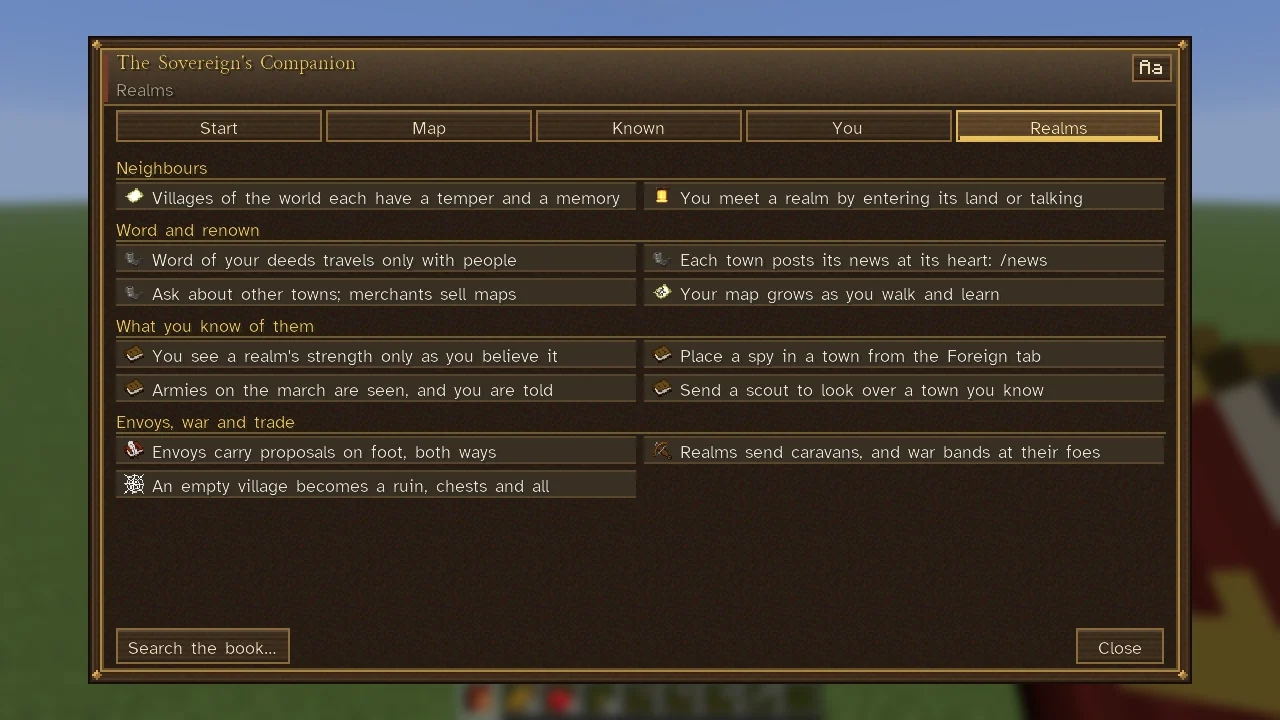
Realms begin as strangers. You cannot treat with a realm you have never met, and its towns are not on your map. You meet one by:
- crossing into its land (the influence field decides where its land begins);
- speaking with its people;
- visiting its Town Heart;
- founding a town near it (towns founded within 800 blocks of another know it from the start);
- receiving its caravans or envoys.
Both realms are told of a first contact. After that you may judge them only by what you believe of them (a range, with where it came from and how old it is; see The Command Table, Foreign tab), and they judge you the same way.
How realms rise
- By a charter. A player with enough standing (a following of 25 in a town, the station of a property owner or higher, or a homestead built up to 120 crowns' worth that they have lived at within 3 days) founds a realm with a Royal Charter; used on their own homestead's ground, the town is founded there, its house deeded to them as one of the town's and those living at it the town's first people. See Founding a Realm.
- By a rising. A town whose people hate their crown can rise: it breaks away as a free realm of its own, or goes back to the realm it was taken from if that still stands. A faction's towns can likewise go over together as a realm of their own. See Factions and Demands.
- By settlement. A crowded town can send settlers to found a new town.
- By an oath. A realm may swear fealty to a stronger one and keep its own rule as a vassal; a vassal that has been sworn long enough may be folded into its overlord by treaty. See Diplomacy and Envoys.
How realms fall
- By war. Towns are taken in war, and a realm that loses them all is no more. See War and Peace.
- By division. A civil war or a rising can split a realm.
- By ruin. A town the world runs gives up when it fails: most of its people hungry with less than a day's food put by, or fewer than two grown people left. After three mornings of failing, a realm with another town that is not failing gives it up, and its households take the road after the supply train. A realm's only town does not give up: it begs, raids or scatters.
- By disbanding. A sovereign may dissolve their own realm.
A village whose people have all died or left is abandoned after some days and becomes a ruin. Its doors hang open and its lights go out, but whatever was in its chests is still there. (A server setting decides whether ruins also crumble; by default they do not.) A realm with no towns left is no more.
Reading a realm
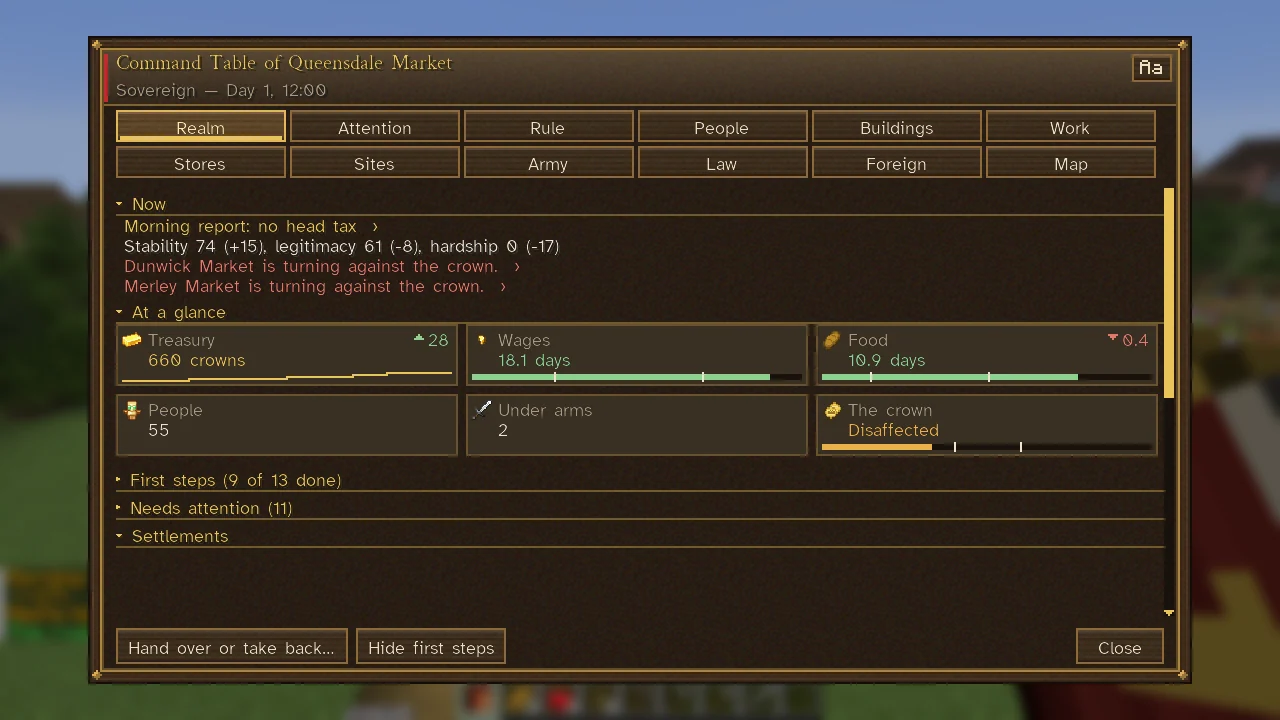
/realm info [realm]lists a realm's members, settlements and relations;/realm listnames the realms of the world;/realm chronicleshows the latest entries of your realm's chronicle.- The Command Table's Realm tab shows how your own realm fares at a glance: its treasury, how many days of wages it holds, food, people, soldiers and what they think of the crown as tiles, its towns as cards, and the realms you know as chips in the colour of their standing. The morning after its crown decides a law, tax or grant, a Morning report heads it and the Rule tab (the sovereign and officers also get it as a line in chat): what was decided, and how stability, legitimacy and hardship moved. In a realm of more than five towns, four stand open as cards, those in want or ill at ease first, then the most peopled, and the rest are folded under More settlements with their count. The Foreign tab shows the others as cards (its standing, how it regards you, what you believe it musters, a world realm's temper), past twelve as chips, and the Map tab colours the land by whose it is or by where each realm stands with you, and draws other realms' forces only as your people know them: seen now, last seen, or reported somewhere in a ring. See The Command Table.
- How a realm is governed (
/realm government, or How it is governed on any of its towns' sheets) is open to its own people, to anyone whose realm knows it and to anyone standing at one of its towns: who rules, its offices, its laws, and on its Relations tab how it stands with every realm it deals with (wars, truces, treaties, regard and the warrants each keeps). See Government and Law-making and Diplomacy and Envoys. - A realm's neighbours see its strength only as they believe it: travellers' word is rough, an envoy sees a court, a scout counts a town, a spy living there knows closely.