Magistrates and Codes of Law
DiscussFrom the Sovereign Realms Encyclopedia
A magistrate is the member of a realm who keeps its law. Magistrate is one of the realm's ranks: it carries the right to manage the law, and the use of the realm's stores. The sovereign can do everything a magistrate can. A realm's ranks are set from the People tab of the Command Table; see Citizenship and Ranks.
The magistrate's tool is the law book. It is a sheet titled "The Law of" the realm's name, found at any of the realm's jails and on the Command Table's Law tab. Any member can read who is wanted, who owes fines and who is in the cells. Only a magistrate can change anything. Where a player is not a member, the sheet shows only what the realm holds against that player.
What the law book shows
- Your record (for the reader): what you owe, and a button to pay your bail if you are in a cell.
- Wanted, Owing fines and In the cells: the realm's lists of people.
- Lately: each crime seen this week, with its place and day, and "Missing, taken unseen" for goods that vanished without a witness.
- Trouble spots: where crimes keep happening. People who live near trouble feel unsafe. A magistrate or marshal may send the watch to patrol there, and a company on garrison duty walks the streets about it.
The Law tab
On the Command Table, the Law tab opens on the law at a glance. Four tiles count the Wanted (red when anyone is), those Owing fines, those In the cells and this week's Incidents, each naming who or what on its hover. Under The laws, each law a magistrate keeps is a card with its setting on a gold chip: The law code, Proof, Arrest for fines, Conscription, Inheritance, Contraband, and Crime by crime (how many crimes are ruled apart from the law code). Its facts say what the law does and the fear it brings, such as "fines ×1 · fear +8" under a customary code. Clicking a card opens that law's choices.
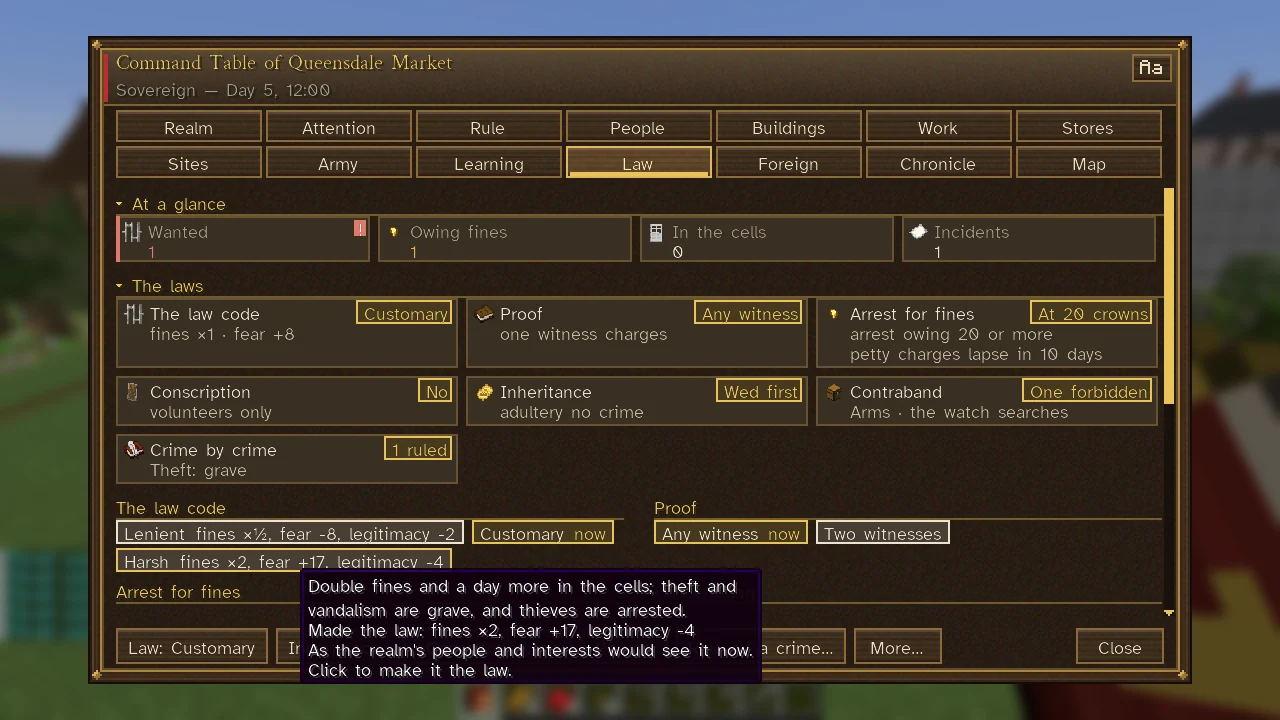
Under each law's name, its choices stand as chips. The law in force is gold and says "now"; every other says what making it the law would do, as the realm's people and interests would see it now: to fines (a harsh code doubles them, a lenient one halves them), to the people's fear (the law's own part of it), to the rule's legitimacy (how well the laws would fit the citizens' leanings), and to the two interests it moves most. Each chip's hover says what the choice would do and what a click does (for a law code, inheritance or contraband, what the choice means as well), and, where a council or an assembly makes the law, how it would likely vote on the change now ("The council would likely carry it, 4 to 3"). A magistrate's click makes it the law; anyone else is told that only a magistrate may change the law. Inheritance and contraband move nothing the people's reading weighs, so their chips say only what they are; a good's chip says forbidden or allowed, and a click turns it. What the people later come to suffer of a law, and the crimes it lets go unpunished, move them in time and are not foreseen on the chips.
Changes to the law code, proof, arrest for fines and conscription are put to the realm's law-making, so under a council or an assembly they go to a vote (see Government and Law-making). The law book follows the cards on the tab, without repeating them: the wanted, the fined and the cells, the crimes as ruled, what happened lately, and trouble spots.
What a magistrate can decide
| Decision | Choices |
|---|---|
| The law code | Lenient (half fines, a day less in the cells, and the people fear the law less; the same crimes are grave as under the old customs), Customary (the old customs), Harsh (double fines, a day more, theft and vandalism are grave, thieves are arrested, the gravest are hanged). Charges already laid keep the law as it stood. |
| Rule on a crime | For the middling crimes (trespass, theft, vandalism, assault, unlawful mining, adultery, menaces, bribery, burglary, receiving stolen goods, poaching, letting beasts loose, animal theft, nuisance, racketeering, smuggling and forgery): grave (arrest), never grave (a fine), as the law code has it, or no crime here at all, never charged. |
| How we are told of a crime | Crime by crime: told at once, told with the petty news, or in the law book only. By default grave crimes are told to your members at once and lesser ones gathered each minute. |
| Proof | Any one witness, or two witnesses (or one of the watch or a member), for all petty crime, or crime by crime. |
| Arrest for fines | The fines owed at which the guards arrest even for petty crimes: 10, 20 (the usual), 40 crowns, or never for fines alone. Grave crimes are always arrested for. |
| Contraband | Forbid strangers to carry burglars' tools, fire and powder, arms, or intoxicants. The watch takes them from strangers it searches and charges them. |
| Pardon | Wipe a person's charges, or open a cell and let a prisoner go with the rest of the sentence forgiven. |
| Declare outlaw | Make someone already charged, or a band of the wilds, an outlaw. Every guard then wants them for arrest; for a band, your soldiers attack it on sight, there is a reward on each, and its camp shows on your map. |
| Conscription | Whether the realm may press the unwilling into service (they will resent it). See Armies and Soldiers. |
| Inheritance | Who inherits under the realm's law (see Dynasties and Succession). Adultery is a crime where the magistrate rules it so, or where the realm keeps a temple of its faith (under a proclaimed state faith, only where that faith holds fidelity). |
| Faith and the law | State faith… proclaims one of the world's faiths, or none; Other faiths… sets them tolerated, favoured or forbidden; where they are forbidden, Appoint an inquisitor… names one. Under a council or an assembly these go to a vote. See Religion. |
A petty charge that is not repeated lapses after ten days. Policy for taxes, wages, rations, work, trade and hunting is not the magistrate's: it sits on the Command Table's Stores and Rule tabs (see Government and Law-making), though your steward can change them if you say so in plain words (Your Steward).
Dealing with outlaw bands
Bands of outlaws camp in the wilds between realms. A band that robs your people is declared outlaw by your magistrate. Besides that, a magistrate may offer one member of a band amnesty at a parley: the weary will take it and come to live in your town. Pay them for passage, or carry a white banner to parley. People can tell you where outlaws camp, and you can tell the watch. See Outlaws and Raiders.
The underworld
A magistrate whose realm has an organised criminal gang in its towns can order a raid on a hideout the realm knows, if the watch is strong enough and the magistrate honest; seen, soldiers walk there and search it, and the stash is seized and its people arrested. A crackdown is a decree, lasting a week, that costs coin (the watch is paid a crown more a day each) and the commons' goodwill, and makes the law look harder at every organisation in the realm. A crown may also strike an understanding with an organisation instead. All this is on the Underworld page, which opens to a magistrate once an organisation has been named to their law. A magistrate in an organisation's pay lets the charges against its people lapse, and when the corruption is brought to light the bribe is over and they are charged with bribery. See The Underworld.
For rulers
Players who want a different law write it themselves: set the law code, rule on the crimes you care about, and decide how you hear of each. A realm's laws as a whole, including votes and petitions, are in Government and Law-making.
See also
Crime and Punishment, Arrest and Jail, Wanted and Bounties, The Watch and Watchtowers, Realms.