Land, Estates and Landlords
DiscussFrom the Sovereign Realms Encyclopedia
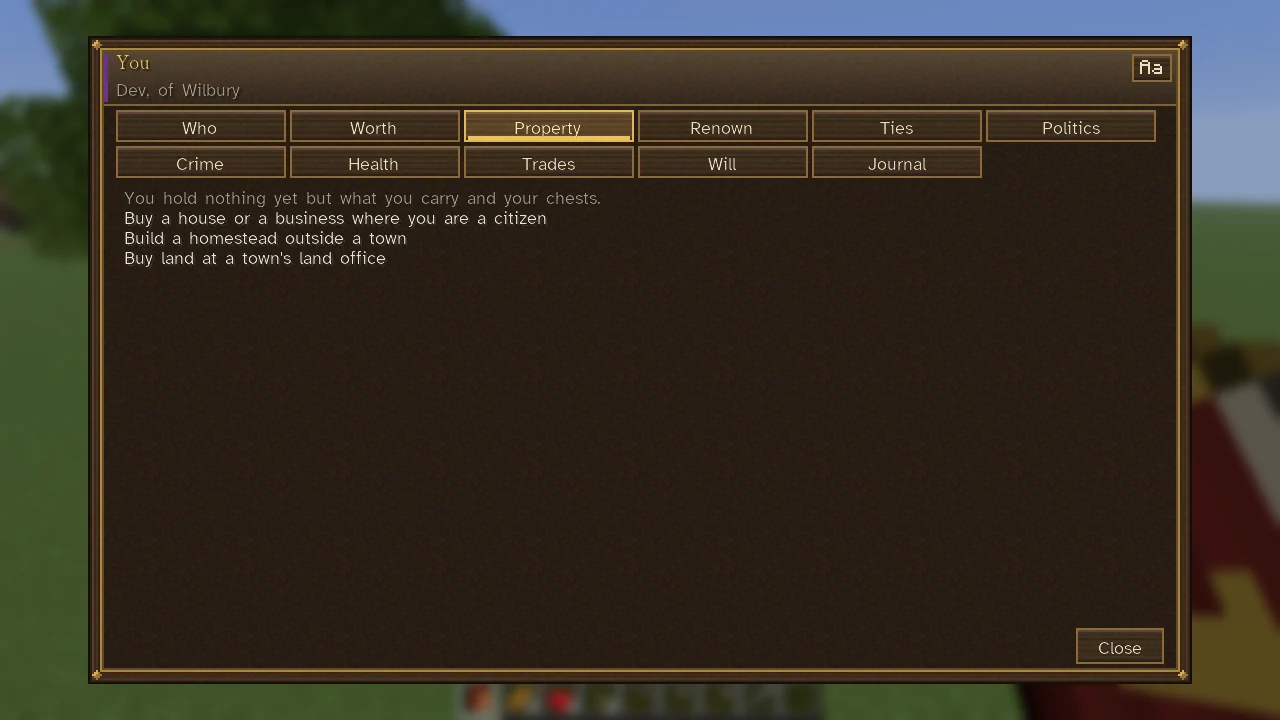
Land in Sovereign Realms is held by title. A realm's influence says whose word counts in a place (see Influence), but a plot or an acre can be owned by a town, a player or one of the world's people. A town surveys its vacant ground into plots and its country into acres and offers them at its land office. What stands on a plot you hold is deeded to you, and you may sell it again.
You need no deed to make a home. A bed, a chest and forty blocks of your own building, anywhere outside a town's own ground and others' titled land, make a homestead, yours by custom: a house in the woods, with hunting and a field, from which you may live off the land, and which can one day become a town.
Plots in a town
Each town's vacant ground within it is surveyed into plots of 16 by 16 blocks (256 square blocks, about a sixteenth of an acre). It never takes the square, the streets and roads, a building or its grounds, another's title, water, steep ground, or anything someone has built. The town surveys each morning, but only over ground that is loaded and no more than six plots are offered at once, the nearest to the square first.
Buying a plot
You must be a citizen of the town's realm and not an outlaw of it, and carry the crowns. See Citizenship and Ranks.
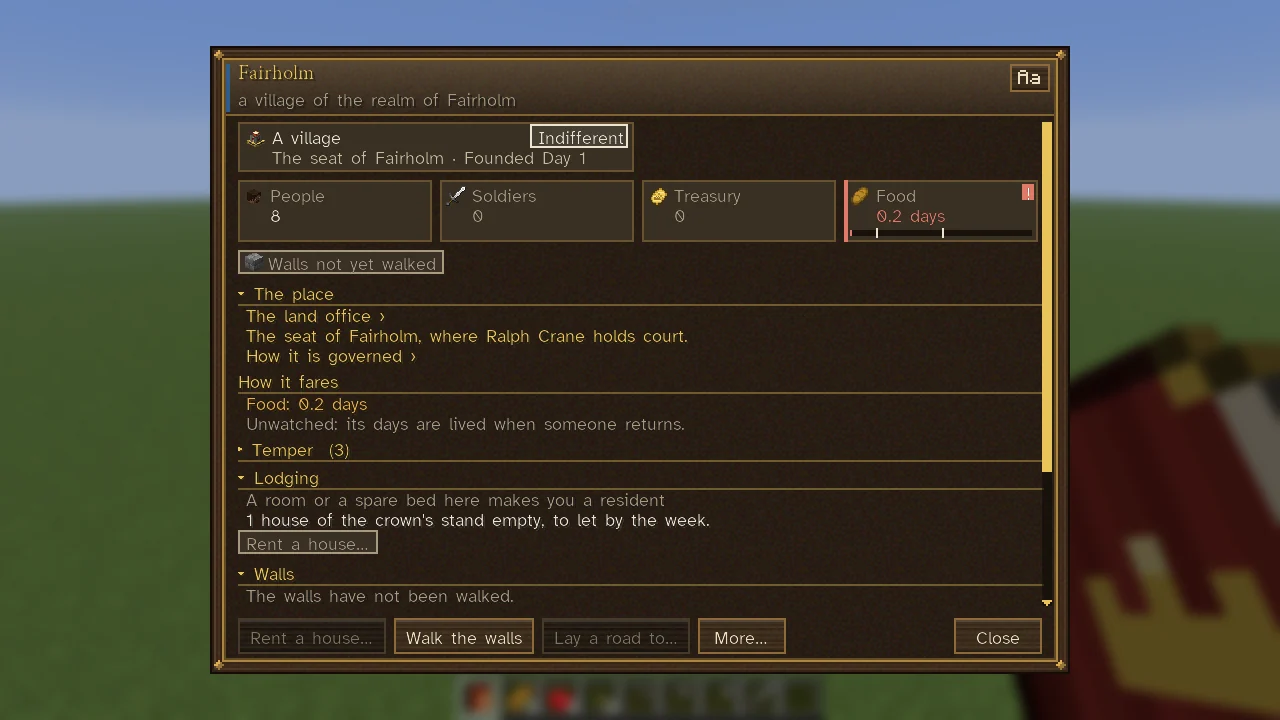
- Stand by the Town Heart and open its sheet, then The land office ›, a link under The place. It lists the plots for sale; each opens the land where it lies, with Buy it for N crowns. Or stand on the ground and type
/realm land(or use a Realm Lens there). - Confirm. The coin goes into the town's treasury and the title is yours. If the offer changed while you looked, it is refused and nothing moves.
- Where the town sells land on credit, a plot may be bought with a third down (a quarter for one in good standing), the rest repaid over twelve weeks. See Credit and Moneylending.
What a plot costs
Ground is priced by what a square block of the town's land is worth where it lies. A village plot is some 190 crowns. The price is dearer:
- as the town grows, from ten people up (a town of thirty four times, a great city of eighty-odd some fifteen times, at the most twenty-five times);
- nearer the square, up to twice as much beside the heart;
- within the walls, a quarter more;
- in a realm's seat, three tenths more.
The ground under houses the town values is reckoned the same way, so a plot cannot be bought cheap and sold dear.
Country acres
You can also buy land outside a town: an acre, 64 blocks square, within 256 blocks of a realm's town and reached by that realm alone. Stand on it, type /realm land and choose Have this acre surveyed. You need to be within about 96 blocks, with the whole acre in sight.
The surveyor walks the acre, reading its ground, soil, timber, stone, ores and water, and prices it by them and by how far out it lies; an ordinary acre is some four hundred crowns. The town offers it for seven days to whoever buys first. A town keeps at most twelve surveyed acres on offer. A survey is refused if anyone's building, grounds, road, homestead or title is on it, if it is mostly water, or if two realms both reach it. Land no realm reaches is no one's to sell.
An acre is held as any title: you build on it as owner, and a farm, mine or lumber camp marked there is registered to the town that sold it and deeded to you, worked and taxed like any business. See Businesses and Property, Prospecting and Mining and Work and Professions.
What a title lets you do
On your own plot the holder builds as its owner: what you set down there is not the town's to take up, what you break there is no crime against it, and a building you mark there is registered to the town but deeded to you, with the hearth tax on it as on any (see Treasury and Taxes).
The building code. On land you hold in a town, the town's building code holds. Open the land where you stand (/realm land) and read What you may build here. The realm's law building code sets it, and a town's governors may set their own:
| Code | What you may raise |
|---|---|
| Build as you please | Anything lawful, any height, any material. |
| Ordered building | Homes, trades and workshops anywhere in town; farms and industry only outside its inner quarter; and nothing above the height limit. |
| Uniform building | As ordered, and every wall, floor and roof of the town's own timber and stone; glass, doors, lights and furnishings as you please. |
The default height limit is 10 blocks in a village, 14 in a town of 30 or more people, and 18 at the realm's seat, unless the town sets its own (8, 10, 12, 16 or 20 can be chosen, or none). A block that breaks the building code is not set down, and you are told why; what stood before stands, since a change of law pulls down nothing that already stands. Out in the country no code reaches.
Having the town build for you. On a bare plot you can have the town's builders raise a house at your charge: a cottage, a family house or a fine house. You pay the price of the materials, the builders' days at the realm's builder's wage and the town's twentieth, into the treasury, and the house is deeded to you when it stands. For a business, the land office lists what trades would stand on your plot (see Businesses and Property).
Selling land
Open the land where it lies (/realm land, or the Land section of your sheet's Property page) and choose Offer it for sale, at your price (between 1 and 100,000 crowns). It is offered at the town's land office and on the ground. When it sells, the town keeps a twentieth (a crown at least) and holds the rest for you at its land office; take it there with Take the N crowns, within 160 blocks of the town's heart. Take it off the market withdraws the offer. What stands on the land goes with it, houses and businesses included.
If you still owe the crown for the land, what is owed is settled first out of the price.
Homesteads
A homestead is a home held by custom, not by deed: a bed, a chest within 24 blocks of it and 40 blocks of your own building make one, anywhere outside a town's own ground and land titled to someone else. The realm whose frontier or claimed land it stands in meets it the same day: it recognises you as its landholder and asks its hearth tax, and you may register the acre it stands on as your title for a twentieth of the acre's price; or it calls you a squatter, and you may register the acre at its full price or sell it the homestead. In the wild, beyond every realm, the strongest realm about may offer to protect it for a tithe. A homestead on an acre stops a realm's survey of it. Making one, the pedlar, raids and watchmen, settlers and founding a town at a homestead are described in their own article.
Landlords and rents
Rent to the crown. A realm's rent law sets a crown's houses' rent: none, or one to three crowns a bed a week. By custom it is a crown a bed a week where bread is bought, and none under the common granary. The grown people of a household in a crown's house pay their share of its beds each week; one that falls behind feels it.
Private landlords. Among the world's people a holder of a house who does not live in it is a landlord: the people the town lodges in its beds pay them the rent per bed. A holder may buy more land to let where the town has people without a home, but buys no more after three plots in a town. Now and then, when the treasury of a town in a realm the world's people rule is short of wages, the crown sells one of its houses with tenants to the richest citizen who can pay a fifth over the price and holds fewer than three houses, for twenty-six weeks of its rent or its price if less.
Renting for yourself. A room at an inn, a spare bed in a household, or a whole empty house of the crown's, let by the week from the Town Heart, are described in Lodging. A house let whole costs about a hundredth of its price a week, paid to the town's treasury.
What happens to land when its holder dies
The land of one of the world's people who has died or left the realm passes to their heir by the realm's law, one of its citizens; with none, it is the town's again. A holder fallen into want offers their unbuilt land. Now and then, the one of most means among a town's citizens who holds no land buys the cheapest plot fairly offered and has a house raised on it; and a town's farmers, herders, foresters, miners and quarriers buy country acres suited to their trade and have their works raised there. A player's estate, owned chests and barrels, houses and businesses, passes by their will and the law; see Dynasties and Succession.
An old title from before a realm's rule is recognised by the realm before it can be sold.
See also
- Businesses and Property: buying and running workplaces.
- Town Heart and Towns: where the land office stands.
- Construction: how building sites are made.
- Homesteads: a home of your own outside the towns, held by custom.