War and Peace
DiscussFrom the Sovereign Realms Encyclopedia
War is the state in which two realms fight on sight. It begins when one realm's envoy delivers a declaration naming what the war is for, runs on soldiers, raids and sieges while a tally called the warscore records who is winning, wearies both sides day by day, and ends only when one side offers terms the other accepts. It is a serious step in the game: grave choices about war are asked twice, and war costs a realm at home as well as in the field.
This article covers the diplomatic frame of a war. The fighting is in Armies and Soldiers, Campaigns, Walls and Sieges, Morale and Outlaws and Raiders.
Declaring war
War is declared by envoy, not by a stance button. From the Foreign tab, choose Send an envoy, pick the realm, and choose one of the declarations. Each asks twice, and its hover gives the war's goal as the game reckons it. See Diplomacy and Envoys for envoys in general.
| Declaration | War aim |
|---|---|
| Declare war on realm to humble them | To win in the field: win 2 battles, and 5 battles and raids in all. |
| Declare war on realm for tribute | To plunder enough: 300 crowns' worth taken. Coin and tribute come cheaper at the peace. |
| Declare war on realm for their fealty | To break them: half their soldiers fallen. Their oath comes cheaper at the peace. Offered only if neither realm is a vassal. |
| Declare war on realm to take town | To take the named town (not their seat; up to three are offered). It comes cheaper at the peace, and taking it is worth warscore: a company or a brigade sent to Take it can win the goal outright (see Campaigns). |
| Declare a holy war on realm for place | To take the town that holds a sacred site of your realm's faith, or their seat where your faith has cast their ruler out. Offered only where your faith has such a claim (up to three). A site's town comes cheaper at the peace; your faithful are glad of the war, unless your faith holds peace. See Religion. |
A war may also be declared on your realm, in which case you did not choose the aim.
Before you declare, each choice shows our means: the coin and gold your realm holds against ten days of its wages on a war footing (soldiers' pay is reckoned half as much again), and the days of food your stores hold against ten days. This is the same reckoning the world's rulers make; for a player it is a warning, not a bar. A war you cannot pay or feed is lost at home: each day broke, hungry or unpaid wearies you toward peace.
Declaring war is refused if a truce holds between the two realms (see below), or if the sender knows nothing of the other realm, or if no envoy can reach them.
What war means
- Soldiers and war bands of each side attack the other's people, soldiers and caravans on sight.
- Their gates are shut to you, and your trade with them ends.
- A war band that finds no one watching lays siege, and the battle is decided by arms, armour and heart; the dead are real either way. A band sent to take a walled town invests it instead: nothing goes in, and the siege runs morning by morning until the town gives up, is stormed or relieved, or the band goes home. See Walls and Sieges.
- When a war band comes to one of their towns, their other towns and their allies send relief.
- Allied soldiers defend each other's land. An ally at war may send you a call to arms, asking you to join it against an enemy it is at war with and you are not; you may send one to your own allies likewise.
- A vassal goes to war with its overlord's enemies, and the overlord with whoever makes war on its vassal.
- A town is taken in war: by a war band sent to take it that wins outright, or to which a besieged town gives itself up (see Campaigns and Walls and Sieges), or by a realm at war with the one that held a fallen town raising its own Town Heart over it (see Town Heart).
- Deeds of war (burning, plundering, killing a town's people) make grievances that the wronged carry with them, and make a name for the doer. See Renown and Following.
On the roads between them, a realm of the world at war keeps a patrol out from its town nearest the enemy, walking toward the enemy's nearest town where the two lie near enough by land, and a host it sends on campaign is followed, when its food runs low, by supply columns carrying its bread. Patrols of the two sides that meet fight a skirmish, and a patrol may fall on a column, leaving the host it was bound for short of food. Each skirmish is a point in the war. See Campaigns.
Warscore
Each war keeps a tally of points each side has won. A side's warscore is its points less the other's, from −100 to +100. Points are won by:
- battles won;
- towns taken (25 points for a village, 40 for a town, double for a realm's seat), each written "took town"; a besieged town that surrenders counts as taken;
- sieges: a point a day for each of the enemy's towns your bands invest ("kept 1 town under siege");
- raids on the countryside (1 to 3 points each, by what is carried off or burned: a raid is not a battle won);
- skirmishes won on the roads (1 point each): patrols that meet, a patrol set on, a supply column ambushed;
- blockades;
- soldiers slain, by the share of their army each was;
- reaching the war's goal (25 points);
- time with the upper hand.
The war on the Foreign tab
On the Foreign tab each war comes first, as a card: the enemy's banner and name, War on its chip, the warscore and the war's days, what you believe the enemy musters and, for a realm of the world, its temper. Where the enemy holds prisoners of war of yours, the card says how many ("2 of ours held"), and its hover names each player among them with the ransom asked (see Taken in Battle). The warscore is drawn on a meter marked at even, and Make peace stands in gold: a click on the card opens the negotiating table. The card's hover gives the war's reckoning: the warscore with the towns each side has taken, the points, battles, raids and towns taken on each side, the skirmishes won once there have been any, and each side's weariness.
Beside the wars, four tiles say what they cost at home, under a heading that sums it up in a word or two ("At home: paid and fed", "At home: paid; some hungry", or the wants by name: broke, hungry, unpaid):
| Tile | What it shows |
|---|---|
| Army's pay | What the army costs a day |
| Wages held | The days of the crown's wages the treasuries hold, on a meter marked at 5 and 14 days |
| Food held | The days of food the stores hold, on a meter marked at 3 and 7 days |
| Going hungry | How many of the realm's people and soldiers go hungry |
Each tile's hover is the whole reckoning: every figure, which measure counts the realm hungry or broke, what would relieve each want, and the days of want so far. The Army tab shows the war's cost at home too, with what has been spent on the army since the war began and the days of want (see Campaigns).
Weariness
Every war wearies a realm. A realm's weariness is a share of what its temper can bear; at the whole of it, the realm sues for peace. It has three parts:
- The war's days, after the first week (and fast, from the third day, where neither side can reach the other);
- Its fighting: losses, towns lost and taken, raids suffered, ports shut, its towns under siege (twice as much for one whose stores hold under three days), a war going against it, hopeless odds;
- Want at home: each day the realm is broke, hungry or wages go unpaid, and a levy kept from its work.
A martial realm bears the most; a pious one the least. The negotiating table states each side's weariness in the form "Our weariness: N% of what we bear; theirs: N% of what they bear."
A realm counts as hungry when its stores hold under three days of food, or when more than a tenth of its grown people go hungry; and as broke when its treasuries hold under a third of a fortnight's wages.
A realm past the whole of what it bears sues for peace at its next morning's council, its envoy carrying the terms (days on the road; over the sea only from a town with a boat). It takes a white peace, or terms the war allows, when an envoy brings them.
Making peace
A war ends only when a peace is accepted. Either side may offer one.
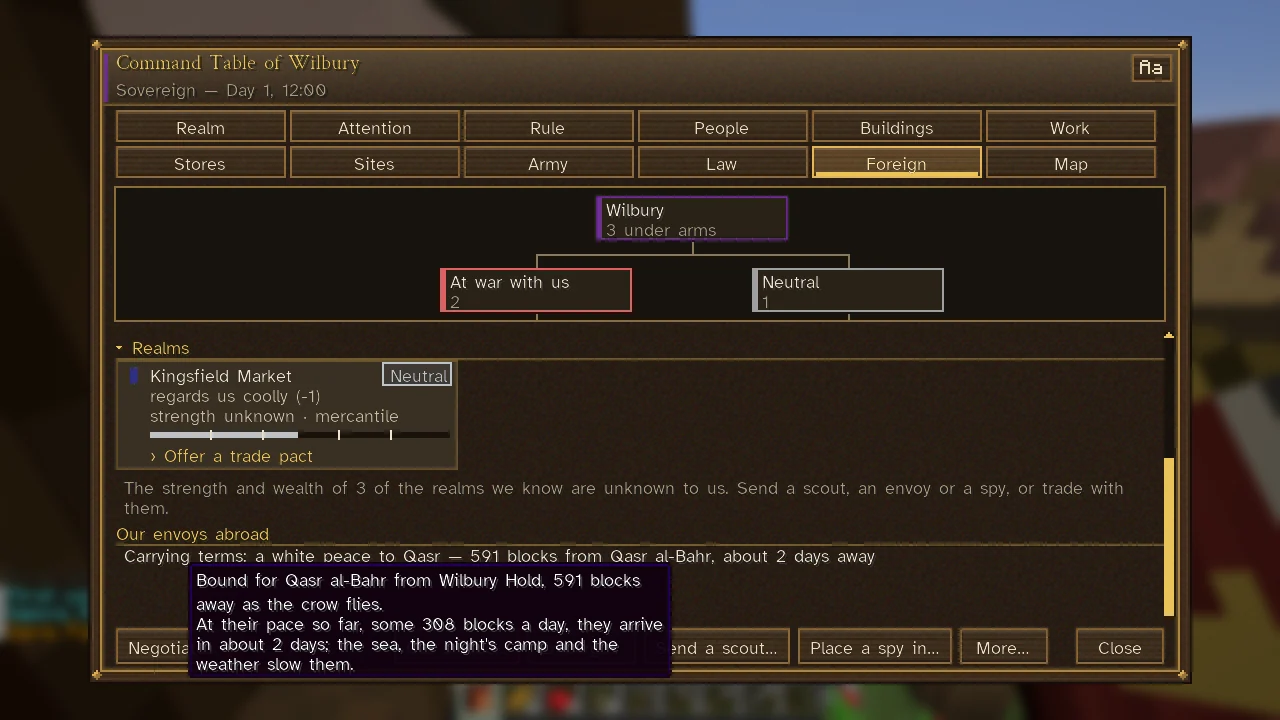
- A white peace (Offer … a white peace): peace with nothing given either way. The other side accepts if the war allows it, judged by your warscore and their weariness.
- Terms (Negotiate…, or a click on the war's card: the negotiating table): at war, every term has a cost in warscore to the side that gives it, shown on the term's chip; a chip over the send reads Would accept or Would refuse, with the reason beside it. The receiver accepts when what the deal asks of it (its demands less your offers) is no more than your warscore, its own weariness and its temper allow. Any accepted deal ends the war.
The winning side demands what its goal and its warscore allow: its own towns back first, then the war's goal, then coin, tribute and land. The losing side offers what its weariness makes worth it: towns it took, coin, tribute, land, a town, its fealty. A town under siege weighs on both: a winning realm of the world asks for a town of the loser's that its band besieges whatever its temper, a losing one offers first a town of its own that the enemy besieges, and such a town costs its giver 10 points of warscore less to cede to its besieger (20 less while its stores hold under three days). Near even, a weary side asks for a white peace. The terms you may name include crowns, tribute, goods, ceding or returning a town, ceding land, releasing a vassal, fealty, annexation, freed prisoners, safe passage, lifted embargoes and more; see Diplomacy and Envoys for the list. A deal refused may be sent back with a term changed, once.
After peace
- Both realms stand down to neutral.
- A truce holds: no war may be declared between them until it ends. A white peace gives a week; a deal gives 18 days, longer after a hard peace.
- Allies and vassals who joined a side's war are made peace with, so that their war does not draw the leader back in.
- The prisoners of war each side holds go home, players and the world's people alike (see Taken in Battle).
- The wars lately ended are kept on the Foreign tab for the record, under Wars lately ended: who fought, for how many days, and the terms; the war's goal and the final warscore are on the hover.
Civil wars
A civil war (Factions and Demands) is fought as any other, and its peace decides the faction's demand.
The end of a realm
A realm that loses every town is no more. A realm may swear fealty to a stronger rather than lose its towns, and a vassal may be folded into its overlord by treaty. See Realms and Diplomacy and Envoys.
Wars under way
Wars under way is the list of the world's wars where there is fighting, the nearest first, for anyone looking for a war to join. It is offered:
- on the Adventurers' Guild's page, and on a barracks' and an inn's page: the nearest three, each with its coach, and How to join them (or *All n* wars, and how to join them**) for the whole list;
- on every Town Heart, under Swords for hire: *Wars under way: n***;
- by
/wars; - by the Companion, asked "where is there fighting?" or how to become a mercenary: it names the nearest war (who against whom, where, how far and which way, its day) and how many more, with the list a click away (see The Sovereign's Companion).
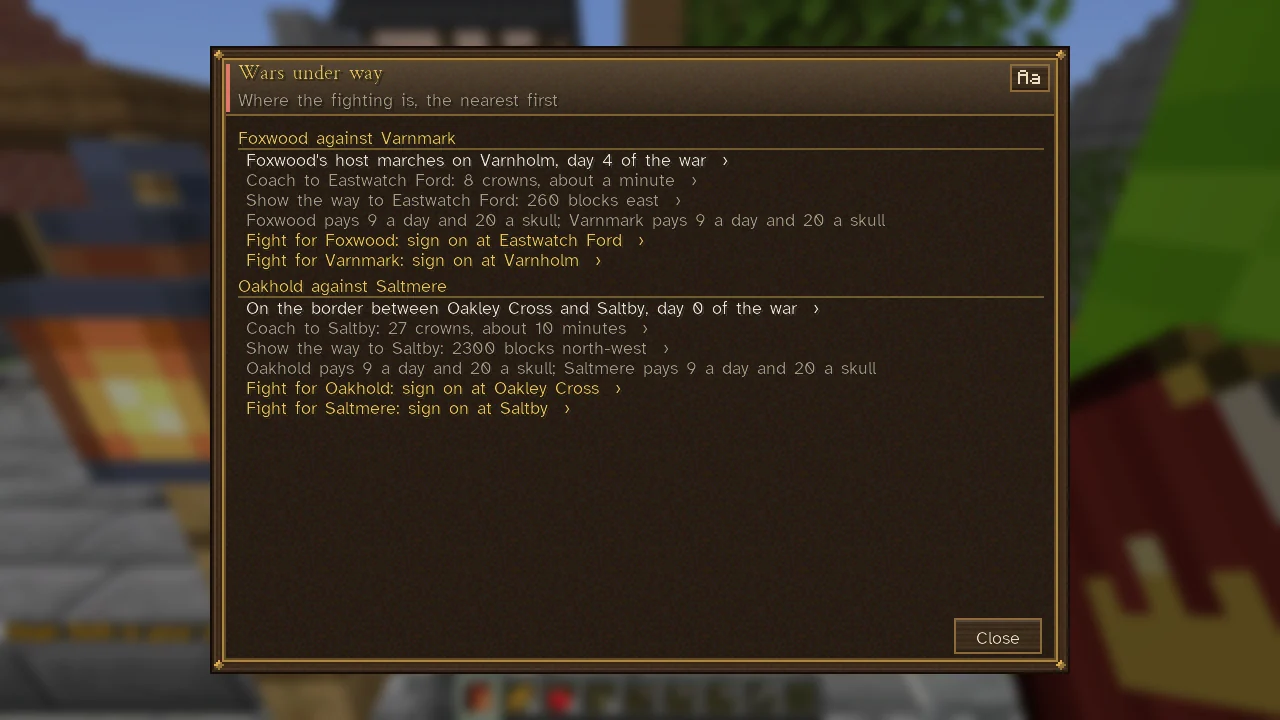
The page itself, headed "Where the fighting is, the nearest first", shows up to six wars, then how many more lie farther off. Each war is headed "realm against realm", the side that went to war first named first:
| Line | What it says |
|---|---|
| Where the fighting is, day n of the war | A host marching on a town ("…'s host marches on …"), besieging it or raiding the land about it; with no host out, "on the border between" the two sides' nearest towns. A click shows it on your map. |
| The coach | From the town you stand in toward the two sides' towns nearest the fighting, the nearer first: "Coach to town: n crowns, risk n%" (a click opens its planner, where you book it), a coach part of the way ("Coach toward town, as far as town"), or why none goes ("No coach leaves town", "Coaches leave from a town's heart"). |
| Show the way to town: n blocks direction | Puts the way to that town at the top of your screen and on your map. |
| realm pays n a day and 20 a skull; realm pays … | Each side's day pay for a mercenary, and a soldier's skull. The hover gives every skull's price, says that anyone may sell skulls whether signed on or not, and names a side's notice for swords at the guild. |
| Fight for realm: sign on at town | One line for each side: its terms, at its town nearest the fighting (see Mercenaries). |
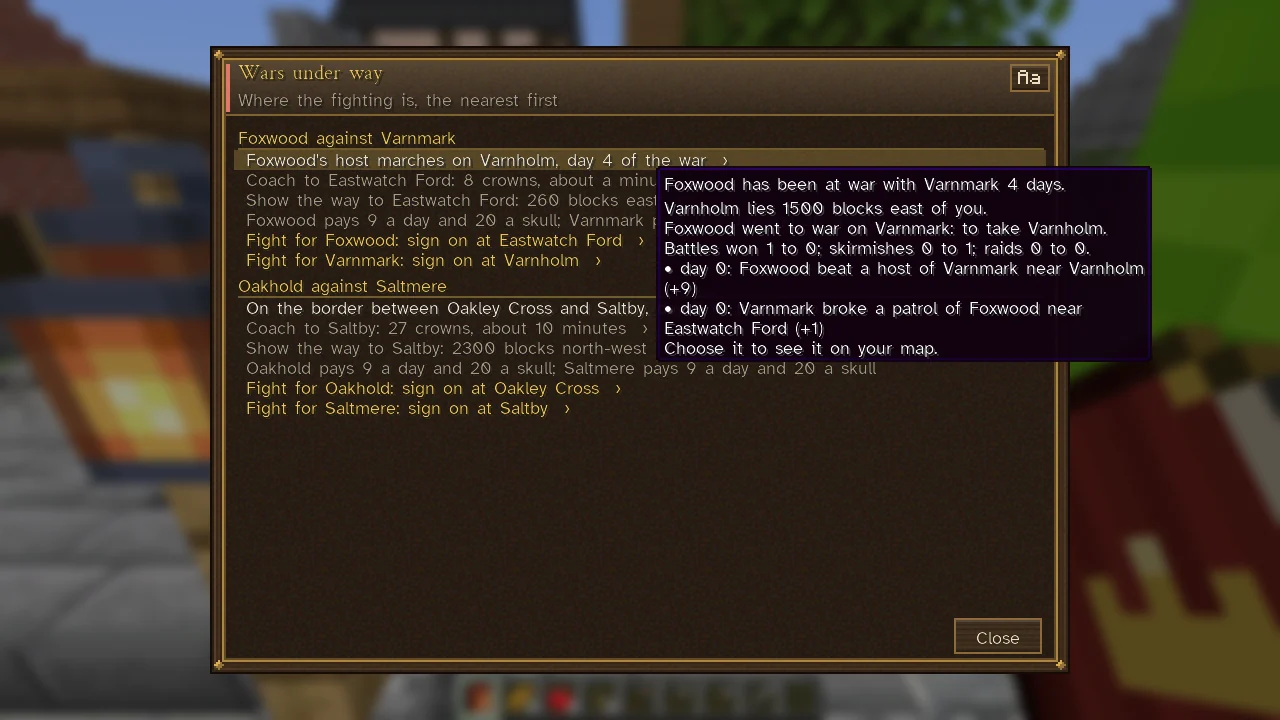
The hover of a war's first line gives the days it has run, how far its place lies and which way, who went to war on whom and for what, the battles, skirmishes and raids won on each side, and the three latest happenings in it. The towns the list names go on your map, and a coach office lists first a town of them that it would book. The map's Wars layer, hidden at first and turned on by a click on a war, pins each war under way where its fighting is.
A war counts as under way when a blow was struck in it within the week, when a host of either side is on the march against the other, or when it began within the week between realms that can reach each other; a war declared across a sea neither side can cross, with no blow struck, is not listed. With none under way the page says "The world is at peace, or its wars are quiet.", and its hover suggests asking again in a day or two.
Players at war
- Look at your means before declaring.
- Keep the treasury paying the army and the stores full; the The Command Table's Army tab shows each company as a card with its strength, kit and food, and at war what the war costs at home.
- Players who command a company can send it, or a whole brigade as one host, against an enemy town it knows, to raid it or to take it; the list says how far each town is and whether the food lasts. See Campaigns.
- A player ruler at war can call out the levy (see Armies and Soldiers).
- Follow the war on the Command Table's map: enemy forces where they were seen, rings where they are only reported, and your own bands with where each is bound (see The Command Table).
- Soldiers' hearts matter: see Morale.
- A realm none of whose players is on is not marched on by the world's realms; a player realm's envoys wait for someone of theirs to answer.
- A player with no war of their own can sign on with a realm at war as a mercenary, for a day's pay and a bounty for each deed; the list of wars under way shows where. See Mercenaries.
- A player struck down by an enemy realm's soldiers with no friend near can be carried off a prisoner, to be ransomed, asked back by their realm, break out or go free at the peace. See Taken in Battle.