Citizenship and Ranks
DiscussFrom the Sovereign Realms Encyclopedia
A player belongs to at most one realm at a time. There are two ways to belong. You may join a player realm by invitation or petition, and hold a rank in it; or you may become a citizen of one of the world's own realms by paying for its freedom, which makes you one of its people without giving you any hand in ruling it. This article covers both. To found a realm of your own, see Founding a Realm.
Joining a player realm
- Invitation. A member whose rank may manage members invites you, from the Command Table (People tab, Membership, petitions and offices, then Invite…) or with
/realm invite <player>. You receive a message with an [Accept] link; or you may swear fealty at any of the realm's Town Hearts (the heart's sheet offers Swear fealty), or type/realm join <realm>. You must belong to no realm to be invited. - Petition. At a Town Heart of the realm, a player without a realm may choose Ask to join. The realm's members are told; its stewards answer from Petitions… on the Members page, taking you in as a Member or turning you away. You must be within 24 blocks of the heart.
- Joining takes effect at once and is written in the realm's chronicle: "swore fealty to …".
- When you found or join a realm, a Your Steward comes to live in your town and keep your affairs.
Ranks
Every action in a realm checks the actor's rank. A new member is a Member. The sovereign sets everyone else's rank.
| Rank | May do |
|---|---|
| Sovereign | Everything: change ranks, disband the realm, pass the crown, and all below. |
| Steward | Invite and remove members; found and rename settlements; register and configure buildings; assign jobs, homes and duties; set taxes, wages, rations and stock targets; plan and cancel construction; use the stores. In practice stewards also change the law and issue decrees; see Government and Law-making. |
| Marshal | Recruit soldiers and command companies; register and configure buildings; use the stores. See Armies and Soldiers. |
| Magistrate | Set the law: rulings, pardons, sentences, outlawry; use the stores. Also sits in judgment at Court and Petitions. See Magistrates and Codes of Law. |
| Envoy | Conduct diplomacy: envoys, stances, embargoes; use the stores. See Diplomacy and Envoys. |
| Member | Take from the realm's stores without it counting as theft; nothing more. |
Ranks stand in order: the sovereign above stewards, stewards above the officers (Marshal, Magistrate, Envoy), officers above members. Only someone who outranks another may banish them.
Managing members
From the Command Table's People tab, open Membership, petitions and offices. The Members page lists everyone with their rank, whether they are here now, and what each rank may do. Its buttons:
| Button | Who | What |
|---|---|---|
| Invite… | Those who manage members | Invite a player who has no realm. |
| Ranks… | Sovereign | Make a member a Steward, Marshal, Magistrate, Envoy or Member. Pass the crown to … makes them sovereign and makes you a steward (asks twice). |
| Petitions… | Those who manage members | Take someone in, or turn them away. |
| Banish… | Those who manage members | Remove a member you outrank (asks twice). The sovereign cannot be banished; nor can a presumed-dead sovereign or a pretender while the realm's crown law preserves their right. |
| Cast a seal / Break all our seals | Sovereign | See below. |
| Leave the realm | Anyone but the sovereign | Leave for good. A sovereign must pass the crown first, or disband. |
The same actions exist as commands: /realm invite, /realm join, /realm leave, /realm kick <player>, /realm rank <player> <rank> and /realm disband. See Commands.
Any member of a player realm may open the The Command Table and see the whole realm, but each action is checked against rank.
Steward's seals
The sovereign may cast a steward's seal from the Members page for a gold ingot. Any member of the realm who carries it may see to the realm's people (work, homes and rations) whatever their rank. It can be handed on, lost or stolen. Break all our seals makes every seal cast so far worthless. See Steward's Seal.
Absent sovereigns
A realm's own laws say what happens when its sovereign is away, since days pass only while someone plays. By default the realm's first officer becomes regent after three days; after the days its law sets, a sovereign still away is presumed dead and the crown passes by its law of succession, to be given back or not if they return. These laws are set on the Rule tab; see Government and Law-making and Dynasties and Succession.
Citizen of a world realm
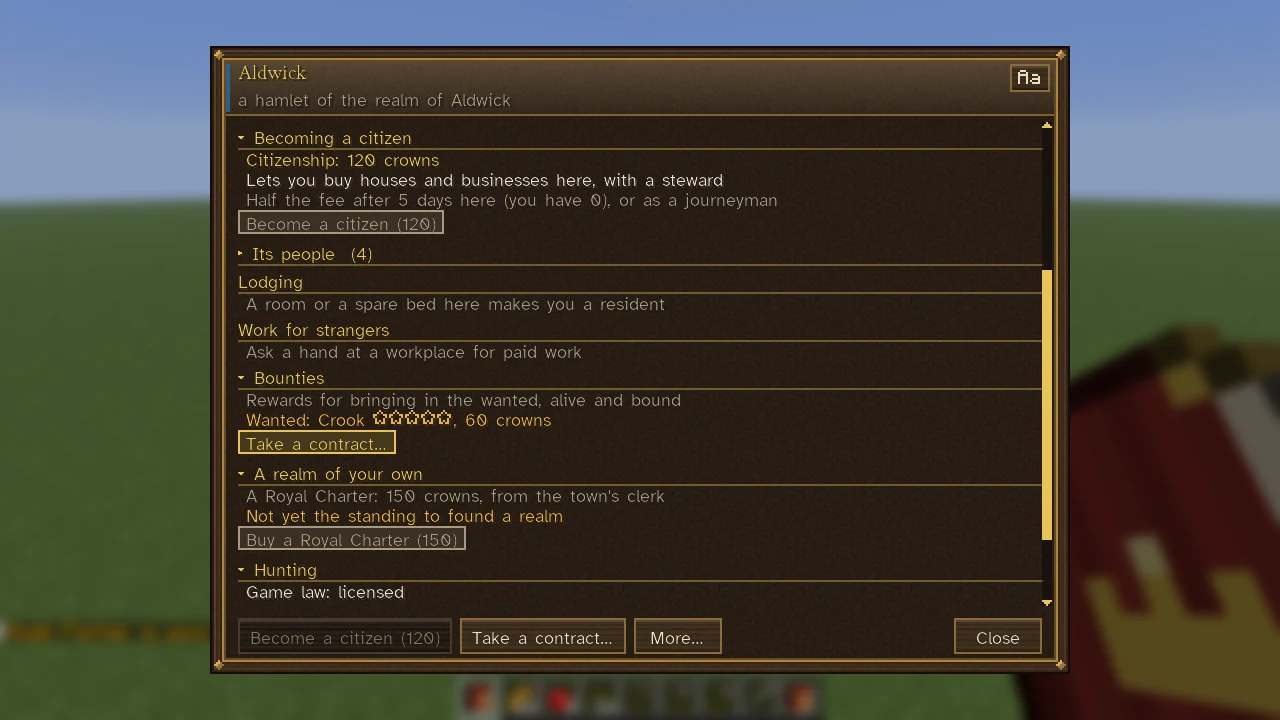
A player who belongs to no realm may become a citizen of one of the world's own realms, at one of its towns, by its Town Heart. Open the town's sheet and look under Becoming a citizen.
- The fee is paid in crowns into the town's treasury (or another of the realm's, if that has no room). It is 120 crowns for a lordship; a princedom costs twice that, a kingdom four times and an empire eight times (see Realms for how a realm's title follows its size).
- Half the fee for someone who has lived about the town for five days or more (the game counts each day you spend in its land once, while you are on), or who works there as a journeyman hand. Nothing for a trusted hand. See Businesses and Property.
- A name that goes before you makes it dearer or cheaper: the admired pay as little as half of the full fee, the despised up to twice. See Renown and Following.
- You must stand within 24 blocks of the heart, carry the coin, and not be wanted by that realm: the wanted are not taken in.
- A citizen of one realm renounces it for the new one, told in both chronicles. One who holds a rank above Member in a player realm gives it up first.
- On taking the oath the town's bell rings, those standing by hear it, and it is written in the realm's chronicle and told as news.
What a citizen may do
- Buy property and businesses in the realm, with a steward to keep your affairs. See Businesses and Property and Land, Estates and Landlords.
- Keep the realm's laws, as anyone in its land does. See Crime and Punishment.
- Petition for a change in the law: at the government page (
/realm government), for a clerk's fee of 5 crowns paid into the treasury, one petition at a time. It is heard the next morning, or the morning after if the next is less than half a day away, and you can talk the lawmakers round first. See Government and Law-making. - Show papers of citizenship at the town's sheet; papers found to be forged are taken and the bearer charged.
A citizen has no right to the realm's stores (taking from them is theft), and does not have the Command Table: its menus say it is for those who rule. Citizens' own affairs are at the Town Heart.
Residents
A room at an inn or a spare bed in a house makes you a resident of the town, which is lighter than citizenship and needs no fee. It ends when its nights run out, when you give it up, if war breaks out between your realm and the town's, or if the household gives you notice. See Lodging.