Diplomacy and Envoys
DiscussFrom the Sovereign Realms Encyclopedia
Diplomacy is how realms deal with one another. Every realm holds a stance toward each realm it knows, and keeps a regard for it that drifts with what each has done to the other. Proposals (a trade pact, an alliance, peace, a gift, a demand for tribute, a declaration of war) are not clicked into effect: they are carried by a real envoy who walks the road to the other realm's Town Heart, presents the proposal, waits for the answer, and walks home with it.
You manage all this from the Foreign tab of the The Command Table.
Meeting and knowing
Realms begin as strangers; you cannot treat with a realm you have never met. See Realms for how you meet one. Once met, a realm appears on your Foreign tab as a card with its standing, how it regards you, what you believe it musters and its temper.
You never see another realm's true strength, only what you believe of it: a range, with where it came from and how old it is. Travellers' word and merchants' reckoning are rough; walking a town's streets takes its measure; an envoy sees a court; a scout counts a town; a spy living there knows closely. Old knowledge grows vague. The world's realms judge you the same way, so they can be wrong about you. Asking people about other towns tells you what their realm knows of them.
Stances
A stance is what one realm declares toward another. The relation two realms actually have is the lower of the two declarations: war is unilateral, while a trade pact or an alliance needs both sides to agree.
| Stance | Meaning |
|---|---|
| War | Soldiers attack each other's people, soldiers and caravans on sight. |
| Hostile | Guards turn away and watch closely; trespassers are arrested. |
| Neutral | Ordinary travel is tolerated; restricted buildings are guarded. |
| Trade Pact | Caravans and merchants are welcome; markets trade freely. |
| Alliance | Soldiers defend each other and share roads and markets. Allies' soldiers defend each other's land; while an ally thinks no ill of the other, it keeps the other's warrants: its watch acts on them as the other's own would and holds those it takes for the other, in the other's own cell if it is a short walk off, else in its own (an overlord and its vassal likewise; see Wanted and Bounties). |
Kept warrants lapse. A realm keeps another's warrants only while the reason stands, read afresh each time: an alliance or fealty between them, peace (an overlord at war with its own vassal keeps none of its warrants), no ill will (regard not below nothing), and both realms standing. The moment any of these ends, its watch, golems, coach offices and townsfolk act on none of the other's warrants: a stop under way on one is given up, and anyone held in its jail on the other's account is let out, the time they did not serve owed to the realm that wanted them (a captive taken in war owes nothing). A player wanted on such a warrant is told once, in a short line with the reason on its hover: "Aldmark no longer keeps Lucerna's warrants", "Aldmark and Lucerna no longer keep each other's warrants", or "The realm of Lucerna is no more: its warrants on you are void". The wanting realm's own warrant still stands in its own lands, and the keeper's own warrants are untouched.
Our stance… lets a realm lower what it holds without asking: declare another Hostile, or end a trade pact or alliance and hold it Neutral again. Coolness is not a treaty, but the other realm will not like it. War is declared by envoy (see War and Peace), a holy war among them where the realm's faith has a claim on the other (see Religion), and the higher stances by proposal.
Regard
Each realm has a regard for each other realm, which the sheets describe in words: warmly (60 and over), well (25 and over), coolly, with hostility (−25 or lower), with hatred (−60 or lower). A realm's card shows it as words and a number ("regards us well (39)") over a meter marked where each word begins. It drifts a little each day toward a baseline: a little warm for allies and trade partners, and for the rest set by temper (merchants mild, the land-hungry cold). What rubs pushes it down: land claimed by both (Influence), the other's wrongs against our people lately, another faith (and the more where they persecute ours or their ruler is cast out of it: see Religion), deposits of what we lack in their land, their tolls on our traders, their friendship with our enemies, and our offers they have lately refused. Now and then a neighbour gives a slight. So regard does not drift ever warmer: alliances and pacts fray and are broken off when regard falls far enough, and neighbours who rub come to blows. A marriage between two ruling houses, while it stands, binds the realms the closer, and so does one faith that both realms have proclaimed their law.
Each world realm also has a temper, which sets how readily it offers or accepts a trade pact or an alliance, how readily it goes to war, and how hard it takes a wrong: martial, mercantile, pious or expansionist. See Realms. Two neighbours threatened by a stronger realm that is at war or has lately taken a town are drawn together.
What realms remember
Each independent realm has a long memory of what others have done to it: thefts, killings, fair trade, gifts, raids. Every deed counts, by its temper, and a wrong is felt harder by a realm with a long grudge. Large ones go into the chronicle. See Renown and Following for how what a player does is known abroad.
Envoys
Proposals travel with envoys who walk the road. A realm needs an envoy before it can send anything.
- Name an envoy from the Foreign tab: one of the people of your seat takes up the work (up to two without an Embassy), or build an Embassy and its sheet gives more. They carry proposals, declarations and terms, on the road for days each time.
- Send an envoy, then choose a realm and a proposal. Only an Envoy or the sovereign may send one. Each choice says what it would mean on hover. Where no town of yours has a boat, none can be sent over sea to a realm beyond it.
- One at a time. If every envoy of the realm is on the road, wait for one to come home.
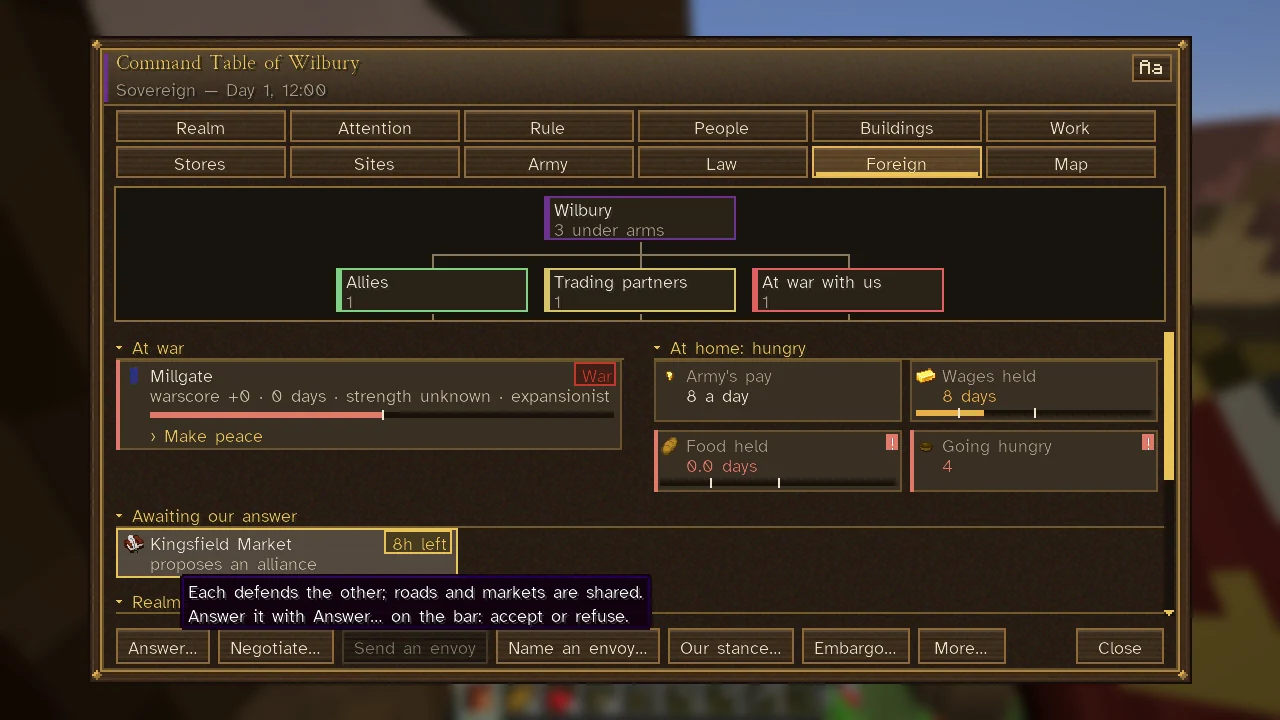
- Answers. An independent realm answers at once, by its temper and by what the proposer has done to it. A player realm's answer waits a day for someone of theirs to be there: time while none of those who may answer is online does not count, and an envoy who has waited a week with no one ever there goes home unanswered, without offence taken. Envoys who come to you wait a day for your answer, and you are told when you come online. Each waits as a card under Awaiting our answer on the Foreign tab, saying what they propose, with the hours left on a chip and what it would mean on its hover; answer with Answer…, first on the bar.
- Grave choices ask twice: declaring war, and accepting a call to arms, an alliance, tribute, a release, fealty, annexation, terms, or anything that costs crowns.
What an envoy may carry
| Proposal | What it is |
|---|---|
| A trade pact | Caravans and merchants welcome on both sides. |
| An alliance | Each defends the other; roads and markets are shared. |
| Peace | An end to a war: both sides stand down to neutral, and the prisoners of war each holds of the other go home (see Taken in Battle). See War and Peace. |
| A gift | Goods or coin, freely given to win favour (10, 25 or 50 crowns can be chosen). |
| Tribute | A payment of crowns, or goods in kind, demanded. Refused, it is an insult they remember. |
| A declaration of war | Notice that the sender is now at war with the receiver. See War and Peace. |
| The release of prisoners | Let the sender's people held in the receiver's cells go home, its players among them; a ransom may come with the envoy. |
| Safe passage | For five days the receiver's guards let the sender's people cross its land, however they mislike them. |
| A call to arms | An ally at war asks the receiver to join it against its enemy. |
| A plea for aid | A realm in want asks for food, carried by the giver's own people. |
| Cession of land | The receiver gives up its claim to the land about a deposit the sender names; the sender plants its standard there. |
| Mining rights | For ten days the sender's miners may dig a deposit the sender names; the sender pays the fee it offers. See Prospecting and Mining. |
| A supply pact | The receiver sends so many of a good every five days, and is paid the price named on each delivery, until either ends it. See Merchants and Supply Trains. |
| An oath of fealty | The sender becomes the receiver's vassal. |
| A demand of fealty | The receiver is to become the sender's vassal, or else. |
| Annexation | A long-loyal vassal is folded into the overlord's realm. |
| A marriage between houses | A grown, unwed one of each ruling house wed; the houses stay joined while the marriage stands. |
| A gate pact | Each realm's waygates open to the other's. See Fast Travel. |
| Terms | A deal of several terms, from the negotiating table. |
The negotiating table
Negotiate… on the Foreign tab opens a table with one realm; so does a click on a war's card, or Negotiate with … on a realm's page. At war it is the terms of peace: what you ask, what you give, against the warscore. At peace it is a treaty: trade, supplies, rights, gifts, an alliance. Each term has a cost or worth shown before anything is sent, and the other realm's verdict is shown as its envoy will judge it. Terms include crowns, tribute (so many crowns a week, carried by the payer's bearers), goods, ceding a town or land, returning a town, releasing a vassal, fealty, annexation, mining rights, supply pacts, lowered tolls, freed prisoners, safe passage, a lifted embargo, trade pacts and alliances. A deal refused may be sent back with one term changed, once.
The table has two columns, We ask of them and We offer; + Ask… and + Offer… add a term, and its cross takes it off. Each term is a card with its picture (a gold ingot for crowns, a gold nugget for tribute, a bell for a town, a banner for fealty, a load's own good), its words, steppers for its amounts, and what it costs or gives on a chip in its colour: amber for what it costs or asks, green for what it gives, red with a red edge for a term they refuse. Over the send, a chip reads Would accept or Would refuse, with the reason beside it. Terms of theirs that wait on your answer can be accepted (Accept theirs, which asks twice), refused (Refuse theirs), or put on the table to change and send back as yours (Answer with changes).
Fealty
A realm sworn to an overlord is its vassal. It keeps its own rule, but sends a tithe of a tenth of its seat's treasury (five crowns at least) every seven days, goes to war with its overlord's enemies, and is defended in turn: the two are allied. A vassal grown strong (seven-tenths of its overlord's strength) that has come to hate its overlord declares its independence, and there is war between them. A vassal sworn forty days or more may be folded into its overlord's realm by treaty, if it thinks well of it and is far the weaker; a martial realm never gives up its own rule. A realm swears fealty to end a war it is losing rather than lose its towns. An overlord gone from the world leaves its vassals free.
Other tools of foreign affairs
| Action | What it does |
|---|---|
| Embargo… | No trade with a realm, both ways, short of any quarrel. They will resent it. An embargo stands as a chip under Treaties and trade; it is lifted again from the same menu. |
| Send a scout… | A soldier or sentry walks to a town you know of, looks it over (people, soldiers, walls) and comes home to tell. |
| Place a spy in… | One of your townsfolk takes a room in a town with a purse of 40 crowns and writes home every two days. Each day they may be found out, likelier in a watchful town, under a harsh law or at war; found out, they are charged with espionage, and where the law is harsh or you are at war with them, they hang. |
| Put word about us… | For ten days, travellers and merchants tell others you are stronger (or weaker) than you are, for 30 crowns. Scouts, envoys and spies are not fooled. |
| Question strangers | On or off: the watch questions strangers in your towns, which makes a foreign spy likelier to be found out (a magistrate, an envoy or the sovereign may order it). |
| More… | Other actions. |
Armies on the march are seen by the watch of any town within sight of them (farther with a watchtower) and by anyone near. When an army is seen marching on one of your towns, you are told at once, with when it may come, and so are your allies; it shows on your map and on the Command Table's map, as far as your people know it (see below).
At a trading partner's or ally's Town Heart you can hire one of its companies to escort you for a day. See Armies and Soldiers.
Reading the Foreign tab
The Foreign tab of the The Command Table reads as a diplomat's desk. From the top:
- The chart of the realms you know under your own: your vassals, then your allies, trading partners, those at war with you, the hostile and the rest, each with what you believe it musters. A realm in the chart opens its page.
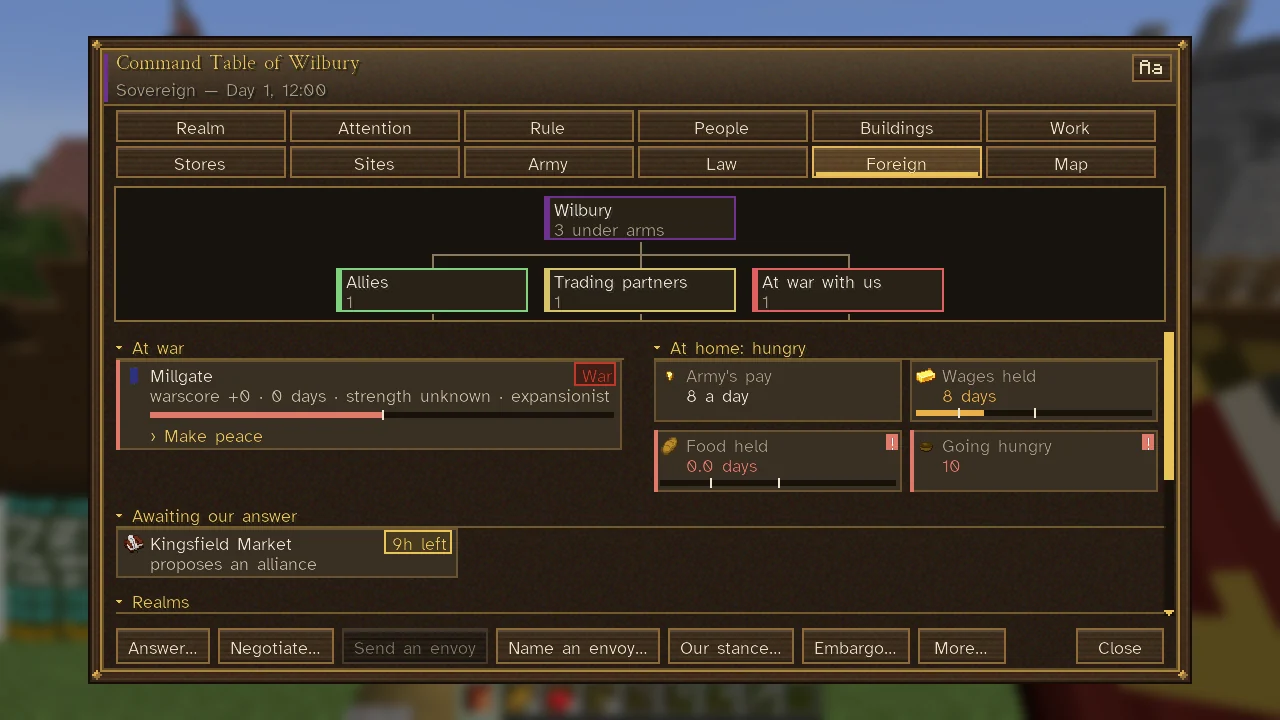
- At war: each war as a card, with the war's cost at home as four tiles beside it (see War and Peace). A click on a war's card opens the negotiating table.
- Awaiting our answer: each envoy waiting on you, as a card with the hours left on its chip.
- Fealty, if the realm is a vassal or an overlord.
- Realms: every other realm you know as a card, up to twelve, by standing (the hostile first, then allies, trading partners and the neutral), those you have dealings with first; the rest are chips in their standing's colour. A realm whose strength and wealth you do not know is named in one line under them, with how to learn it: send a scout, an envoy or a spy, or trade with them.
- Treaties and trade: what stands between you and each realm, a chip each: alliances and trade pacts, tribute either way ("pays us 15 a week"), tolls held by treaty ("their toll 15%"), supplies, rights to dig and embargoes. The whole of each is on its hover, and each opens its realm's page.
- Wars lately ended, the gate pacts, and Our envoys abroad: where each envoy is bound, what it carries, how far it has yet to go and about how many days at its pace so far.
A realm's card
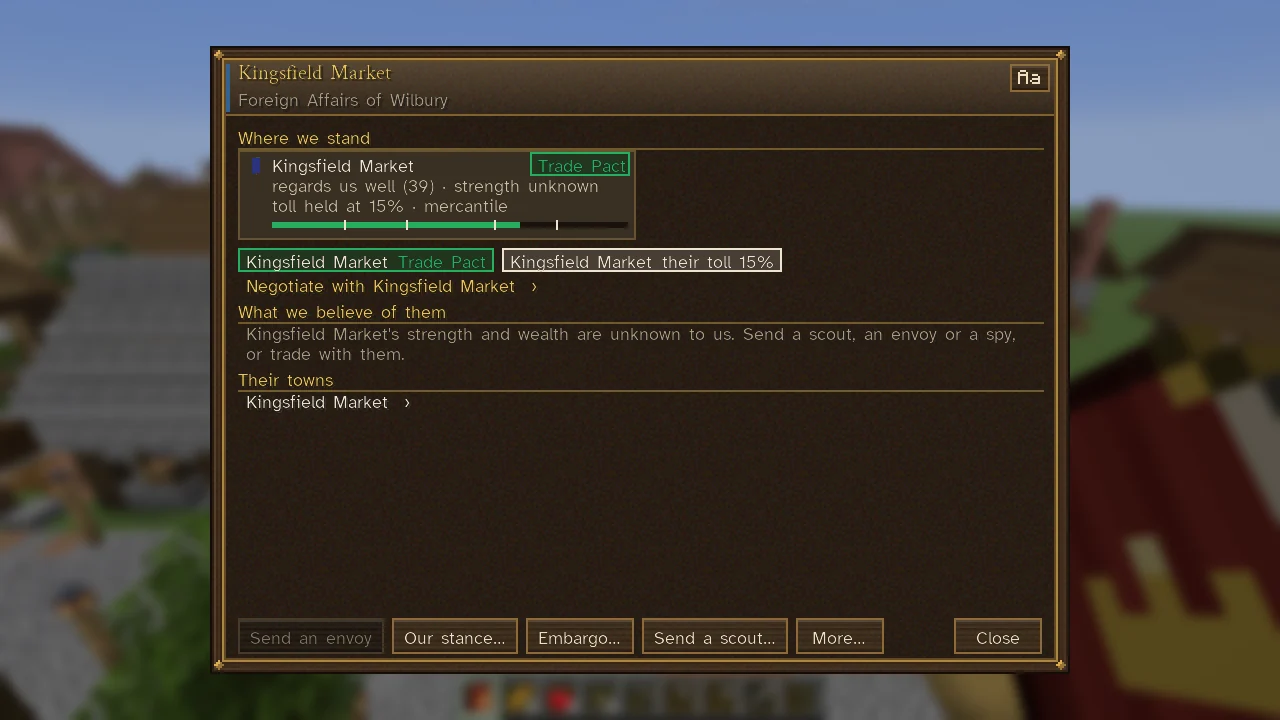
Each realm's card carries its banner, in the dye nearest its colour, and its name; its standing on a chip (War, Hostile, Neutral, Trade Pact or Alliance); how it regards you, on its meter; what you believe it musters; the first treaty between you (our vassal, our overlord, tribute either way, a toll held, supplies, under our embargo); "no envoy can reach them" where none can; and, for a realm of the world, its temper. Under them, in gold, stands the errand its standing first allows:
| Standing | Errand on its card |
|---|---|
| War | Make peace (the card opens the negotiating table) |
| Hostile or Neutral | Offer a trade pact |
| Trade Pact | Offer an alliance |
| Alliance | Call them to arms, while you are at war with a realm they are not fighting; otherwise Send them a gift |
A click on a card opens the realm's page, where Send an envoy carries the errand. The card's hover gives where you stand, what each side declares, their temper, what they remember of you and where their regard is heading, as far as a hover holds.
A realm's page opens on the same card, without its errand, then the treaties between you as chips, Negotiate with …, what you believe of them, and their towns. Its bar holds Send an envoy, Our stance…, Embargo…, Send a scout… and Place a spy in…, the last under More… where the bar is full. Its Send an envoy lists the errands under headings: Peace, Friendship, Supplies and rights, Prisoners, Demands, Fealty and War.
A realm's relations
How a realm stands with the others is not only for its rulers. Anyone who may read how it is governed (see Government and Law-making) finds it on that page's Relations tab, and every town of a realm has a Relations section on its sheet: up to six of the realms its realm deals with as chips, each with where they stand (or truce until Day 10), and Relations with every realm ›, which opens the tab (see Towns).
Under Realms it deals with the tab lists every realm at war or under a truce with it, hostile, allied or trading with it, bound to it by fealty, tribute, a toll, a supply, a right to dig or an embargo either way, keeping its warrants or having them kept, or regarding it strongly, warmly or coldly (a regard of 25 or more, or −25 or less): war first, then truces, the hostile, allies and trading partners. Each is a card, twelve at most and the rest as chips: its banner and name; where they stand on its chip (War, Truce, Hostile, Neutral, Trade Pact or Alliance); how it regards the realm in words ("regards Lucerna well") over a meter; and as many of these as the card holds whole: the warscore or when the truce ends, the warrants kept ("keep each other's warrants"), the first treaty between them ("toll held at 10%") and, for a realm of the world, "regard rising" or "regard falling". Its hover gives the regard's number, the war or truce, which keeps whose warrants by treaty, and to the realm's own people what each side declares, the other's temper, what it remembers of them and where its regard settles; to anyone else, what their stance means. A card opens that realm's page: for the realm's own people on their Foreign side, for others how that realm is governed.
Under them, Others it knows names the realms it is merely at peace with, a chip each, and Treaties and trade shows the realm's own people the Foreign tab's treaty chips, and everyone its toll: "Foreign traders pay 5% at its markets: they bring less, and dearer." or "Foreign traders are paid in full: they bring the most, and the cheapest."
On the map
The Command Table's Map tab draws wars and pacts on the land. Two chips choose its layer:
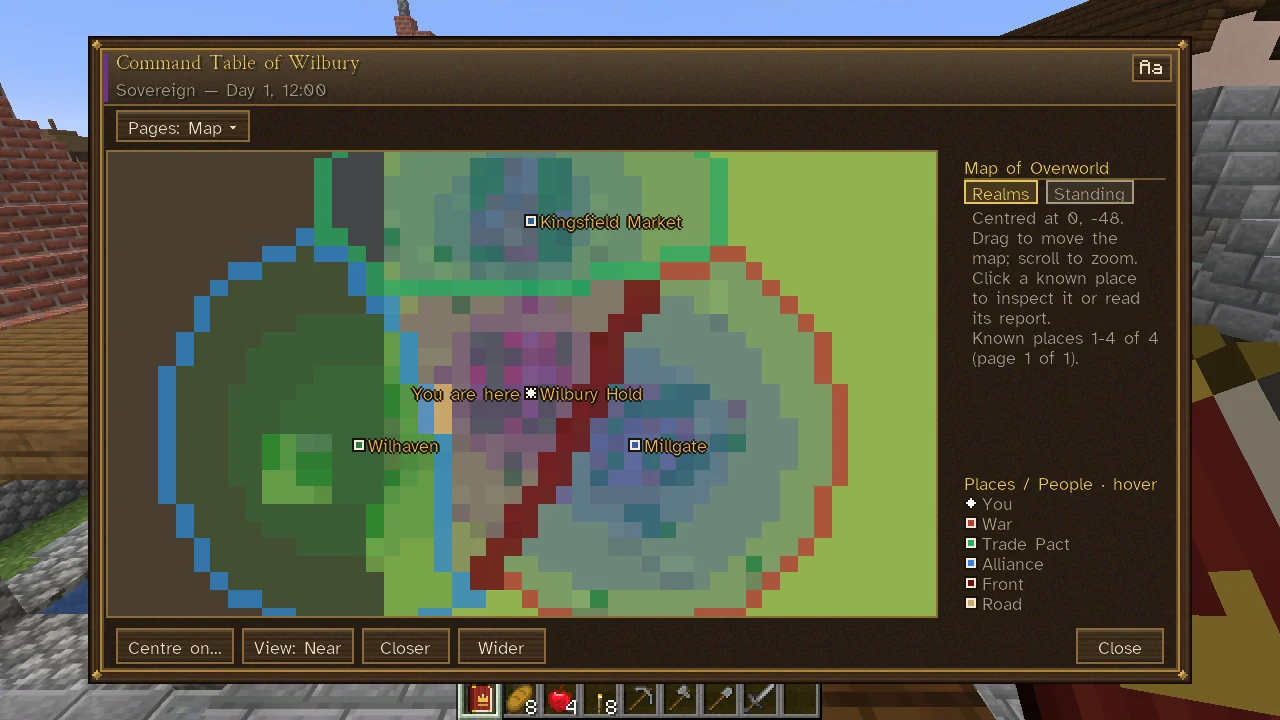
- Realms: each realm's land in its own colour; the land of a realm at war, hostile, allied or trading with you is ringed in its standing's colour.
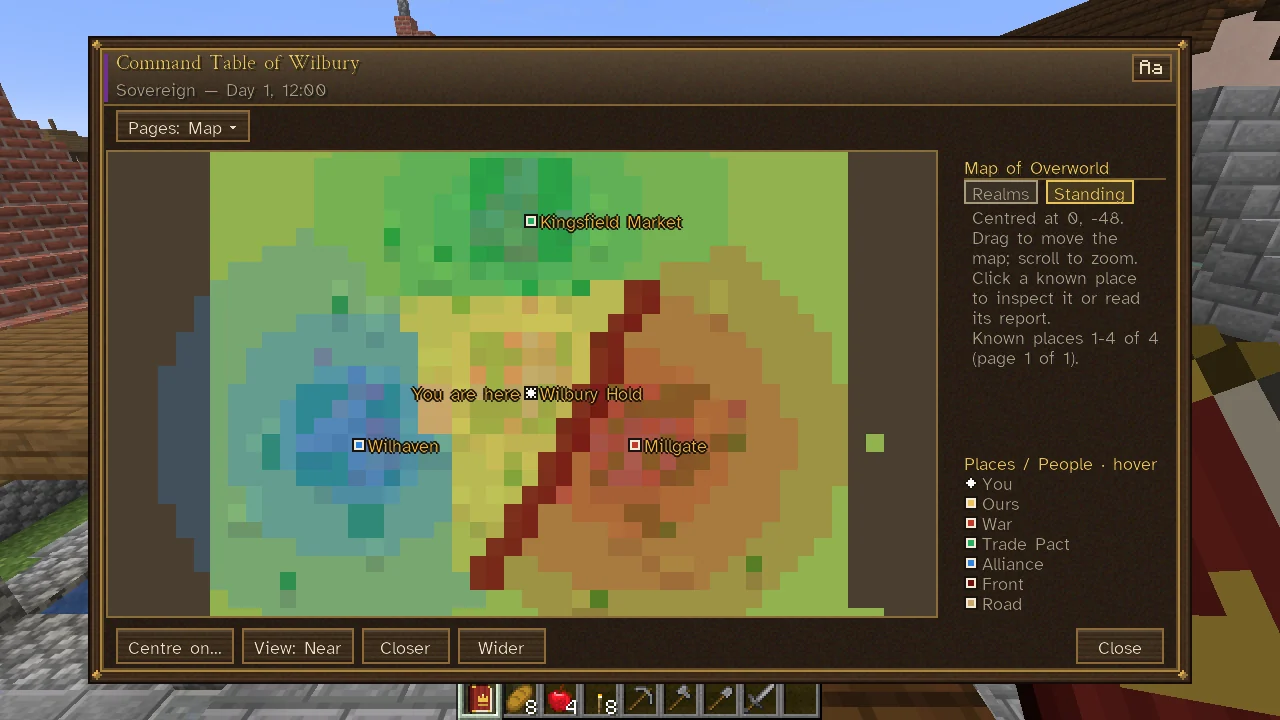
- Standing: each realm's land in the colour of where it stands with you, your own in the crown's gold.
On both layers the front, where your land meets an enemy's, is drawn in dark red. The standings keep their colours on the map, chips and cards alike: War red, Hostile orange, Neutral grey, Trade Pact green and Alliance blue. Each known town is lettered with its name; its realm and that realm's standing are on its hover. Where you stand is a white diamond lettered "You are here". A key of swatches names only what is drawn: You, Ours, each standing, Front and Road.
Over either layer the map draws the forces of other realms as far as your realm knows them, and your own: a host seen now where it is, one last seen where it was when sight of it was lost (its mark dulling with age), a reported one as a dashed ring, the wider the less is known, and our bands with where each is bound, when it should arrive and its food. A force no one of yours has seen is not drawn: it may come unseen. The key names each kind drawn and explains it in a line. See The Command Table and Campaigns.