The Watch and Watchtowers
DiscussFrom the Sovereign Realms Encyclopedia
The watch is how a town keeps its peace and defends itself, with its players on or away. It is the realm's soldiers in their daily duty: standing guard at the places that matter, walking patrols through the streets and out to the fields by night, shutting the gates, answering the bell. A watchtower gives it eyes: a sentry climbs the tower's ladder and keeps watch day and night; when enemies come into sight they ring the bell, and every soldier nearby comes running.
Posts
A town of twelve or more people (or any town with a barracks) keeps standing guard posts at the doors of what matters most: the Town Heart, the treasury, the granary, the armory, the jail, the storehouse and the market while it trades. A post is a real place, beside a banner set up by the door, or else just outside the door, a step to one side. By default a town keeps at most eight posts, the heart and treasury first. A town of fewer people than that, with no barracks, is a hamlet.
The garrison keeps the posts day and night in shifts, two of twelve hours or three of eight, which you set at a barracks (the Shifts… choice under The watch on its Manage & details page). Each shift's soldiers go to the posts first, one at each, the nearest to it; then walk the patrols; then take a second place at the heart and the treasury; then pair the patrols; and only then go on their round of the barracks. A post keeper holds their post when the alarm sounds elsewhere, for a distraction is the oldest trick there is. Off shift, soldiers sleep in their hours of rest. A post left empty for want of soldiers is told on the building's sheet, the barracks' and the realm's alerts. On the Command Table's Attention tab such a town has a card, Posts empty (or Watch too thin, where some shift will leave a post empty), with Muster more soldiers on it and, for empty posts, which they are on its hover.
A keeper does not simply stare at the door: they look along its walls now and then, and every minute or two walk a round of the building, corner by corner, and back to the post. A careful thief who watches the post can time the minute the back is left, and a noise brings the keeper whenever it is made.
Patrols
By day a patrol walks the streets, the square and the walls: a loop through the doors of the town's buildings, in a different order each day. By night the patrols double, and the second walks the outskirts too: the fields, pastures, woods, mine head and apiaries, and the roads just outside town, meeting what comes out of the dark before it reaches the streets. A patrol carries a lantern by night and looks into buildings whose doors stand open. A town's ruler may set the route at a barracks (Add where I stand to the patrol route), or with the Architect's Plans' Watch tool (a click for each place, and P sets a post; see Architect's Plans); the world's towns plan their own. You can also add waypoints to a company's patrol route with the Command Horn.
Where crimes keep happening, the law book shows a trouble spot: send the watch to patrol it (see Magistrates and Codes of Law).
Off the roofs. The watch keeps to ground it can walk. A patrol's place or a gate's post that would fall on a roof no walk comes down from (the top of a house or a gatehouse where the road comes in) is set in the street beside it instead. No one of a town takes a way that drops onto a roof or a ledge they could not walk back down from (save one whose errand is up there, as a builder at work on it; never the watch), no one comes into the world standing on one, and anyone who still ends up stranded up there is brought down to the street out of every player's sight.
By night a town's lamplighter (the first of the night patrol) takes lanterns and torches from the town's stores and puts back any lamp that has gone missing. Light is what lets the watch see, and keeps monsters from being born in the streets.
A town with no soldiers keeps a rota of its able: each morning one grown person is chosen to keep the night watch by the heart or the gate and another to be about the place by day, shared fairly. The sick, the old (sixty and more) and the parents of infants are passed over.
Strangers at night
At night the first of a town who sees a stranger (one not of its realm) where they should not be tells them so in a line of chat, and the law follows only if they stay. Those of the realm are never told, nor an enemy at war with it, which is war's business.
- In a house not theirs, not let to them: "You've no business in this house at night. Out, or answer for it." Still there ten seconds later, they are charged with trespass.
- Abroad after the curfew, where the realm keeps one and they lodge nowhere in the town: told to take a room at the inn or be on their way, and charged if they stay out. The inn's common room is no trespass.
- Sleeping rough, where the realm's law forbids vagrancy and they have no bed in the town: told to take a room at the inn or leave, given a minute to do it, then charged with vagrancy.
- Asleep in a bed not theirs: left to sleep until one of the town sees them there, the household first. Then they are woken where they lay, the night does not pass, and they are told who woke them; after that they are dealt with as anyone found in the house. See Lodging.
Found the same way two minutes or more after a warning, they are warned again, and charged again if they stay.
When a crime is seen
A crime seen is shouted from one person to the next, a hue and cry. The nearest post keeper and the nearest patrol go after the one who did it, whoever of the watch sees them joins, and every sighting is shared. A chase never loses one lying down: those after them come on to take them in. A bell near any of them is rung, and a bell turns out everyone able within its range. The gates are shut meanwhile, until the offender is caught: a barred gate does not open to a stranger's hand. By night, strangers are kept out as the realm orders: every night, or only while none of its players is on.
A player the watch acts on is told plainly, over the hotbar and in the chat with a [Your crimes] button, the guard named: … of the watch is coming for you, or, for a search of their pack for contraband and stolen goods, … of the watch stops you to search your pack. The watch searches only those it does not know for wanted: one it knows for wanted at two stars or more, by its own realm or on a warrant its realm keeps by treaty, it stops on the warrant or takes (see Wanted and Bounties). A warrant is kept only while the treaty holds: when the realms go to war or fall out, or the wanting realm is no more, a guard stopping you on it, or on the way to, gives it up. The guard's own words are on the line's hover. When a guard who was coming for you reaches you, the stop's conversation opens at once and counts down the time you have to answer; it covers the Stop right there! that the game puts across the middle of the screen, with the reason under it.
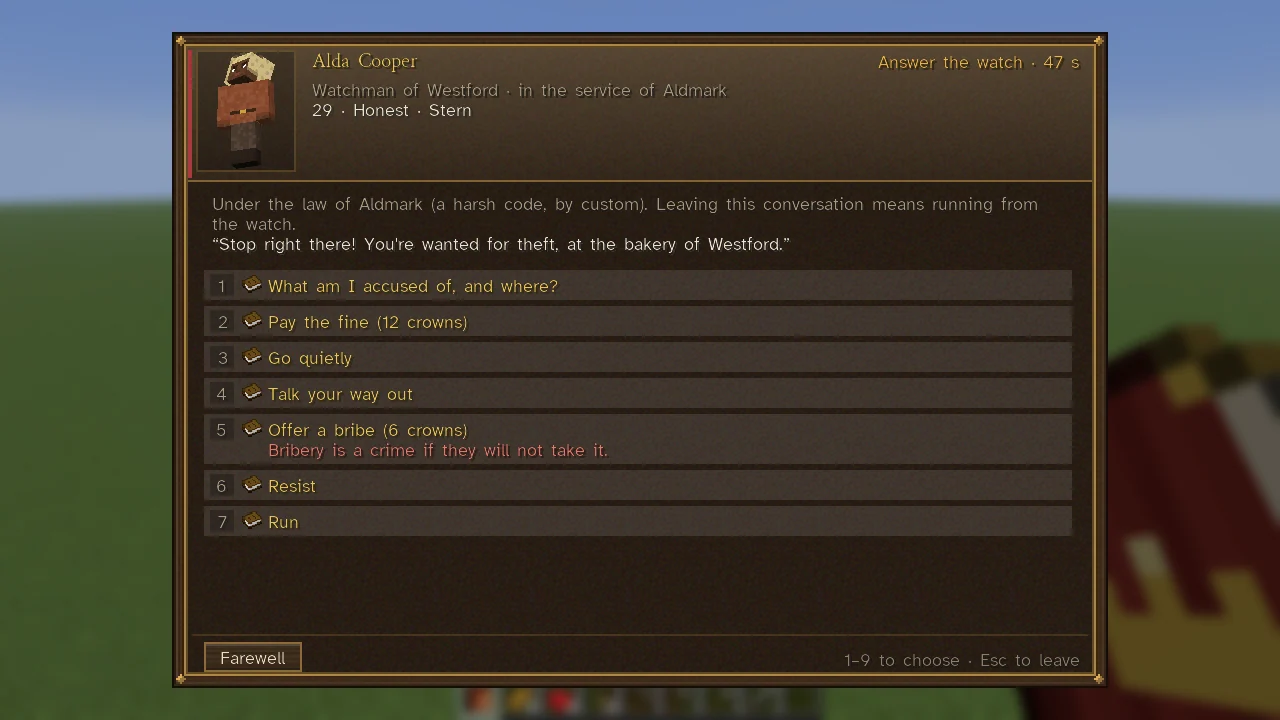
The watch subdues rather than kills: a blow that would leave the offender near death takes them instead. It fights as a team: a shield raised against a foe at arm's length, two to one rather than one each, and a guard losing calls for help, so that the garrison comes. One who breaks away from the watch's keeping while their sentence is put to them is chased so at once, the guard who had them and the one who put the choice first after them. For the stop, the arrest, the sentence and the cells, see Arrest and Jail, Wanted and Bounties and Crime and Punishment. A locked store of a treasury, armory or jail cannot be broken open by hand; with a tool it takes long work, and the noise brings the hue and cry.
No blow through a wall. A blow lands only with a clear reach to some part of its target's body, as a player's must: a wall two blocks high stops every blow, though over a wall one high the head and shoulders can still be struck. The same holds for the watch and soldiers, townsfolk in a hue and cry, posts, brawlers, the arena's fighters and golems. Behind a wall of blocks a player set down in the town, the watch pulls those blocks down, a second's work each. A wall of the town's own, or of no one's, is never pulled down: they shoot if they carry a bow or a gun and can see their man, go round, or wait.
When no player of a realm is on, the watch keeps a log of who came to its towns, what they did and took, who was taken and who got away, which is told to each player the next time they come (see Catch-up Simulation).
Watchtowers
A Watchtower is a raised watch post. It is declared with a 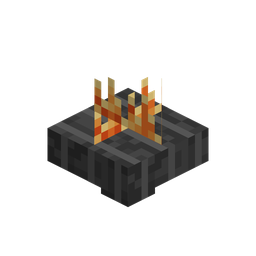 Watch Brazier and must stand at least six blocks above the land about it, under open sky; it wants a bell to sound the alarm, and banners. A tower of ten blocks or more is manned by two sentries, a lower one by one. Sentries see far, and the realm's reach grows with the tower's height (see Influence).


A sentry's shift on a tower: climb the ladder, stand by the brazier looking out over the land, ring the bell when enemies come, and climb down again at the end of the shift. Armies on the march are seen by the watch of any town within sight of them, farther with a watchtower, and by anyone near. When an army is seen marching on one of your towns, you are told at once (see Campaigns).
A Great tower, the second level, stands at least twelve blocks high and flies two banners from its top; it sees further and is a platform for a gun (see Artillery).
Beacons. A watchtower with a fire laid on its top (a campfire) is a beacon. When war comes to its town (raiders breaking in, a war band at the walls, enemies sighted by its sentries) the fire is lit, burning a log or a lump of coal from the town's stores. Every other town of the realm with a beacon within sight (320 blocks) of a lit one lights its own, and so on down the line; each that lights raises the alarm at home, and its soldiers muster. The fires burn while the alarm lasts and a while after. No fuel, no fire; no beacon, no warning.
The alarm
When a bell is rung in alarm, it draws a realm's soldiers toward it for a while, and the alarm fades on its own. Townsfolk hurry indoors and wait for quiet. Soldiers take posts on the walls, in towers and at the guns; archers climb the nearest ladder to a wall-walk or tower and shoot from there. At a gatehouse the portcullis comes down. See Walls and Sieges. The first blow on a Town Heart by anyone not of its realm rings every bell in the town and brings the whole garrison.
Other guards
Golems keep a watch that needs no wage nor sleep: a warden that watches and rings the bell, a sentinel that fights. A town also posts them at its palace, its treasury, its gates and its fields. A town's golems leave a petty thief to the watch to stop and fine: they take on the wanted only for a grave charge, at four stars, or once someone has fought or run from the watch.