Walls and Sieges
DiscussFrom the Sovereign Realms Encyclopedia
A siege is an attack on a walled town. Raiders who find a town walled must batter down its gates and hack through its walls before they can reach the stores, and the defenders fight them from the walls, the towers and the gates, with guns, with traps and with the town's garrison. Walls are real blocks. They are also reckoned in the war's arithmetic: when a siege is fought where no one is watching, the walls weigh in the defenders' favour, and each engine the attackers bring cuts that advantage down. A war band sent to take a walled town does not storm it at once: it invests it, and nothing goes in until the town gives up, is stormed or relieved, or the band goes home (see "Investing a walled town" below).
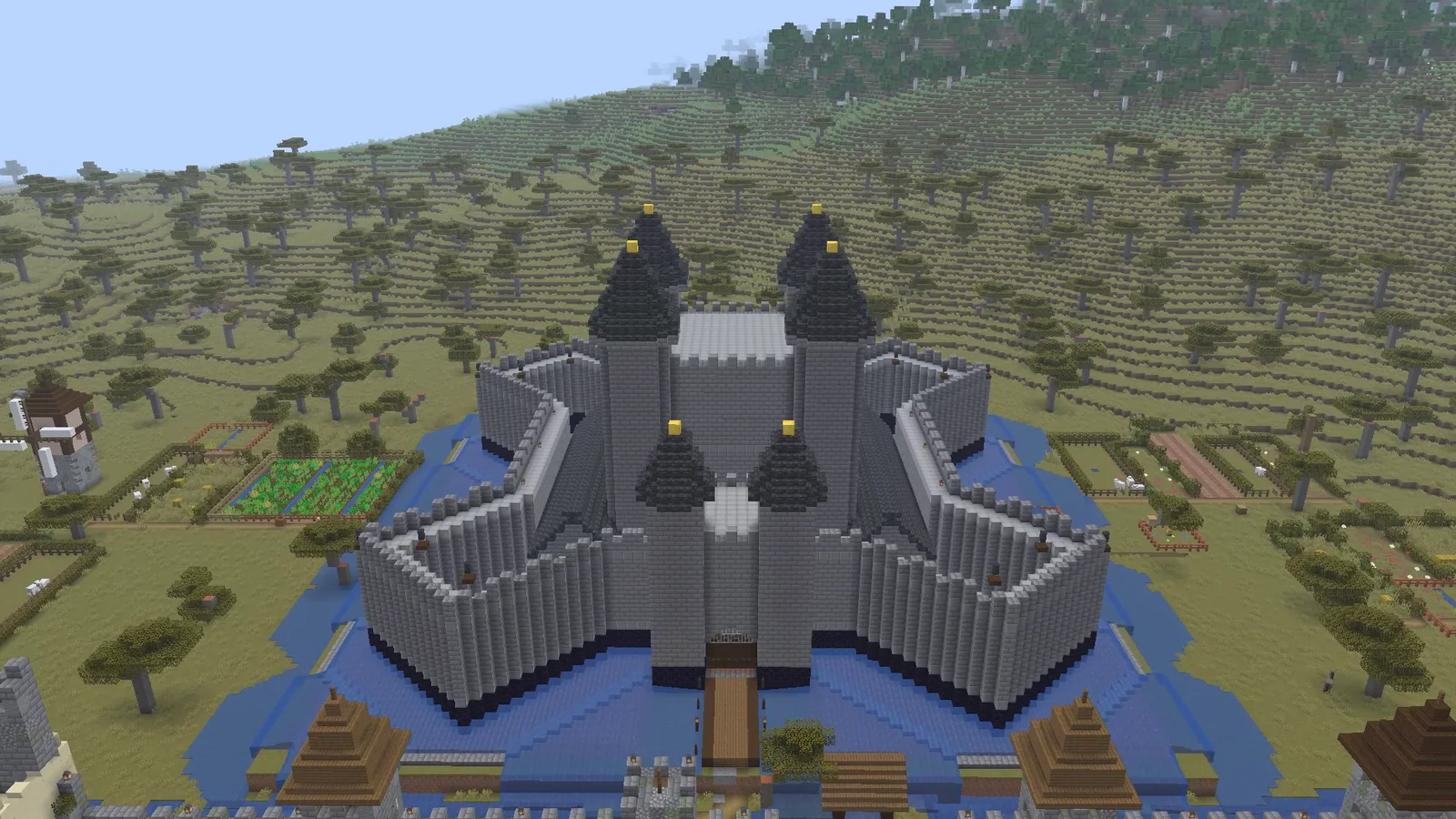
Reading a town's walls
Walk the walls from the Town Heart's sheet (the Walk the walls button, offered to the realm's own people; see Sheets and Town Heart). The survey starts at the heart and spreads to every place someone could walk, stepping up a block, dropping up to three, swimming, but never through a door or gate. If that ground runs out past the town's edge, the town is open, and the sheet says in which direction one walks out. Otherwise the town is enclosed. A second walk from the outside in finds what an attacker meets: the outer face of the walls, whose tenth-weakest part is taken as what the walls are worth, and the gates in them. Hills, cliffs and water-filled ditches count as much as masonry; a fence counts too, but it is soon broken.
The Walls section of the town's sheet tells you whether the town is closed, how many gates it has, the material the walls are mostly made of, the weakest point (to which side of the heart), how many blocks of the wall are broken (with a Repair the walls button), and how many percent the walls add to the defenders' strength in a siege no one sees.
What walls are made of
The survey reads the tier of the wall from what stands, block by block. Each tier has a proper height and a worth to the defenders, in multiples of a palisade's:
| Tier | Proper height | Worth | What it is |
|---|---|---|---|
| Barricade | 2 | 0.5 | Logs, fences, carts and bales heaped; anyone can raise one, and it burns |
| Palisade | 4 | 1.0 | Sharpened logs with a ragged top; quick and cheap; axes and fire get through it |
| Earthwork | 3 | 1.2 | A bank of earth from a ditch dug before it, a fence along its crest; rams do little against it |
| Stone wall | 5 | 2.0 | Rubble stone, two thick, with merlons along a walk; raiders must break stone to get in |
| Dressed stone | 6 | 2.6 | Brick or dressed stone with a wall-walk behind crenels and arrow slits |
| Deepslate curtain | 7 | 3.2 | Deepslate brick over a tuff core, a tower every sixteen blocks |
| Obsidian wall | 7 | 6.0 | Obsidian over a core of crying obsidian: great guns and bombs barely scratch it; ruinously dear |
A wall that stands short of its proper height is worth less. You build walls from the Architect's Plans (the Defense plans; see Walls and Fortifications and Construction).
Works beyond the wall
A wall may carry works that make a town harder to take and its ruler harder to kill. Each is built from a plan. When a siege is seen, each works as itself; when it is reckoned unseen, the survey counts what stands.
| Work | What it does |
|---|---|
| Towers | At corners and along the curtain; they flank the walls, so no stretch is out of a bowshot |
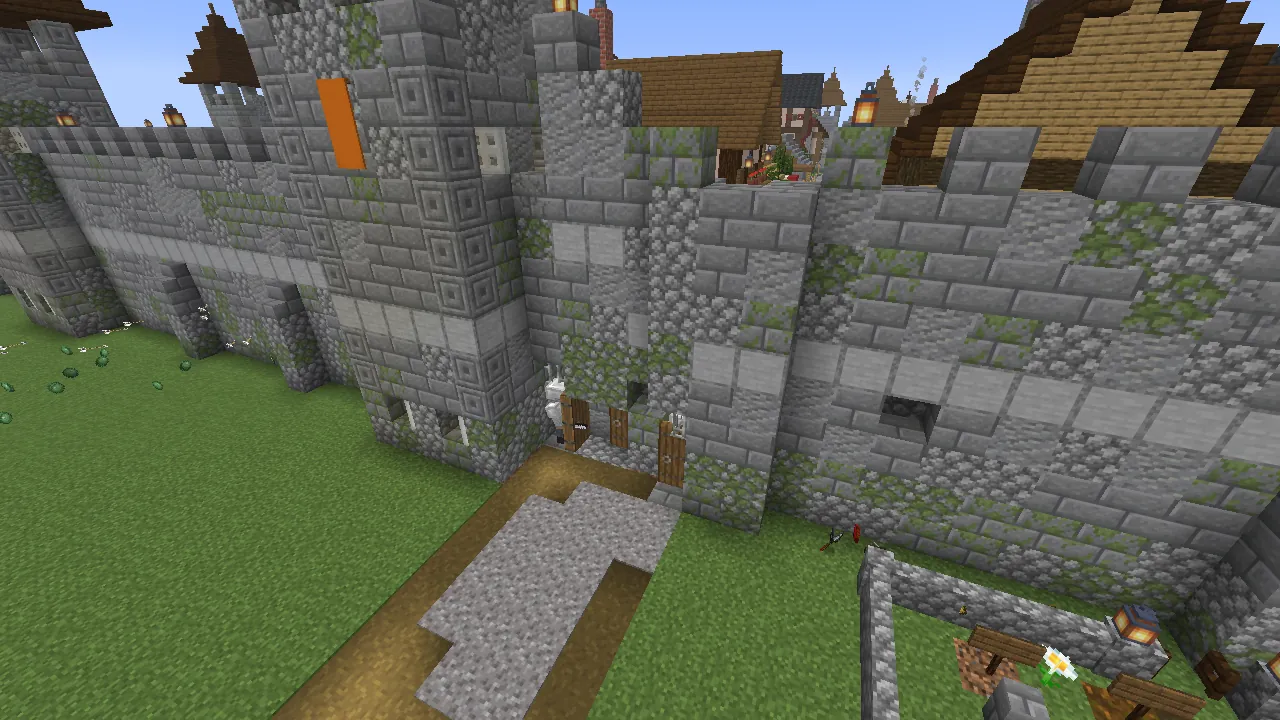
| Gatehouse | A gate between two towers with a room over the passage: the weakest place made the strongest |
| Portcullis | An iron grate let down in front of the gate at the alarm: rams and axes have two gates to beat in |
| Drawbridge | A bridge over the ditch or moat, drawn up at the alarm to stand against the gate |
| Wall-walk and crenels | A walk behind a parapet from which archers shoot and ladders are thrown down |
| Arrow slits | Loops in towers and keep, each a post for an archer who cannot be shot back |
| Murder holes | Holes in the floor over the gate passage: whoever beats in the gate is shot and stoned from above |
| Ditch | A dry ditch: ladders fall short and rams must be dragged down and up again |
| Water moat | No mine can be dug under it, and a ram cannot cross it |
| Lava moat | A ditch of lava kept in its channel: nothing crosses but by the drawbridge; ruinously dear |
| Arrow, fire, pit, stone-drop, flood and lava-curtain traps | Works that strike the realm's enemies, never its own people, in a passage or stair |
| Keep | A great tower to fall back to: stores and a well below, the lord's chamber at the top behind two doors |
| Castle | A curtain of towers about a bailey and a keep, with barracks, a stable, a well and a chapel |
At the alarm the watch lets the portcullis down and draws the bridge up at the gatehouse winch. Anyone of the realm may hold the gate shut with the winch by sneaking and using it, or let it go again. When the bells ring at a town with a keep, its ruler makes for the lord's chamber at the keep's top, past traps that spare the realm's own, and stays behind two doors until the alarm has been quiet a while. A walled town's watch shuts its gates when the hue and cry is raised, and at night to strangers if the realm so orders; a barred gate does not open to a stranger's hand.
The Town Heart is slow to break. The first blow on it by anyone not of the realm rings every bell in the town and brings out the whole garrison. By default it takes three minutes of hacking with an iron pickaxe, and it cannot be broken at all while one of its guards stands on their feet within 16 blocks. Outside war, striking it is treason, the gravest crime there is.
A town's guns
Cannon and mortars a walled town keeps, with shot and powder for them, make it harder to storm: a quarter more for each, three at most. They count whether they are in its stores or standing within its walls, but only while the town has a cannonball or a mortar shell and gunpowder in store. Set the guns on your walls and keep shot and powder in the armory: when the alarm rings, your garrison serves them, gunners first, firing at the enemies in reach that they can see. See Artillery.
The attack
Raiders storming a town make for its stores (the granary, storehouse, treasury and armory) by its streets and gates. A door or gate shut to them is battered down. Where no way leads, they break through the wall in front of them block by block, slower through stone than timber and quicker with the right tool. At a chest they fill their packs with what is worth carrying, coin first and then food, and carry it back to their camp. Raiders at the same door or wall break it together. Kill them before they leave and the plunder is still on them. When the alarm sounds at the walls, your archers climb the nearest ladder onto a wall-walk or tower and shoot from there.
A war band against a walled town sets up its engines first (see Siege Engines): rams for the gate, throwers and guns against the walls, ladders to take the walls, mantlets to shelter its bowmen, petards for the gate, and kegs or great bombs for a breach.
Storming to take a town
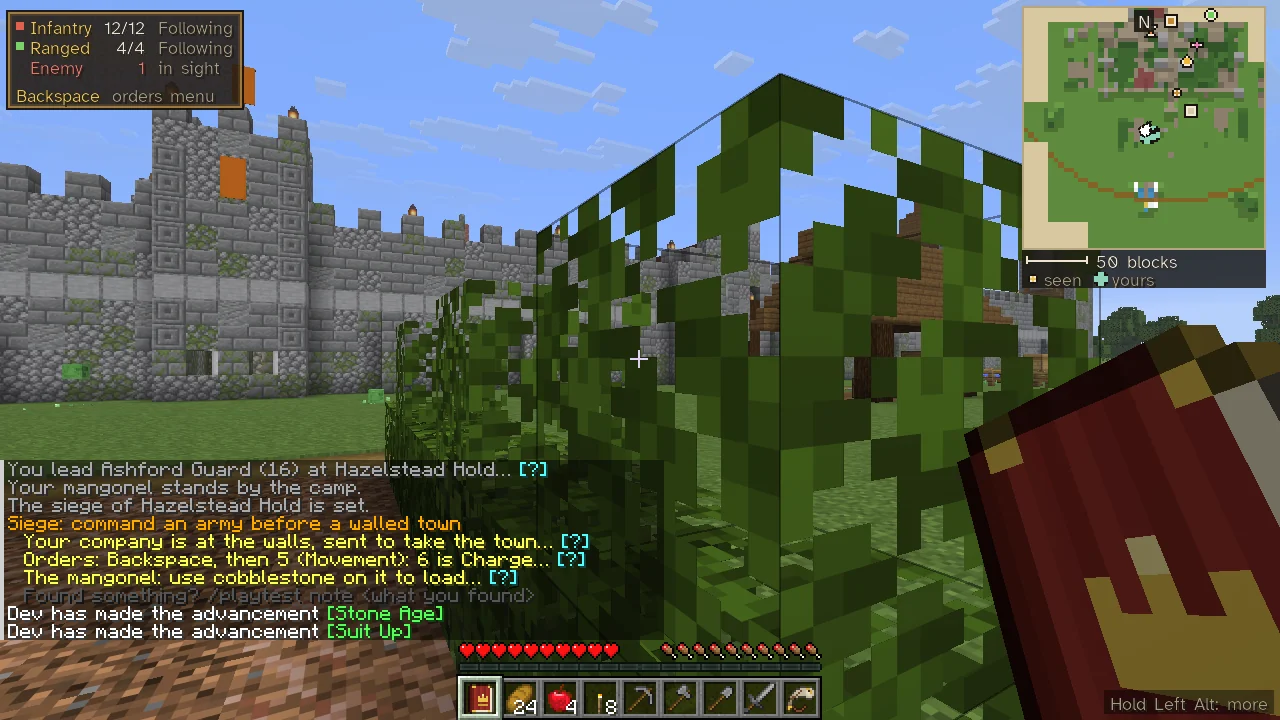
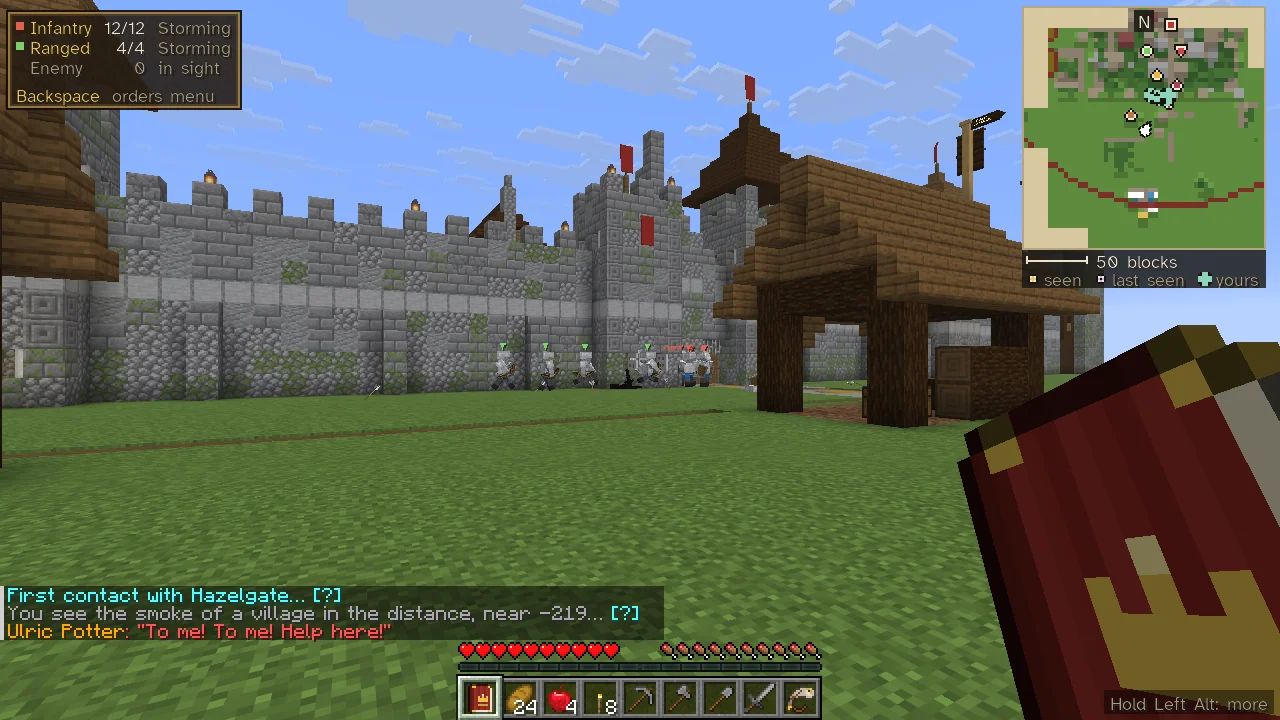
The storm on foot is how a band takes an open town, how a raiding band attacks a walled one, and how a siege ends in sight when it calls the storm. A war band sent to take a town (see Campaigns) does not leave the walls when its packs are full or the stores are bare: it storms for the whole of its time, about five minutes with someone there to see it, unless half of it falls. A company whose commander stands with it at the walls (its captain, the player it follows, or whoever holds its Command Horn, within 128 blocks) answers their orders as in the field, following them or holding where they put it, while the rest of the band storms. Charge from the Battlefield Orders sends it at the walls, and its line on the battle panel reads Storming.
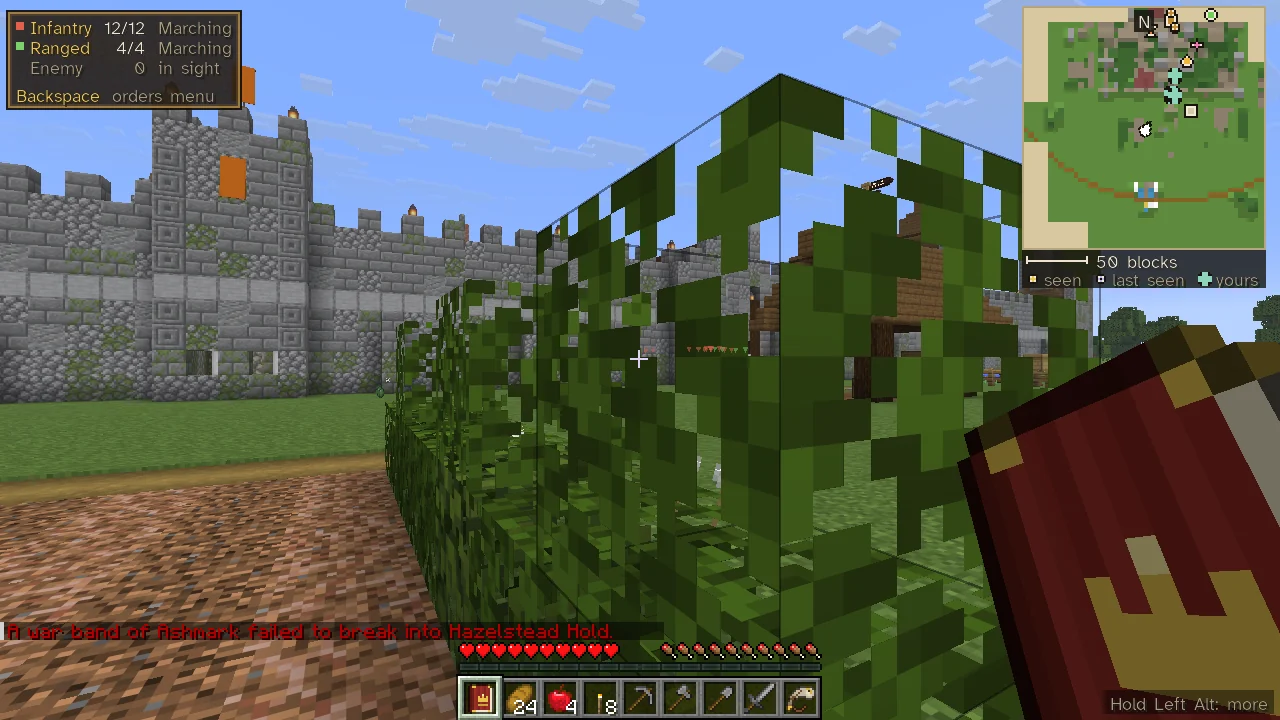
The town falls at once if all its defenders are fallen or fled. When the storm's time is spent, those of the band still on their feet are weighed against the defenders still on theirs, behind the town's walls and with its golems and guns, as a siege fought unseen is weighed but without its chance. A band that clearly outweighs them takes the town: it passes to the band's realm, the heart with it, and a few of the band stay as its garrison. Otherwise the band withdraws and turns for home, and the chat and both realms' chronicles say so.
What each does to the walls' advantage
Where a storm is fought unseen, the walls' advantage to the defenders (their worth above one) is multiplied by these factors (and, after a siege, cut down again by as much as the walls are broken), so that the smaller the factor, the more of it is gone.
| Siege work | Factor |
|---|---|
| A ram | 0.5 |
| Mangonel with stones, each (two count) | 0.8 |
| Trebuchet with stones, each (two count) | 0.65 |
| Siege ladders | 0.85 |
| A petard (with a ram, 0.8) | 0.5 |
| A great bomb, each (two count) | 0.55 |
| A powder mine, each charge (two count) | 0.6 |
| Mantlets, each (two count) | 0.9 |
| Cannon with shot, each (three count) | 0.5 |
| Mortars with shells, each (two count) | 0.75 |
Seen, the same things work as themselves. A powder mine is a sapper's work: with powder kegs in the band's baggage, a sapper at a stone wall steps back, digs a gallery under its foot, packs the kegs at its end, lights the train and gets out. The blast hollows the ground, and a stretch of wall comes down level with the ground, for the rest to storm through; defenders see nothing of it until it goes up. A water moat stops a mine. A petard fixed to a gate and lit blows it in. A band sets a great bomb at the gate and every one of them runs clear (see Bombs).
Investing a walled town
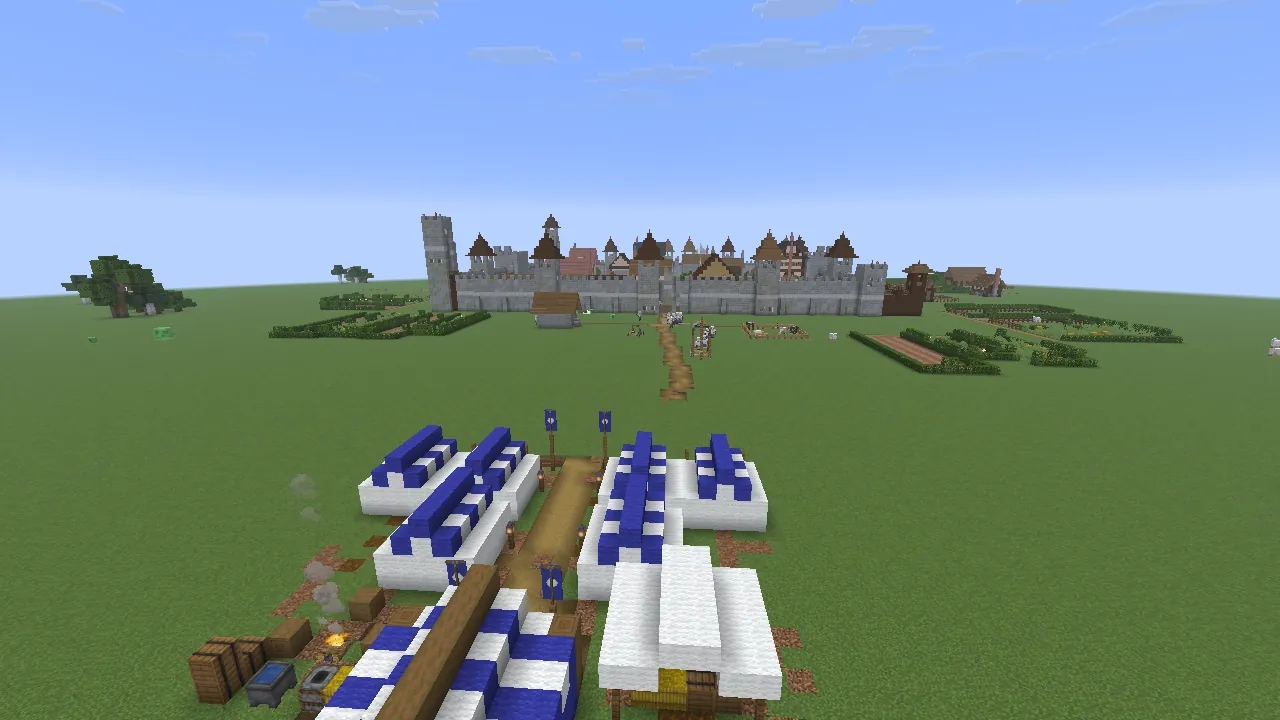
A war band sent to take a walled town (see Campaigns) invests it. Open towns, and bands come only to raid, are stormed as before (see "Storming to take a town" above). The band pitches its camp out of bowshot, some way beyond the walls' reach along the way it came, and both realms hear it: the town's "Town is under siege by realm: nothing comes in.", the band's own "Company has invested town: nothing goes in. Its stores last about n days."
- Nothing goes in. Caravans, supply trains, carters, deliveries, pedlars, tithes and supply columns of any realm but the besieger's, bound for the town, find the enemy before its gates and turn back with what they carry. No supply train can be sent in or out of it ("Town is under siege: no train can go in or out."), and its crown buys it no food, from other towns or of the far ships, since none could come in; far ships' food bought for it before the siege waits at sea or in the harbour's stores until the siege is over. Its people eat as they always do, so its stores fall.
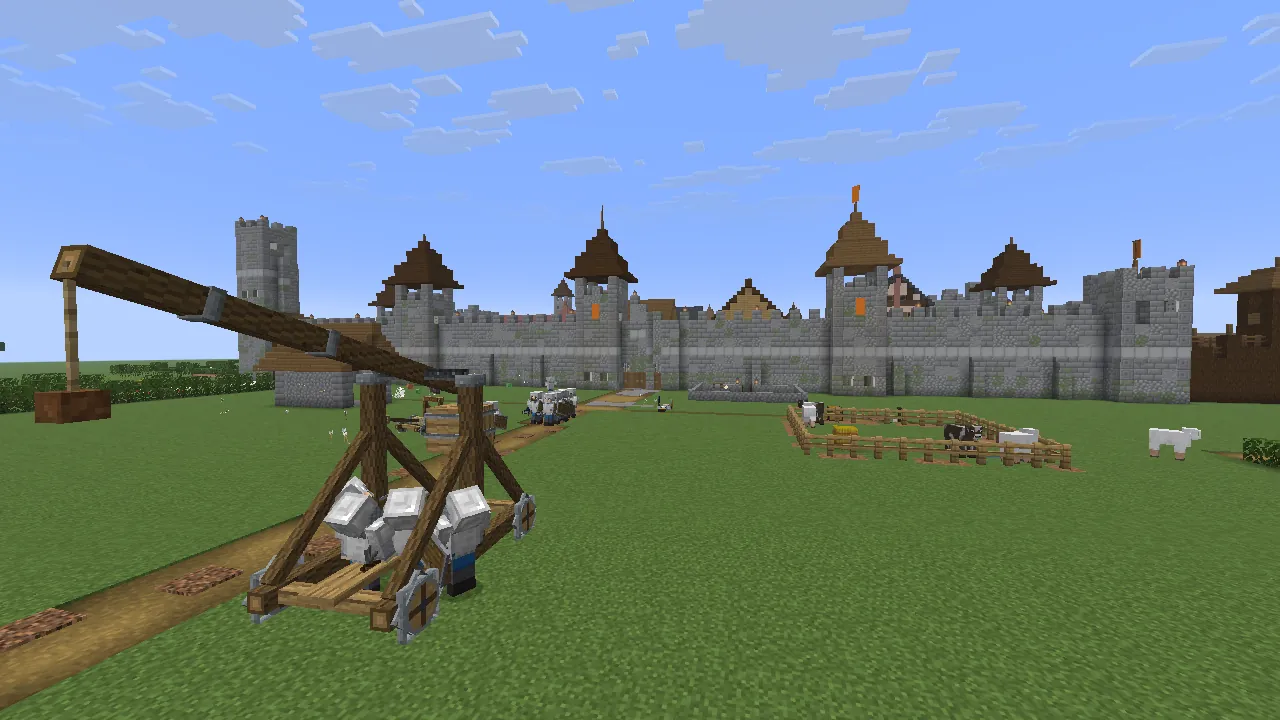
- Each of the town's mornings, whether anyone is near or not, the siege takes a step. The engines in the camp break the walls a little more (see the table below); out of anyone's sight they spend their stones, shot and powder as they do it. The town's food and the band's are read again.
- Then one ending is looked for, in this order:
- Surrender. The town gives up when its stores hold under half a day of its eating and a tenth of its grown people go hungry, or when its walls are breached and the band clearly outweighs its defenders. Its garrison marches out under arms to its realm's nearest town, and the band's best stay to hold the town, as when a town is taken by storm.
- Relief. A relief force standing at the town, with those of the garrison who would come out, fights the band in the open. Won, the band is driven off; lost, the relief goes home beaten and the siege goes on.
- A sally. Where the band has engines in its camp and the garrison could spare enough from its walls (all but a third of it) to outweigh the camp's guard (the band less two hands to each engine), it sallies against them. Won, it burns the band's best engine (great guns first, then a trebuchet, a mangonel, a mortar, a ram, a mantlet), and a sally that far outweighs the whole band drives it from the walls; lost, it is thrown back with its dead.
- The storm. The band storms when its captain orders it, when the walls are breached, or, with ladders and clearly outweighing the walls as they stand, before any breach. Unseen, the storm is reckoned with the walls as broken as the siege has left them, and the town is taken, sacked, or the band beaten back. Seen, the band goes in on foot, as in a storm (above).
- Lifted. When the band's food would no longer last its walk home and half a day more, and no supply column of its realm is on the way, it lifts the siege and goes home. The town has held.
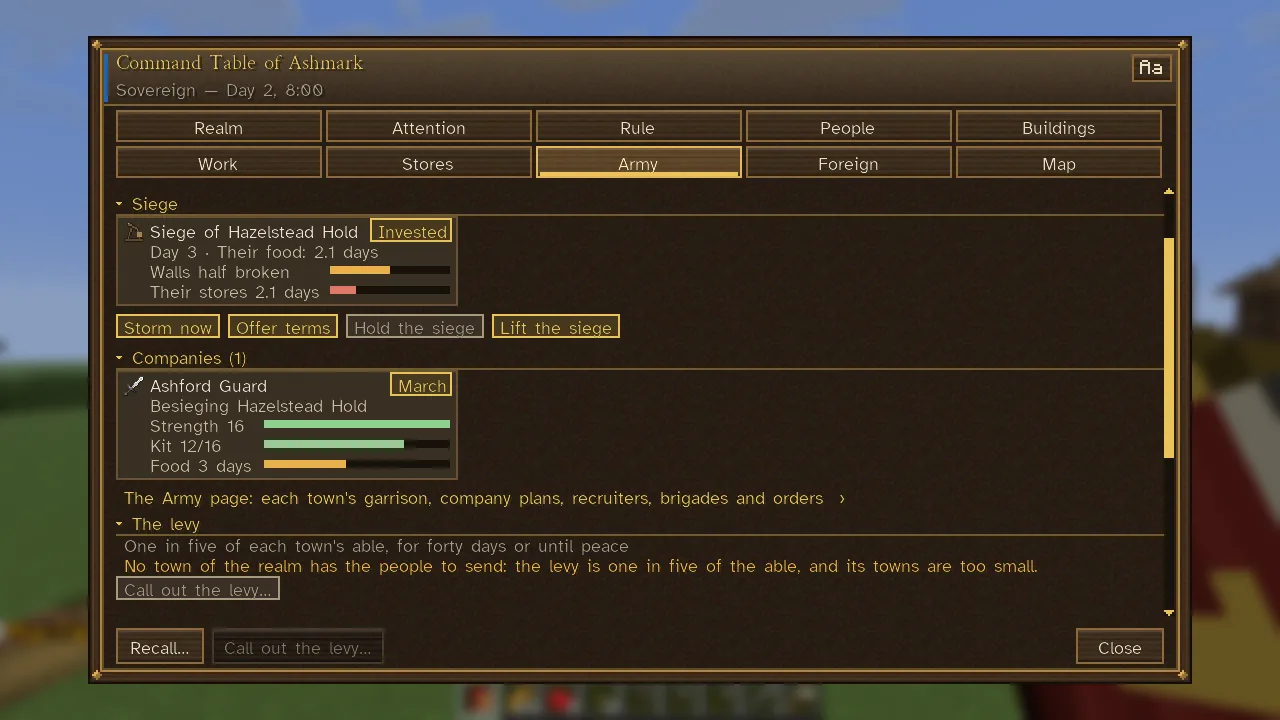
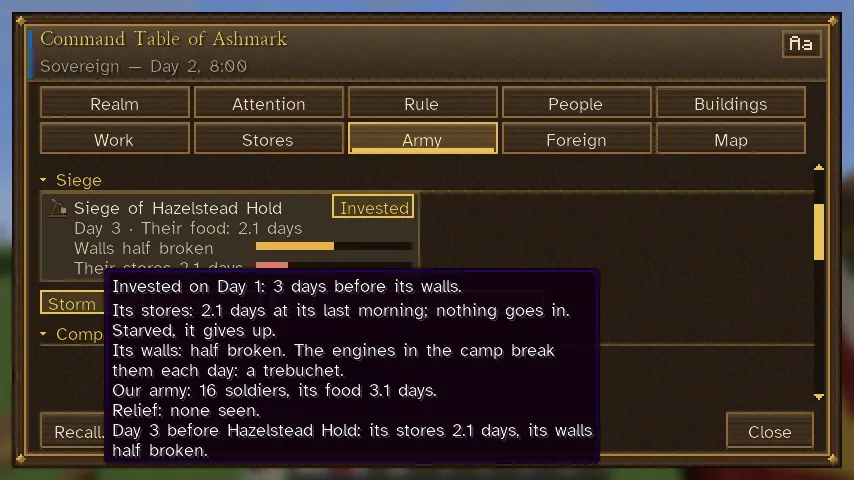
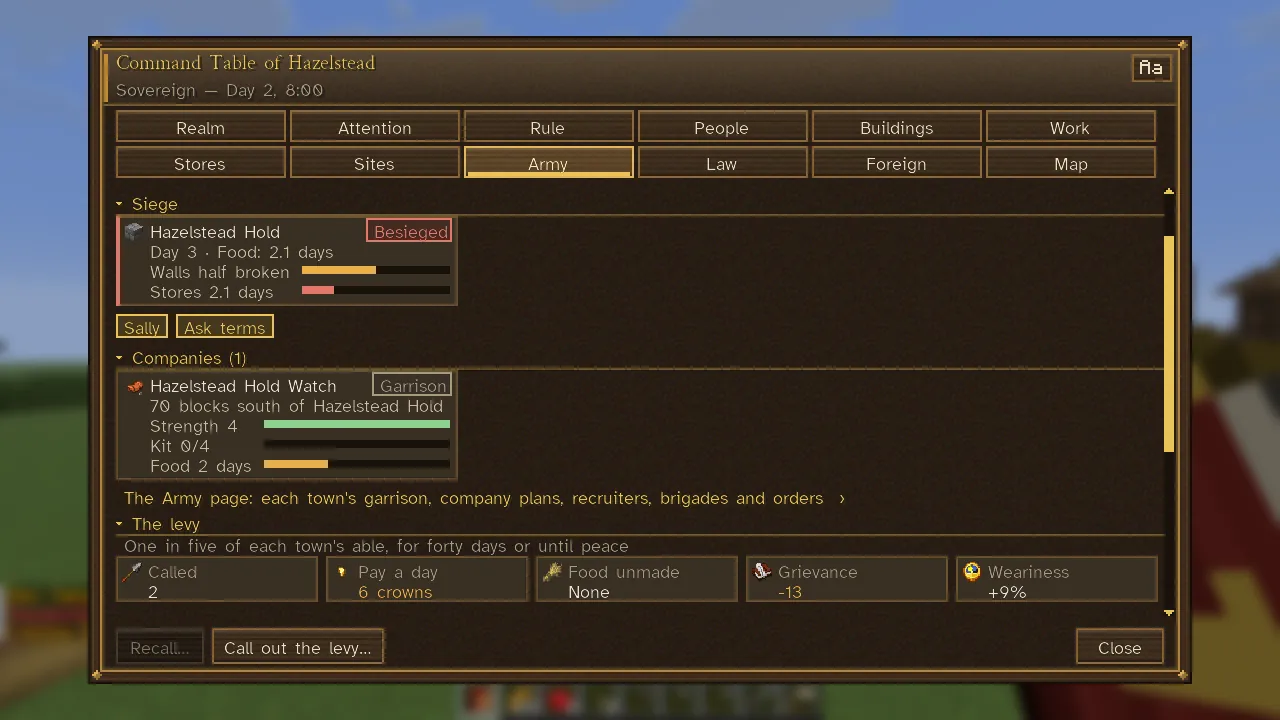
A relief fight and a morning's sally are reckoned only where no one is watching. In sight, a band that loses half its number to the defenders' arrows and sallies is driven from the walls. While it invests a town in sight, its crews work its engines from the camp and the rest keep the camp until the siege calls the storm; a company whose commander stands with it answers their orders, as in the field. Each morning with no ending, the band's company keeps a line of how it goes: "Day 3 before town: its stores 2.1 days, its walls half broken."
Both realms are told how a siege ended, and it goes into their chronicles: the town surrendered (its food gone, its walls breached, or on terms, with how many of its garrison marched out and where), relieved, the besiegers driven off by a sally, or the siege lifted (its food ran short, or its captain called it off); a storm is told as any storm is. A siege also ends if peace is made: the band goes home without a blow.
What the engines break each day
The walls are broken a share at a time, a breach being the whole. A day's battering breaks at most half of it. Engines at the gate are slowed by a portcullis, and again by a moat or an earthwork; throwers and guns are slowed by the wall's worth for its tier (see the table of tiers above: a palisade's one, a stone wall's two, an obsidian wall's six).
| What the band has in camp | A day's breaking |
|---|---|
| A ram (two count) | A quarter, at the gate |
| A petard (two count) | A fifth, at the gate |
| A mangonel with stones (two count) | A fifth, against the wall |
| A trebuchet with stones (two count) | Seven twentieths, against the wall |
| A cannon with shot (three count) | Nine twentieths, against the wall |
| A mortar with shells (two count) | A fifth, against the wall |
| A great bomb, or a powder mine of two kegs (two of each count) | A half, under the wall; half that against obsidian |
Out of sight a thrower spends eight stones a day, and a gun two shot and two gunpowder; petards, bombs and kegs are spent as they are set. A breached wall is worth no more to its defenders than a town without walls has: its great works. A siege's walls read whole, a quarter broken, half broken, nearly breached or breached.
The siege card and its orders
Each siege a realm lays or stands under has a card on the The Command Table's Army tab, above the companies, under Siege (or Sieges and their number), and on the besieging company's page. The besieger's card is Siege of the town, its chip Invested; the defender's bears the town's own name, its chip Besieged; either reads Storming while a storm is under way. The card gives the day of the siege and the town's food, the walls on a meter, and the stores on another (up to ten days). Its hover gives the day it was invested, the stores at the last morning, the walls and the engines breaking them, the band's numbers (and, to the besieger, its food), any relief at the walls or on the road, the terms standing, and the last morning's line. A besieging company's card on the Army tab says where it is: "Besieging town".
Under the card stand its orders, for the realm's marshal or sovereign (and, for the besieger, the player captain of a company in the band):
| Side | Order | What it does |
|---|---|---|
| Besieger | Storm now | Storm it today, against its walls as they stand: unseen the fight is reckoned, in sight the army goes in on foot. |
| Besieger | Offer terms | Offer the garrison its life and arms if it gives up the town. A garrison of the world's own takes them only when its stores hold under three days, or its walls are half broken and the band clearly the stronger; otherwise it refuses at once. A player's realm finds the terms standing on its card, to take or leave. |
| Besieger | Hold the siege | Keep the siege as it goes: storm when the walls are breached, lift it when the food runs short. |
| Besieger | Lift the siege | Call the army home now. |
| Defender | Sally | Send those of the garrison who can be spared from the walls against the camp's engines: won, an engine burns; lost, they fall. Only while the camp is out of everyone's sight; in sight a sally is fought on the ground. |
| Defender | Ask terms | Ask what they would take to go. A besieger of the world's own answers at once: starved (stores under three days), or half broken and outweighed, give up the town; holding, so many crowns: 15 for each soldier of its band, 20 at the least. A player besieger is told, and answers with its own Offer terms. |
| Defender | Give up the town or *Pay n* crowns** | Take the terms standing. Given up, the town passes to them and its garrison marches out under arms to the realm's nearest town. Paid, the crowns go from the town's treasury (which must hold them all) into the band's baggage, marked as the town's, and the band lifts the siege and goes home. |
The march out
A garrison marching out of a town its realm gave up goes out by the town's gates and doors (its portcullises wound up for it where the town's land is loaded), and those it gave the town up to let it be, and it them, unless one strikes the other. Its soldiers join the garrison of the realm's nearest town and live there now. A realm with no other town has no march out.
At the peace table
A siege counts in the war (see War and Peace). The besieger gains a point of warscore each day for each of the enemy's towns its bands invest ("kept 1 town under siege"); a surrender scores as a town taken. The besieged realm wearies the more for each of its towns under siege, and twice as much for one whose stores hold under three days. A town under siege is cheaper to cede to the realm besieging it: 10 points of warscore less while it is invested, 20 less while its stores hold under three days. A winning realm of the world asks first for a town of the loser's that its band besieges (never the seat), whatever its temper, and a losing one offers first a town of its own that the enemy besieges, the hungriest first.
The world's realms
A realm of the world besieges a walled town it means to take but cannot storm, so long as its host outweighs all the town's garrison could bring out in the field, by 1.35 times, the walls left out of the count: it means to starve or break the walls, not to climb them. The towns it means to take are those within 2,000 blocks of one of its own, for a martial or expansionist realm, and, whatever its temper and however far, the town it went to war to take; that town is the first it marches on.
Defending, step by step
- Walk the walls from the Town Heart. Close any gap the survey finds.
- Raise stone walls or better, with towers and a gatehouse; add a portcullis and a drawbridge where the gate is the weak point.
- Build a watchtower with a bell so that approaching enemies are seen; a campfire laid on its top makes a beacon that lights the others of the realm.
- Keep an armory, a barracks and a garrison (Armies and Soldiers), and keep shot and powder in a magazine (Gunpowder).
- Keep the walls in repair: builders put back exactly what was lost, from the stores.
Walls also keep the dead out: a walled town is never come for by the hordes of the dead that gather round a town with no walls on a moonless night.
See also
Walls and Fortifications for building the walls; Siege Engines, Artillery, Bombs and Gunpowder for what attacks them; Campaigns for sending an army to raid a town or to take it; Golems for guards that need no wage.