Walls and Fortifications
DiscussFrom the Sovereign Realms Encyclopedia
Walls and fortifications are what make a town hard to take. A wall is built by the town's builders along a line you stake, from a heap of carts and fences to an obsidian curtain; gatehouses, towers, ditches and moats, traps, keeps and castles add to it. Raiders who find a town walled have to batter down its gates and hack through its walls, which takes longer through stone than timber (Walls and Sieges); a town's defenders stand on the wall-walk and in the towers and shoot from there. A war band sent to take a walled town invests it instead, and its engines break the walls a share each morning, the harder the wall's tier the slower, until the town starves or a breach is stormed.
Building a wall
There are three ways to build defences.
- Stake a ring with the Mason's Line. Peg the corners (or draw them in the Walls mode of the The City View), choose the wall's kind and works on the line's sheet, read the bill and lay it out. Your builders raise the wall along the ground, with a gate wherever a path or street crosses it. See Mason's Line for the kinds and what each is worth.
- Single plans from the Architect's Plans. The Defense tab has a palisade, a palisade gate, a stone wall and a gatehouse to place piece by piece, and keeps and castles (below) (Architect's Plans).
- Use the land. A cliff, a river or the sea can close a gap, and buildings the wall runs into are left standing: their own walls close the line.
The seven kinds of wall, from weakest to strongest, are a barricade, a palisade, an earthwork, a stone wall, dressed stone, a deepslate curtain and an obsidian wall. A stone wall is five high and two thick; the greater curtains are three thick with a wall-walk behind crenels; stone and better are worth twice a palisade's value to those behind them or more, and obsidian six times. The table is in Mason's Line.
Towers, gatehouses and ditches
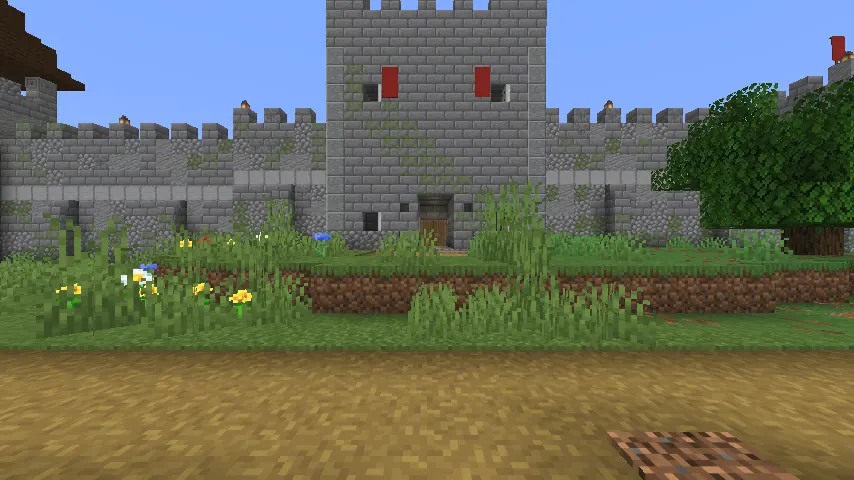
For a wall of stone or better, the usual works are towers at the corners (and, for the great curtains, every sixteen blocks or so), a gatehouse at each gate and a ditch before it. A palisade also has its timber towers and a gatehouse by default. You can change each of these on the line's sheet: "No towers" or "Towers at the corners", "Plain gates" or "Gatehouses", and "Before it..." a dry ditch, a moat of water or a moat of lava (only before stone or better). The wall follows the ground and wades through shallow water.
A gatehouse has a portcullis, murder holes and stone-drops over the gate passage, a winch in the room above, and a drawbridge over the ditch or moat. A Portcullis is a grate of oak shod and strapped with iron, far harder to beat in than a door: a ram or a petard is wanted. It is let down across the gate by the Gate Winch in the room above. At the alarm the watch lowers the portcullis and draws up the bridge, and the watch shuts the gates at night while none of your realm is on, or every night if you order it, and while the hue and cry is up (The Watch and Watchtowers). Shut gates bar strangers; your own people come and go by them as ever.
Posts and the wall-walk
A walled town's defenders take posts when the alarm sounds: behind an arrow slit in a tower, keep or gatehouse wall; beside a murder hole over a gate passage; at the gatehouse winch; on the wall-walk; and, for the ruler, at the doors of the lord's chamber in the keep. When the alarm sounds at the walls, your archers climb the nearest ladder onto a wall-walk or tower and shoot from there. A walled town also counts for more in a siege: each cannon or mortar it keeps, with shot and powder, makes it harder to storm by a quarter, up to three (Artillery).
Traps
A Trap Works is a block set into a gate passage or stair. What you use on it decides what it does:
| Use on it | It becomes |
|---|---|
| Arrow | Arrow works: looses arrows along the passage it faces |
| Fire charge | Fire works: looses small fireballs |
| Pointed dripstone | Pit works: a false floor dropped onto stakes |
| Gravel | Stone-drop works: gravel and stone let fall |
| Water bucket | Sluice works: the passage flooded while the enemy are in it |
| Lava bucket | Lava trough: a curtain of molten rock let fall before the enemy |
A trap springs only on the realm's enemies and, while the bells are ringing, on any stranger in its defences. Never on the realm's own people.
Is the town walled?
From a Town Heart's sheet, "Walk the walls" sends a walk round the town's defences from its heart. The survey records whether one can walk out of the town from the heart without passing a door or gate, how far the enclosed ground reaches, the gates, how tough the walls are (the weaker end of what they are made of) and where they are open or weakest. The town's sheet reads "Enclosed, with one gate", "Open to the north", or "The walls have not been walked." A citizen can walk the walls as any of the town's people may; the ruler's sheet has the same button.
Your map and the corner map draw a known town's walls at the streets' and a district's scales: the walls its builders raised as a dark line, and each gateway the last walk found as a pale gap with a gatehouse pin named Gate. The gates are listed in the map's Find a place..., nearest first, to follow. Gates within eight blocks of one another, such as a gatehouse's outer and inner doors, count as one gateway. See Maps, the Corner Map and the Compass.
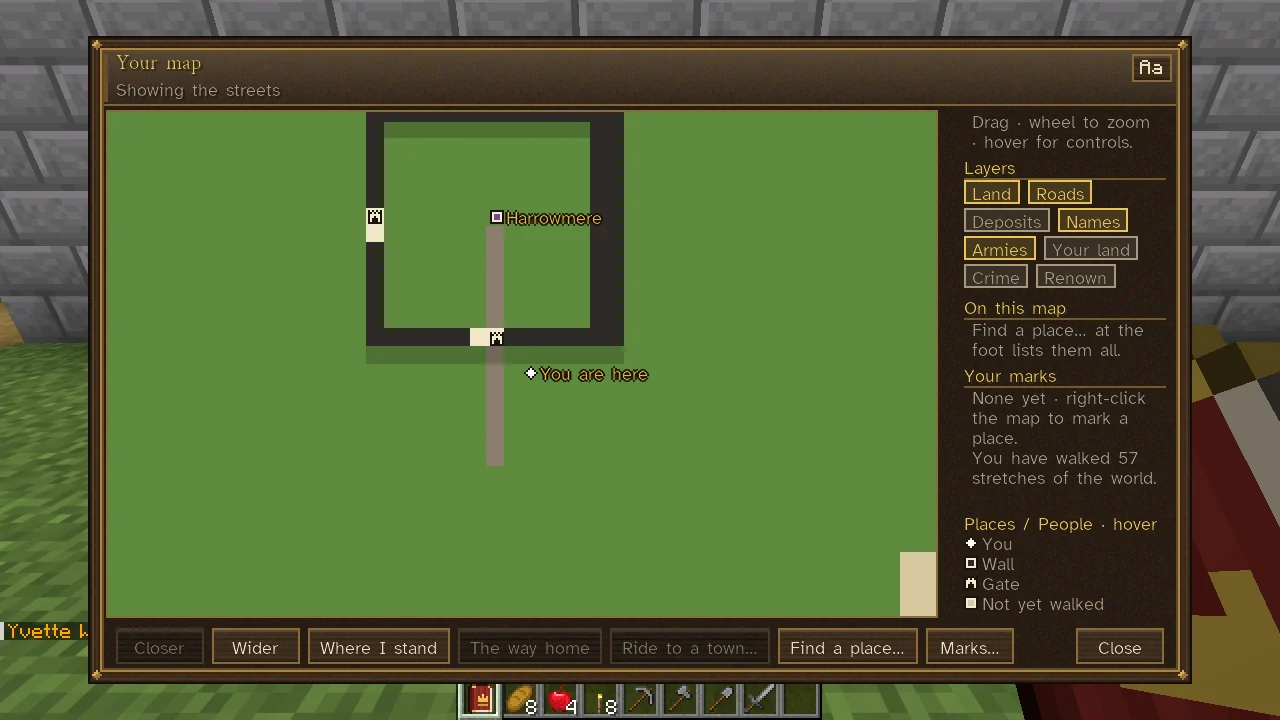
Broken walls are repaired from the Town Heart's sheet: "Repair the walls" has builders put back what was lost (Construction).
Keeps and castles
A castle keep is a guarded inner refuge behind two gate lines, with quarters and stores; its doors can still be battered or its masonry broken. It needs two pairs of gate doors, two refuge beds, two supply chests or barrels, an alarm bell and light.
A castle is declared by the castellan's keys, kept by the well, with the alarm bell and the lord's banner in the bailey. The castle holds as long as its curtain closes the bailey (walked from inside and out), its gates are shut and its keep stands, staffed and stocked. See List of Building Types.
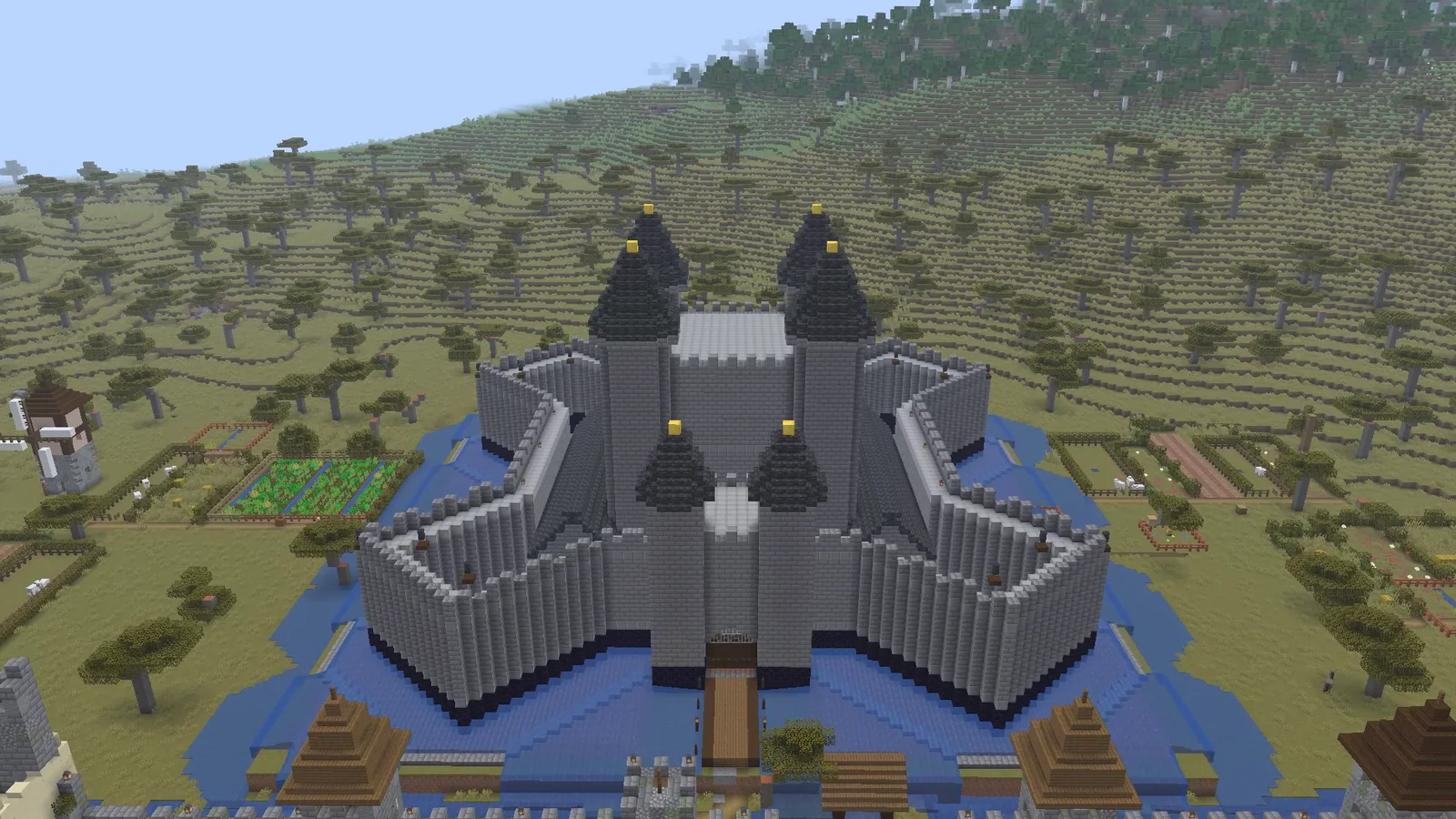
The Defense tab's castles come in four sizes: a motte and bailey (a timber palisade on a bank about the bailey, with the keep raised on its motte), a stone castle (a stone curtain with four corner towers and a twin-turreted gatehouse), a concentric castle (a low outer curtain and a tall inner one, in a moat of water) and a fortress-palace (the concentric castle grown to a court, with a palace range, fire and a curtain of lava in its inner gate). Each is drawn in the way of the five peoples (The Five Peoples). Every castle has a keep, a barracks, a stable, a chapel and a well within.
Great walls
Two Great Works stand for fortification: the Great Wall, a section of obsidian curtain with its towers read in its gate tower's guardroom, and the Citadel, a fortress-palace on bastions about a great keep that holds with a small garrison. While they stand whole, staffed and supplied, the realm's heart in the town they are in is harder to take.
See also
- Mason's Line: staking a wall.
- Walls and Sieges: how walls are attacked and defended.
- Siege Engines, Gunpowder and Artillery: what breaks them.
- The Watch and Watchtowers: who keeps the posts and gates.
- Towns: what a walled town is.