Prospecting and Mining
DiscussFrom the Sovereign Realms Encyclopedia
Prospecting and mining are how a realm finds and digs what the ground holds: coal, iron, copper, gold, redstone, lapis, diamond, emerald, sulphur and saltpetre. Where the ore lies is not given away. In the lands the world sets out, ore lies in bodies called deposits, and nothing about them is known until someone looks. What a realm does not know of, it does not act on. See Resources and Scarcity for why this matters to a realm's fortunes.
How a realm comes to know a deposit
A realm knows each deposit with one of three degrees of certainty:
| Certainty | How it is learnt |
|---|---|
| Rumour | Word from traders and travellers of the rock about the towns of realms it knows, and of the diggings their miners work. A realm of the original world also starts with old tales of the deposits of its own country. A rumour is not a find: miners must go and read the rock before they dig. |
| Sign | A Prospector's Pick or prospector pointing toward richer ground; and the hills about a staffed mine, which its miners come to know. |
| Confirmed | Stood on and read with the pick; ore cut out of the deposit by a miner; the rock within a long walk of a town (the people there have lived and dug on it). |
A realm never knows a deposit less surely than it once did. What a player reads with the pick goes on the player's own map and into the survey of the player's realm. The deposits you have seen signs of show on your map (the Map tab of the Companion) while its Deposits layer is turned on; see Maps, the Corner Map and the Compass.
A merchant sells a survey of deposits for 200 crowns: a map of the deposits that merchant's realm knows.
The Prospector's Pick
The Prospector's Pick is crafted from iron ingots, sticks and an amethyst shard. Strike bare rock with it (stone, deepslate, cobblestone, or anything a pickaxe mines) and it reads the rock:
- the rock of the land you stand on, its kind and how rich it is;
- any deposit directly under you, with its richness and the heights it lies between;
- up to two nearby deposits, with the direction they grow stronger and roughly how far (within a long walk).
It cannot be used again for two seconds, and each strike wears it: it lasts 96 uses. In a world with no provinces the rock is ordinary everywhere ("like any rock anywhere") and the pick finds nothing special.
The Prospector's Lodge
The Prospector's Lodge is declared with a Prospector's Tripod (flint or cobblestone over sticks) set in open air with a chest near it for what is found; see Building Markers. One prospector works from it. They walk a circuit of the realm's land and a little beyond, out to about 350 blocks from the town, stopping about every 64 blocks. At each place they dig a real test pit, one block across and six deep, read the rock at its foot, and either fence it round or fill it in and set a stone on it. What comes up goes to the lodge chest. A find is announced to the realm and entered in its chronicle. The prospector needs a pickaxe, and takes fences for the pits from the stores when there are any.
Ground held by another realm is not tested. When the whole circuit is done the prospector reports that the land about is all tested.
Mines
A Mine is declared by a mine windlass with a chest for the ore (and light, which the miners want). Its zone is staked out; see Surveyor's Stakes. Miners cut a spiral stair down a shaft beside the windlass, then a main gallery with side galleries, and follow any ore they find in the walls. A mine has places for two miners. The ore goes to the mine's chest, then to the town's stores.
Where towns sink mines
A town's planner (every town of a world realm, and a player's town whose building is left to the Your Steward) sinks mines where its realm knows the ore is. A town of twelve people or more with no mine lays one out when its realm knows for certain (from its people's own ground, a prospector's sign or a find; a rumour is not enough) of a deposit of iron, coal, copper or gold, not worked out, whose edge lies within 96 blocks of the town's heart. The mine's head is set out among the town's outlying works (beyond the walls and moat of a walled town where it can be), on the side toward the nearest such deposit. A town with idle hands for whom no place is open, whose mines all work a deposit and have all their places filled, may sink another when a miner's day there is worth more than the wage.
While the town's workshops wait on the ore its mine works (iron for the smith's ingots for soldiers' kit and workers' tools, coal for the kilns), the town wants hands at the mine as urgently as at a quarry when stone is short, its second miner as well as its first. What a miner's day is worth is reckoned from what the deposit gives, so a new mine that has brought nothing in yet is not judged worthless.
Light for the galleries
Miners light their galleries with torches, and a mine with no torch and nothing to make one with stops cutting. A miner makes four torches at a time from a stick and a lump of coal or charcoal out of the town's stores; with no stick to be had but a plank, they split the plank in two, use one stick and keep the other. The town orders a stack of sixteen torches for each miner at its mines, less what its stores hold, and the coal to make them: a lump for every four torches, less the coal and charcoal it has. In a world whose ore lies in deposits, a mine on iron brings up no coal: a town counts on its own mines for coal only if one works a coal deposit, and otherwise must buy coal or make do with charcoal.
The chain from the mine
Iron ingots a town's orders want are sought as the raw iron that is smelted into them, not as nuggets, and the same for copper and gold. A town's caravan buys what the town is short of and cannot make itself; the ore its forge, kilns and mine's torches wait on (coal, raw iron, raw copper and raw gold) goes on its list first. See Merchants and Supply Trains.
Setting the depth
On the mine's sheet, choose Dig to… (rank permitting). The three choices:
| Choice | Digs down to | Needs |
|---|---|---|
| Iron and coal | y 16 | nothing special |
| Gold and more iron | y -16 | an iron (or better) pickaxe in the town's stores or the mine's chest: stone will not cut gold or diamond |
| Deep: diamonds and redstone | y -54 | an iron pickaxe, the craft of deep mining known to the realm, and 16 logs in the stores to prop the galleries |
A realm that does not know deep mining may learn it from a miner of a realm that does, from a book of the craft, or by working a mine down to the gold depth. See Book of the Craft. Where a mine is dug matters: ore lies in different depths for each ore, and the deposits of each land are of the ores its rock holds most readily (see Resources and Scarcity).
Panning river gold
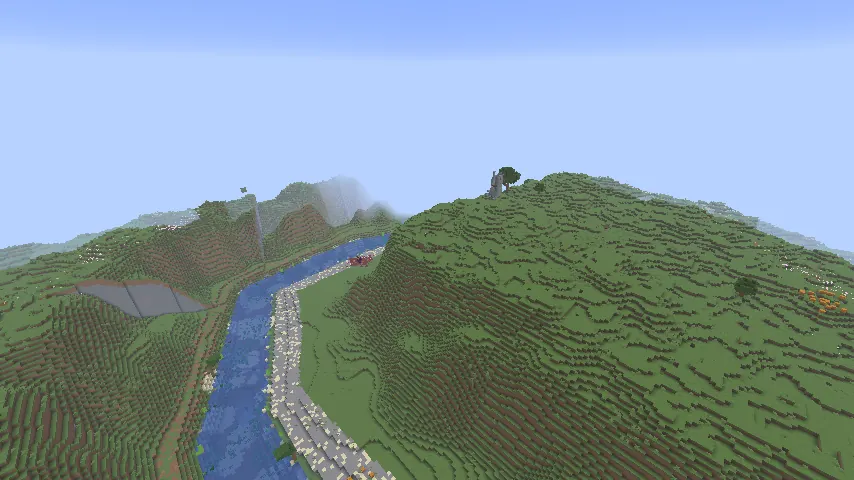
On certain rivers the gravel carries gold. A Sluice is declared by the Panner's Sluice Box (planks and wooden trapdoors) with a chest near it, and the stretch of riverbed below it is marked with Surveyor's Stakes. One panner digs gravel or sand from the marked bed, washes it through the trough, and puts the gravel back. On a gold-bearing river the washing yields gold nuggets; on any other river it yields nothing, and the panner says so.
The gold comes out of the river's own stock, which the river renews slowly, so a stretch worked hard gives less. A player who digs gravel or sand by the water in such a stretch also finds nuggets, but less often than the sluice does. A rumour of river gold, or a prospector's pick, tells where such rivers run; see Wilderness Discoveries.
Mining in another realm's land
Ore is the ground's, and the ground belongs to the realm that holds it. Digging ore out of ground that another realm holds, without its leave, is the crime of unlawful mining; see Crime and Punishment. Leave is mining rights: one realm lets another's miners dig a named deposit in its land for ten days. A player or a realm asks for them through Diplomacy and Envoys (a proposal to mine, with a fee). A fair fee, by the deposit's richness, is 10 crowns for a barren or poor deposit, 24 for a common one, 40 for a rich one and 60 for a motherlode. While the right holds, the holder's people dig there lawfully and the holder knows the deposit for certain. A realm the world runs sends a party of its miners to sink a shaft and carry the ore home.
Miners sent to what a realm lacks
A realm the world runs also sends parties of miners to what it lacks (see Resources and Scarcity). For iron and coal it counts as lacking not only when its stores hold less than it keeps put by, but also when its towns' workshops are waiting on more than that: the iron ingots its smiths are ordered to make for soldiers' kit and workers' tools, the coal and charcoal its towns' orders ask for. It then sends two or three of its people who do not keep a town fed, with the town's pickaxes, to the nearest deposit of each thing it lacks that it knows for certain, in its own land or land no realm holds, within 1,600 blocks of one of its towns. Failing one, they go where a rumour puts one, read the rock, and dig if it is there.
See also
- Work and Professions for the other trades
- Salt and Gunpowder for the sulphur, saltpetre and salt that realms seek
- Markets and Trade and Merchants and Supply Trains for buying what a land lacks