Work and Professions
DiscussFrom the Sovereign Realms Encyclopedia
Work is how a town makes what it needs. Every grown townsperson may hold a trade, and every trade is done at a building: a farm, a bakery, a smithy, a market. People do real work with real materials, moving real goods from one chest to another: wheat is in a chest, bread is in a pocket. A worker who lacks a tool says so on their sheet. A town's trades decide what food it has, what its builders can build, what its soldiers carry, and how much coin its people earn and spend.
How people take work
Adults who are idle take up work at buildings with free places, where the town needs hands most: a ruler's quotas first, food when it runs short. A bread shortage with wheat in the granary wants bakers, a building site wants builders, low timber wants foresters. Once a town has about eight grown people it also keeps its offices: someone at the treasury, who pays wages and takes dues, and someone at the market, who keeps the stalls and tills. Each morning a town that does its own hiring may move a hand from where they are least wanted to where they are wanted most. People keep their job until they leave it, are moved, or their workplace falls out of order.
A town's workshops (its smithies, joineries, masonries, powder mills, golem works, tinkers', clothiers' and scribes') take on hands by the hours of work they have: the town's open orders of their trade (among them what sold at its counters in the last three days; see Markets and Trade), as many as the makings to hand cover, and what a shop's racks lack, each piece at the hours it takes, a hand for each day of that work. Once a trade has as many hands as its work keeps busy, more are wanted less than any idle hand. A workshop of the crown's with too little work keeps its first hand and those its work keeps busy and half as many again; each morning a town that does its own hiring lets one hand beyond that go, from the trade with the most to spare, never below the least a ruler set for it and never one set to the work by hand in the last three days. The one let go remembers why ("there was too little work there for its hands"), and the realm's chronicle and its rulers' morning report say so, at most once a week a town. A crown that is saving its coin still takes on a workshop hand whose hours of work bring in more than the wage, and keeps one whose trade's work keeps all its hands busy.
A long piece of war on a workshop's bench (an engine on a joinery's siege bench, a gun in a foundry, a great bomb on a powder mill's charging bench, though never a player's own piece) also takes on a crew of the idle each morning, seen or unseen: as many as the piece has days of work left, eight at the most, the town's idle first and then those of the realm's other towns, each paid a labourer's day from the treasury into their own purse. What the treasury cannot pay is not worked. See Siege Engines.
Seeking work elsewhere
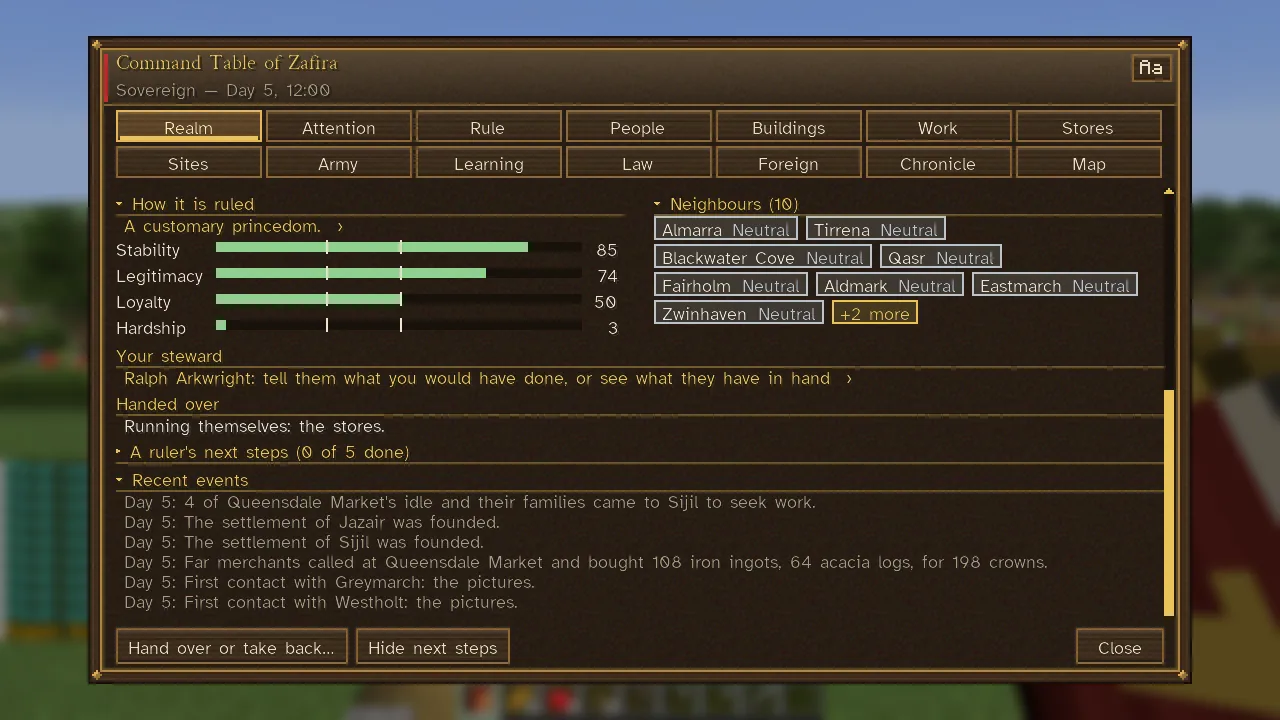
A town with no work for its idle sends them where the work is. Each morning in which its own hiring left no place open that it wanted, a town keeps one idle hand in twenty of its grown people (two at least); of the idle beyond that, a fifth set out each morning (no more than 64 grown in a morning), with their families: the unwed first, the youngest first, then couples. A youth come of age with no place by their second morning goes first, however few idle the town holds. They go to the nearest town of their own realm within 8,000 blocks whose hiring left places open and wanted, with free beds and room to feed them (what its land and trade feed beyond its people; see Food, Granaries and Hunger), as many as it has places; then to a town of a realm with open borders, not at war with theirs, within 3,000 blocks. One of them at work who goes with the household gives up the place, which is open to the town's idle the next morning. The town's ruler reads it in the chronicle ("4 of Queensdale Market's idle and their families set out to seek work in Sijil."), and the realm they come to hears in one line as they arrive ("… came to Sijil to seek work.", with the realm they came from where it is not its own). A town's open places are kept with the world, so a restart does not hide them from others' idle.
Children follow a parent, or another master, to work from the age of twelve and learn the trade; people come of age at sixteen and retire at sixty-five (see Townspeople). Craftsmen also pick up tricks from better hands at the same trade.
A realm chooses how work is given out (the labour law):
| Choice | What it means |
|---|---|
| The town hires | Idle folk are put to work each morning where they are most needed, food first. |
| The steward assigns | No one is set to work except by a steward's hand; the idle wait and say they want work. |
| Free choice | Idle folk take up whatever open place they like best: their own skill, nature and fancy, not the town's needs. |
Assigning work
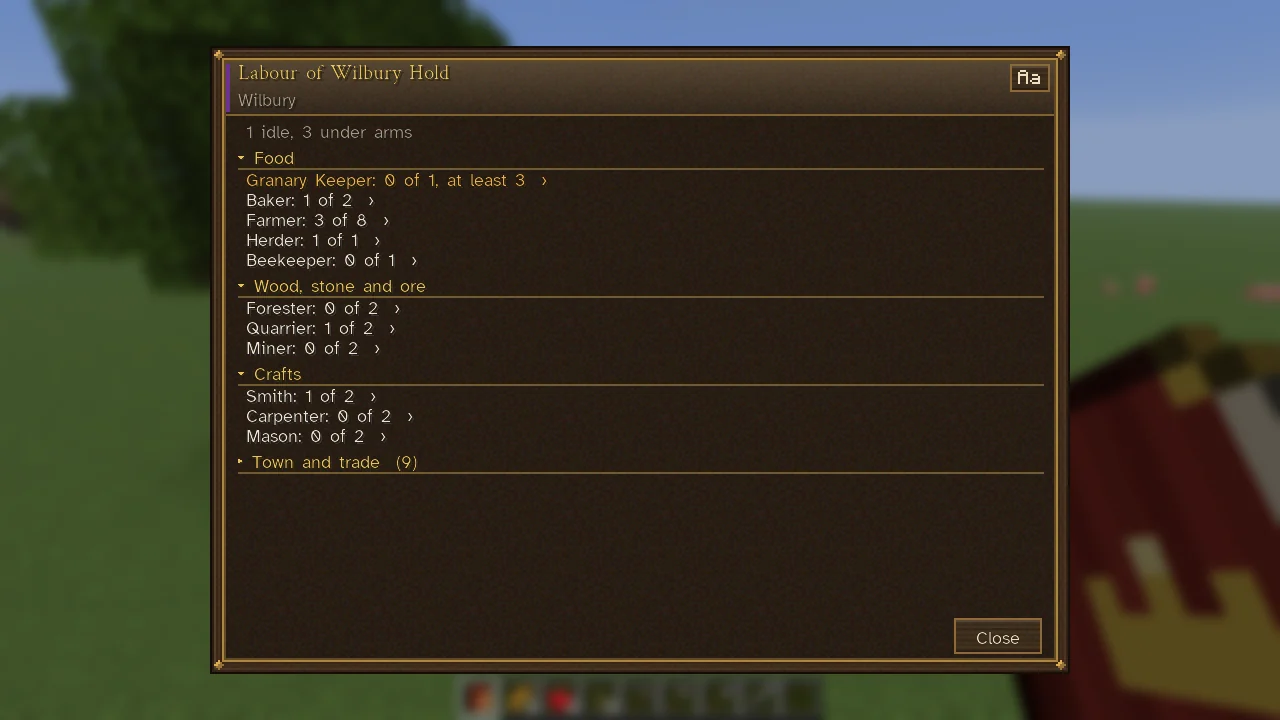
On a person's sheet, Assign work picks a workplace with a free place, and Dismiss frees them. A dismissed person is not taken on again by the town for three days, though a steward may set them to work by hand. On a town's Labour sheet (its labour board, opened from the Work tab), each trade shows its hands against the places it has, and you can set Keep at least… and Keep at most… quotas, or Send hands elsewhere… to another of your towns: they go with their households. Quotas are filled first from the idle, whatever else the town wants. See Your Steward for how your steward does this by word.
The Work tab
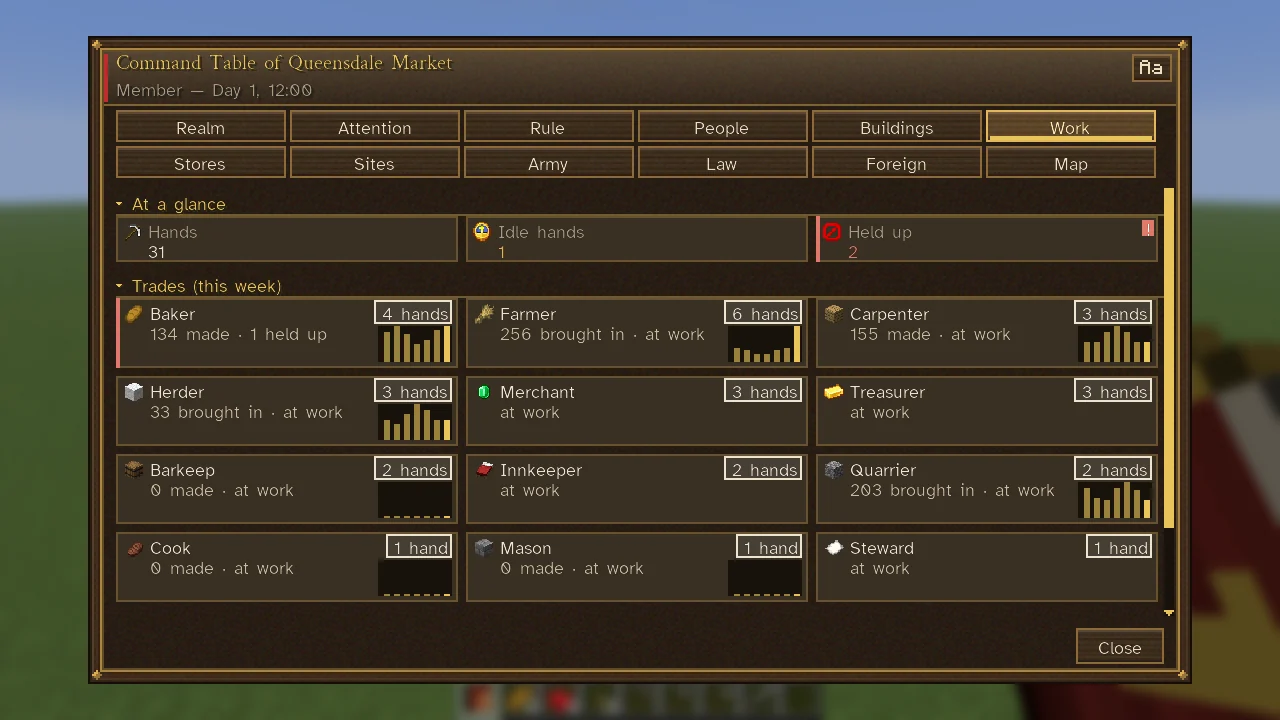
The Command Table's Work tab answers who works at what across the realm, and what is held up. It opens on three tiles under At a glance:
- Hands: grown townspeople at work in the realm's trades, soldiers not counted.
- Idle hands: grown folk of working age with no trade and not under arms (counted the same way as the People tab's Idle tile and the Attention cards), with an arrow for how the number moved since the morning before (green when it falls). Click it for the People tab at the idle of the town with the most, to set them to work.
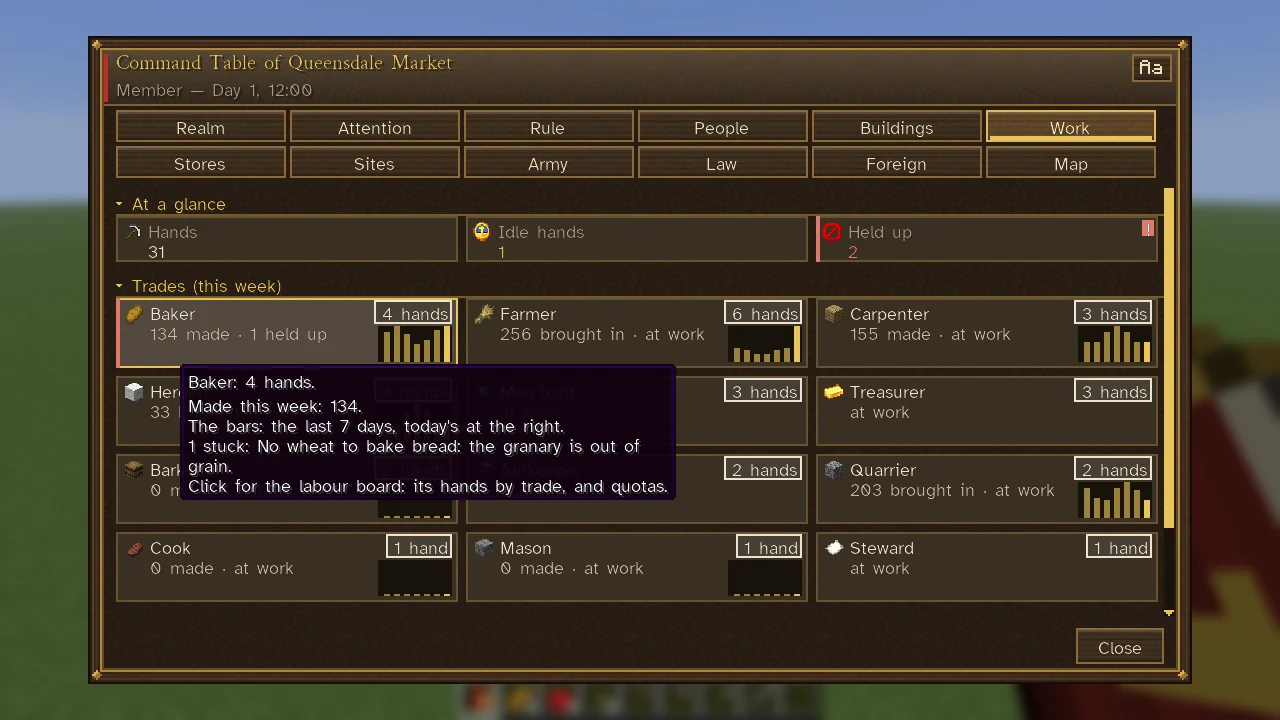
- Held up: people stopped at their work, in red, with what holds them on its hover.
Under Trades (this week) each trade is a card: its picture and name, its hands on a chip, what it brought in, made or laid into buildings this week, and either "at work" or how many of its hands are held up, and for a trade that yields goods a bar for each of the last seven days, today's at the right. Trades with hands held up come first, edged in red, then those with the most hands. A card's hover gives the week's total and what holds its hands; a click opens the labour board of the town where most of its hands are.
The realm's books record what was brought in, made and laid, not who did it, so each good is counted to the trade that yields it: grain to the farmers, planks to the carpenters, blocks laid to the builders, bread to the bakers (or to the cooks, where a realm has no bakers). Merchants, innkeepers, treasurers and other trades that yield no goods show their hands and no bars.
Below the cards come the Production chains (this week): bread, timber, stone, iron and arms, wool and cloth, and powder, each with what was brought in, made and in store, and plainly why a chain is held up ("no one works the mine"). Then each town has its own section: its hands at work and idle (opening its labour board), the goods its work wants ("Wanted: …"), who is stuck and why, each linked to their sheet, its building sites, houses whose pantries hold less than a day's food, and soldiers without a weapon.
Work troubles also reach the Command Table's Attention tab as cards: Idle hands ("Build workplaces") when a town has more than two idle adults, Want work ("Set them to work") where the steward assigns work, Stalls bare when a staffed market has nothing on its stalls, and No tools, Doors barred or Nothing to eat for workers held up for those reasons.
The trades
| Trade | Workplace (marker) | What they do |
|---|---|---|
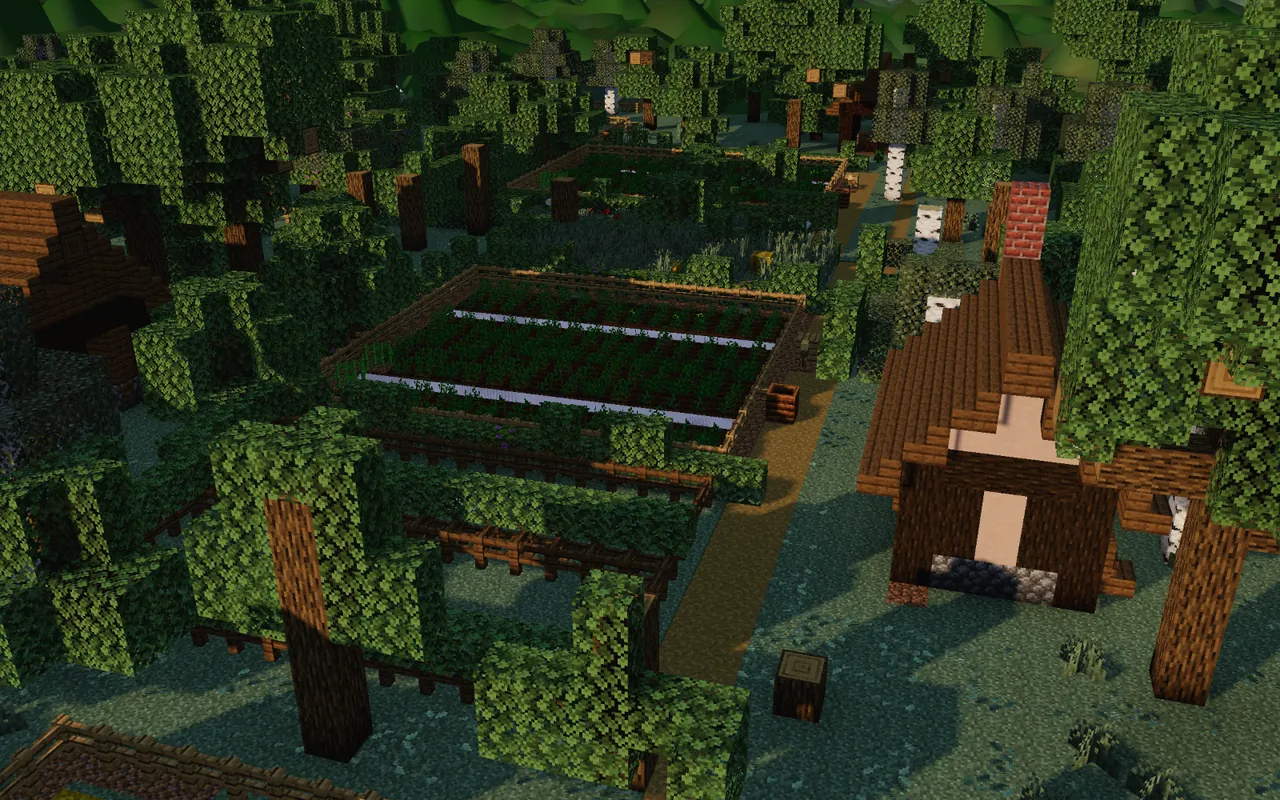
| Farmer | Farm (scarecrow) | Till, sow and harvest the marked fields |
| Herder | Pasture (shepherd's post) | Breed, shear and slaughter the animals; milk cows and gather eggs |
| Fisher | Fishery (fisher's creel) | Cast from the shore into the marked water |
| Forester | Lumber Camp (woodcutter's stump) | Fell and replant the marked woodland, setting saplings in open ground or among its grass, ferns and leaf litter, from the camp's chests or fetched from the yard or the storehouse. A camp of the world's realms whose woods stand felled out with nothing growing in them has them staked anew a day on, as large as before, where the most standing trees are within 14 blocks |
| Quarrier | Quarry (quarry cairn) | Dig the marked pit layer by layer, leaving a stair out |
| Miner | Mine (mine windlass) | Cut a stair down a shaft beside the windlass, then galleries away from town, following any vein of ore that shows in a wall (iron, coal, copper, gold and the rest); see Prospecting and Mining |
| Beekeeper | Apiary (beekeeper's skep) | Take honey from the hives, in bottles for the sick and as comb for candles |
| Salter | Saltern (salter's rake) | Rake up the salt the sun leaves in the salt pans; see Salt |
| Panner | Sluice (panner's sluice box) | Wash river gravel through the trough; on a gold-bearing river the gold stays in the riffles |
| Prospector | Prospector's Lodge (prospector's tripod) | Walk the land, dig test pits, and bring back word of what lies in the rock |
| Baker | Bakery (baker's peel) | Bake bread; smoke meat and fish |
| Cook | Cookshop (cookshop counter) | Hot meals from the town's stores, set out for sale |
| Smith | Smithy (forge bellows) | Smelt ore; forge the tools, weapons and armour the town and its workers ask for |
| Carpenter | Joinery (carpenter's sawhorse) | Planks, doors, chests, beds, ladders and fences, what building sites wait for |
| Mason | Masonry (mason's banker) | Dress stone, fire bricks and melt glass |
| Builder | Builder's Yard (builder's bench) | Raise the town's building sites, from its stores; see Construction |
| Porter | Storehouse (storehouse ledger) | Carry goods to where they belong; lead supply trains |
| Granary Keeper | Granary (granary tally) | Keep the food stores; see Food, Granaries and Hunger |
| Merchant | Market (market bell) | Stock the stalls, keep the tills; see Markets and Trade |
| Treasurer | Treasury (counting table) | Pay wages, take dues and strike coin; see Treasury and Taxes |
| Innkeeper | Inn (tavern keg) | Let rooms, sell hot meals; see Lodging |
| Barkeep | Alehouse (alehouse tap) | Brew and pour drink; see Alehouses and Drink |
| Groom | Stable (stable manger) | Break horses to the saddle and breed them |
| Healer | Infirmary (healer's mortar) | Tend the wounded and sick; see Hurts and Healing |
| Apothecary, Clothier, Scribe, Tinker, Enchanter | The shop of the same name | Remedies; cloth and leather; paper, books and maps; clockwork; enchanted books. Each keeps a counter. |
| Supplier | Builders' Merchant (supply ledger) | Keeps racks of the town's surplus and its counter |
| Gunsmith, Powder-maker, Nitre-man | Gunsmith, Powder Mill, Nitre Works | Firearms made at the gunsmith's benches, powder, and the nitre beds; see Firearms and Gunpowder |
| Golemwright | Golem Works (golem mould) | Dormant golems; see Golems |
| Sailor | Harbour (harbour bollard) | Keep the realm's ships in port and crew them; see Harbours |
| Priest, Acolyte | Temple, Sanctum | Keep the altar and its rites; see Faith and Temples |
| Envoy | Embassy (envoy's desk) | Speak for the realm abroad; see Diplomacy and Envoys |
| Jailer, Sentry, Soldier | Jail, Watchtower, Barracks | The watch and the army; see The Watch and Watchtowers and Armies and Soldiers |
| Guildmaster | Adventurers' Hall | Keeps the guild's book and sees to its board |
Each trade has a skill that grows with practice: Farming, Forestry, Mining, Hauling, Cooking, Smithing, Building, Trade, Husbandry, Fishing, Carpentry, Masonry, Medicine, Salt-making, Seamanship, Devotion and others. A smith at a smithy, a carpenter at a joinery and a mason at a masonry use the real recipes and the real materials in the stores. See List of Building Types for what each workplace needs to count as built.
Wages and the working day
Wages are paid from the treasury each morning: a worker is paid a set number of crowns a day. A realm starts with 2 crowns a day for workers and 3 for soldiers, and may set these, and the craftsmen's and officers' wages, anywhere up to 12. Unpaid workers grow bitter.
The craftsmen's wage (where a realm sets one; otherwise they are paid as workers) goes to every trade that makes things at a bench: smiths, carpenters, masons, bakers, cooks, builders and healers, and gunsmiths, golemwrights, enchanters, apothecaries, tinkers, clothiers, scribes and powder-makers. Gunsmiths and golemwrights are paid half as much again (eleven at a craftsmen's wage of seven). A craftsman's pay also rises with skill in the trade: a skilled hand (skill 6) is paid a quarter more, an expert or a master (skill 11) half again, and always at least a crown more than a skilled hand; a gunsmith's or golemwright's pay, skill and all, goes no higher than twice the craftsmen's wage. The Stores tab's Policy line reads "Wages: n for workers, n for craftsmen, n for soldiers", its hover what a skilled hand and an expert or master are paid. A business owned by one of the world's people pays its hands the same: the realm's wage for its trade, set again once a week, and its craftsmen by their skill; a player's business pays what its owner sets (see Businesses and Property).
A realm also sets the length of the day: short days (the eighth hour to the sixteenth, less done but liked), the usual day (the seventh to the seventeenth), or long days (the sixth to the nineteenth, more done at a cost in rest and goodwill). The care law decides how miners, quarriers and foresters go about dangerous work: careful (a fifth slower, no one hurt), as they see fit, or hasty (faster, and people are hurt far more often). See Treasury and Taxes and Households and Wages for what people do with their wages.
A manager who runs a player's business is paid otherwise: a share of what the business clears in a week before their pay, 20% at trade 0 rising a point a level to 40% at trade 20, paid a seventh at a time each morning from its till, never less than a small retainer (a quarter of the realm's wage for the business's trade, a crown at the least) and never more than a wage that fits their trade (that wage and a tenth more of it for each level of trade, three times it at trade 20). See Businesses and Property.
Earning your way as a player
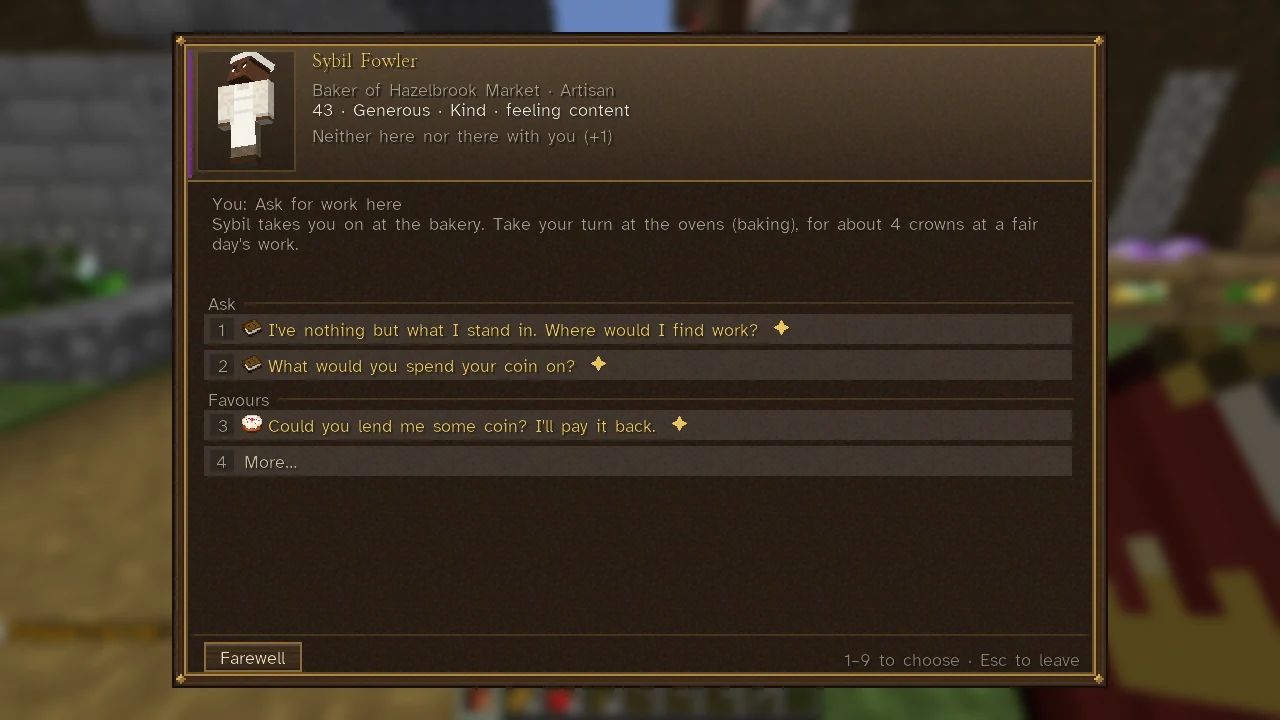
In a town that is not yours, you can work for hire. Talk to a worker at a farm, camp, quarry, mine, fishery, pasture, apiary, bakery, smithy, joinery, masonry, harbour, treasury, market or embassy, and ask for work. Asked in chat where to find work (? where do I find work) while you have none, the Companion names a workplace whose hands would set you a task, the one you stand at first if it would, and shows its way.
Two kinds of work are offered:
- Tasks. The master sets you a task of the trade: bring so many logs, cobblestone, coal, raw iron, wheat, fish, wool, honeycomb, bread, iron ingots, planks or stone bricks to the building's chest, within two days. It is paid from the town's treasury at what the goods are worth when you count them into the chest. The sizes run from small to large; for example, 16, 32 or 48 logs, or 6, 12 or 18 raw iron.
- A knack. Some trades are done as a short round of a game at the building, scored by how well you do it, and paid by that score against a fair mark: bilging at a harbour's pumps, forging at a smithy, reckoning at a treasury, market or embassy, and baking at a bakery. The smithy and bakery need iron or wheat in store, and the work is real: the loaves are baked from the bakery's wheat. A building has only so many turns a day, one for each of its places.
Your standing grows with tasks done: a hand at first, a journeyman after five tasks (bigger tasks and a quarter more pay), and a trusted hand after fifteen (half as much again). A task let lapse lowers your standing and the master's regard. Your Trades page on the You sheet shows where you stand.
A task in hand
While you hold a task, it stays where you look:
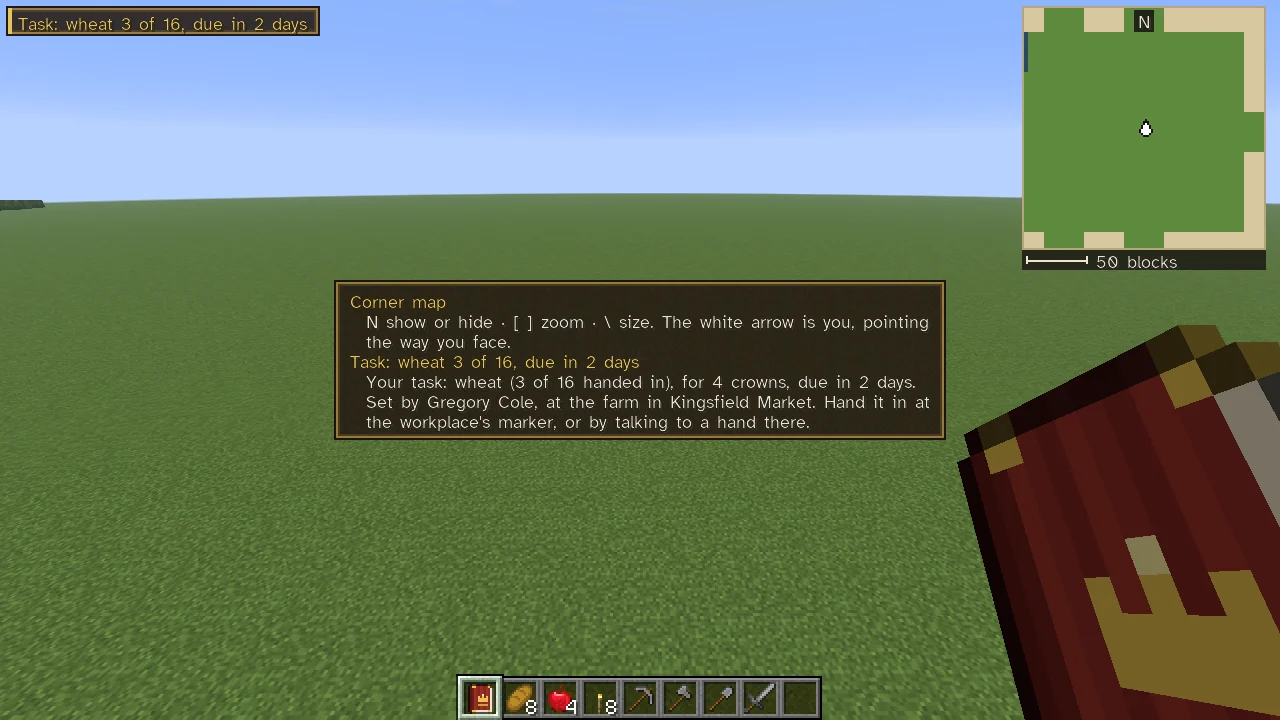
- On the screen. A plaque at the top left says what the task is, how many you have handed in and when it is due: "Task: wheat 3 of 16, due in 2 days", or "Task: a turn at the bakery, due today" for a knack. It turns amber once the task is overdue. Hold
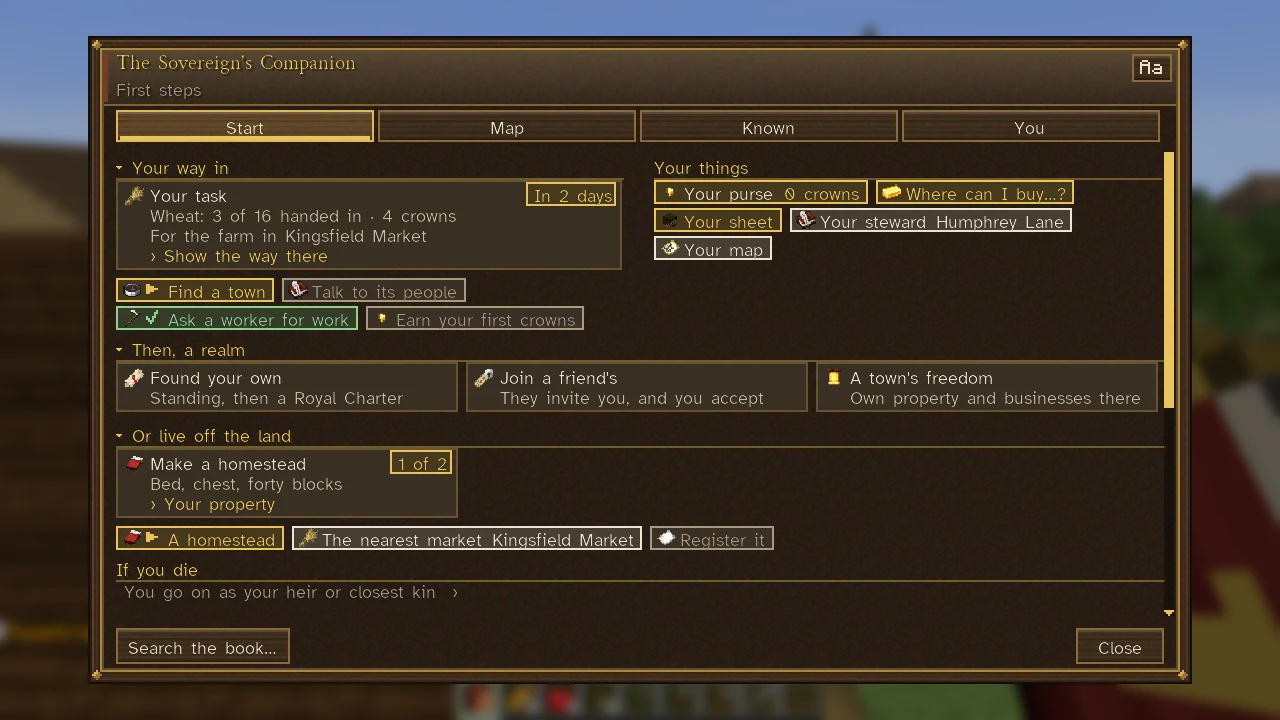
Left Altand it is said in full: the task and its pay, who set it and at which workplace, and that you hand it in (or take your turn) at the workplace's marker or by talking to a hand there. See Controls and Key Bindings. - In the Companion. Its Start tab leads with a Your task card: what and how many handed in, the pay, whose work it is, when it is due on its chip, and Show the way there, which shows the way to the workplace at the top of your screen. See The Sovereign's Companion.
- On your sheet. The Trades page of the You sheet has it on a line, its pay and when it is due on the hover.
All three say when it is due the same way, counting the sky's days from one sunrise to the next, as the master who set it did: a task set "within 2 days" is due in 2 days that day, due tomorrow the next, due today on its last day, and overdue once its time has passed. When the task is all handed in, the plaque and the card go.
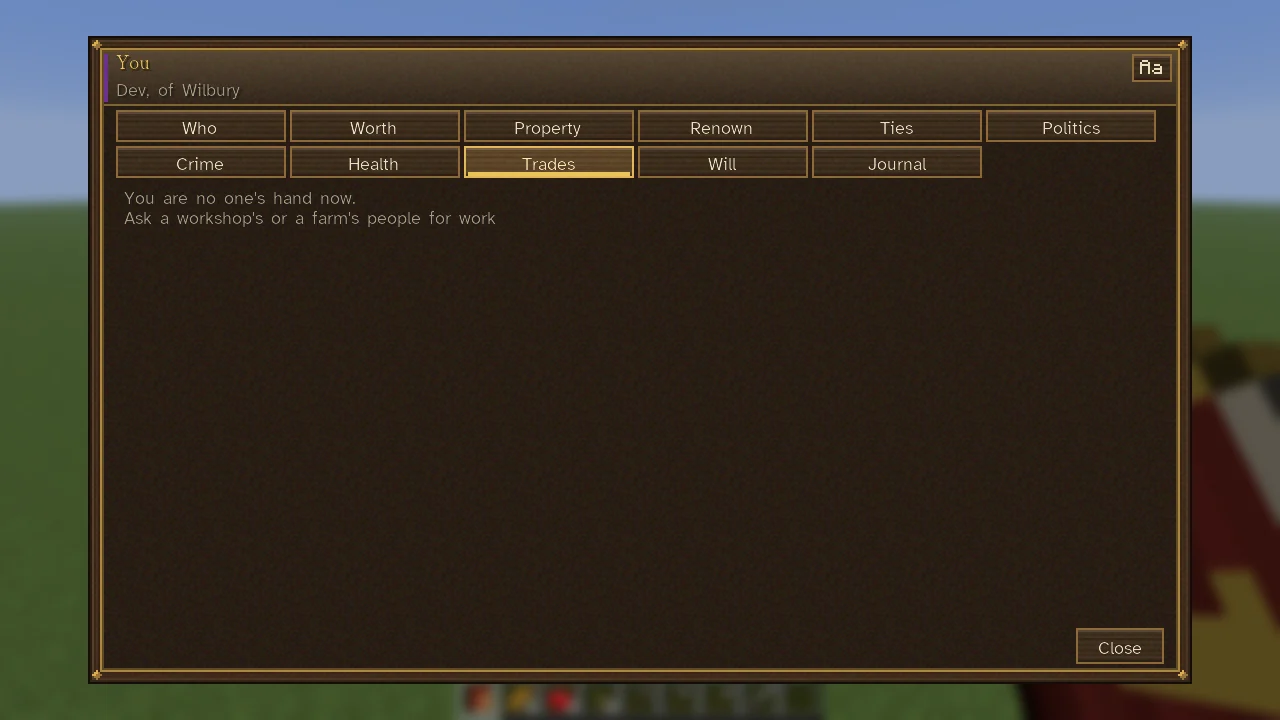
You will be refused if you rule the town (set your people to work instead), if the realm's borders are closed to strangers, if the master thinks ill enough of you, or if there is neither coin to spare nor bread to pay in. A town short of coin pays in bread, as it pays its own. Any town's heart also shows the work it has for hire: goods it wants, paid a quarter over their worth when you bring them, and rewards for murderers, outlaws, escaped prisoners and deserters. When you are first taken on at a building, a steward is appointed to keep your affairs (see Your Steward).
To employ others in a business of your own, or let a manager of the town keep its hands for you, see Businesses and Property. For other ways to make crowns, see Crowns and Nobles and Markets and Trade.