Resources and Scarcity
DiscussFrom the Sovereign Realms Encyclopedia
Resources and scarcity describe the fact that the world's wealth in the ground is not spread evenly. Each land has its own rock, and each kind of rock holds some ores readily and others hardly at all. Most ore lies in deposits: bodies of ore of a particular kind, of a given richness, at certain depths. A realm that has good iron may have no gold; a realm of dry country may have saltpetre and nothing else. What a realm lacks drives much of its dealings with its neighbours.
Provinces: what a land's rock holds
Each land has a province, which says which ores its rock holds most readily, and a richness (barren, poor, common, rich or motherlode) that scales how much. Its deposits are of the ores it holds best.
| Province | What the rock holds |
|---|---|
| Iron hills | Iron and coal in the hills |
| Copper coast | Copper, and clay in the shallows |
| Gold country | Gold in the rock and the rivers, redstone, and nitre crusted in the dry ground |
| Coal basin | Coal seams, and a little iron |
| Old shield | Deep diamonds, lapis and redstone in ancient rock |
| Volcanic | Gold, sulphur, obsidian and hard black stone |
| Barren | Little of anything but nitre in the dry ground |
Outside its deposits a land holds only traces of each ore, thinner or thicker by its province.
The ores and where they lie
Each ore's deposits lie within a band of heights. These are the heights the world is made with:
| Ore | Lies between y |
|---|---|
| Coal | 0 and 190 |
| Iron | -24 and 80 |
| Copper | -16 and 112 |
| Gold | -64 and 32 |
| Redstone | -64 and 16 |
| Lapis | -64 and 64 |
| Diamond | -64 and -16 |
| Emerald | -16 and 256 |
| Sulphur | -40 and 40 |
| Nitre (saltpetre) | 40 and 110 |
Salt is not in the rock. It is made from the sea and gathered at salt marshes on warm coasts, which realms know and covet as they do deposits. See Salt.
Setting the scarcity
When you create a world you choose Scarcity, and Regrowth (how fast fish, clay, river gold and wild woods come back).
| Scarcity | What it means in play |
|---|---|
| Abundant | Ore turns up well beyond the deposits, and they are rich; good soil; what is taken comes back quickly. |
| Balanced | Most ore lies in deposits, a little beyond; soil and regrowth as usual. |
| Scarce | Ore almost only in deposits, and thinner; poorer soil; slow regrowth. What a realm lacks is traded or fought for. |
| Harsh | No ore outside the deposits, and poor ones; poor soil; very slow regrowth. Every deposit is worth a war. |
See Installing Sovereign Realms for the world types.
What a realm needs
A realm counts itself short of a resource when its stores hold less than a set amount and it knows of no deposit within reach of its towns that it works. For iron and coal the amount is what it wants put by and what its towns' workshops are waiting on besides: the iron ingots their orders call for (the soldiers' kit, the workers' tools) and the coal and charcoal their kilns want. The resources a realm cannot do without:
| Need | Why | Amount it wants put by |
|---|---|---|
| Iron | tools and arms | 24 |
| Coal | the forge and the ovens | 32 |
| Gold | the mint (see Crowns and Nobles) | 8 |
| Salt | the tables | 8 |
| Sulphur | powder | 16 |
| Saltpetre | powder | 16 |
Sulphur and saltpetre are wanted only by a realm that knows how to make powder (see Gunpowder). A realm with nitre beds of its own does not count itself short of saltpetre, and a town by the sea is not short of salt, since it may make its own, slowly.
A deposit near its towns answers the lack only while it is worked: a mine sunk in it that its miners can work, or a party of its miners at it. A deposit merely owned gives nothing.
What a short realm does
A realm that lacks something may:
- look for it: send a prospector (see Prospecting and Mining) and its miners to deposits it knows of;
- buy it: from merchants and from abroad. At a harbour of the second rank you may buy any good from abroad at nearly twice its worth, more for iron, salt, saltpetre, sulphur, gold and gems; bought at a market to have at once, an import costs about twice what that market's stalls would ask, and never less than the far markets do (see Harbours, Markets and Trade and Merchants and Supply Trains);
- settle near it: found a town by a deposit that no one holds (see Founding a Realm);
- ask for mining rights: leave to dig a named deposit in another realm's land for ten days, for a fee (see Diplomacy and Envoys);
- demand or take it: the deposits a realm knows of in land another holds are coveted; see War and Peace.
Digging in land another realm holds, without mining rights, is a crime; see Crime and Punishment.
Timber
Timber is not one of the needs above: a town short of wood is answered nearer home. A lumber camp of the world's realms whose woods stand felled out, with nothing growing in them, has them staked anew where standing trees are (Work and Professions). Where a town's stores hold under eight logs' worth, a building site that has waited a day on wood has its builders fell trees near it themselves. A town that lays out its own building counts what such sites wait for as timber it is short of, and lays out another camp (Construction); and a realm whose stores run themselves sends such a town timber from its best-stocked town (Merchants and Supply Trains).
Seeing what runs short
The Command Table's Stores tab is a ruler's ledger of what the realm has and what runs short. It opens on four tiles under At a glance:
| Tile | What it shows |
|---|---|
| Treasury | What the towns' treasuries hold, with how it moved since the morning before and a line of its last mornings |
| Food | How many days of what the realm eats its towns' granaries, warehouses, workshops, stalls and yards hold, on a meter marked at 2 and 7 days; a town no one is near is counted as of its last kept day, and the hover says how many are (see Food, Granaries and Hunger) |
| Wages a day | What the crown pays its people in wages a day at the wages set; its hover sets the treasuries' coin and gold against the wages and the officers' stipends, and how many days they last: amber under five days, red under two |
| Goods short | How many goods run short in the public stores, in red, named on its hover |
Below, each town's public stores (granaries, storehouses, armories and builder's yards) stand under a heading such as "In the public stores at Wilbury Hold" and a line with the town's treasury, opening on what needs a ruler: its short goods first, ten at most, then up to five glutted ones, four weeks' worth and more at the week's use or 640 and more that no one uses ("More than the town uses: one to sell, or to send where it is short", says the hover). A town with eight goods or fewer shows them all. A line counts the rest "by kind below", or says "Nothing short or glutted". The three towns with the most goods short stand open and the others folded. Every other good waits under its kind, Food, Materials, Tools and Arms, each a folded heading with its count: a tile a good, with what the realm's towns hold of it together and, on its hover, which town holds how many. A town's tile has the good's picture, name and count; one used this week also shows how many days of supply are left at the past week's use, after its count and on a meter marked at 2 and 7 days: green from seven days, amber under three. The use is what the town's books record as eaten, laid into buildings, sent away and handed out; what a workshop uses up at its bench is not counted there.
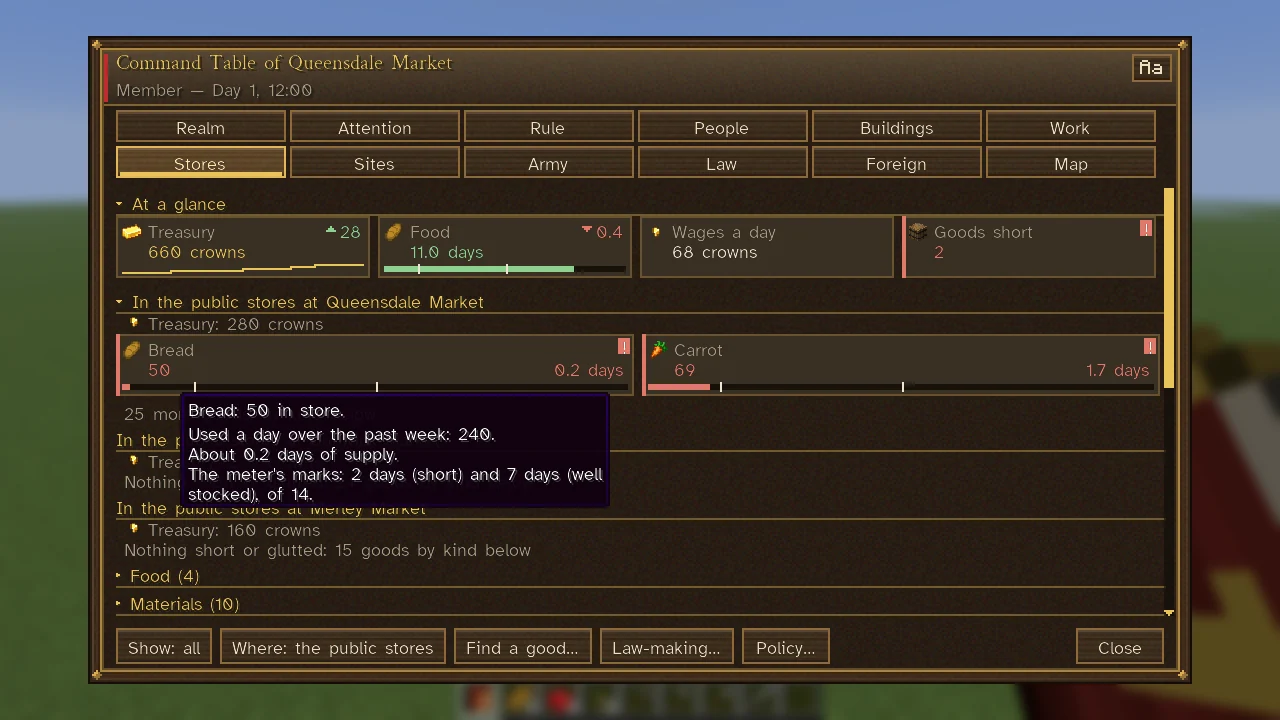
A good is short when it lasts under two days, or when the town's work has asked for it (the orders the Work tab lists as "Wanted"). A short good is drawn in red with a red edge and a mark at its corner, and comes first; a good the work wants and the stores lack entirely has a tile at 0 that reads, for example, "1 wanted". A tile's hover gives the count, what the work wants, the use a day and the days of supply.
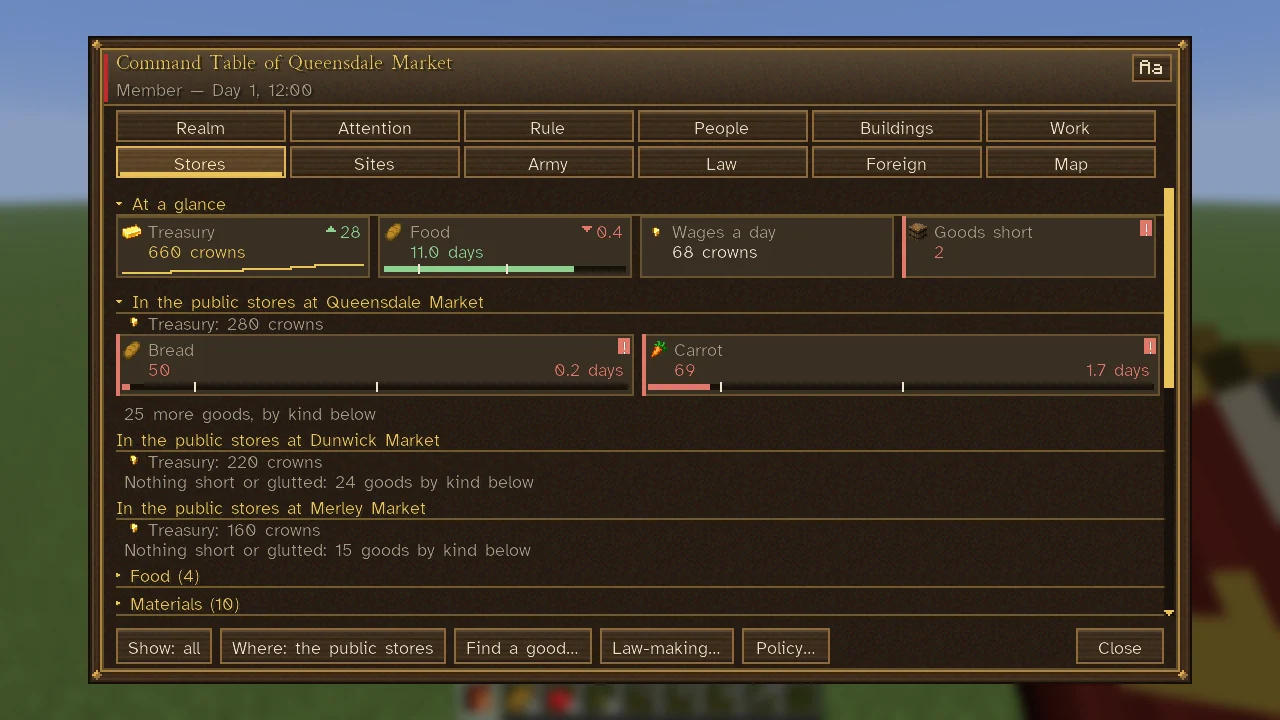
Under the goods, the Which stores chips show the goods elsewhere: the public stores, the workshops, the market's stalls, the households' pantries, the treasury, the barracks, goods on the road, or each store by building, each town's goods there as a grid of tiles. The Which goods chips (All, Food, Materials, Tools, Arms) show one kind alone, each town's goods of it as a grid; the chosen chip is gold, and the same choices are on the Show and Where buttons at the foot. Find a good…, a chip beside them and a button at the foot, lists every good in the public stores by name with where it is held; the good chosen stands first under the tiles, under Found: and its name, a tile for each town that holds it, with Clear the search to put the tab back. Below them come the realm's books for recent days, where its coin is, its debts, its policy and, with more than one town, Send a supply train… to move goods from a town that has them to one that lacks them (see Merchants and Supply Trains); then the policy's settings in five folded groups (see The Command Table).
What it means for you
- Read the ground before you plan a mine or a smithy: strike rock with a Prospector's Pick, or buy a survey of deposits from a merchant for 200 crowns.
- Keep iron, coal and salt in the stores. Smiths, bakers and soldiers all draw on them (see Work and Professions), and the Stores tab marks in red whatever runs short.
- A land poor in one thing is often rich in another: trade the one for the other. See Markets and Trade.
- The Companion's pages cannot tell you where ore lies; your map marks only what you have found. Ask townspeople what they have heard of rich ground; see Talking with People.
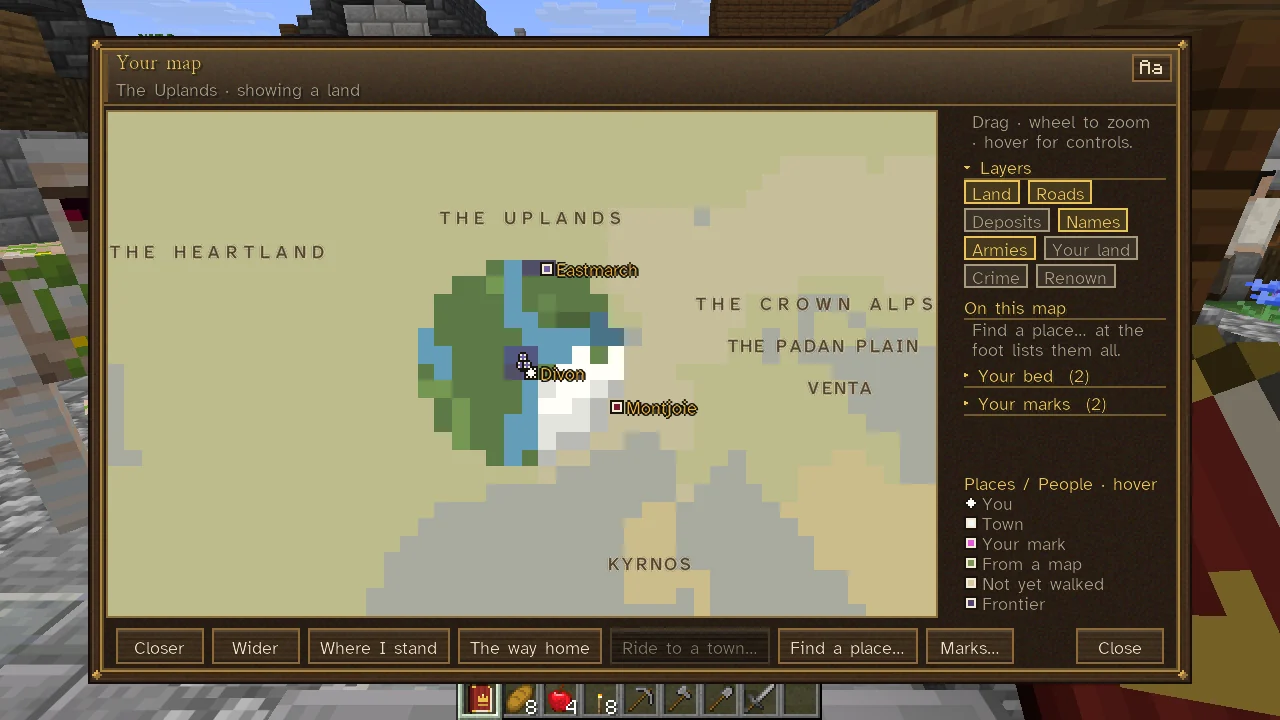
Deposits you have seen signs of can be shown on this map; see Maps, the Corner Map and the Compass.
See also
- The Known World for the lands and their peoples
- Regions of the World for the regions and what their lands hold
- Natural Wonders for rarer sights in the lands