Households and Wages
DiscussFrom the Sovereign Realms Encyclopedia
A household is the people who live in one house: a family and whoever shares its beds. It is the unit that eats, shops and saves. Each household has a pantry, which is the chests and barrels at its home, and a purse for each grown member. Wages go into the purses of the people who work; food comes out of the pantry; and the realm's laws decide how much of each the household keeps. Nothing here is a number on a screen: wages, food and shopping are all real items and real Crowns and Nobles carried from one place to another.
People who are hungry, homeless or lonely grow unhappy, and people miserable for days pack up and leave, household and all. See Townspeople.
How a household is paid
Grown people with work are paid their trade's daily wage, from the treasury or from the till of the business that employs them. Wages are set by the realm: by default a worker earns 2 crowns a day and a soldier 3, up to 8. Details, and who pays the head tax, are in Treasury and Taxes. In a town where someone is near, workers walk to the treasury after work to be paid and to pay their tax; out of sight, the same is reckoned each morning.
Not everyone has wages. A household may live on what its farm brings in (the realm's harvest share lets a farmer's, herder's, fisher's or beekeeper's household draw a share of what they brought, from the granary each morning), on what a craftsman keeps of their work (the makers' share), or on selling what they make at a market bell. See Work and Professions and Markets and Trade.
How a household is fed
With the Stores tab's Policy… button (the Food law), a realm chooses one of three ways its people are fed:
| Law | What it means |
|---|---|
| Common granary | Food is shared from the common stores under the ration law. |
| Bread for coin | Households pay for food at the granary, bakeries and markets with their wages, and the poor are given relief. Their own pantry is used first. |
| Free market | Households buy at farms and stalls, and the granary sells only what lies above the town's reserve. |
The world's realms turn to bread for coin once they have a dozen grown people and a bakery or a market in one of their towns, and raise wages to at least 4 crowns for workers and 5 for soldiers when they do.
Rations are a separate law: none, half rations (a bread-equivalent a day to each home) or full rations (a full day's food), delivered by porters from the granary. A ration priority law chooses whose homes are kept first when the granary runs low: everyone alike, soldiers first, or children first. A food due asks every household for a number of loaves from its pantry every seventh day, never taking its last two days' food; what it cannot give is asked again at the next due. See Food, Granaries and Hunger.
Where food is bought, the household's shopper buys when the family's food drops below two days, aiming for up to a week, using coin from the shopper's purse and the home. A household that cannot buy its bread draws relief if the realm allows it: the crown's relief from the granary at the treasury's cost, the temple's alms, or none, in which case hunger, debt and unrest follow.
A town's sheet counts the households that cannot buy a day's bread under "How it fares".
What a household buys
Beyond food, a household buys what it needs, in this order, each at a shop or stall in its town. What it wants depends on its standing, which follows its trade and its savings.
| Standing | Set by | Added to its basket |
|---|---|---|
| Peasant | Farmers, herders, fishers, and those without work | Food, salt, hearth fuel (coal, charcoal or logs) |
| Labourer | Most other trades | Clothes (wool or leather), and tools for their trade |
| Artisan | Bakers, cooks, smiths, carpenters, masons, healers, priests, and any household with 150 crowns or more | Meat or fish, a light for the house (candles or a lantern), something for the home |
| Owner | Merchants, treasurers, envoys and stewards, business owners, and households with 500 crowns or more | Fine food, a book, something for the house, imported goods |
| Gentry | Holders of high rank | The same, with more imports |
A household also keeps coin back. Each standing sets aside a share of its coin when it shops (peasant 5%, labourer 10%, artisan 20%, owner 40%, gentry 45%), and its comforts are bought only from coin above a nest egg (5, 10, 30, 80 and 150 crowns in that order). Necessities (food, salt, fuel, clothes and tools) are bought whatever its nest egg. Meals come first and may use savings if they must. Buying also needs an open market and stock on a stall.
Imported goods such as cocoa, sugar and fine dyes arrive by sea; see Merchants and Supply Trains.
Reading a household's accounts
If you hold the right to manage the realm's economy, its people or its law (or command its army, for a soldier's household), a person's sheet has a Household accounts link. It shows:
- This week: crowns spent on food and household goods in the last seven days, and any relief received (in loaves' worth).
- Money and home: coin carried in purses and coin kept at home, with a link to the home.
- Food: days of food at home and carried by the family, the realm's food law, and the money available to the shopper.
- Next household purchases: the saving preference and the next four needs due.
Mere membership of a realm does not open these accounts. A realm that wants households to afford more can raise wages, lower the head tax, or set the food law to relief and rations.
Households on the Command Table
A ruler sees the realm's households from several tabs of the Command Table:
- Stores: the Wages a day tile gives what the crown pays its people in wages a day at the wages set; its hover sets the treasuries' coin and gold against those wages and the officers' stipends, and says how many days they last. It turns amber under five days and red under two. The Which stores chip Households' pantries shows what the pantries of each town hold, a tile a good. Lower down, Debts lists who owes back taxes or food dues, the most first (the first eight each opening their sheet), and the harvest shares households have not yet drawn from the granaries.
- Work: under each town, the houses whose pantries hold less than a day's food for their residents.
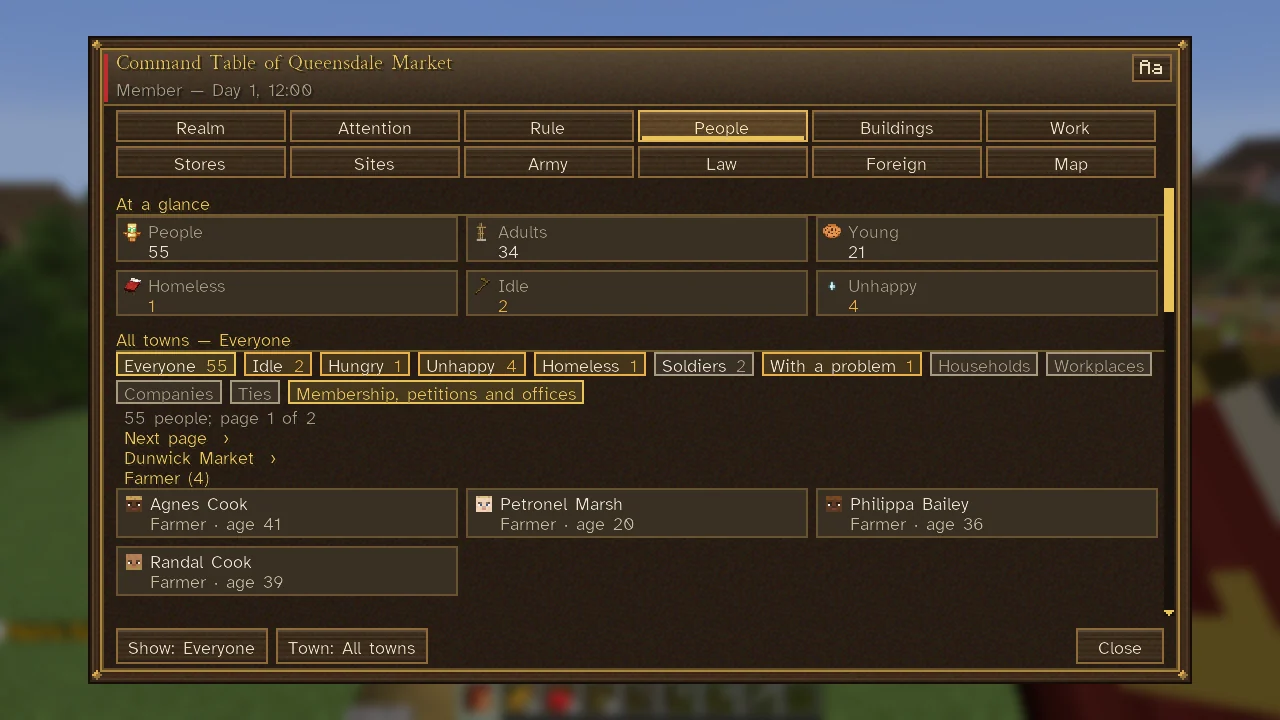
- People: the Households chip lists each town's people grouped by the house they share.
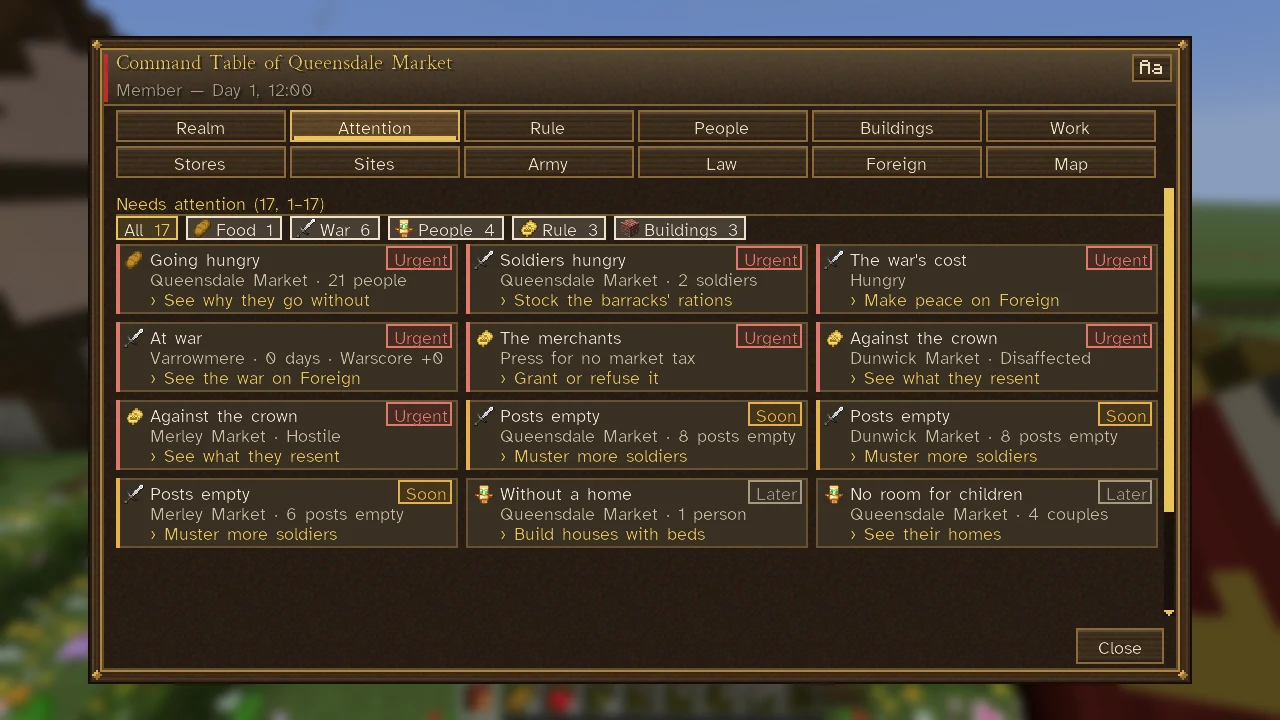
- Attention: cards for households in trouble, such as Without a home ("Build houses with beds"), No room for children (couples putting off children for want of room, food or safety; "See their homes", which opens the People tab by household) and Deep in debt (three or more people owing the realm 5 crowns or more; "Ease their dues on Stores", where the head tax, dues in goods and each debt are; an amnesty is a decree on the Rule tab).
Rent
A household that lives in a house of the crown's pays rent each week: the realm's rent per bed, which falls on the grown members. A household behind with the rent grows unhappy. A household with a bed to spare may let it to you; see Lodging. Houses that people own, and the hearth tax, are in Land, Estates and Landlords and Businesses and Property.