Wanted and Bounties
DiscussFrom the Sovereign Realms Encyclopedia
Wanted is how hard a realm's law is after someone. It is shown as stars, from none to five, and it is kept per realm: you can be at five stars in one realm and unknown in the next. A realm's allies, its overlord and its vassals may keep its warrants, and then their watch acts on them as its own would (below). The stars apply to players and to the world's people alike. A realm's own bounty is the reward it posts for bringing a wanted player in.
What each star means
| Stars | What the realm does |
|---|---|
| 1 | The watch eyes you and a guard tells you to move along. You owe fines or a debt but are not on the arrest list. |
| 2 | You are stopped on sight. Townsfolk who know you for wanted back away and send for the watch. A town's golems take you on only for a grave charge, or once you have fought or run from its watch. |
| 3 | The alarm goes up wherever you are seen, and the soldiers about come. A bounty is posted if the realm's treasuries can pay it. |
| 4 | The whole realm is told, bounty hunters are sent after you, and the watch comes armed with no parley. |
| 5 | The realm's army makes you its first target: a company is marched to where you were last seen. Under a harsh code, the arrest ends at the gallows. |
The stars are read from your record in that realm, not from a single event:
- Five for treason or being declared an outlaw, two or more murders, or an escape from custody after a killing.
- Four for a murder, an escape from custody (running from your sentence among them), fines of 150 crowns or more, or three or more grave charges.
- Three for someone on the arrest list with a grave violent charge, or fines of 60 crowns or more.
- Two for any other record that puts you on the arrest list.
- One for fines or a debt that does not.
On top of that, infamy and heat raise it: an infamous player (a name known for deeds the realm despises), or someone whose business with a criminal organisation has made them hot, is hunted a star harder (see The Underworld).
The watch must know who you are. It knows you by name if you are famous, suspected, or plainly as described; a mask hides your name, not your clothes, and a guard who comes near a wanted one in a mask lifts it. See Stealth and Thievery.
Warrants kept by other realms
A realm keeps another's warrants when the two are allied, or one is the other's overlord or vassal, they are not at war, and it thinks no ill of the other (its regard for it is not below nothing). A realm that is merely at peace or trading with the one that wants you keeps none of its warrants. See Diplomacy and Envoys.
In the lands of a realm that keeps the warrant, its watch, soldiers, golems and townsfolk act on it as the wanting realm's own would:
- At two or three stars a guard stops you on sight, with the usual choices (see Arrest and Jail). At three the alarm goes up where you are seen.
- At four or five stars, or if you have lately fought or run from the wanting realm's watch, or it has outlawed you, they come armed on sight: soldiers, the hue and cry, pursuers and golems.
- Beaten down and bound, you are taken under the wanting realm's law: taken to its own cell where that is within 160 blocks, or nearer than the keeping realm's; otherwise held in the keeping realm's own nearest jail on the wanting realm's account (and handed back however far only where the keeping realm has no cell). Handed back, you are told "The watch of" the keeping realm "hands you back to" the wanting one, and both realms' chronicles record it.
- One custody answers every warrant that watch keeps against you. Each other warrant it keeps adds its sentence, and its fines as time, to the time you serve, and is answered and cleared with it ("Zwinhaven's warrant is answered with it."). The choice of sentence goes by the gravest single warrant, never by stars or days summed across them: a killing in any one of them rules out exile, and another warrant sends you to the gallows only if it alone would under its own realm's law.
- A watch that knows you for wanted on a warrant it keeps stops you or takes you; it does not search your pack instead, and a search that finds nothing does not let you off the warrant.
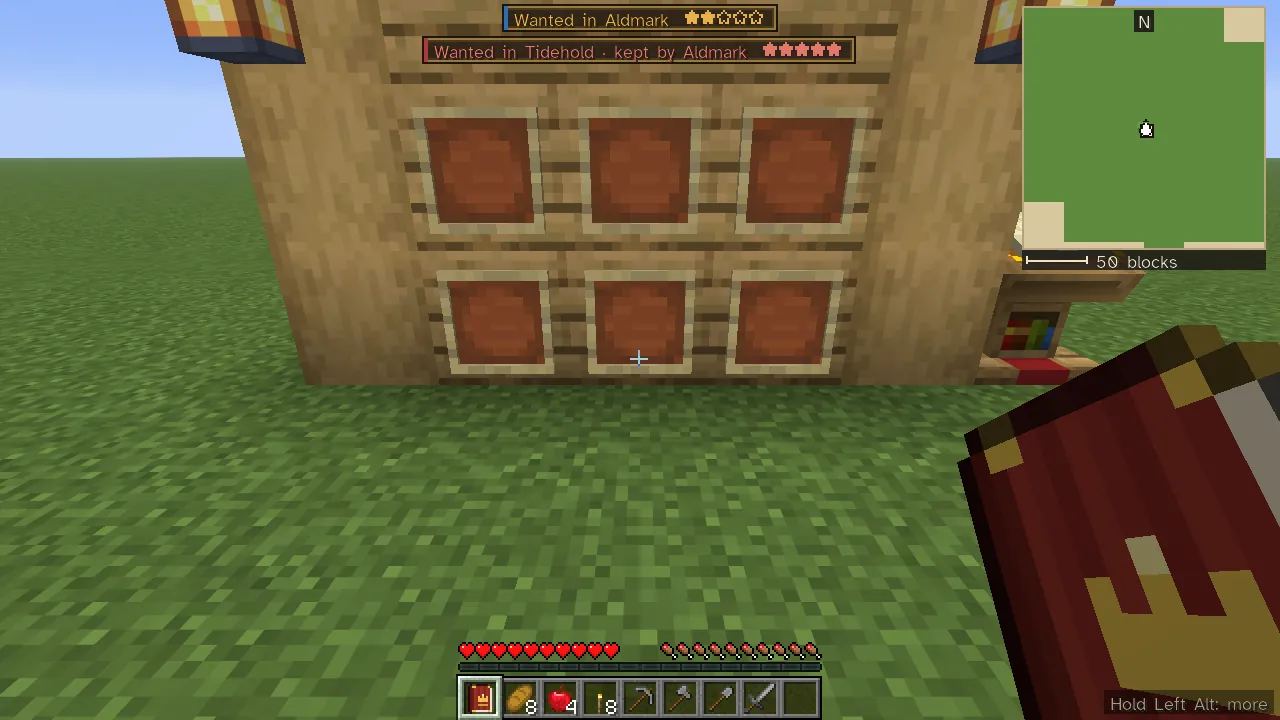
- Its people bar their doors against you ("… has barred the door against you: Aldmark keeps Tidehold's warrants."), its market will not deal with you, and its townsfolk who know you back away and send for the watch.
A coach will not carry you there either (see Fast Travel).
When the keeping ends
Whether a realm keeps another's warrants is asked afresh each time, never remembered. When their alliance or fealty ends, they go to war (an overlord and its own vassal too), the keeper comes to think ill of the other, or either realm is no more, the keeper's watch, golems, coach offices and townsfolk stop acting on the other's warrants at once, and its "kept by" line leaves the top of your screen:
- A guard stopping you on that warrant, or on the way to stop you, gives it up; a stop's conversation closes on the reason. A stop you have resisted is the keeper's own charge now, and goes on.
- Held in the keeper's jail on the other realm's account, you are let out: "Aldmark no longer keeps Lucerna's warrants: you are free, but the time you did not serve is owed to Lucerna." The days not served become a debt to the wanting realm, ten crowns a day. One taken in war owes nothing.
- You are told once, over the hotbar and in a row of chat with the reason on its hover: "Aldmark no longer keeps Lucerna's warrants", or, where each kept the other's, "Aldmark and Lucerna no longer keep each other's warrants". The wanting realm still wants you in its own lands.
- When a realm that wants you is no more, its warrants are void, and you are told so: "The realm of Lucerna is no more: its warrants on you are void". A realm that is no more keeps no warrant, its own or another's: none of its guards or golems left about acts on one.
The keeper's own warrants are untouched.
Seeing the stars
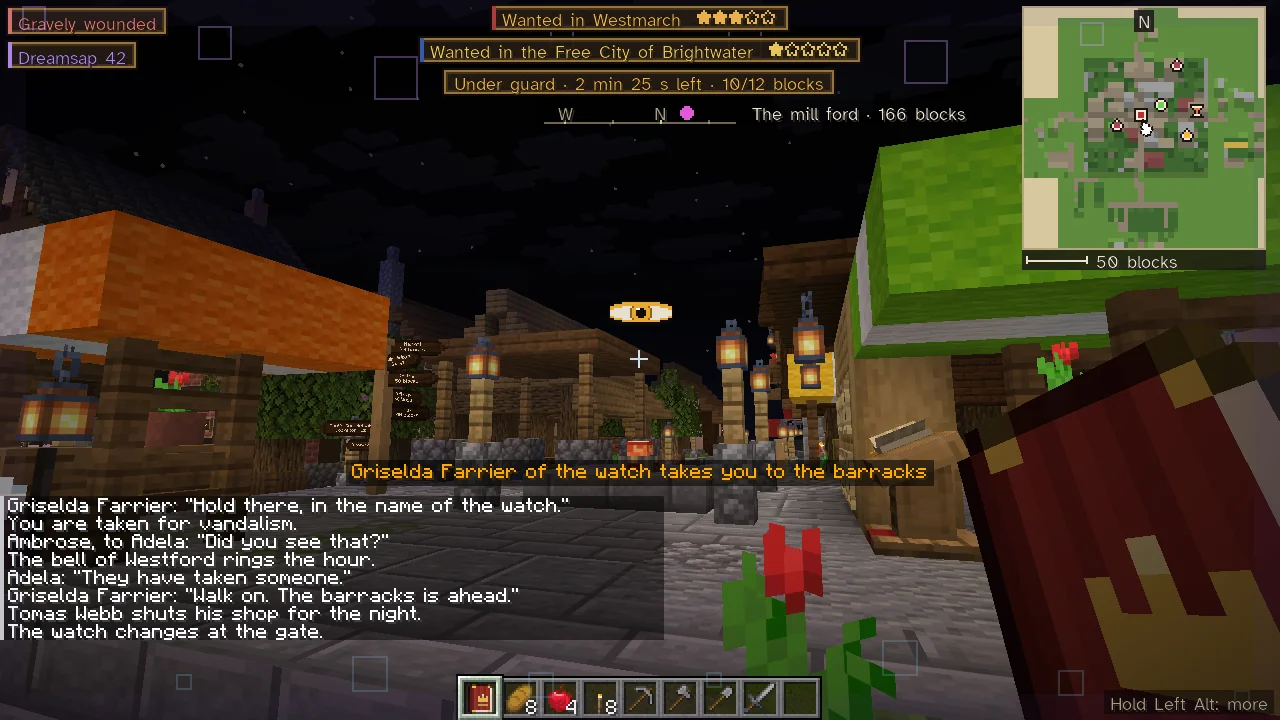
- Stars show at the top centre of your screen, under any boss bar: a short line for each realm whose warrant runs where you stand (up to four), such as "Wanted in Westmarch ★★★☆☆", with the realm's colour at its left edge and the words gold at one star, amber at two or three and red at four or five. In a realm's lands its own line comes first, then the warrants it keeps by treaty, each marked with who keeps it ("Wanted in Tidehold · kept by Aldmark"), the most stars first; a warrant the realm does not keep has no line there, and is on the Crime page. Out in the wild, no realm's land, every realm that wants you has its line, the most stars first. Where a realm's name is too long for the room, the stars come first and the name is cut short. While you are held, your custody's line stands under them (see Arrest and Jail).
- They are also on your sheet's Crime page: press J, or type
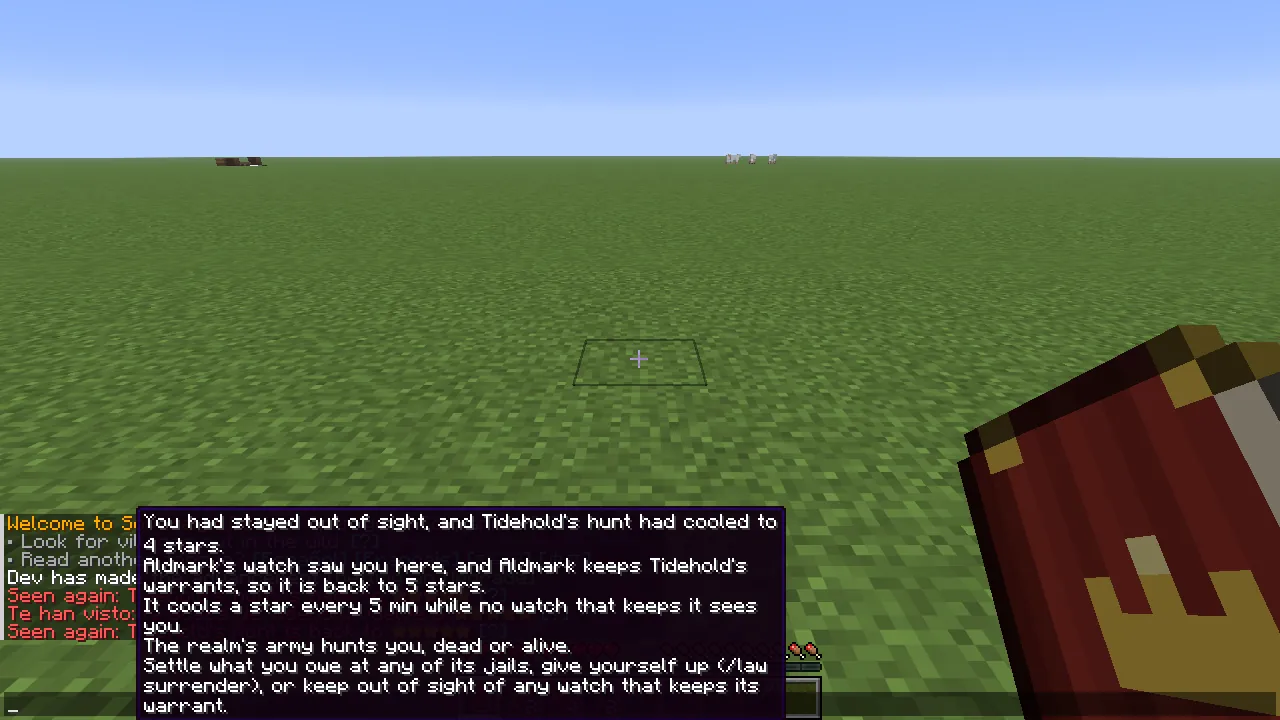
/you crime. The page opens on cards (where you are wanted, the fines you owe, the price on your head, your debts and any rewards owed you), then lists each realm with anything against you: its stars, your charges and fines, the price on your head and your infamy there. - When a realm's wanted level on you rises, the realm and its stars show over the hotbar (Wanted in Aldmark: ★★☆☆☆), and one row of chat says what you did, where and who saw it, then the stars it comes to: Theft at Westford market: seen by Wenna Smith · ★. Stars put on you for running are told as Ran from the watch of the realm. A hunt that had cooled and is brought back when a watch sees you, with nothing new done, is told as Seen again: Tidehold's hunt is back to its stars; its hover says what it had cooled to, whose watch saw you (the realm's own, or one that keeps its warrants), and how fast it cools. The row's
[?]holds on hover what you did, whether it is grave or petty under the realm's law code, what you owe, what the stars mean and how to be rid of them; a click on the row opens the Crime page. When the stars cool, the line over the hotbar and in the chat says so ("(cooling)"), with a [Your crimes] button. - Hold Left Alt and each realm's line at the top of the screen is set out in full: what its stars mean, who keeps its warrant where you stand ("Aldmark keeps Tidehold's warrants by treaty."), any running from its watch, the crimes behind the stars (up to three, the latest first, the rest counted) and when a star cools, or what ends it. See Crime and Punishment.
/finelists what you owe, realm by realm, with a button to pay each.

The Crime layer of your map
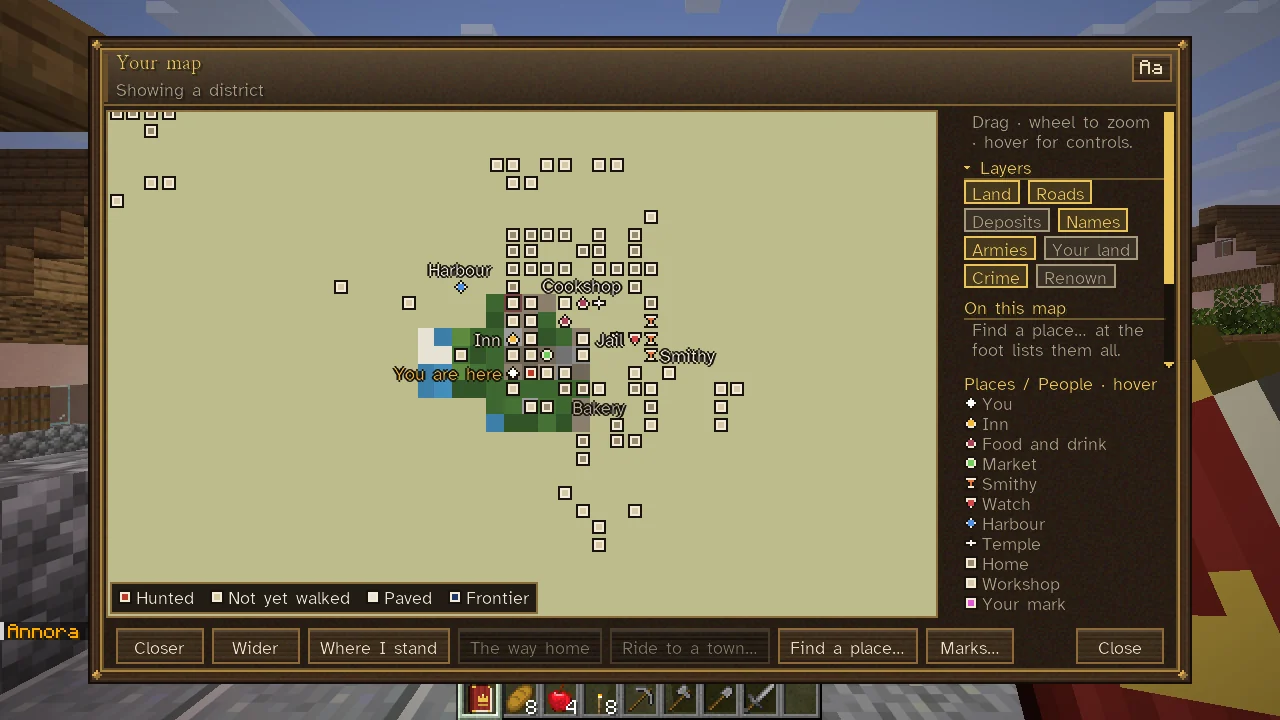
Your map has a Crime layer: turn it on with the Crime chip among the map's layers, or with On your map on the Crime page (its Open your map opens the map). See Maps, the Corner Map and the Compass.
- Towns that want you keep their own pins, in the colour of the danger, which the map's key names in a word: Hunted (three stars or more, or outlawed), Wanted (fewer stars, or a price on your head), Charged (charges or a debt but no hunt) and Notorious (nothing but your ill name there). Where the town's name is lettered your stars follow it. Its hover gives the realm's row from the Crime page, what the stars mean, and the price on your head.
- Your deeds of the past week are each an X where you did them, named "Your crime" in the key. Its hover says what it was and what came of it (charged, no proof, masked so no one could say who, and the like); for one no one has pinned on you, that only you know it was you, or that the watch is asking who did it.
- At the scale of a region and wider, each realm's land is also washed in its danger's colour. On the streets and in a district the land keeps its own colours, so the town stays readable.
Cooling and clearing
Out of sight of the realm's watch, and of any watch that keeps its warrant, the stars cool, slowly: one star for each six hours of the world's clock unseen (five minutes of play at the usual pace). They never cool below two for someone the realm would arrest, and never below four for an outlaw or a traitor. At one or two stars there is nothing to cool, so you stay at that level until you clear your record.
To clear it:
- Pay. Settle your fines at one of the realm's jails (Settle fines on its sheet), at a stop, from anywhere with the Crime page's Pay … fines button, or with
/fine pay. Grave charges cost double. Murder, treason, outlawry and escape from custody are not paid off with coin. - Answer for it. Serve, go into exile, accept the Nether rite or choose the gallows and wait for the hangman (see Arrest and Jail).
- Be pardoned. A realm's magistrate may pardon you from the law book.
A wanted player cannot take the freedom of a realm that wants them (see Citizenship and Ranks), and a realm will not grant a letter of marque to someone it wants (see Naval Warfare).
Outlaws
A magistrate can declare an outlaw someone already charged: every guard of the realm then wants them for arrest. A realm may also outlaw a band of the wilds that has robbed it, with a reward on each head. Someone who breaks out of custody a second time (a run from the choice of sentence counts) becomes an outlaw in that realm, dead or alive, and killing an outlaw there is no murder. A declared outlaw of the world's people may be posted on a guild board of the realm, dead or alive, for the realm's reward: brought to its cells, or their skull brought to the board, paid there and not a second time (see Adventurers' Guild). Deserters and others wanted by the law who flee for good may join the outlaw bands (see Outlaws and Raiders).
Bounties
The world's realms post a reward on a player they want at three stars or more, while their treasuries can pay it. The reward is not paid out of nowhere: it comes from the realm's real treasury.
Taking a contract
- Go to a Town Heart of a realm that has posted one and open its sheet. Under Bounties it lists who is wanted, what they look like when last seen, the reward, and whether others have taken the contract.
- Choose Take a contract... while standing at the heart. The contract stands for a week for you. The hunted player hears that someone has taken it, but not who.
- Find the quarry and bring them down (see Down, Not Dead). Fighting the wanted is no crime in that realm. Killing them is murder, unless the realm has outlawed them, when the reward is owed for the body.
- Bind them (their sheet when downed offers Bind them) and carry them to the realm's law: a free cell of its jail, one of its watch, or its magistrate.
- Hand them over there. The reward is paid in real coin from the realm's treasuries. What a treasury cannot pay is owed to you, to be claimed at any of its Town Hearts.
The reward
The reward is the fines on the quarry's record (at least 20 crowns), raised by half at four stars and doubled at five, and raised a little more by the quarry's infamy. It is always between 20 and 250 crowns. For the killer of a realm's sovereign the realm posts a larger reward, up to four times that ceiling, as far as its treasuries hold.
What is not paid
No one farms coin with it:
- Nothing is paid for one of your own crew or house, or for someone you have been seen with about a town for a while (a pair who stand together are known for companions).
- Nothing is paid for crimes of your own making: a wrong done to you, or a charge laid on your word.
- The same hunter is paid for the same quarry once a month at most, and a realm posts on someone again only a week after it last paid.
The world's own bounty hunters, sent at four stars, hunt for a day and then go home. Whether they are sent at all is a server setting.
Rewards for the world's wanted
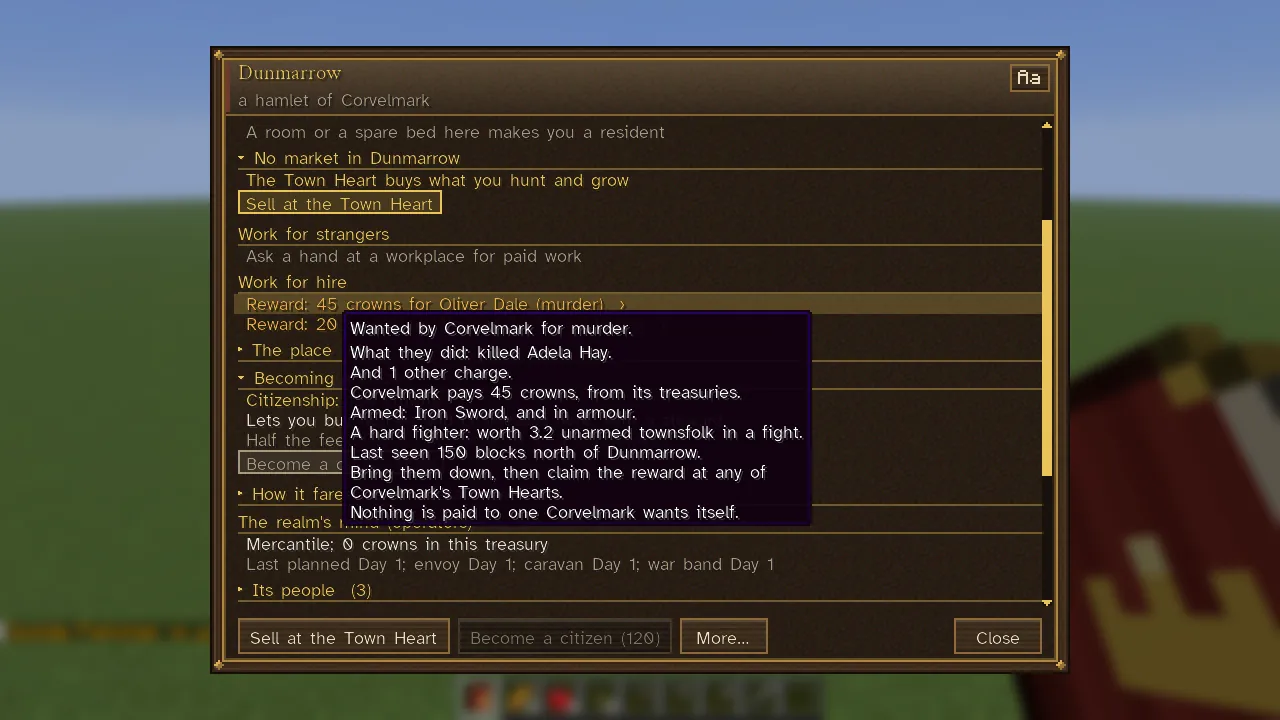
A realm also pays to see the world's people it wants for a grave crime brought down. A town's sheet lists them under Work for hire, the dearest first, a line each for four and the rest on one line (And 3 more wanted, their names and rewards on its hover): Reward: 500 crowns for Piers Dale (murder). Only those alive and at large are listed, never one in a cell or in the watch's hands, and never a player: a wanted player is hunted by contract, as above. The line's hover tells:
- What they did: the realm and the gravest charge (Wanted by Westmarch for murder.), what was done, and how many other charges stand.
- Who pays: the realm, and how much, from its treasuries.
- How dangerous: what they carry in hand and whether they wear armour, a word for the fighter (No great fighter, A fair fighter, A hard fighter or A deadly fighter) with their worth in a fight counted in unarmed townsfolk, and their band if they have one (its captain, or one of it, and how strong it is).
- Where they keep: the band's camp, or where they were last seen, on a road if they were on one, by the nearest town and a bearing (Last seen on the road to Ashby, 120 blocks north of Harrowgate.), or Where they keep is not known.
- How to claim it: bring them down, then claim the reward at any of the realm's Town Hearts. Nothing is paid to one the realm wants itself, and where the Adventurers' Guild has a notice on them too, whoever holds it is paid at the board instead.
A click on the line opens their sheet, which tells each realm's reward for them the same way (Wanted by Westmarch: a reward of 120 crowns). Bringing one down is told as fair dealing (see Renown and Following).
See also
Crime and Punishment, Arrest and Jail, The Watch and Watchtowers, Renown and Following, Magistrates and Codes of Law.