Crime and Punishment
DiscussFrom the Sovereign Realms Encyclopedia
Crime in Sovereign Realms is something a realm's law charges you with when someone of that realm sees you do it, or when the watch later finds the proof. The law is the same for players and for the world's Townspeople: a baker who steals is charged as you would be. Each realm keeps its own record against each person, its own law code, and its own jails.
The short rule from the Companion is that taking from a realm's stores without leave, breaking its buildings, lingering in its treasury or barracks after a warning, and striking or killing its people are crimes, but only if someone sees. Witnesses remember, and tell.
Who counts as a witness
A crime is charged at once when someone of the realm sees it. The people who can bear witness are the realm's townspeople, its watch, sentries on towers, golems at their posts, and players of the realm (who are told what they saw and may report it with /law report).
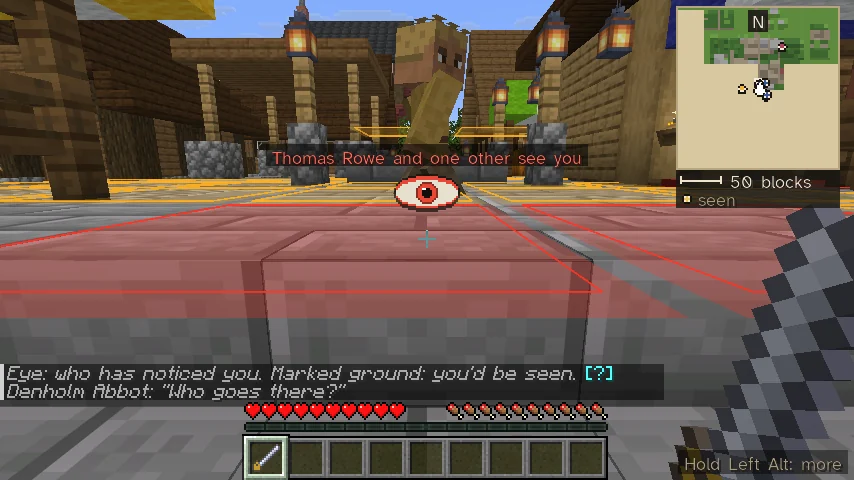
- Townspeople see what is in front of them. The watch keep a wider eye, but not behind them. A sentry on a tower sees all about.
- Darkness, creeping and being unknown help a thief; light, closeness and being known do not. The details are in Stealth and Thievery.
- A mask hides your name, not your deed. Someone who sees a masked crime remembers that it was done and may describe what they saw, but cannot say who it was. A guard who comes within a few blocks of a masked offender sees through it.
- A realm's magistrate may ask for proof: two witnesses, or one of the watch or a member of the realm, before a petty crime is charged. A single townsman's word then lays no charge, though they remember it. Grave crimes need only one witness.
- A loud crime (a crash, a cry, a break-in) is heard through walls and carries to people who did not see it.
A crime nobody saw is not forgotten. The watch can find it later: stolen goods marked on you, a witness who knows you again, or a fence who names you can bring the charge days afterwards. The scene is logged in the law book as a trouble spot, and a magistrate can send the watch to patrol where crimes keep happening.
What counts as a crime
The game keeps a customary fine and a customary sentence for each crime, counted in days. A grave crime is one the guards arrest for. The other, petty crimes earn a fine, and only become grounds for arrest when the fines pile up past a limit the magistrate sets.
| Crime | Customary fine (crowns) | Sentence (days) | Grave |
|---|---|---|---|
| Trespass (entering a restricted building) | 2 | 0 | No |
| Theft from the realm's stores | 5 | 1 | No |
| Vandalism | 4 | 1 | No |
| Unlawful mining | 6 | 1 | No |
| Contraband (carrying what the realm forbids) | 4 | 0 | No |
| Burglary (a lodger's room or a householder's chest) | 12 | 2 | No |
| Receiving stolen goods | 8 | 1 | No |
| Smuggling | 10 | 1 | No |
| Forgery | 15 | 2 | No |
| Bribery | 10 | 1 | No |
| Menaces (threats) | 8 | 1 | No |
| Poaching, animal theft, letting beasts loose | 4, 6, 3 | 1, 1, 0 | No |
| Assault | 10 | 2 | Yes |
| Resisting arrest | 10 | 2 | Yes |
| Assaulting a guard | 20 | 3 | Yes |
| Horse theft | 20 | 3 | Yes |
| Arson | 30 | 4 | Yes |
| Sabotage | 25 | 3 | Yes |
| Espionage | 25 | 3 | Yes |
| Desertion | 20 | 3 | Yes |
| Escape from custody (out of a cell, away from an escort or a house arrest, or a run from your sentence) | 15 | 3 | Yes |
| Piracy (taking or sinking ships with no letter of marque) | 30 | 5 | Yes |
| Counterfeiting | 40 | 5 | Yes |
| Murder | 40 | 5 | Yes |
| Conspiracy to murder | 50 | 6 | Yes |
| Treason (striking at a Town Heart outside war) | 100 | 10 | Yes |
There are more minor charges: nuisance (leaving things in the town's way), vagrancy and drunkenness where the realm bans them, adultery where the realm treats it as a crime, and others. A realm's magistrate may rule on most of the middling crimes (see Magistrates and Codes of Law): grave, never grave, as the law code has it, or no crime at all in that realm. Where a realm forbids every faith but its own, preaching another (and keeping one, before its inquisitor) is heresy, fined 6 crowns and a day by custom and grave under a harsh law code (see Religion).
For a theft, a poaching or a beast taken, the worth of what was taken is added to the customary fine.
- Poaching. Whether taking game in a realm's land is a crime is its game law: open to all, licensed (its own people hunt freely, others need a licence) or the crown's forest, where 20 crowns are added to a poacher's customary fine. It holds in the realm's claimed land outside its towns; the frontier and the wild are free. See Hunting and Game Laws.
- A town's fields. Trampling the crops of a town's field is a crime unless you are of its realm. The first time in a day you are only told to keep to the paths; trample its fields again that day and it is vandalism. Reaping a town's crops is theft, and what falls from them is still the realm's: anyone else who takes it up from the ground is charged with theft.
- Homesteads. Taking from a homestead's stores is theft from its holder, judged by the realm that protects it for a tithe, wherever that protection holds; else by the realm whose land reaches it most strongly, else by the holder's own realm; where none does, no law judges it and the loss is the holder's. A beast tamed or bred on a homestead the realm recognises is its holder's: killing it is poaching, leading it off is theft. See Homesteads.
- A house at night. Someone not of the realm found at night in a house of its town that is not let to them is told to leave by the first of the town who sees them, and charged with trespass only if they are still there a little later. One asleep in a bed that is not theirs is first woken by whoever finds them, the household first, and then told the same; sleeping there sets no respawn and moves no one. See Lodging and The Watch and Watchtowers.
Warned before a slip
Some deeds the law counts as crimes are easy to do without meaning to, so the first time the game stops you and says what it would be. A crime is then a choice:
- A stall's barrel. Used standing, a market stall's barrel opens the market's counter. Crouched, your hand goes into the barrel itself, the keeper's own store, and what you take from it is theft. The first crouched reach is stayed and a yellow line says so: "That barrel is the stall's own store: reach in again and what you take is theft." Its hover names the realm's law and says that the goods for sale are at the counter. Crouch and use it again within a minute and you reach in; you are not asked again at that market that day. The keepers of the stall, and those of the realm who may use its stores, are not stopped. See Markets and Trade.
- A caravan's packs. A caravan's pack beast come to market carries its realm's goods, not goods for sale. The first crouched hand on its packs is stayed the same way ("Those packs are" the realm's "goods: open them again and what you take is theft."), and only one made again within a minute opens them.
- A light blow. A punch or a blow as light, struck at one of a realm's townspeople by someone that realm holds nothing against, is let pass the first time in a day: the one struck steps back, and you are told "Strike again and it is assault." Its hover says whether assault is grave or petty under that realm's law code, and so whether the watch would take you or fine you. Strike one of its people again that day and it is assault. A weapon's blow, a blow at one of its watch, and any blow from someone the realm already has stars against are struck at once.
Trampling a town's crops is told the same way (above), and a restricted room is warned of before it is charged.
Law codes
Each realm's law code is Lenient, Customary or Harsh, set by its magistrate. The law code changes how hard every charge falls. Those who govern see the realm's laws on the Command Table's Law tab, each as a card with its setting, and the other settings as chips that say what choosing them would cost and gain (see Magistrates and Codes of Law).
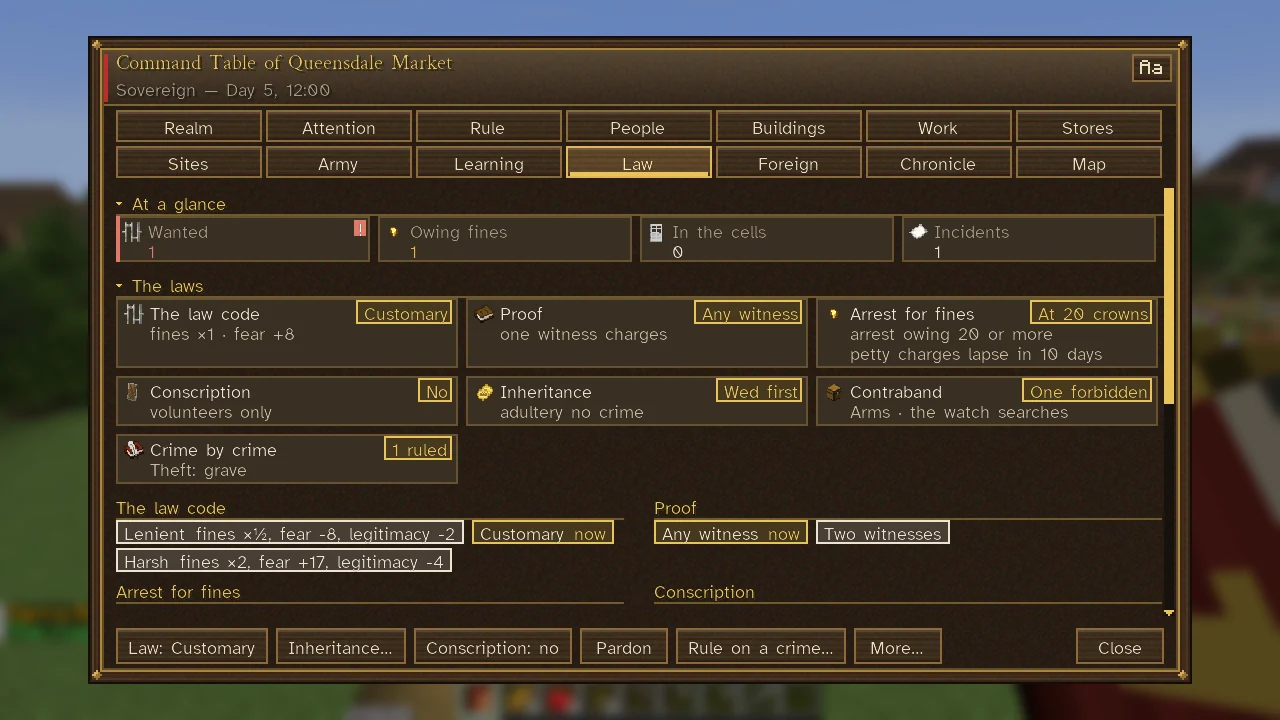
| Code | Fines | Sentences | Grave crimes |
|---|---|---|---|
| Lenient | Half | A day less | As above; property crimes are not made grave |
| Customary | As above | As above | As above |
| Harsh | Double | A day more | Theft and vandalism are grave too, so thieves are arrested; the gravest are hanged |
A lenient code also makes the realm's people fear the law less, and a harsh one more.
The realm's people shade its law code with their own custom. Sunland realms reckon fines a quarter dearer, Verdant realms a quarter cheaper, and some peoples hold particular lesser crimes grave: the Northfolk count assaulting a guard, poaching and animal theft; the Sunlanders count smuggling and forgery; the Verdant count poaching; the Marchers count animal theft and letting beasts loose. See The Five Peoples. A charge keeps the law as it stood when it was laid.
Stolen goods, false coin and contraband
- Stolen goods carry a mark that shows on the item. Honest markets refuse goods stolen from their own realm or its friends (allies, trading partners, overlord or vassals, while the realm is not at war with them and thinks no ill of them) and call the guard. They pay half, no questions asked, for goods stolen anywhere else, or from a realm that is no more. The realm robbed takes its goods back when its guards find them on you.
- False coin, struck with a Coiner's Die, spends as Crowns and Nobles, but whoever takes it may look at it. About one payment in three the false coin is seen, seized and melted down, and in a town you are charged with counterfeiting. Where false coin spreads through a realm's treasuries and stalls the realm's coin is debased and prices rise.
- Contraband is whatever a magistrate forbids strangers to carry: burglars' tools (lockpicks), fire and powder, arms, or intoxicants. The watch takes it from strangers it searches and charges them.
- A town's heart cannot be broken while a guard stands near it, and its first blow rings every bell. A realm's locked treasury, jail and armory open only to its officers or to a lockpick, and a failed try scrapes loudly. Their doors and chests can also be forced, in 45 seconds with a good tool or minutes by hand, and loudly; a forced chest comes away whole and still locked (see Lockpicks).
- Things you drop in a town, or chests and blocks you set down there, are taken up by the watch (after a day, for what was placed). You may reclaim them at the Town Heart within a week for a fee.
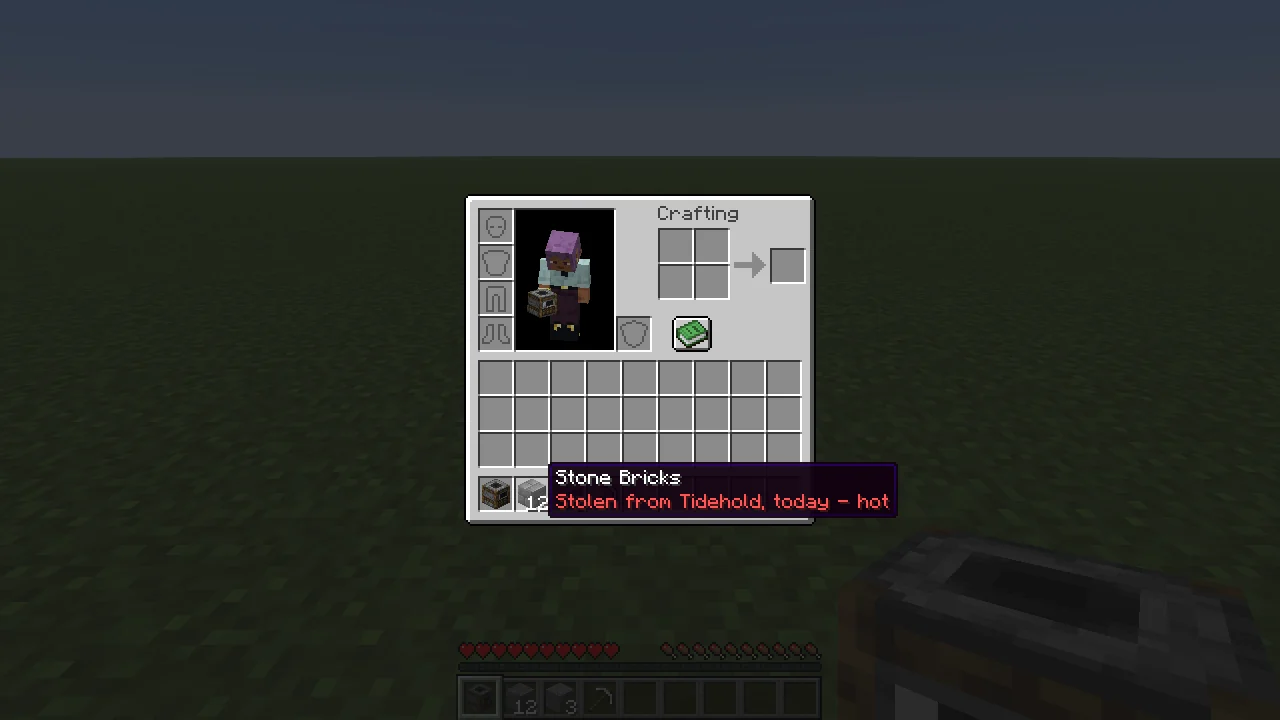
- A town's fittings. What a building's people use is its owner's: a bed, a smoker, a furnace, a crafting table or any trade's bench (an anvil, a loom, a stonecutter and the like), a lectern, a cauldron, a brewing stand, a bell, anything else that holds things. (Its chests and barrels are its stores, a house's its pantry: breaking one with goods in it is theft.) Mined out, it drops marked Stolen from the holder of the building's deed, or for a house the head of its household, else the realm, and what it held spills out marked too. Taking it is theft where someone sees. Unseen, it is found missing when someone next goes to the building's stores or at the morning's tally, and you hear then that what you took is hot. See Stealth and Thievery.
- A town's walls and buildings. The stone of a town's buildings, walls and works as built is the town's, whatever stone it is (andesite and sandstone as much as stone bricks). Broken out, it drops marked stolen (the walls' from the realm, a building's from the owner its fittings name), and breaking it is vandalism (a gate or door of the walls, sabotage). Unseen, damage to the walls is found at the morning's tally. Earth, stone and wild growth dug from a town's open ground are no one's goods: the digging is damage where it is seen, but what it turns up is not stolen.
- What stays yours. Your own house and land you hold by title, a house you rent whole (what you break there is booked against the let, to be answered for when it ends), works you may end (the building site of your own house, or works your realm has you manage), blocks you set down yourself, and the wild. A lodger's or tenant's chest is theirs, not the town's: breaking into it is burglary. Nothing of your own realm's is a crime against it, nor an enemy's in open war.
- Putting it back. Put the same block back in the same place within two minutes and the damage is made good, and the charge that break brought is withdrawn. Fill the gap with a block of your own while you carry the town's marked one, and the town's goes back to its stores. An empty fitting put back is made good; one that held things is not. Anywhere else the town's block is still stolen.
Your record
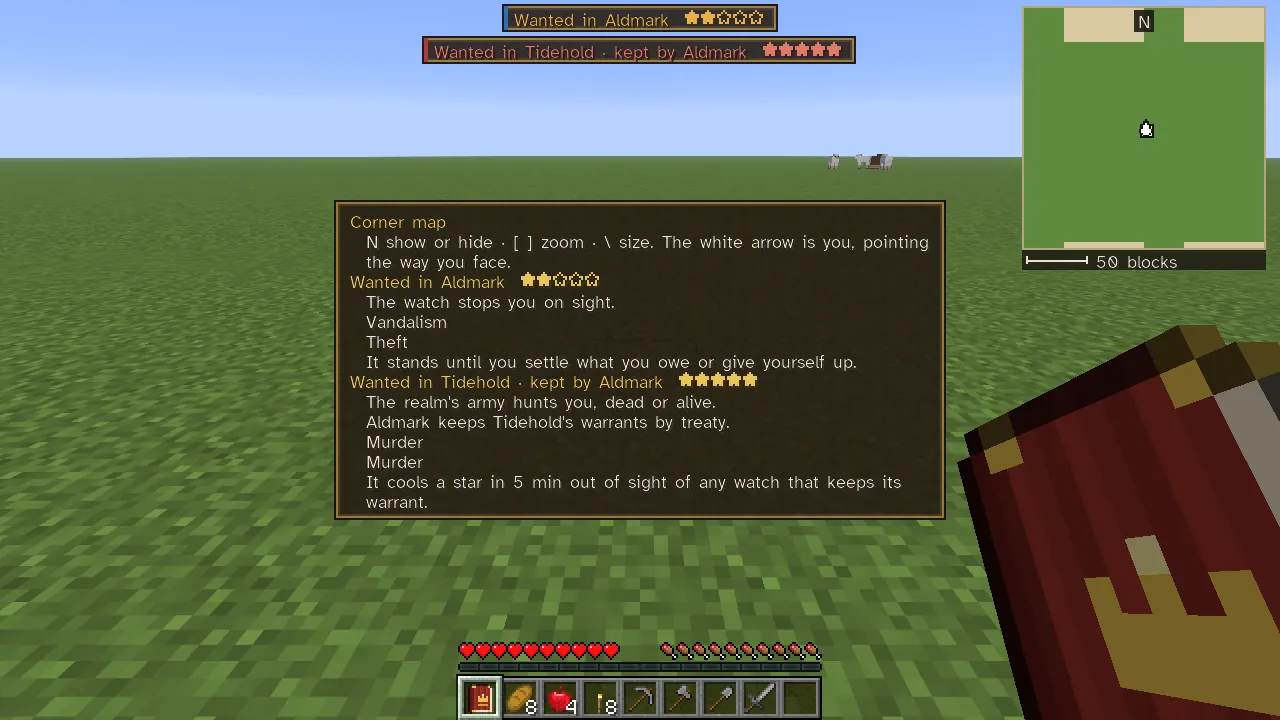
When a realm's stars on you rise, you are told in one row of chat what you did, where, and who saw it, followed by the stars it comes to: Theft at Westford market: seen by Wenna Smith · ★. Its words are gold at one star and red at two or more; the stars stay gold. Where a row has no room for all of it, who saw it or where it was done is left out, never what was done. Over the hotbar the realm and its stars show as well (Wanted in Westmarch: ★☆☆☆☆). The row ends in [?]. Its hover says what you did, whether that crime is grave or a petty charge under the realm's law code, what you owe (with what a grave charge costs to settle with the watch: grave charges are paid double), what the stars mean, and how to clear it. Fines alone are settled with /fine pay from wherever you are; a record the watch would take you for is settled at any of the realm's jails, by giving yourself up (/law surrender), or by keeping out of sight of any watch that keeps its warrant. A click on the row opens the Crime page of your sheet.

Stars that rise for another reason are told in the same kind of row: Ran from the watch of the realm, or Got away from the watch of it, when running put them on you; Seen again: Tidehold's hunt is back to its stars, when a hunt that had cooled is brought back by a watch that sees you, the realm's own or one that keeps its warrants; or a debt left unpaid.
A charge that does not raise your stars is told in one red line of its own, such as Aldmark charges you with theft: you owe so many crowns, or, where the charge puts you on the arrest list, that its guards will take you. Its [?] hover has the particulars, what a grave charge costs to settle with the watch and how to settle it, and a click opens the Companion's Law chapter. The law's other notices (the hue rising, the watch coming for you, a search, a stash found by warrant) come over the hotbar and in the chat with a [Your crimes] button.
At the top centre of the screen each realm that wants you has a short line, such as Wanted in Westmarch ★★★★☆. Hold Left Alt, the key that says in full what the screen's edges show (see Controls and Key Bindings), and each realm's line is set out with the crimes behind its stars: what the stars mean, who keeps its warrant where you stand if another realm does, any running from its watch that put stars on you, then the crimes in the words the chat used ("Assault at Westford market: seen by Hal Cooper and 1 other"), the latest first, and when it cools a star or what ends it. Up to three crimes are named, and the rest are counted ("And 2 more charges.").
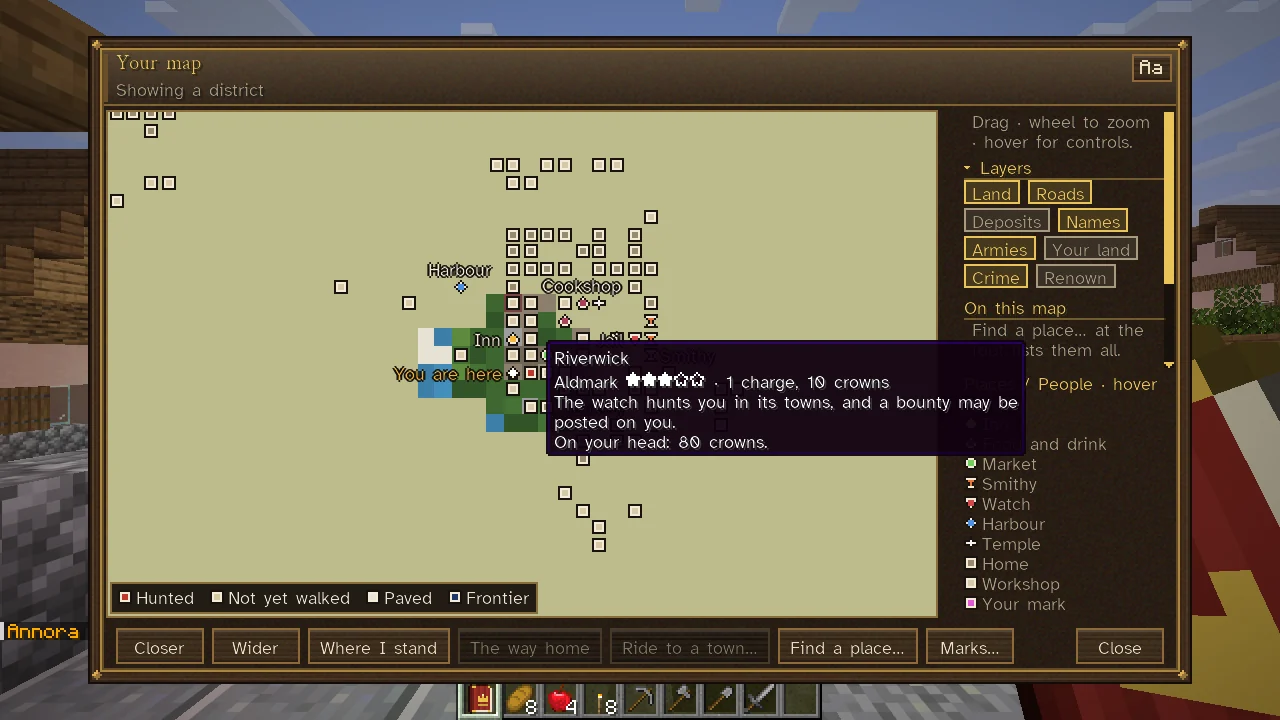
Open your sheet with J and go to the Crime page. It opens on cards: where you are wanted, the fines you owe (with a button to pay them from wherever you are), the price on your head, your debts and the rewards owed you. Then it has a row for each realm with anything against you: how many stars it wants you at, your charges and fines, any price on your head, and how infamous you are there, from whispered of to notorious, infamous and a byword for villainy. Below are the charges, what you did that no one has pinned on you, and what you have answered for. On your map turns on your map's Crime layer, where the towns that want you are marked in the colour of the danger and this week's deeds are crossed where you did them.
Petty charges lapse after ten days; grave charges stand until you answer for them. A realm holds at most twenty charges against one person; the oldest petty ones drop off first.
You can clear a record in several ways:
- Pay at a stop (see Arrest and Jail), at one of the realm's jails (Settle fines on its sheet), with the Crime page's button, or with
/fine pay. Grave charges are paid at double. - Serve the sentence, or choose another way of answering for it.
- Be pardoned by the realm's magistrate.
Whether players may hurt each other at all is the server's setting. Where they can, striking a realm's people, players among them, is assault if someone sees, and killing them is murder.
Allied law
Allies, and an overlord and its vassals, keep each other's warrants while they are not at war and think no ill of each other: a realm that keeps another's warrant acts on it as the wanting realm's own watch would. At two or three stars its guards stop you; at four or five they come armed on sight, with its soldiers, the hue and cry and its golems; and one they take is booked under the wanting realm's law and held near: in that realm's own cell if it is within 160 blocks, else in the keeping realm's own jail on its account. One custody answers every warrant that watch keeps against you. They stop rather than search one they know for wanted, and their doors and markets are shut to you as the wanting realm's are. A realm at odds with the one that wants you, or merely at peace with it, will not hand you over. When the keeping ends (war between them, the alliance or fealty broken, ill will, or either realm gone), it ends at once: a stop on the warrant is given up, one held on it is let out, and you are told. See Wanted and Bounties and Diplomacy and Envoys.
See also
Arrest and Jail, Wanted and Bounties, Magistrates and Codes of Law, The Watch and Watchtowers, Outlaws and Raiders, Government and Law-making.